Outdoor Kitchen Countertop Materials That Survive the Weather
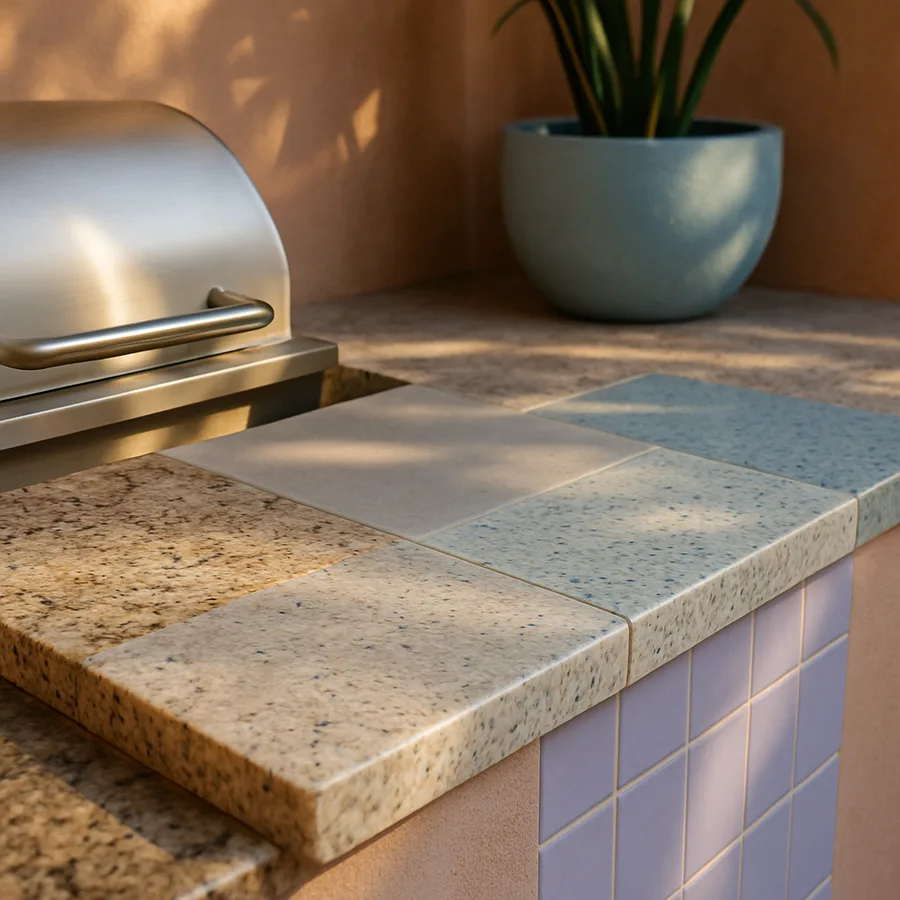
The Harsh Reality of Outdoor Countertop Performance
An outdoor kitchen countertop endures conditions that would destroy most interior surfaces within a single season. Direct ultraviolet radiation beating down for hours every day, rain that pools on flat surfaces and penetrates microscopic pores, freeze-thaw cycles that exploit the smallest crack and expand it into a visible fracture, and temperature swings that can span 80 degrees or more between a summer afternoon and a winter morning all attack your countertop simultaneously and relentlessly. The material you choose must withstand all of these forces while also resisting stains from food, grease, wine, and marinades that are part of everyday outdoor cooking. Selecting a countertop based on how it looks in a showroom without understanding its weathering characteristics is the most expensive mistake you can make in outdoor kitchen planning.
The National Kitchen and Bath Association (NKBA) reports that outdoor kitchen installations have increased by approximately 56 percent over the past five years, driven by homeowner demand for functional outdoor living spaces that extend the usable footprint of the home. This surge in popularity has pushed manufacturers to develop and certify materials specifically for outdoor use, but it has also flooded the market with products marketed as outdoor-suitable that lack the long-term performance data to support those claims. Understanding the material science behind countertop durability protects your investment and ensures that your outdoor kitchen looks as good in its tenth year as it does during its first summer.
Indoor countertop materials and outdoor countertop materials overlap far less than most homeowners assume. Engineered quartz, the dominant material in interior kitchens, is explicitly not recommended for outdoor use by every major manufacturer including Caesarstone, Cambria, and Silestone because the polymer resins that bind the quartz particles together degrade under UV exposure, causing yellowing, surface chalking, and structural weakening over time. Standard marble, while technically a natural stone, is too porous and too soft to survive outdoor food preparation without constant sealing and inevitable staining. Even some granites that perform admirably indoors have absorption rates too high for unprotected outdoor exposure. The outdoor countertop selection process requires evaluating materials through a completely different lens than the one you used for your interior kitchen.
Before examining specific materials, it helps to understand the four performance criteria that matter most in outdoor applications. Porosity determines how readily the material absorbs water and stains; lower is better. UV stability measures resistance to color fading and surface degradation from sunlight. Thermal tolerance encompasses both the material's ability to handle hot pots and grill accessories placed directly on its surface and its resistance to cracking from thermal cycling. Structural integrity refers to flexural strength and impact resistance, which matter because outdoor countertops often span longer unsupported distances than indoor installations and are more likely to receive impacts from heavy grilling equipment, cast iron cookware, and the general roughness of outdoor use. A material must perform well across all four criteria to qualify as genuinely outdoor-durable.
Granite: The Proven Performer for Outdoor Kitchens
Granite has earned its reputation as the default outdoor kitchen countertop material through decades of proven performance in every climate zone. This igneous rock formed under extreme heat and pressure deep within the earth, which gives it inherent hardness, density, and heat resistance that few other natural materials can match. The crystalline structure of granite makes it resistant to scratching from knives and utensils, and its mineral composition withstands UV radiation without the fading or degradation that affects resin-based products. A properly sealed granite countertop installed outdoors today will still be structurally sound and visually attractive 30 years from now, which is a performance timeline that justifies its premium cost for homeowners who view their outdoor kitchen as a permanent addition to the property.
Not all granite performs equally outdoors, and the variation between slabs can be significant enough to make the difference between a successful installation and a disappointing one. Low-absorption granite with a water absorption rate below 0.2 percent, as measured by ASTM C97 testing standards, performs best in outdoor environments because it resists moisture penetration that causes staining, freeze-thaw damage, and biological growth. Darker granites like Absolute Black, Ubatuba, and Tan Brown generally have lower absorption rates than lighter varieties because their mineral composition is denser and less porous. The Natural Stone Institute maintains a searchable database of absorption test results for commercially available granites, and checking this resource before selecting your slab prevents the costly error of installing a beautiful but porous granite that stains permanently the first time someone spills red wine on it.
Sealing is the essential maintenance requirement that keeps granite performing outdoors. A high-quality impregnating sealer penetrates the stone's pore structure and creates a barrier against liquid absorption without changing the surface appearance or texture. Outdoor granite countertops need resealing every one to two years, compared to every three to five years for indoor granite, because sun exposure, rain, and temperature cycling accelerate sealer breakdown. The resealing process takes about 30 minutes for a typical outdoor kitchen and requires nothing more than a clean surface, the sealer product, and a lint-free cloth for application. This modest maintenance investment is the price of granite's exceptional longevity, and skipping it transforms a durable surface into a stain-collecting liability within a surprisingly short time.
The cost of outdoor-grade granite countertops, including fabrication and professional installation, typically ranges from $60 to $150 per square foot depending on the specific stone selected and the complexity of the countertop layout. Edge profiles, cutouts for grills and sinks, and seam placement all affect the final price. According to industry data compiled by the Marble Institute of America, the average outdoor kitchen contains 30 to 50 square feet of countertop surface, placing the typical granite countertop investment between $1,800 and $7,500. This represents 15 to 25 percent of most outdoor kitchen budgets, which is a substantial line item but reasonable given that the countertop is the most visible, most touched, and most functionally critical surface in the entire installation.
Concrete: Customizable and Increasingly Popular
Cast concrete countertops have moved from a niche specialty product to a mainstream outdoor kitchen option, driven by their complete design flexibility and the growing number of skilled fabricators who can produce them. Unlike natural stone, which limits you to colors and patterns that exist in nature, concrete can be integrally pigmented to any color, embedded with decorative aggregates like recycled glass or stone chips, and cast in virtually any shape including curves, integrated drainboards, and built-in trivets. This design freedom allows concrete countertops to match any architectural style from rustic farmhouse to sleek contemporary, and the material's handcrafted character gives each installation a one-of-a-kind quality that mass-produced materials cannot replicate.
The durability of outdoor concrete countertops depends almost entirely on the mix design and the sealing regimen. High-performance concrete mixes formulated specifically for countertops use a low water-to-cement ratio, fiber reinforcement, and pozzolanic additives that produce a dense, strong material with compressive strengths exceeding 8,000 PSI. These specialized mixes resist cracking, surface erosion, and freeze-thaw damage far better than standard concrete, which is why hiring a fabricator who specializes in concrete countertops rather than a general concrete contractor is critical for outdoor applications. The Concrete Countertop Institute certifies fabricators who have completed training in proper mix design, reinforcement, and sealing techniques, and choosing a certified fabricator substantially reduces the risk of premature failure.
Sealing concrete for outdoor use requires a more robust approach than indoor applications demand. Reactive penetrating sealers that chemically bond with the concrete matrix provide the most durable protection against water, stains, and UV degradation, outperforming topical sealers that sit on the surface and wear away under outdoor exposure. Even with excellent sealing, concrete develops a patina over time as it ages outdoors, which many homeowners consider an attractive characteristic that adds character and warmth to the surface. Others prefer a consistent appearance and should be prepared to reseal annually and address any staining promptly to maintain the countertop's original look. The Houzz outdoor kitchen galleries showcase concrete countertops at various stages of aging, and reviewing these images helps set realistic expectations for how your concrete surface will evolve over the years.
Have you considered how concrete's thermal mass might actually benefit your outdoor cooking experience? Concrete absorbs and retains heat slowly, which means it stays cool to the touch on hot days longer than stone or metal surfaces and provides a naturally tempered surface for setting out food during outdoor entertaining. In the evening, concrete releases stored warmth gradually, which can make the countertop surface pleasantly warm to lean against during cool-weather gatherings. This thermal behavior is a genuine functional advantage that no other common countertop material provides to the same degree, and it adds a comfort dimension that goes beyond pure durability considerations. Cost for professionally fabricated concrete countertops ranges from $75 to $150 per square foot installed, putting them in the same price bracket as mid-range to premium granite.
Quartzite and Soapstone: Natural Stone Alternatives
Quartzite is a metamorphic natural stone that offers an appealing combination of extreme hardness, UV stability, and visual beauty that positions it as a premium alternative to granite for outdoor kitchens. Formed when sandstone is subjected to intense heat and pressure deep underground, quartzite achieves a hardness rating of 7 on the Mohs scale, which is harder than granite and hard enough to resist scratching from virtually any kitchen implement. Popular quartzite varieties like Taj Mahal, Sea Pearl, and Super White feature dramatic veining and translucent crystal structures that give them a visual sophistication that many homeowners find more appealing than granite's more granular appearance. The critical distinction between quartzite and engineered quartz must be understood clearly: quartzite is a natural stone that performs excellently outdoors, while engineered quartz is a manufactured product that degrades outdoors.
The primary challenge with quartzite is sourcing genuinely outdoor-suitable slabs, because the market is plagued by mislabeled materials. Some stones sold as quartzite are actually dolomitic marble or soft marble with quartzite-like veining, and these imposters lack the hardness and density that make true quartzite suitable for outdoor use. Requesting a physical hardness test on the specific slab you intend to purchase, rather than relying on the stone yard's label, protects you from this common sourcing problem. A true quartzite will not be scratched by a steel knife blade, while marble and dolomite will show a visible scratch line. The Geological Society of America defines quartzite as containing a minimum of 90 percent quartz grains recrystallized into an interlocking mosaic, and any stone that does not meet this mineralogical definition should not be trusted for outdoor countertop service regardless of what the retailer calls it.
Soapstone offers a completely different value proposition for outdoor kitchens. This metamorphic stone composed primarily of talc is remarkably soft by countertop standards, which means it scratches easily and develops surface marks from regular use. However, soapstone's porosity is essentially zero, making it the most stain-resistant natural stone available and completely impervious to water, acids, and oils without any sealing whatsoever. The scratches that accumulate on soapstone's surface are superficial and can be refreshed with mineral oil or simply embraced as part of the stone's evolving character. Soapstone's natural dark gray to charcoal color deepens beautifully with mineral oil treatment and complements outdoor kitchen designs that favor natural, organic material palettes. Its exceptional heat resistance allows hot pots, pans, and grill grates to be placed directly on the surface without any risk of thermal damage, which is a practical advantage that outdoor cooks use constantly.
Both quartzite and soapstone occupy the premium tier of the outdoor countertop market. Quartzite slabs in desirable patterns range from $80 to $200 per square foot installed, reflecting both the stone's beauty and the careful fabrication it requires due to its extreme hardness. Soapstone is somewhat less expensive at $70 to $120 per square foot installed, but availability can be limited because soapstone quarries are fewer and smaller than granite or quartzite sources. For homeowners who prioritize material uniqueness and are willing to invest at the top of the budget range, these natural stone alternatives deliver performance and character that justify their cost premium over granite. For those who want natural stone durability at a more moderate price point, granite remains the most cost-effective choice without meaningful compromise on weather resistance or longevity.
Tile, Stainless Steel, and Other Alternatives
Porcelain tile countertops represent the most budget-friendly path to a durable, attractive outdoor kitchen surface. Large-format porcelain pavers in thicknesses of 20 millimeters or more, originally developed for outdoor flooring, have been adapted for countertop use with excellent results. These tiles are virtually non-porous, completely UV-stable, frost-proof, and available in an extraordinary range of colors and patterns including convincing imitations of natural stone, wood, and concrete. A porcelain tile outdoor countertop installed over a concrete backer substrate costs between $25 and $60 per square foot including materials and labor, which makes it the most affordable permanent countertop option by a significant margin. The American Society of Interior Designers (ASID) has recognized large-format porcelain as one of the most significant material trends in outdoor living design, noting its combination of performance, affordability, and design versatility.
The limitation of tile countertops is the grout lines between individual tiles, which create maintenance points where staining and biological growth can occur despite the tiles themselves being impervious. Epoxy grout formulated for outdoor use resists staining and mildew far better than standard cement grout, and using the largest tile format practical for your countertop dimensions minimizes the total linear feet of grout joints. A countertop surfaced with 24-by-48-inch porcelain pavers has dramatically fewer grout lines than one tiled with 12-by-12-inch squares, and the visual effect is cleaner and more contemporary as well. Skilled tile installers can execute bullnose or mitered edge treatments that give the countertop a finished appearance comparable to slab materials, though this detailing adds to the labor cost.
Stainless steel countertops bring professional kitchen functionality to the outdoor environment with unmatched hygiene and heat resistance. Grade 316 stainless steel, also called marine grade, contains molybdenum that provides superior corrosion resistance in salt air, humid, and coastal environments where grade 304 stainless would develop pitting and rust stains over time. Stainless steel countertops are fabricated to order by sheet metal specialists and installed over a plywood or concrete substrate, with costs ranging from $80 to $200 per square foot depending on gauge thickness and edge detailing. The National Sanitation Foundation (NSF) certifies stainless steel as the gold standard for food contact surfaces, which is why every commercial restaurant kitchen uses it, and this same hygiene advantage transfers directly to outdoor cooking environments where food safety is challenged by ambient temperature and insect exposure.
What about the scratching that makes many homeowners hesitate about stainless steel? Outdoor stainless steel countertops should be specified with a number four brushed finish rather than a mirror polish, because the directional grain of a brushed finish disguises scratches and wear marks that would be glaringly visible on a polished surface. Over time, a brushed stainless countertop develops a uniform patina of fine scratches that actually improves its appearance by softening the industrial look and creating a warm, lived-in character. Fingerprints and water spots, the primary cosmetic complaints about indoor stainless steel, are far less noticeable outdoors where natural light replaces the directed task lighting that makes every smudge visible in an interior kitchen. For serious outdoor cooks who prioritize function over decorative warmth, stainless steel is the professional's choice for good reason.
Making a Weather-Proof Choice for Your Outdoor Kitchen
The material selection for your outdoor kitchen countertop should begin with an honest assessment of your climate, your maintenance tolerance, and your budget rather than with aesthetic preferences that may not survive contact with outdoor reality. Homeowners in freeze-thaw climates need materials with proven frost resistance and low absorption rates, which narrows the field to granite, quartzite, porcelain, and properly formulated concrete. Homeowners in hot, sunny climates must prioritize UV stability and heat tolerance, which adds soapstone and stainless steel to the viable options while firmly excluding engineered quartz and most resin-based solid surfaces. Coastal homeowners face the additional challenge of salt air corrosion, which favors natural stone and grade 316 stainless over materials with metal components that corrode in marine environments.
Your maintenance willingness is the second honest assessment that shapes the right decision. If you genuinely will reseal a granite countertop every year and find satisfaction in caring for natural materials, granite or quartzite will reward that attention with decades of beautiful service. If maintenance is something you know you will defer and eventually neglect, PVC-based options, porcelain tile, or stainless steel provide durability without relying on your ongoing attention to maintain it. According to a homeowner satisfaction survey published by the American Institute of Architects (AIA), the single strongest predictor of long-term countertop satisfaction is alignment between the material's maintenance requirements and the owner's actual maintenance habits rather than any aesthetic or performance characteristic of the material itself.
Budget constraints are real and should be respected rather than stretched beyond comfort. A well-installed porcelain tile countertop at $40 per square foot will outperform a poorly installed granite countertop at $100 per square foot, because installation quality affects durability at least as much as material selection. Investing your budget in the best installation craftsmanship you can afford, even if it means choosing a less expensive material, produces better outcomes than stretching for a premium material and cutting corners on the labor that installs it. Every material discussed in this guide is capable of providing years of beautiful, functional outdoor kitchen service when properly specified, fabricated, and installed by qualified professionals.
Take the next step by visiting stone yards and tile showrooms with the specific dimensions of your outdoor kitchen countertop in hand so you can get accurate pricing rather than broad estimates. Request samples of your top two or three material candidates and leave them outdoors on your patio for two weeks, exposing them to whatever weather your area delivers during that period. This simple field test reveals staining behavior, surface temperature characteristics, and visual appearance under your actual lighting conditions in a way that no showroom visit can replicate. The countertop that earns your confidence through real-world testing is the one most likely to earn your satisfaction for the long term.
More Articles You May Like



Comments
Post a Comment