Terrazzo Flooring Revival: Where It Works in Modern Homes
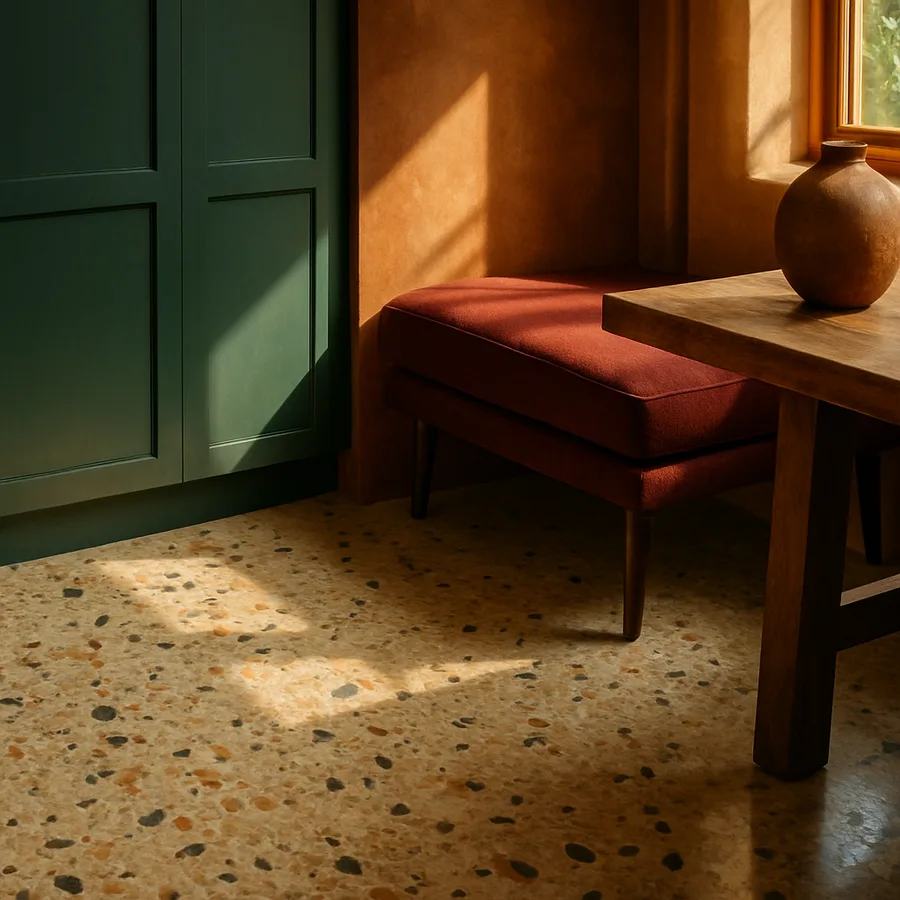
Terrazzo has returned to residential design with a momentum that few industry observers predicted when the material was widely dismissed as a dated relic of mid-century institutional architecture. What was once associated primarily with airport terminals, hospital corridors, and 1960s school lobbies has been reimagined through contemporary color palettes, refined aggregate selections, and sophisticated installation techniques that reposition it as a premium residential flooring choice. The material's fundamental appeal has not changed: terrazzo is a composite of marble, glass, quartz, or granite chips suspended in a cement or epoxy binder, ground smooth, and polished to reveal the aggregate pattern within. What has changed is how designers are using it, where they are placing it, and the aesthetic vocabulary they are applying to a material with roots stretching back to fifteenth-century Venetian craftsmen.
The resurgence is backed by measurable market growth. The National Terrazzo and Mosaic Association (NTMA) reported a 35 percent increase in residential terrazzo specifications between 2020 and 2025, reversing a decades-long decline that had pushed the material to the margins of the flooring market. Design publications from Architectural Digest to regional shelter magazines have featured terrazzo prominently, and social media platforms have amplified its visual appeal to audiences who might never have encountered it otherwise. The hashtag for terrazzo content on design-focused platforms has accumulated hundreds of millions of views, exposing a generation of homeowners to the material's unique combination of pattern, texture, and color.
This guide focuses on practical application: which rooms in a modern home benefit most from terrazzo flooring, what design considerations guide the selection of aggregate type, chip size, and base color, and what the realistic cost and maintenance picture looks like for homeowners considering this investment. Terrazzo is not a budget flooring material, and it is not appropriate for every room or every design context. Understanding where it excels, where it merely functions, and where it may not be the right choice allows homeowners to deploy it strategically for maximum impact.
The following sections examine terrazzo's performance in specific residential applications, moving from the spaces where it is most commonly and successfully used to those where it requires more careful consideration. Along the way, the discussion addresses the practical questions that homeowners and their designers need to answer before committing to a material that, once poured and polished, becomes a permanent part of the home's architectural fabric.
Entryways and Foyers Where First Impressions Begin
The entry foyer is the single most effective location for terrazzo flooring in a residential setting, and it is where the material appears most frequently in contemporary homes. A foyer demands a floor that is visually striking, extremely durable, easy to clean, and capable of withstanding the concentrated wear of every person who enters and exits the home. Terrazzo meets every one of these requirements at the highest level. Its polished surface creates an immediate impression of quality and permanence. Its composite structure resists scratching, chipping, and wear from foot traffic, luggage wheels, and muddy shoes. Its seamless, non-porous surface cleans with a damp mop and does not trap dirt in grout lines or texture valleys.
The design opportunity in an entry foyer is amplified by the relatively modest square footage involved. Most residential foyers range from 30 to 80 square feet, which means even a premium terrazzo installation represents a contained investment compared to flooring an entire living area. This concentrated area allows homeowners to select higher-end aggregates, more complex chip mixtures, and custom colors without the cost scaling to prohibitive levels. A foyer terrazzo floor can serve as the home's design thesis statement, establishing the color palette, material sensibility, and quality standard that the rest of the interior develops. Warm-toned chips in a neutral base set the stage for organic, earthy interiors. Cool gray and white combinations signal modern minimalism. Bold colors announce an eclectic, expressive design philosophy.
The American Institute of Architects (AIA) residential design survey found that entryway flooring was the most commonly cited location for decorative hard-surface materials, with homeowners consistently rating it as the area where they were most willing to invest in premium materials. Terrazzo's ability to incorporate custom patterns, borders, logos, and color transitions makes it uniquely suited to this high-visibility, high-impact application. Some homeowners commission monogram or address number inlays, geometric border patterns that define the foyer's boundaries, or color gradients that transition from one palette at the front door to another at the threshold of the main living space.
Practical considerations for foyer terrazzo include the transition detail where it meets adjacent flooring materials. A clean metal divider strip in brass, stainless steel, or black creates a deliberate threshold that acknowledges the material change. A flush transition where terrazzo meets hardwood or tile at the same height reads as more seamless but requires careful planning during subfloor preparation. The foyer floor is also the most likely location for salt, sand, and moisture tracking during winter months, and while terrazzo handles these elements well, an entry mat inside the door protects the polished surface from abrasive grit that can dull the finish over time. Have you considered how your front door opens and what the first three steps into your home look like? That small area of floor carries disproportionate visual and functional weight, and investing in terrazzo there creates an impact that far exceeds its modest square footage.
Kitchens and the Case for Seamless Flooring
Terrazzo's practical properties make it a strong candidate for kitchen flooring, though its application in this space requires more careful consideration than in an entryway. Kitchens subject flooring to a demanding combination of foot traffic, dropped objects, spilled liquids, grease exposure, and frequent cleaning with aggressive products. Terrazzo's hard, non-porous surface handles all of these conditions competently. Spills wipe up without staining. Grease does not penetrate the sealed surface. Dropped utensils and cookware may chip the surface if the impact is severe, but minor impacts that would scratch wood or crack tile leave terrazzo unaffected.
Epoxy terrazzo, which uses a resin binder rather than traditional cement, is the preferred type for kitchen installations because of its superior moisture resistance, thinner profile, and wider color range. Epoxy systems can be poured as thin as three-eighths of an inch, minimizing floor height changes at transitions to adjacent rooms. The epoxy binder creates a virtually non-porous matrix that resists staining from wine, coffee, tomato sauce, and other kitchen liquids that would penetrate cement-based terrazzo if the sealer were compromised. The National Kitchen and Bath Association includes epoxy terrazzo among its recommended hard-surface kitchen flooring materials, noting its durability, hygiene, and design versatility.
The seamless quality of a poured terrazzo floor is particularly valuable in kitchens, where grout lines in tile floors collect food debris, grease, and moisture that harbor bacteria and require aggressive scrubbing to keep clean. A terrazzo kitchen floor has no grout lines, no seams, and no joints where contaminants can accumulate. The entire surface is continuous and uniformly sealed, creating what the National Sanitation Foundation (NSF) considers one of the most hygienic hard-floor options available for food preparation areas. For homeowners who prioritize kitchen cleanliness and food safety, this seamless characteristic alone may justify terrazzo's premium price over tile alternatives.
The comfort trade-off in kitchens is terrazzo's hardness underfoot. Like concrete and stone, terrazzo is an unforgiving surface for extended standing, and kitchens are rooms where people routinely stand for 30 minutes to an hour or more during meal preparation. Anti-fatigue mats at primary work zones, such as the stove and sink, mitigate this discomfort effectively, but they interrupt the visual continuity that is one of terrazzo's primary appeals. Homeowners who spend significant time cooking should honestly assess their tolerance for standing on a hard surface and consider whether the aesthetic benefits of terrazzo outweigh the comfort compromise compared to softer alternatives like cork, rubber, or luxury vinyl that offer more give underfoot.
Bathrooms and Wet-Area Performance
Bathrooms are the residential space where terrazzo's combination of water resistance, seamless construction, and visual beauty converges most powerfully. A terrazzo bathroom floor eliminates the grout maintenance that makes tiled bathroom floors a perpetual cleaning challenge, provides a waterproof surface when properly sealed, and delivers a spa-like aesthetic that transforms a utilitarian room into a retreat. The material's long association with Mediterranean and midcentury architecture gives it an inherent sense of place and history that resonates in bathroom settings, where natural materials and sensory comfort are valued above the practical concerns that dominate kitchen and entry design discussions.
Houzz bathroom design surveys consistently rank terrazzo among the top five flooring materials for master bathroom renovations, and the material's representation in design publication bathroom features has increased markedly over the past several years. The visual effect of a terrazzo bathroom floor extending continuously into a curbless shower creates a seamless, open plane that makes even modest bathrooms feel more spacious and architecturally resolved. This continuous-floor treatment is one of the hallmarks of high-end bathroom design and is significantly easier to achieve with poured terrazzo than with tile, which requires careful drain integration and consistent grout across the wet and dry zones.
Slip resistance requires specific attention in bathroom terrazzo installations. A highly polished terrazzo surface, while beautiful, can become dangerously slick when wet. The solution is to specify a honed rather than polished finish in wet areas, or to apply anti-slip treatments that increase surface friction without significantly altering the floor's appearance. The Americans with Disabilities Act (ADA) specifies a minimum static coefficient of friction of 0.6 for wet areas, and terrazzo finishers can achieve this threshold through controlled grinding that leaves a slightly textured surface while retaining the aggregate visibility and color depth that define the material's aesthetic. Some installers offer zone-specific finishing, polishing the dry vanity area for maximum visual impact while honing the shower and tub-adjacent zones for safety.
Color and aggregate selection for bathroom terrazzo leans toward palettes that evoke natural stone and water. White and pale gray bases with subtle chips of marble, mother-of-pearl, and recycled glass create a luminous, calming surface that complements the water-centric purpose of the room. Soft pinks, greens, and blues in the aggregate add color without overwhelming the typically compact bathroom space. Darker bases with contrasting light chips produce dramatic floors that work in larger master bathrooms where the scale can support bold pattern without feeling cluttered. What mood do you want your bathroom to establish each morning? The terrazzo palette you select will answer that question every day for decades, making it one of the more consequential color decisions in a residential design project.
Living Areas and Open-Plan Considerations
Terrazzo in living rooms and great rooms represents the most ambitious residential application of the material, both in visual impact and financial investment. An open-plan living area of 400 to 800 square feet of continuous terrazzo creates a monolithic ground plane that unifies the space with a single, uninterrupted surface. The effect is architecturally powerful, grounding the room with a material that has genuine substance and presence. Unlike tile, which segments the floor into a grid of individual units separated by grout, terrazzo reads as a single continuous surface that flows without interruption from wall to wall, creating a sense of spatial generosity that smaller, repeated units cannot achieve.
The investment for living area terrazzo is substantial and represents the material's primary barrier to broader residential adoption. Poured-in-place epoxy terrazzo installed by specialized contractors costs between $25 and $60 per square foot, depending on aggregate selection, complexity, and regional labor rates. A 600-square-foot living area therefore represents a flooring investment of $15,000 to $36,000, two to five times the cost of hardwood and five to ten times the cost of luxury vinyl plank for the same area. Precast terrazzo tiles, which offer a terrazzo aesthetic at reduced cost, range from $10 to $30 per square foot installed but reintroduce grout lines that partially negate the material's seamless advantage.
Acoustic performance is a consideration that intensifies in living areas where terrazzo's hard surface can create echo and sound amplification. Open-plan rooms with terrazzo floors, hard wall surfaces, and minimal soft furnishings can develop uncomfortable reverberation that makes conversation tiring and media listening unpleasant. Generous use of area rugs, upholstered furniture, curtains, and acoustic panels mitigates this effect, and most living rooms naturally contain enough soft surfaces to maintain comfortable acoustics. The area rugs that temper terrazzo's acoustic behavior also address its hardness underfoot, creating zones of cushioned comfort within the broader expanse of polished stone composite.
The design integration of terrazzo into living areas demands careful attention to the overall material palette. Terrazzo is visually busy by nature; the aggregate chips create a pattern that competes for attention with other detailed surfaces. Pairing terrazzo floors with busy wallpapers, heavily patterned upholstery, and ornate rugs creates visual noise that can feel chaotic rather than curated. The most successful terrazzo living rooms balance the floor's inherent pattern with restrained wall treatments, solid-color furnishings, and deliberate moments of visual quiet that let the floor breathe. Think of terrazzo as the room's primary texture: everything else should complement rather than compete with the ground plane you have invested so heavily in creating.
Outdoor Covered Spaces and Transitional Zones
Cement-based terrazzo has a long and proven history in outdoor and semi-outdoor applications, and covered patios, screened porches, and breezeway floors represent residential applications where the material performs exceptionally well. Cement terrazzo is inherently resistant to UV degradation, temperature fluctuations, and moisture exposure that would damage many interior flooring materials. Its mass and thermal stability make it comfortable in covered outdoor spaces where it absorbs solar warmth during the day and releases it slowly through the evening, creating a naturally temperate surface that extends the usability of outdoor living areas into cooler seasons.
The design opportunity in transitional spaces is to create visual continuity between the home's interior and its outdoor living areas. A terrazzo floor that flows from an interior living room through sliding doors onto a covered patio unifies the two spaces into a single expanded living environment. This continuity is most effective when the interior and exterior terrazzo share the same base color and aggregate but differ in finish, with a polished interior surface transitioning to a honed exterior surface that provides appropriate slip resistance for an area exposed to rain and condensation. The Portland Cement Association has published guidelines for exterior terrazzo installation that specify a honed finish, proper drainage slope, and compatible sealers for surfaces exposed to weather.
Maintenance of outdoor terrazzo focuses on sealing and periodic repolishing. While the material itself is nearly indestructible, the sealer that protects it from staining and moisture penetration degrades faster in outdoor environments due to UV exposure and weather cycling. Resealing every two to three years maintains the floor's stain resistance and color vibrancy. Organic debris from trees and plants can stain unsealed terrazzo if left in contact for extended periods, making regular sweeping or leaf blowing an important maintenance habit for terrazzo patios beneath or near mature trees. Power washing is acceptable for cement terrazzo at moderate pressure but should be avoided on epoxy systems, which can be damaged by high-pressure water.
Pool surrounds represent an adjacent application where terrazzo's slip resistance (in honed finish), durability, and aesthetic quality create a premium alternative to the stamped concrete, pavers, and stone that dominate most pool deck installations. The aggregate options for pool-area terrazzo can include glass chips that catch sunlight, recycled shell fragments that evoke coastal settings, or cool-toned marble that minimizes surface temperature in direct sun. Pool chemical splash does not damage properly sealed terrazzo, though chlorinated water should not be allowed to pond on the surface for extended periods. For homeowners building or renovating outdoor living areas that merit the same design attention as the home's interior, terrazzo provides material continuity and architectural credibility that few alternatives can match.
Choosing Aggregates, Colors, and Finish Levels
The aggregate selection is where terrazzo design becomes genuinely personal, because the chips suspended in the binder define the floor's character more than any other variable. Marble chips are the traditional choice, offering natural color variation, a luminous quality when polished, and a direct connection to terrazzo's centuries-old Venetian origins. White Carrara marble in a white cement base produces the clean, contemporary aesthetic that dominates current residential terrazzo design. Colored marbles, including greens, pinks, reds, and blacks, enable bolder palettes that suit expressive, personality-driven interiors.
Recycled glass aggregate has become one of the most popular contemporary choices for residential terrazzo, adding environmental credentials to the material's performance profile. Post-consumer glass in clear, amber, green, and cobalt blue chips catches and refracts light in ways that opaque stone aggregate cannot, creating a floor that sparkles subtly in direct light. The environmental benefit is real: glass terrazzo diverts waste from landfills and reduces the demand for quarried stone. The U.S. Green Building Council recognizes recycled-content terrazzo as a contributor to LEED certification points, which appeals to environmentally conscious homeowners even in non-certified residential projects.
Chip size dramatically affects the floor's visual scale and texture. Fine chips of 1/8 to 3/8 inch create a dense, uniform pattern that reads as textured stone from a distance, making it suitable for smaller spaces where large-scale pattern could overwhelm. Standard chips of 3/8 to 3/4 inch produce the classic terrazzo appearance with individually distinguishable aggregate pieces, working well in medium to large rooms where the pattern can be appreciated at its natural scale. Large chips of 3/4 inch to 1.5 inches create a bold, graphic surface with highly visible individual stones, best suited to generous spaces where the floor functions as a primary design element. Mixing chip sizes within a single pour adds textural complexity and produces a more dynamic visual field than a single uniform chip size.
Finish level completes the design specification. A high-gloss polish produces maximum reflectivity, color depth, and aggregate visibility, and is the most dramatic option for dry, interior spaces where slip resistance is not a primary concern. A medium honed finish retains color clarity and aggregate definition while reducing reflectivity and improving traction, making it the most versatile option for residential applications including kitchens and casual living areas. A low honed or matte finish prioritizes function over visual drama, appropriate for wet areas, outdoor spaces, and high-traffic corridors where slip resistance is paramount. When working with your terrazzo installer, request physical samples at your desired finish level rather than relying on photographs, because the difference between polish levels is a tactile and optical experience that images cannot fully convey.
Conclusion
Terrazzo's residential revival is grounded in the material's genuine and irreplaceable qualities: seamless construction, extraordinary durability, hygienic performance, and a visual character that no other flooring material can replicate. Its aggregate-studded surface tells a story of geology, craftsmanship, and design intention that synthetic materials can imitate but not authentically duplicate. The homes that use terrazzo most effectively deploy it strategically in spaces where its strengths align with the room's demands, rather than defaulting to it uniformly throughout the entire floor plan.
Entryways, bathrooms, and kitchens represent the strongest residential applications, where terrazzo's durability, water resistance, and seamless surface directly address the functional challenges those rooms present. Living areas and outdoor spaces are compelling but demand larger budgets and more careful design integration to ensure the material enhances rather than overwhelms the space. The cost premium is real and significant, but for homeowners who value material authenticity and architectural permanence, it represents an investment in a floor that will outlast every other finish in the home.
The decision to use terrazzo should be made with full awareness of both its strengths and its limitations: its hardness underfoot, its acoustic reflectivity, its installation complexity, and its permanent nature that makes color and pattern changes impossible without complete removal. These are not flaws but characteristics of a material that trades flexibility for permanence and compromise for commitment. A terrazzo floor is a statement that the homeowner has made a deliberate, informed choice about the ground they walk on, and that statement, made visible in polished stone and colored aggregate, is one that grows more valuable with every year it endures.
If terrazzo appeals to you, begin with a consultation with a certified terrazzo installer in your area. Bring images of the spaces you are considering, discuss aggregate and color options with physical samples, and request a detailed estimate that accounts for your specific subfloor conditions, room dimensions, and finish preferences. The NTMA maintains a contractor directory that connects homeowners with qualified installers who understand both the traditional craft and the contemporary design possibilities of this remarkable material.
More Articles You May Like



Comments
Post a Comment