Terrazzo Countertops vs Quartz: Cost, Durability, and Style
What Makes Terrazzo and Quartz So Different
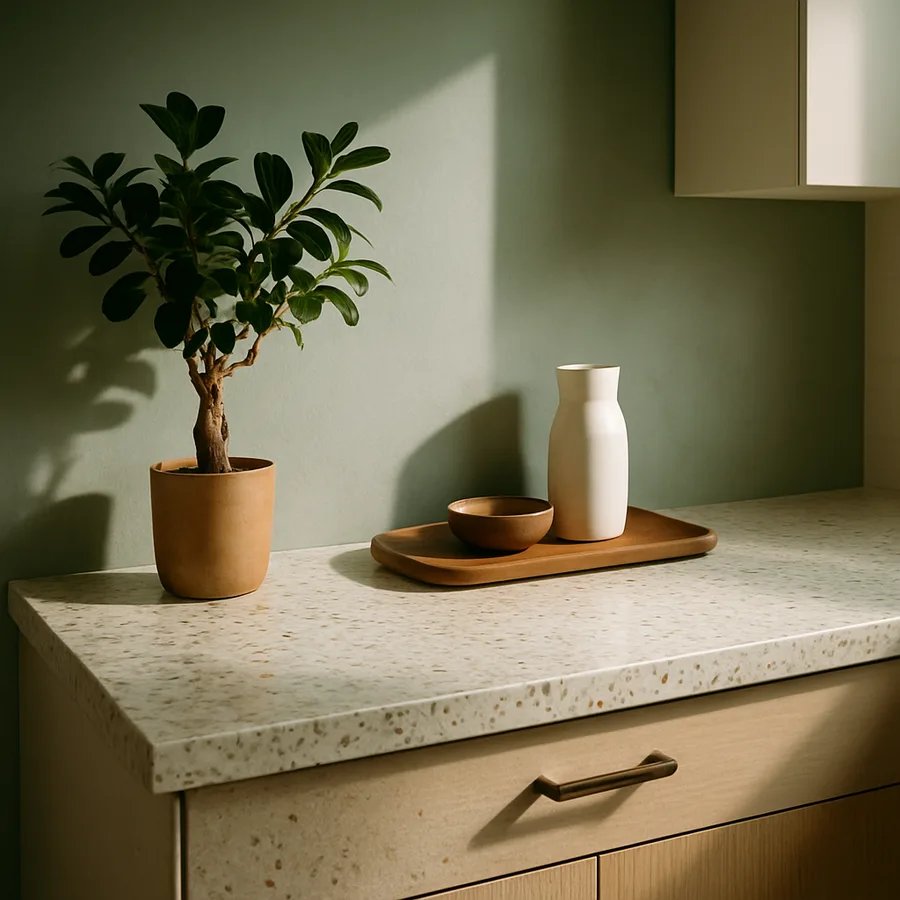
Terrazzo and quartz countertops both deliver striking visual results, but they originate from fundamentally different manufacturing processes. Terrazzo is a composite material made by embedding chips of marble, granite, glass, or other aggregates into a cement or epoxy binder, then grinding and polishing the surface to a smooth finish. Quartz countertops, by contrast, are engineered stone products that combine roughly 90 to 94 percent ground natural quartz crystals with polymer resins and pigments. The distinction between a poured composite and an engineered slab shapes nearly every performance characteristic that matters in a kitchen or bathroom. Understanding these foundational differences helps homeowners avoid costly surprises after installation.
The National Kitchen and Bath Association (NKBA) reports that countertop selection ranks among the top three decisions homeowners agonize over during a kitchen remodel. That statistic reflects just how permanent and visible the choice feels once the slab is set. Terrazzo carries a mid-century heritage that has experienced a significant revival in residential design, while quartz has dominated the engineered-stone market for more than two decades. Both materials appear in showrooms from coast to coast, yet the selection criteria extend far beyond appearance. Have you considered how each surface handles the daily punishment of a working kitchen?
One reason the comparison confuses shoppers is that both materials can be customized in color and pattern. Quartz manufacturers like Caesarstone and Cambria offer hundreds of colorways, many designed to mimic natural marble or granite veining. Terrazzo, on the other hand, achieves its look through the actual size, color, and density of embedded aggregate chips. The visual effect is inherently more random and textured. Neither material is objectively superior in aesthetics; the right pick depends on whether you prefer controlled uniformity or organic variation.
According to a 2024 survey by the Houzz research team, approximately 34 percent of renovating homeowners selected quartz for their kitchen countertops, making it the most popular engineered surface in North America. Terrazzo captured a smaller but growing share, particularly in homes where owners sought a distinctive retro or artisanal look. These market trends suggest that both materials have earned their place, but for different reasons and different budgets.
Breaking Down the True Cost of Each Material
Price is often the first filter homeowners apply, and here the gap between terrazzo and quartz is significant. Quartz countertops typically cost between $50 and $150 per square foot installed, depending on brand, edge profile, and regional labor rates. Entry-level quartz from brands like Silestone starts at the lower end, while premium lines from Cambria or Caesarstone push toward the upper range. That price includes templating, fabrication, and professional installation, which is standard for engineered stone. Most kitchen projects land between $3,000 and $7,500 for a full quartz countertop package.
Terrazzo countertops demand a larger investment. Poured-in-place terrazzo, which is custom mixed and finished on site, can run from $75 to $200 per square foot. Prefabricated terrazzo slabs reduce that range slightly, but availability remains limited compared to quartz. The labor component is higher because terrazzo installation requires skilled tradespeople who understand the grinding and polishing sequence. A comparable kitchen project in terrazzo might cost $5,000 to $12,000 or more, depending on aggregate choices and complexity.
Beyond the sticker price, consider the long-term cost of ownership. Quartz requires virtually no sealing or specialized maintenance, which saves money over a 20-year ownership horizon. Terrazzo, especially cement-based formulations, may need periodic resealing every one to three years. Epoxy-based terrazzo is more resistant to staining and moisture but costs more upfront. When you factor in maintenance expenses, the total cost gap narrows somewhat, though quartz still holds an advantage for budget-conscious remodelers.
It is worth noting that both materials hold their value well in a home sale. The National Association of Home Builders has documented that updated kitchens with quality countertops recoup a meaningful portion of renovation costs at resale. Neither terrazzo nor quartz depreciates the way laminate or tile can, so the investment question is really about how much more you are willing to spend for the particular look and feel of terrazzo versus the predictable elegance of quartz.
Durability and Daily Performance Compared
Durability is where quartz has built its reputation. Engineered quartz scores approximately 7 on the Mohs hardness scale, making it highly resistant to scratching from everyday kitchen activities. The resin binder also makes quartz nonporous, which means liquids, bacteria, and odors cannot penetrate the surface. That nonporous quality is why the NSF International has certified several quartz brands as safe for food preparation surfaces. For families who want a surface that shrugs off spills and knife marks, quartz delivers reliable performance year after year.
Terrazzo is durable in its own right, but the specifics depend on the binder. Cement-based terrazzo is porous and can stain if not properly sealed, particularly when exposed to acidic substances like lemon juice, red wine, or tomato sauce. Epoxy-based terrazzo is considerably more resistant to staining and moisture penetration, approaching quartz in daily practicality. Both types are hard enough to resist moderate impact, though neither is immune to chipping if a heavy cast-iron pan drops from a height. The aggregate chips in terrazzo can also create slight surface irregularities that some homeowners find charming and others find difficult to clean.
Heat resistance separates the two materials more clearly. Quartz countertops can discolor or crack when exposed to temperatures above approximately 300 degrees Fahrenheit because the resin binder softens under sustained heat. Trivets and hot pads are essential with quartz. Terrazzo, particularly cement-based formulations, tolerates higher temperatures without damage because cement is inherently heat-stable. If you regularly pull hot baking sheets from the oven and need a momentary landing spot, terrazzo offers a practical advantage that quartz cannot match.
Stain resistance also differs. A 2023 material performance study published by the American Society of Interior Designers (ASID) noted that sealed epoxy terrazzo and engineered quartz performed comparably in standardized stain tests, while unsealed cement terrazzo showed measurable absorption of coffee, wine, and oil within 30 minutes. The takeaway is that terrazzo can match quartz in stain resistance, but only if you commit to the epoxy formulation or maintain a rigorous sealing schedule on cement-based surfaces.
Design Versatility and Aesthetic Possibilities
When it comes to visual personality, terrazzo holds an edge that few materials can match. The ability to choose aggregate size, color, and density means that no two terrazzo installations look exactly alike. You can specify large marble chips for a bold, graphic look, or fine glass fragments for a subtle shimmer. The binder color itself becomes a design variable, ranging from crisp white to deep charcoal. This level of customization appeals to homeowners and designers who want a surface that functions as a statement piece rather than a backdrop.
Quartz countertops offer a different kind of versatility. Manufacturers have invested heavily in digital printing and pigment technology to produce slabs that convincingly replicate Calacatta marble, Carrara veining, and even concrete textures. The consistency of engineered production means that a sample chip accurately represents what the full slab will look like, which reduces the guesswork that comes with natural stone selection. For homeowners who want the look of premium marble without the maintenance burden, quartz delivers that promise reliably.
Where do these materials fit within current design trends? Terrazzo has become a signature element in maximalist and eclectic interiors, particularly in open kitchens where the countertop doubles as a visual anchor. It pairs exceptionally well with brass hardware, warm wood cabinetry, and bold tile backsplashes. Quartz, conversely, dominates in minimalist, transitional, and contemporary kitchens where clean lines and uniform surfaces set the tone. Architectural Digest has featured both materials prominently in recent kitchen design roundups, reinforcing that neither is niche or dated.
Have you thought about how your countertop choice will interact with your flooring and cabinetry? Terrazzo's inherent visual complexity means it works best when surrounding finishes are relatively restrained. Quartz's uniformity makes it more forgiving in busy kitchens with patterned backsplashes or richly grained wood floors. The decision is as much about the broader room composition as it is about the countertop in isolation. Consulting with a certified kitchen designer through the NKBA can help you visualize how each option will land in your specific space.
Installation Process and Practical Considerations
The installation process for quartz is well standardized across the industry. A fabricator visits your home to create a precise template, then cuts and finishes the slab in a shop environment. Installation typically takes one day for a standard kitchen layout. Seams are joined with color-matched adhesive and are usually difficult to detect on lighter colorways. The entire process from template to completion generally spans two to three weeks, with most of that time consumed by fabrication rather than on-site work.
Terrazzo installation is more involved and varies depending on whether you choose poured-in-place or prefabricated slabs. Poured-in-place terrazzo requires building forms on top of your cabinetry, mixing and pouring the composite, allowing it to cure, and then grinding and polishing on site. This process can take several days and generates significant dust and noise. Prefabricated terrazzo slabs simplify the process somewhat, but finding a fabricator experienced with terrazzo countertops can be challenging outside of major metropolitan areas.
Weight is another practical concern. Quartz slabs weigh approximately 20 to 25 pounds per square foot at standard thickness, which most standard cabinetry can support without reinforcement. Terrazzo, depending on thickness and aggregate density, can be heavier, particularly in poured-in-place applications where the countertop may be thicker than a standard slab. Your cabinetry and supporting structure should be evaluated by the installer to confirm they can handle the load. Overlooking this step can lead to sagging or structural stress over time.
Repair and modification after installation also differ. Quartz is difficult to repair if chipped or cracked because the resin-bound surface does not respond well to grinding or patching. Most damage requires replacing the affected section or the entire slab. Terrazzo, by contrast, can often be reground and repolished to remove surface damage, scratches, and minor stains. This reparability is one of terrazzo's most compelling long-term advantages and a reason it has survived in commercial buildings for decades with minimal replacement.
Maintenance Routines That Protect Your Investment
Daily maintenance for quartz countertops is refreshingly simple. Wipe the surface with a soft cloth, warm water, and mild dish soap. Avoid abrasive cleaners, scouring pads, and products containing bleach, which can dull the finish over time. For stubborn spots, a paste of baking soda and water left on the stain for a few minutes usually does the trick. Quartz never needs sealing, waxing, or professional refinishing under normal residential use. That low-maintenance profile is a major reason quartz has become the default choice for busy households.
Terrazzo demands a more attentive routine, especially if your countertops use a cement binder. Cement-based terrazzo should be sealed upon installation and resealed every one to three years depending on use intensity. Use pH-neutral cleaners rather than acidic or alkaline products, which can etch the cement matrix. Epoxy-based terrazzo is more forgiving and can tolerate a wider range of cleaning products, but you should still avoid harsh abrasives that can scratch the polished surface. Spills should be wiped promptly rather than left to sit, particularly on cement terrazzo.
Professional maintenance extends the life of both surfaces but is more critical for terrazzo. A professional terrazzo restoration specialist can regrind and repolish the surface every five to ten years to restore its original luster. This process removes the accumulated micro-scratches and surface wear that develop with regular use. The cost typically runs $3 to $8 per square foot, which is a modest investment to rejuvenate a surface that might otherwise look tired. Quartz rarely needs professional attention unless it sustains heat damage or deep scratching that exceeds normal wear patterns.
One frequently overlooked maintenance consideration is UV exposure. Quartz countertops installed near large windows or in outdoor kitchens can yellow or fade over time because UV light degrades the resin binder. Terrazzo, particularly cement-based varieties, is largely unaffected by sunlight. If your kitchen features a large south-facing window that bathes the countertop in direct sun for several hours daily, terrazzo may maintain its color integrity better over the long term. This is a niche concern but a meaningful one for specific floor plans.
Conclusion: Choosing the Right Surface for Your Kitchen
The terrazzo versus quartz decision ultimately comes down to how you weigh customization against convenience. Terrazzo rewards homeowners who value a unique, artisanal aesthetic and are willing to invest more upfront and in ongoing maintenance. Quartz rewards those who prioritize consistent performance, low maintenance, and a broad selection of colors and patterns at a more accessible price point. Neither material is objectively better; each excels in different contexts and for different priorities.
If your budget allows and you want a countertop that no one else on your street will have, terrazzo delivers that distinctiveness with genuine material character. If you want a surface that performs flawlessly with minimal attention and fits a tighter renovation budget, quartz remains the most pragmatic choice on the market. Consider visiting a local stone yard or design showroom to see and touch both materials before committing. The tactile and visual experience of standing in front of a full slab reveals qualities that photos and specifications cannot capture.
Whatever direction you choose, ensure your installer has documented experience with your selected material. A poorly installed quartz countertop with visible seams is just as disappointing as a terrazzo surface that was inadequately polished. Request references, review portfolios, and confirm that the fabricator stands behind their work with a written warranty. Your countertop will be a daily companion for a decade or more, so the quality of the installation matters as much as the quality of the material itself.
Ready to take the next step? Schedule consultations with at least two certified fabricators in your area, bring your cabinetry dimensions and design inspiration photos, and ask each one to walk you through sample options for both terrazzo and quartz. That hands-on comparison will make the final decision far clearer than any online research alone.
More Articles You May Like



Comments
Post a Comment