Sunroom Flooring Choices That Handle Temperature Swings
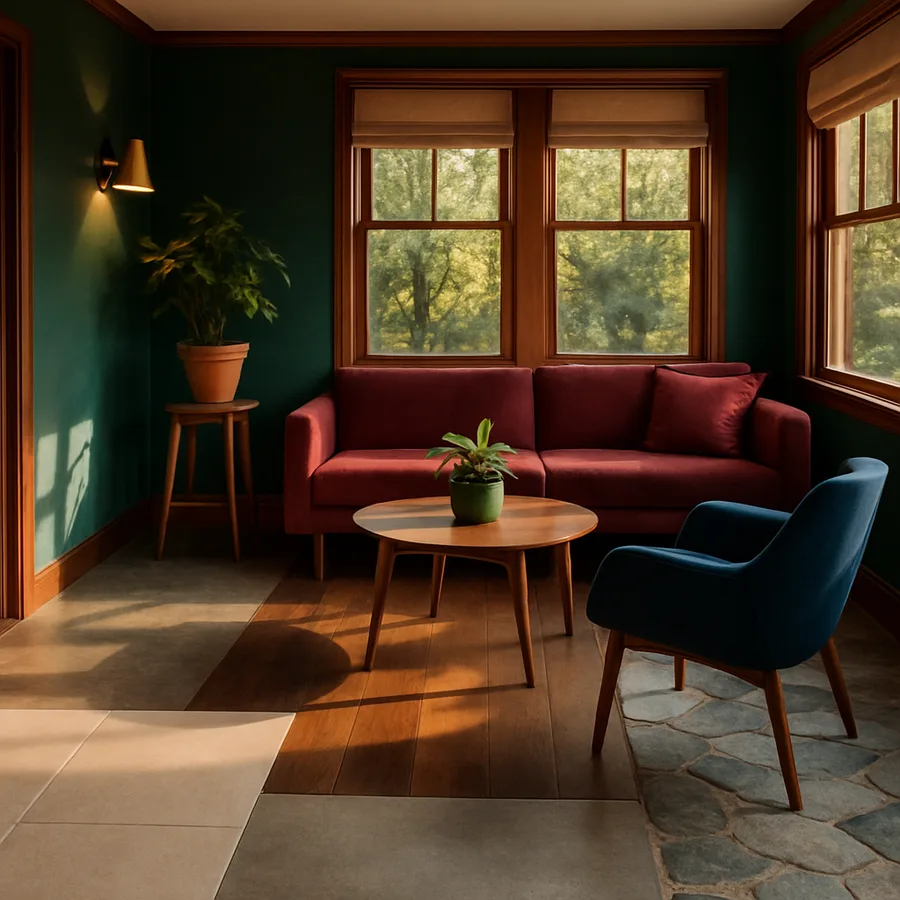
The single most stressful environment in a typical home for flooring is the sunroom. A four-season sunroom can drift from 50 degrees Fahrenheit at dawn to 95 degrees at two in the afternoon on a January day, then drop 40 degrees again by midnight. A three-season room can freeze in winter and exceed 110 degrees on a closed-up July afternoon. Humidity bounces with every storm. Direct UV hits the floor for eight to ten hours on clear days. Ordinary solid oak that performs beautifully in the living room will cup, crown, and gap within two summers if it is installed in a sunroom without climate control.
The question is therefore not what flooring you like, but what flooring survives these swings. This guide works through the major candidates (porcelain tile, natural stone, engineered hardwood, luxury vinyl plank, polished concrete, cork, and a handful of less common options) with realistic assessments of each. The National Association of Home Builders performance standards and the National Wood Flooring Association (NWFA) installation guidelines both address temperature and humidity tolerance, and those numbers guide the recommendations below.
The Physics of Temperature Swing in a Sunroom
Before picking a material, understand what the material has to survive. Solar gain through glass can push interior surface temperatures 30 to 50 degrees above ambient air temperature. A black slate tile in direct sun can hit 140 degrees while the air in the room is 75. When the sun drops, the tile cools quickly, contracting as it does. Over a thousand cycles, or roughly three years of daily operation, those expansion and contraction forces test every adhesive and every joint in the floor system.
Humidity amplifies the problem. Wood expands and contracts dimensionally with moisture, not primarily with temperature. The NWFA recommends indoor relative humidity between 30 and 50 percent for solid hardwood, a range that a three-season sunroom violates badly in summer. Engineered wood tolerates a wider range because its cross-laminated core resists directional movement, but even engineered wood struggles above 70 percent humidity sustained for weeks.
Porcelain Tile: The Default Answer
If a contractor recommends one material for a sunroom floor without hesitating, it is almost always porcelain tile, and they are almost always right. Porcelain is dense, nearly impervious to moisture (the Tile Council of North America defines porcelain as having less than 0.5 percent water absorption), and it handles thermal cycling better than almost any other flooring category. It is available in large-format rectified tiles that mimic wood, stone, and concrete convincingly enough that most guests will not know what they are standing on.
The main drawbacks are cost, cold feel, and hardness underfoot. Installed, a quality porcelain floor runs 10 to 20 dollars per square foot. In a three-season sunroom with no heat, the floor feels cold nine months of the year. Dropped glass shatters; dropped pottery breaks twice. These are manageable if you pair porcelain with hydronic or electric radiant heat, which is one of the best upgrades you can make in a four-season sunroom. A radiant system under porcelain turns the cold-stone complaint into a warm-stone selling point.
- Frost resistance: verify the tile is rated for exterior or unheated use.
- Tile format: 12x24, 24x24, and 24x48 rectified tiles reduce grout joints and look upscale.
- Grout: epoxy grout resists UV yellowing better than cement grout; specify it.
- Pattern: offset patterns hide minor substrate imperfections; stacked grids amplify them.
Luxury Vinyl Plank: The Practical Winner
Luxury vinyl plank (LVP) has become the most popular sunroom flooring in the United States over the past five years, and the reasons are simple. It costs 3 to 7 dollars per square foot installed, it is dimensionally stable through the kind of temperature swings sunrooms produce, it is warmer underfoot than tile, and modern prints are hard to distinguish from real wood. Major manufacturers like Shaw, Mohawk, and COREtec all publish temperature tolerances on their product data sheets; the better lines handle -20 to 140 degrees Fahrenheit without failing.
LVP falls into two subcategories worth knowing. SPC (stone-polymer composite) cores are rigid, more dimensionally stable, and better suited to extreme temperature swings. WPC (wood-polymer composite) cores are softer underfoot but less stable at high heat. For a sunroom, always specify SPC. Within SPC, wear-layer thickness matters for durability: 20 mil is adequate for residential, 28 mil or 40 mil is preferable if you have pets or heavy use.
The biggest pitfall with LVP is installation. Floating installations work well up to about 400 square feet in a climate-stable room but struggle in larger sunrooms with big solar gain, where the floor can expand enough to buckle if the perimeter gaps are too small. The manufacturer's installation instructions become the binding document here; most specify 3/8 inch perimeter gaps and limits on continuous run before a transition strip is required. Ignore those limits and the warranty goes with them.
Engineered Hardwood: Possible but Finicky
Solid hardwood is a no in sunrooms, period. Engineered hardwood, with its cross-laminated core, is a qualified yes in four-season rooms with proper HVAC, and a no in three-season rooms without climate control. If you want the look and feel of real wood, engineered is the route, but you must match the product to the conditions.
Look for these specifications: a core of seven or more plies for maximum stability, a wear layer of at least 3 millimeters (so the floor can be refinished once or twice), and a manufacturer-stated humidity tolerance that covers your actual conditions. Some engineered floors tolerate 30 to 60 percent humidity; others are rated only for 40 to 55 percent. Wide planks (7 inches and up) move more with humidity than narrow planks; if you live in a swing-humidity climate, stick to 5-inch or narrower planks.
Readers frequently ask whether they can install engineered hardwood over radiant heat in a sunroom, and the answer is yes with strict limits: the manufacturer must specifically warrant the product for radiant use, the subfloor temperature must never exceed 85 degrees Fahrenheit, and ramp-up must be gradual over 72 hours at first startup. Most wood failures over radiant heat come from exceeding the 85-degree limit, usually because an enthusiastic homeowner cranks the thermostat and the floor surface exceeds the wood's tolerance.
Polished Concrete and Stained Concrete
Polished concrete has migrated from industrial spaces into high-end residential, and it is one of the best choices for sunroom floors that see heavy solar gain. Concrete's thermal mass actually works for you: it absorbs solar heat during the day and releases it at night, evening out the room's temperature swings. The U.S. Department of Energy identifies thermal mass as a cornerstone of passive solar design, and a concrete sunroom floor is passive solar design in its simplest form.
The look ranges from raw industrial gray to warmly stained caramel or charcoal. Acid stains, water-based dyes, and densifier-polishers each produce different finishes, and the cost runs 6 to 15 dollars per square foot depending on finish level. Cracks are inevitable in concrete and should be planned as decorative saw cuts rather than fought. Radiant heat can be embedded directly in the slab during pour, which is the single most efficient coupling of heat source and floor.
The drawbacks are weight (you need a real structural slab, not a thin topping over wood framing, for most polished concrete systems), and the same hardness and cold-when-unheated properties as tile. For new construction or a slab-on-grade addition, polished concrete is frequently the best answer. For retrofit over existing wood subfloor, it is usually impractical.
Cork, Bamboo, and Unconventional Choices
Cork flooring is warm, quiet, soft underfoot, and renewable. It is also more temperature-sensitive than many alternatives and can yellow under direct UV. In a four-season sunroom with UV-filtered glass and moderate solar exposure, cork works beautifully; in a three-season room with strong southern glass, it fails within a few years. If you love the feel of cork, consider it for a reading corner with an area rug covering the sun-exposed strip by the glass.
Bamboo is often marketed as a greener alternative to hardwood. Strand-woven bamboo is extremely hard but shares many of hardwood's humidity-response problems. It is more dimensionally stable than solid oak but less stable than engineered oak. For sunroom use, it performs similarly to engineered hardwood and carries the same caveats.
Unconventional options worth considering include rubber flooring (common in home gyms, increasingly seen in playroom-sunrooms), linoleum (true linoleum, not vinyl, which is natural, durable, and handles humidity well), and poured epoxy (the glassy seamless look popular in modern architecture). Each has a narrow but real use case, and each deserves a conversation with your contractor rather than a cold email to a specialty supplier. Is the floor going to see bare feet most of the time, or boots and pet nails? That single question often narrows the field faster than any spec comparison.
Installation, Substrate, and Edge Conditions
The flooring material matters, but the substrate and the edge conditions matter just as much. A sunroom built on a slab has different constraints than one built on crawl-space framing. A room with glass doors on two walls has different transition requirements than one with a single door into the house.
For slab installations, test the moisture content before installing anything. The ASTM F2170 in-situ relative humidity probe test is the industry standard; most flooring manufacturers require a reading below 75 or 80 percent. For wood-framed subfloors, the subfloor's moisture content itself must be below 12 percent for most wood and engineered-wood installations. These readings are cheap to take, and the cost of skipping them is often the entire floor being torn out two years later.
Transitions are the other detail worth obsessing over. Where does the sunroom floor meet the house floor? Where does the interior tile meet the exterior threshold? Thermal breaks and proper flashing at the exterior door protect both the flooring and the structure beneath it. A common reader question is whether a heated sunroom floor can continue seamlessly into an unheated mudroom; the answer is yes, but only with careful expansion-joint detailing and a recognition that one room's floor will see dramatically different thermal conditions than the other.
Underlayments deserve a specific mention because they often get under-specified and almost always get blamed when problems surface. A good uncoupling membrane such as Schluter DITRA beneath porcelain tile allows the tile layer to move independently of the substrate, which dramatically reduces cracking from seasonal expansion. For LVP, a foam or cork underlayment cushions the plank and absorbs minor substrate irregularities, but it must be the thickness specified by the flooring manufacturer. Substituting a thicker pad because it felt softer in the store is a common source of click-lock joint failure. Ask your installer specifically which underlayment they plan to use and why, and confirm the combination is approved by the flooring manufacturer before the first box is opened.
Conclusion
Sunroom flooring rewards a realistic assessment of the conditions your floor will actually see. Spring temperature swings, summer solar gain, winter cold, and year-round humidity extremes all combine to punish any floor that was not specified for them. Porcelain tile is the safe answer, LVP is the practical answer, polished concrete is the best answer for new slab construction, and engineered hardwood is the beautiful-if-risky answer for four-season rooms with strict climate control.
The three principles to remember are these. First, match the flooring to the worst case, not the average case; a three-season room's July peak temperature matters more than its April average. Second, do not skip the moisture and substrate testing, because those tests are cheap and the replacement cost is enormous. Third, plan for radiant heat if at all possible, because warm floors solve the biggest complaint most sunroom owners have about tile and stone.
Budget-wise, a 150-square-foot sunroom floor can range from about 600 dollars for entry-level LVP installed by a handy homeowner to 4,500 dollars for premium porcelain over radiant heat installed by a professional crew. That is a wide range, but it reflects real choices about longevity, comfort, and the feel of the room under your feet for the next twenty years.
Take this next step: before you talk to any flooring contractor, document your sunroom's conditions for one week. Note the high and low temperatures each day, the relative humidity each morning and afternoon, and the direction of peak solar exposure. A 20-dollar digital hygrometer from any hardware store does the job. Walk into the contractor's showroom with that data and you will get recommendations that match your room, not recommendations that match the contractor's current sales goals.
More Articles You May Like
Comments
Post a Comment