Mudroom Flooring Options: Porcelain Tile vs Luxury Vinyl Compared
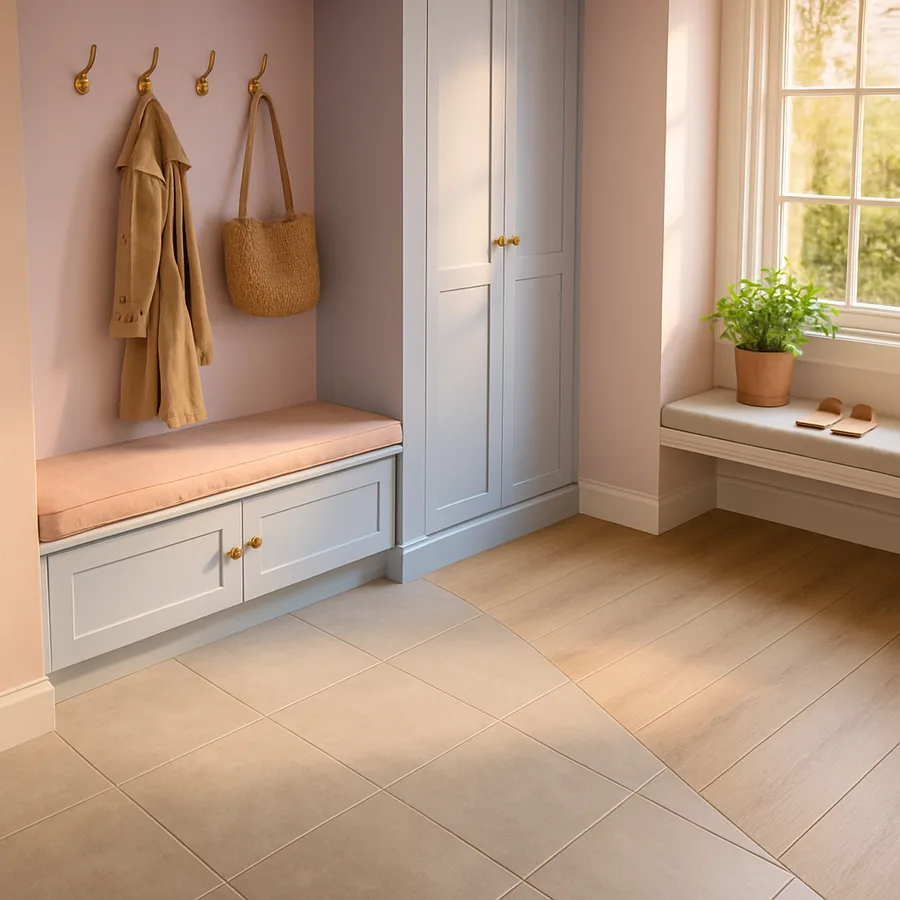
Mudrooms are the mechanical rooms of modern interior design: nobody photographs them for a coffee-table book, but they do more work than any other space of their size. Two materials dominate the mudroom floor conversation today: porcelain tile and luxury vinyl plank (LVP). They are both water-resistant, both widely available, and both heavily marketed to homeowners, which is exactly why choosing between them is confusing. This comparison walks through the decision factors that actually matter in a real mudroom: wet boots, dog nails, dropped gardening tools, January cold, and the budget reality that most homeowners face.
How Porcelain Tile Performs in Real Mudroom Conditions
Porcelain tile is manufactured from a dense, fine clay body fired at temperatures above 2,200 degrees Fahrenheit, which produces a surface with a water absorption rate of less than 0.5 percent (the defining threshold set by ASTM C373 and referenced by the Porcelain Tile Certification Agency). In plain English, this means a puddle of melted snow sitting on porcelain for an hour will simply sit there until you wipe it up; none of it enters the tile. That impermeability is why porcelain is the default specification for commercial entries, hospital lobbies, and any interior space with unpredictable moisture loads.
Durability also leans heavily in porcelain's favor. The Porcelain Enamel Institute (PEI) wear ratings go from PEI I (display only) up to PEI V (heavy commercial). A residential mudroom wants a tile rated PEI IV or higher, which resists dropped tools, dragged furniture, and decades of boot scuffs. A dropped hammer that would dent LVP will simply bounce off porcelain. On the negative side, anything breakable that falls on porcelain is probably lost, so the tradeoff is glassware and dishes versus the floor itself.
How Luxury Vinyl Plank Holds Up to the Same Abuse
Luxury vinyl plank has evolved dramatically over the last fifteen years. Premium products now feature a rigid core (often SPC, stone polymer composite), a printed photographic layer, and a wear layer of 20 to 30 mils on higher-end residential tiers. Water resistance on a properly installed LVP floor is genuinely excellent for short-duration spills; the Resilient Floor Covering Institute classifies most modern LVP as waterproof for surface exposure, though sustained standing water can migrate to subfloors through plank seams over time.
Dent resistance is where LVP runs behind porcelain. A pointed heel, a dropped kitchen knife, or a sharp gardening tool can puncture or dent LVP, particularly lower-tier products with 12-mil or thinner wear layers. That said, the damage is often barely visible because the printed photographic layer masks small surface defects. Scratch resistance under dog nails is a mixed bag: premium LVP with a ceramic-bead-infused wear layer performs well, while budget LVP can scuff noticeably within a year or two in a busy household. Reader question: how do you tell premium LVP from budget LVP at the showroom? Ask for the wear layer thickness in mils and the IIC and STC ratings (impact and sound transmission), which reputable manufacturers publish openly.
Water Resistance in a Real-World Wet Boot Scenario
If the mudroom actually sees wet boots, this is the category that most likely decides the material choice. Porcelain tile over a properly installed mortar bed and cement backer board is genuinely impervious: you can leave a puddle on it for hours with no consequence. LVP is water-resistant at the surface but relies on click-lock seams that are vulnerable to sustained water intrusion. A wet-boot scenario where melting snow drips onto the floor for ten minutes before it's wiped up is fine for LVP; a scenario where a pet has an accident overnight and the liquid sits for eight hours is where LVP can develop seam issues and subfloor damage.
According to property-insurance data summarized by the Insurance Information Institute, interior water damage claims cost an average of over $11,000 per incident, and the mudroom is a surprisingly common origin point because of melted snow, pet accidents, and gear-cleaning activities. A porcelain floor effectively removes the mudroom from the list of possible water-damage origins. An LVP floor requires you to be realistic about your household's tolerance for wet cleanup delay. For installation standards and subfloor moisture tolerances, consult the National Wood Flooring Association and the Tile Council of North America.
Warmth Underfoot and Cold-Climate Comfort
Porcelain tile is cold. On a January morning in Minnesota, a tile floor without any heat source underneath can feel like walking on a refrigerator shelf, which is why radiant floor heating is so commonly specified beneath mudroom tile in cold climates. Electric mat systems add roughly $10 to $15 per square foot to the installation cost but transform the experience. LVP, by contrast, sits at roughly ambient room temperature because of its polymer composition, which means it feels comfortably neutral underfoot without any supplemental heating. This single factor pushes many cold-climate homeowners toward LVP despite porcelain's other advantages.
The U.S. Department of Energy (DOE) also notes that radiant floors can deliver a 10 to 30 percent efficiency improvement over forced-air heating for zoned room applications, so a tile-plus-radiant approach is not just a comfort investment; it is an energy investment. Reader question: is radiant heat compatible with LVP? Technically yes, but most manufacturers cap floor surface temperature at 85 degrees Fahrenheit to prevent warping or wear-layer damage, which limits how much heat you can actually deliver. Porcelain has no such constraint. Detailed radiant-system planning guidance is available from the U.S. Department of Energy.
Cost, Installation, and Long-Term Value
Installed-price ranges depend heavily on product tier and regional labor rates, but the rough numbers look like this: mid-range porcelain tile lands at $12 to $20 per square foot installed, while mid-range LVP lands at $5 to $10 per square foot installed. LVP is unambiguously cheaper at the point of purchase. Over a 25-year horizon, however, the math gets closer: porcelain tile routinely lasts 40 to 50 years with reasonable maintenance, while LVP is typically replaced every 15 to 20 years in high-traffic residential applications per data from HomeAdvisor and the National Association of Home Builders (NAHB).
Installation complexity also differs. LVP click-lock systems can be DIY-installed by a competent homeowner in a weekend, which eliminates labor cost entirely. Porcelain tile requires skilled labor, substrate preparation, and curing time, and it is not a realistic DIY project for most homeowners. If you have the skills and tools to DIY LVP, the lifetime cost-of-ownership gap narrows significantly. If you are paying for professional installation in both cases, porcelain's longer replacement cycle makes its lifetime cost surprisingly competitive. Reader question: is there a hybrid option? Yes: porcelain in the immediate entry zone where water load is highest, LVP in the adjoining mudroom bench and hallway. This is an increasingly common specification in production-builder spec sheets per NAHB builder surveys.
Design Flexibility, Styles, and Resale Considerations
Porcelain tile is now available in wood-look, stone-look, concrete-look, terrazzo-look, and dozens of other pattern families at a level of photographic realism that genuinely competes with the real materials at a third of the installed cost. LVP specializes in wood-look; some stone-look LVP exists but the visual fidelity is generally lower than porcelain in that category. If you want a wood-look floor in a mudroom and realism matters to you, premium LVP and wood-look porcelain are both excellent and the choice comes down to the water, warmth, and durability tradeoffs above.
Resale value is real but easy to overstate. Real-estate broker surveys published through the National Association of REALTORS (NAR) show that porcelain tile in wet zones is consistently viewed as a premium feature in listing descriptions, while LVP is viewed as a neutral-to-positive feature, particularly in midrange price points. In luxury markets, porcelain is often expected. In starter-home markets, LVP meets buyer expectations comfortably. Match the material to your market, not to an aspirational category you are not actually listing into.
Conclusion
Porcelain tile wins on water resistance, dent resistance, longevity, and radiant-heat compatibility. Luxury vinyl plank wins on warmth underfoot without heating, installation cost, DIY feasibility, and acoustic softness. The right material depends on your climate, your household's water load tolerance, your appetite for installation cost, and the long-term horizon you are planning against. There is no universally correct answer, and anyone telling you otherwise is selling something.
For a cold-climate, high-water-load mudroom where you plan to live in the home for a decade or more and can afford professional installation, porcelain tile with radiant heat is the premium, highest-performance specification. For a moderate-climate, moderate-water-load mudroom where upfront budget matters more than lifetime cost and you value warmth underfoot without supplemental heating, luxury vinyl plank is an entirely defensible choice that will meet real-world demands for 15-plus years.
The hybrid specification (porcelain in the immediate threshold zone, LVP in the adjoining mudroom bench and corridor) is the most sophisticated answer for homeowners who want to optimize without committing entirely to one material. It requires a competent transition detail between the two floors, but the performance upside is substantial, and the cost sits between the two pure-material options. Either way, the mudroom is not a corner to cut, because its floor is the first thing you see after the front door and the last thing you touch on the way out.
Still undecided? Request physical samples of your top two candidates in each category, set them in your actual mudroom for a week, and spill water, walk on them with wet shoes, and drop a light object on each. Real-world testing in your own space is the cheapest, most reliable way to settle the debate.
A factor frequently missed in casual comparisons is repairability. A cracked porcelain tile can be replaced individually by a skilled tile setter without disturbing the surrounding field, provided you kept a small stockpile of matching tile from the original installation. A damaged LVP plank in a click-lock floor usually requires dismantling the floor from the nearest wall to the damaged plank and reassembling, which is labor-intensive and risks damaging adjacent planks. For a mudroom where heavy objects are occasionally dropped, porcelain's spot-repair feasibility is a meaningful long-term advantage. Always purchase 10 percent extra tile from the same production lot and store it in a dry, labeled container for future spot repairs.
Sound transmission is another factor rarely discussed in porcelain-versus-LVP debates, and it increasingly matters for multi-story homes and condominiums. The Impact Insulation Class (IIC) and Sound Transmission Class (STC) ratings for LVP typically land in the 55 to 65 range with a quality underlayment, which is comparable to engineered hardwood. Porcelain tile over standard backer board tends to transmit more impact noise unless a dedicated sound-isolation membrane is installed, which adds roughly $2 to $4 per square foot. For a ground-floor mudroom this factor does not matter; for a mudroom over a finished basement media room, it matters a great deal.
Thermal mass behavior is another subtle differentiator. Porcelain tile absorbs and slowly releases heat, which is exactly what a radiant-heated floor is designed to exploit. LVP has much lower thermal mass, which means it warms up faster but also cools down faster once the heat source cycles off. In practice, a radiant-heated porcelain floor continues to feel warm for an hour after the thermostat cycles the circuit off, while a radiant-heated LVP floor cools in a few minutes. For homeowners running heat only during morning and evening occupancy windows, this thermal-mass behavior means porcelain delivers meaningfully more comfortable time per kilowatt-hour of input energy.
A final honest note: the Environmental Protection Agency (EPA) publishes indoor air quality guidance noting that some lower-tier LVP products contain phthalate plasticizers and may emit volatile organic compounds (VOCs) for months after installation. Look for products certified under FloorScore, GREENGUARD Gold, or similar third-party indoor-air-quality programs to avoid this risk. Porcelain tile is essentially inert and emits nothing, which is one reason it is specified in healthcare environments. For families with chemical sensitivities or young children, this single indoor-air-quality consideration can swing the decision toward porcelain regardless of the other tradeoffs.
More Articles You May Like



Comments
Post a Comment