Sunburst Mirror Arrangements Above Mantels and Console Tables
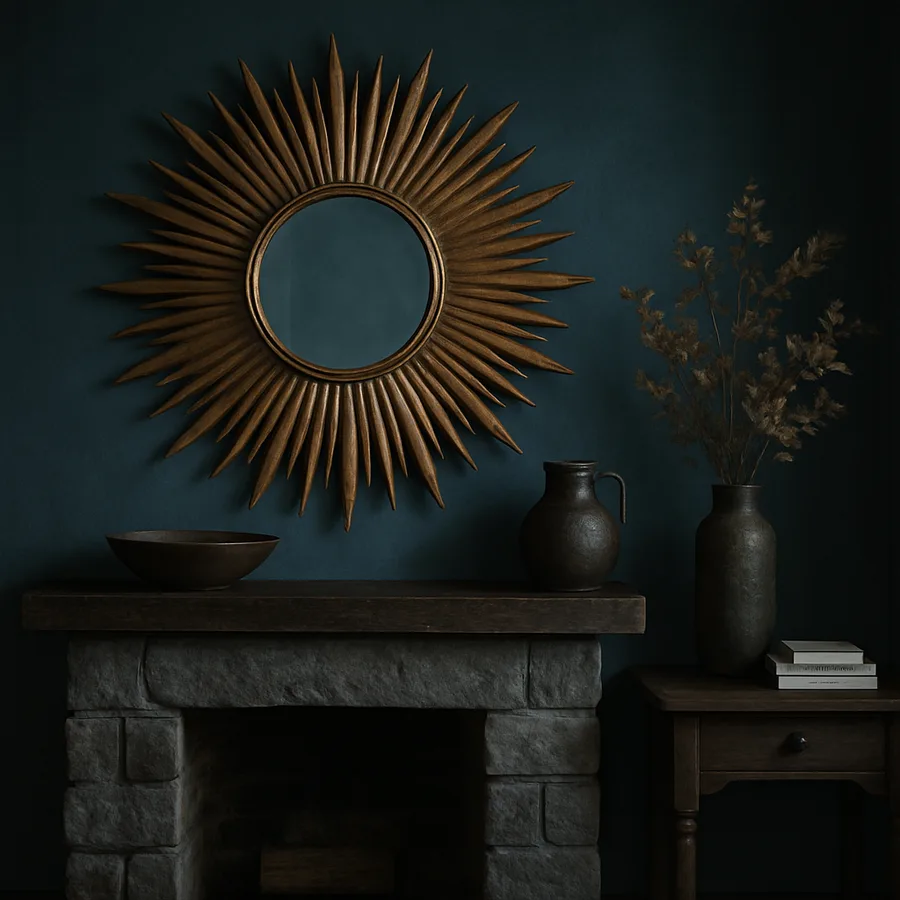
Few decorative objects carry as much personality per square inch as the sunburst mirror. Radiating spokes of wood, metal, or gilded resin announce themselves across a room, drawing the eye with an almost cinematic pull. Originally associated with the French Rococo court and later revived in mid-century modern design by figures such as Line Vautrin, the sunburst mirror has repeatedly reinvented itself, moving from eighteenth-century palaces to California ranch houses and, most recently, to the curated mantels of contemporary homes across Instagram. Its staying power is not accidental; the shape mimics the sun, one of the oldest and most universally recognized symbols of abundance and warmth.
What makes the sunburst particularly interesting as a design element is its flexibility in arrangement. A single oversized sunburst can anchor a mantel on its own, but increasingly designers are grouping two, three, or even five sunbursts in clustered arrangements that read like constellations. A 2025 trend analysis from the Houzz design platform found that multi-mirror gallery walls, with sunburst and round mirrors dominating the category, grew 34% in saved photo collections year over year. Meanwhile, Pinterest reported a 67% increase in searches for "mantel mirror arrangement" during the same period, signaling that readers are hungry not just for single pieces but for complete styling formulas.
The History and Symbolism of the Sunburst
Understanding why sunburst mirrors work so well begins with understanding what they represent. The sunburst motif traces back to the court of Louis XIV, the self-styled Sun King, who used the sun as a personal emblem and commissioned sunburst decorations throughout the Palace of Versailles. The motif spread through European aristocratic interiors over the next two centuries, then largely disappeared until the mid-twentieth century, when designers including Line Vautrin and the craftsmen of the American Hollywood Regency movement reintroduced it with simpler lines and bolder colors.
The symbolic weight of the shape matters more than most homeowners realize. When you place a sunburst mirror above a mantel, you are echoing a decorative language that has signaled light, vitality, and hospitality for over three hundred years. Guests do not need to know this history to respond to it; the response is automatic, almost pre-cognitive. This is why sunburst mirrors so often become conversation pieces, even in rooms that otherwise contain quieter décor.
The mantel itself carries similar symbolic weight. In most homes, the fireplace is the architectural focal point of the main living space, and anything placed above it inherits that prominence. Pairing the mantel, a symbol of hearth and gathering, with the sunburst, a symbol of light and abundance, creates a layered meaning that simpler wall décor cannot achieve. Even a modest room can feel ceremonial with the right combination.
The Single Statement Sunburst: Sizing and Scale
When you want the sunburst to be the unambiguous star of the room, go large and go alone. The mirror's outer diameter, measured spoke-tip to spoke-tip, should occupy between 55% and 75% of the mantel's total length. On a standard 60-inch mantel, that means a sunburst in the 33 to 45 inch diameter range. Smaller than 30 inches and the piece looks like a coaster pinned to the wall; larger than 50 inches and it begins to compete with the ceiling height, especially in rooms under nine feet tall.
Vertical placement follows the same rule that governs most wall art: the center of the mirror should sit approximately 6 to 8 inches above the mantel surface. Any higher and the sunburst drifts into an awkward no-man's-land where the viewer's eye bounces between the mirror and the mantel without settling. Any lower and accessories on the mantel start competing with the lower spokes. Designers affiliated with the American Society of Interior Designers (ASID) often recommend using painter's tape to outline the mirror's footprint on the wall for 24 to 48 hours before committing to hardware, which allows you to evaluate the placement under different lighting conditions.
Finish selection is where individuality emerges. A warm gold or antique brass sunburst reads as traditional and flatters oak, walnut, and cream upholstery. A matte black or oxidized iron sunburst reads as modern industrial and plays well with concrete, charcoal linen, and leather. A distressed silver or white-washed wood sunburst suggests coastal and cottage styles and brightens rooms dominated by navy, soft gray, or sun-bleached textiles. The finish is not decorative trivia; it sets the emotional temperature of the entire mantel.
Building a Three-Mirror Cluster
The cluster arrangement is where contemporary styling gets genuinely playful. The formula that works most consistently is a dominant sunburst flanked or accompanied by two smaller mirrors, with the smaller pieces either both sunbursts in a scaled-down version, or one sunburst and one simple round or oval mirror. The rule is variety within unity: the three pieces should feel like members of the same family but not identical triplets.
Scale proportions matter enormously in clusters. If the dominant mirror has a 36-inch diameter, the secondary mirrors should fall in the 14 to 22 inch diameter range. Anything closer in size creates visual confusion as the eye struggles to identify a hierarchy. Anything dramatically smaller makes the smaller pieces look like afterthoughts. The proportional relationship designers at Architectural Digest most frequently recommend is roughly a 1 : 0.55 : 0.4 ratio across the three pieces, though trained eyes can deviate from this once the underlying logic is internalized.
Spacing between the pieces should be tight, generally 2 to 4 inches between the nearest spoke tips, to create a unified composition rather than three isolated mirrors. When arranging, treat the cluster as a single polygonal shape and aim to fit that overall shape proportionally on the wall using the same 55% to 75% coverage rule that governs single mirrors. Have you considered whether your cluster will read as a single expression or as a crowded gallery? That distinction is usually determined by spacing.
Above a Console Table: Entryways and Living Room Vignettes
Console tables call for different treatment than mantels. Where mantels are architectural and centered, console tables are horizontal and often offset within a wall. The mirror arrangement should respond to the console itself: its length, its height, and the objects styled on top of it. A classic entryway console averages 48 to 54 inches long and 32 to 34 inches tall, which means the mirror arrangement typically starts about 10 inches above the console surface and extends upward by 36 to 48 inches.
A single sunburst above a console is the cleanest option. The mirror diameter should occupy roughly 60% of the console length, leaving breathing room on either side for a table lamp, a small sculpture, or a stack of books. For readers who want more drama, an asymmetric arrangement, with a large sunburst mounted slightly off-center and a smaller piece of framed art or a round mirror filling the opposite side, creates visual tension that feels collected rather than staged.
A reader question that comes up frequently: should the sunburst finish match the console's hardware and legs, or deliberately contrast? The most sophisticated rooms almost always introduce at least one finish contrast. A brushed-nickel lamp on a walnut console with a warm-gold sunburst above creates three distinct material notes that keep the eye interested. Matching every metal in a room is a common beginner's mistake; it flattens the space and removes the layered quality that makes interiors feel curated.
Frame Materials: Metal, Wood, and Mixed Media
Sunburst mirrors are manufactured in a wider range of materials than almost any other decorative mirror category. Metal sunbursts, typically brass, iron, or aluminum, are the most common and the most varied in finish. They tolerate humidity reasonably well but can develop patina over time, which some owners appreciate and others do not. If patina is not desired, look for a clear lacquer coating, which most reputable manufacturers apply during finishing.
Wooden sunbursts, often carved from teak, oak, or pine, introduce warmth and texture that metal cannot replicate. They work particularly well in rooms with natural fiber rugs, linen upholstery, and unpainted wood furniture. The drawback is weight: a large wooden sunburst can exceed 40 pounds, which raises the stakes for correct wall anchoring. The U.S. Consumer Product Safety Commission (CPSC) has reported thousands of annual injuries related to falling wall décor, and heavy sunburst mirrors mounted with inadequate hardware are an unfortunately common cause.
Mixed-media sunbursts, which combine metal spokes with wooden or resin centers, or metal with inset glass beads, represent the most contemporary category. These pieces tend to be the most expensive and the most polarizing; they either look like wearable sculpture or like overworked kitsch, depending on the skill of the designer. Studios like Regina Andrew Detroit and Currey and Company have built reputations on sophisticated mixed-media sunbursts that clear the kitsch threshold cleanly.
Mounting Hardware and Weight Considerations
The sunburst shape introduces a specific mounting challenge that round and rectangular mirrors do not: the spokes extend well beyond the central mounting point, and any tilt in the mounting plate becomes visually obvious because the spokes amplify it. A sunburst hung a quarter-inch off level looks noticeably crooked, where the same deviation on a round mirror would go unnoticed. Use a long spirit level or a laser level during installation, not a short torpedo level.
Hardware should be sized to the weight of the mirror, not guessed. Mirrors under 15 pounds can hang on a single heavy-duty drywall anchor, though two anchors are always better. Mirrors between 15 and 40 pounds require either a stud mount or a pair of toggle bolts rated for at least double the mirror weight. Mirrors over 40 pounds should be mounted with a French cleat, the same interlocking-angle bracket used for heavy rectangular mirrors and large framed art. The National Association of Home Builders and licensed contractors consistently recommend French cleats for any wall décor over 30 pounds.
Another practical tip: check the spoke tips for sharpness before mounting. Some decorative sunbursts, particularly vintage or reproduction pieces from the mid-century revival, have genuinely pointed metal spokes that can injure a passing shoulder or a child's forehead at the wrong height. A quick pass with fine sandpaper or a rubber cap on each spoke tip eliminates the risk without affecting the silhouette.
Styling Accessories Beneath the Mirror
The objects you arrange beneath a sunburst mirror either support or undermine it. The general principle is that the accessories should echo one quality of the mirror without imitating it. If the sunburst is gold, introduce one other gold element on the mantel or console, but do not make everything gold. If the sunburst is geometric and angular, balance it with one organic element, a ceramic vase with a soft curve or a trailing plant.
A classic mantel composition under a sunburst includes: a pair of candlesticks in varying heights, a stack of two to three hardcover books laid horizontally with a small sculpture on top, and a single organic element such as a short vase with eucalyptus or olive branches. The rule of three applies to the visible groupings, but the overall composition should read as asymmetric rather than perfectly balanced. Asymmetry is what distinguishes a styled mantel from a shelf.
Under a console table, the accessories can be more practical: a table lamp with a fabric shade, a catch-all bowl for keys and sunglasses, and a small framed photograph or piece of art leaned against the wall. The International Interior Design Association (IIDA) recommends leaving roughly a third of any console surface clear to preserve function. A console that is too styled to actually hold mail and keys has lost its point.
Conclusion
A sunburst mirror arrangement delivers more decorative value per inch than almost any other mantel or console treatment, precisely because the shape carries centuries of symbolic weight alongside its immediate visual appeal. Whether you choose a single oversized sunburst or a three-piece cluster, the underlying rules are the same: scale the arrangement to the furniture beneath it, maintain a clear size hierarchy among the pieces, contrast finishes rather than matching them blindly, and anchor everything to the wall with hardware that is genuinely rated for the weight.
The mantel and the console are, in most homes, the two most-seen surfaces in the most-used rooms. An investment of attention here pays off in every photograph, every holiday gathering, and every quiet evening in the living room. A well-chosen sunburst, mounted correctly, can remain the room's anchor for a decade or longer with nothing more than occasional dusting and a periodic check of the wall anchors. Few other decorative purchases reward attention so reliably.
If you are considering your first sunburst mirror or reworking an existing mantel, begin by measuring the surface beneath, then photographing the wall from the main seating position at different times of day. The best placement is almost always the one that looks balanced in a photograph, because a camera flattens the space and exposes proportional errors that the eye forgives in person. Get the photograph right, and the real-life installation will follow easily.
Ready to design a mantel or console arrangement that genuinely turns heads? Browse the Interior Bliss curated sunburst mirror collection, download our free mantel styling worksheet, and subscribe to the weekly newsletter for exclusive guides, trend reports, and early access to new arrivals.
More Articles You May Like



Comments
Post a Comment