Soapstone Sinks and Counters: A Material Guide for Kitchens
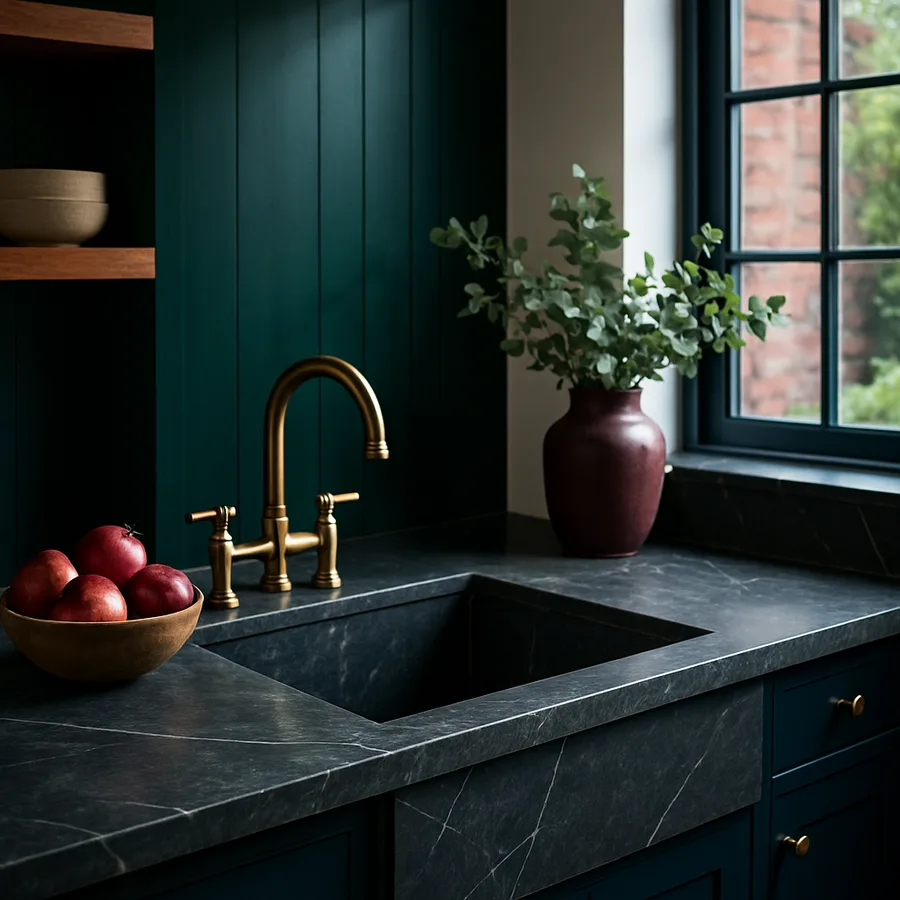
What Sets Soapstone Apart from Other Natural Stones
Soapstone is a metamorphic rock composed primarily of talc, with varying amounts of chlorite, pyroxene, micas, amphiboles, and other minerals depending on the quarry of origin. The high talc content gives soapstone its defining physical characteristic: a smooth, almost waxy tactile quality that feels warm to the touch compared to granite, marble, or quartz. This warmth is not just a subjective impression. Soapstone has a lower thermal conductivity than most countertop stones, meaning it does not draw heat away from your skin as aggressively. In a kitchen where you lean against the counter while cooking or rest your arms on the surface while talking, that subtle warmth registers as comfort.
The mineral composition of soapstone also determines its performance profile. Unlike marble, soapstone contains no calcium carbonate, which means it is completely immune to acid etching. You can squeeze lemon juice directly onto a soapstone counter, spill vinegar, or set a tomato slice on the surface without any chemical reaction occurring. This acid resistance is one of soapstone's most significant practical advantages over marble and even some engineered stones. The Natural Stone Institute classifies soapstone as a non-calcareous stone, placing it in a fundamentally different chemical category from limestone, marble, and travertine.
Soapstone has been used in kitchen applications for centuries, predating the modern countertop industry by a considerable margin. Colonial-era kitchens in New England frequently featured soapstone sinks and hearth surrounds because the stone's heat resistance made it ideal for placement near cooking fires. Historic homes in Vermont, Virginia, and the Carolinas still contain original soapstone surfaces that have been in continuous use for 150 to 200 years. The National Trust for Historic Preservation has documented soapstone installations in numerous preserved properties, demonstrating the material's extraordinary longevity when properly maintained. Few other countertop materials can claim a proven service life measured in centuries rather than decades.
How does soapstone compare to the engineered and natural stone options you may already be considering? It occupies a distinctive niche: softer than granite but harder than pure talc, chemically inert where marble is reactive, naturally dark where quartz offers a broad color palette, and aging gracefully where most materials simply wear. Understanding these distinctions helps you evaluate whether soapstone aligns with your kitchen's functional demands and your aesthetic preferences. The material is not for everyone, but for the homeowners it suits, nothing else delivers quite the same combination of properties.
Heat Resistance and Kitchen Performance
Soapstone's heat resistance is arguably its most compelling functional attribute for kitchen use. The stone withstands direct contact with hot pots, pans, baking sheets, and even open flame without cracking, discoloring, or sustaining any surface damage. This is not a theoretical claim but a demonstrated property rooted in the stone's mineral structure. Talc, the dominant mineral in soapstone, has a melting point above 1,500 degrees Fahrenheit, far beyond any temperature a kitchen generates. You can pull a 500-degree cast-iron skillet from the oven and set it directly on a soapstone counter without a trivet. No other common countertop material, including granite, quartz, marble, or concrete, can make that claim without qualification.
This thermal resilience is why soapstone has historically been used for wood stove surrounds, fireplace liners, and laboratory countertops where Bunsen burners and heated crucibles are part of daily work. The Architectural Digest kitchen design team has highlighted soapstone specifically for its suitability in kitchens where serious cooking takes place, noting that professional and semi-professional home chefs often prefer it over engineered alternatives precisely because it removes the anxiety of thermal damage from the cooking workflow. When you are managing four burners and two oven racks simultaneously, the freedom to set any hot vessel on any surface is a genuine practical benefit.
Soapstone also has a unique thermal mass property. The stone absorbs heat slowly and releases it slowly, which means it does not develop localized hot spots that could burn skin on contact. A soapstone counter next to a cooktop may feel slightly warm to the touch after extended cooking, but it will not reach a temperature that is uncomfortable or dangerous. This thermal buffering effect extends to cold temperatures as well. In winter, a soapstone counter in an unheated kitchen feels less shockingly cold than granite or marble, again because the stone's lower conductivity moderates the transfer of cold to your skin.
What about stain resistance? Soapstone is nonporous in practical terms, meaning it does not absorb liquids the way marble, granite, or concrete do. Water, wine, coffee, and oil sit on the surface without penetrating into the stone matrix. This nonporous quality means soapstone never requires sealing for stain prevention, a significant maintenance advantage over nearly every other natural stone option. Spills can be wiped away with a cloth and the surface will show no trace of the substance. According to testing conducted by the Soapstone Werks fabrication lab, soapstone showed zero measurable absorption in standardized ASTM C97 water absorption tests, confirming its practical impermeability.
Understanding the Patina and Darkening Process
Every soapstone surface undergoes a natural color transformation over time, and understanding this process is essential before you commit to the material. Freshly quarried and fabricated soapstone typically appears in shades of light to medium gray, sometimes with subtle green or blue undertones depending on the mineral composition. Over months and years of exposure to water, cooking oils, and handling, the surface gradually darkens to a deep charcoal gray or near-black. This transformation is called the patina, and it occurs unevenly at first, darkening faster in areas that see more use and moisture exposure while lighter areas lag behind.
Many homeowners accelerate the patina process by applying mineral oil to the entire surface at installation and periodically during the first year. The oil penetrates the talc matrix and produces an immediate preview of the fully darkened color. A freshly oiled soapstone counter has a rich, almost velvety dark gray appearance that many people find dramatically beautiful. The oil is not a sealer or a protectant; it is purely cosmetic, temporarily deepening the color until the stone's natural oxidation catches up. Over the course of six to twelve months with regular oiling, the patina becomes self-sustaining and the stone maintains its dark color without further oil application.
The alternative approach is to let the patina develop naturally without oil, accepting the uneven appearance during the transition period. Some homeowners prefer this gradual evolution because it creates a living surface that visibly responds to how the kitchen is used. Areas around the sink darken first from water exposure, followed by sections near the stove where cooking splashes land, while less-used stretches of counter remain lighter for longer. This patchwork effect is temporary, lasting roughly one to two years before the entire surface reaches a uniform dark tone, but it can be visually striking or distracting depending on your tolerance for variation.
Have you seen a soapstone counter in person at different stages of its patina development? If not, visiting a stone yard that displays both fresh and aged samples is strongly recommended before making your purchase decision. The difference between a newly installed soapstone counter and one that has aged for five years is dramatic, and photographs rarely capture the subtlety of the transition accurately. The Houzz community forums contain extensive photo galleries from homeowners documenting their soapstone patina progression over time, which can serve as a useful visual reference during your decision-making process.
Sourcing Soapstone and Choosing the Right Slab
Soapstone suitable for countertop fabrication is quarried in a relatively small number of locations worldwide. Brazil is the dominant source for the North American market, producing the majority of architectural-grade soapstone slabs imported into the United States. Brazilian soapstone typically has a higher talc content and softer texture compared to domestic sources, which makes it easier to fabricate but slightly more susceptible to scratching. Domestic soapstone quarries in Virginia and Vermont produce stone with a lower talc content and harder composition, offering better scratch resistance at a higher price point. The Alberene Soapstone quarry in Virginia, operated by the Polycor company, is one of the most well-known domestic sources.
Soapstone hardness varies significantly between quarries and even between blocks from the same quarry. The Mohs hardness scale rating for countertop-grade soapstone ranges from approximately 2.5 to 5, depending on the talc-to-chlorite ratio. Stones at the lower end of that range feel noticeably softer and scratch more easily, while those at the upper end approach the hardness of some granites. When shopping for slabs, ask the supplier about the specific quarry of origin and the approximate Mohs rating. Reputable soapstone dealers will have this information and should be willing to share it. If a supplier cannot tell you where the stone was quarried, consider that a warning sign about their sourcing practices.
Pricing for soapstone countertops typically falls between $70 and $120 per square foot installed, placing it in the mid-to-upper range of natural stone options. The installed cost includes templating, fabrication, and setting, which should be performed by a fabricator experienced with soapstone because it requires different cutting and polishing techniques than granite or quartz. The National Kitchen and Bath Association (NKBA) recommends requesting references specifically for soapstone projects when evaluating fabricators, as the stone's softness requires gentler handling and more careful edge finishing than harder materials.
Slab selection should be done in person whenever possible. Visit the stone yard and examine the full slab under both natural and artificial light, looking for color uniformity, vein patterns, and any natural fissures or inclusions that might affect structural integrity or aesthetics. Bring a sample of your cabinet color and flooring material to evaluate the pairing. Soapstone's limited color range, essentially variations of gray, means it pairs most naturally with white, cream, navy, forest green, and warm wood cabinetry. It can feel heavy or monotone when combined with dark gray or black cabinetry, so consider the overall kitchen palette carefully before committing.
Soapstone Sinks: Integrated and Farmhouse Options
Soapstone sinks represent one of the most distinctive applications of this material, offering a visual and functional continuity that no other sink-and-countertop combination can match. An integrated soapstone sink, carved from the same slab as the countertop, creates a seamless surface with no joints, seams, or caulk lines between the counter and the basin. Water flows directly from counter to sink without encountering any obstacle or gap where debris and bacteria can accumulate. This hygienic advantage, combined with the visual elegance of a monolithic stone surface, makes integrated soapstone sinks a premium choice for high-end kitchen designs.
Farmhouse or apron-front soapstone sinks are the more common configuration, featuring a separate carved sink basin that is installed in an undermount or flush-mount position within the countertop. These sinks are typically available in single-bowl and double-bowl configurations, with bowl depths ranging from 8 to 10 inches. The front apron extends forward beyond the cabinet face, creating the characteristic farmhouse profile that has been a staple of American kitchen design for over a century. Soapstone farmhouse sinks from fabricators like Alberene and Vermont Soapstone are hand-carved from solid blocks, giving each sink a weight and solidity that stainless steel and fireclay alternatives cannot replicate.
The practical performance of soapstone sinks aligns with the material's broader strengths. Hot water, boiling pasta water, and cold water can alternate freely without any risk of thermal shock cracking. Acidic foods, coffee grounds, and red wine rinse away without staining. The surface develops the same darkening patina as the countertop, ensuring that the sink and counter age in visual harmony. Soapstone's natural antibacterial properties, a consequence of its nonporous surface, mean that the sink does not harbor bacteria in pores or crevices the way natural stone sinks with higher porosity can. Routine cleaning with dish soap and a soft sponge is all that is required.
Cost is the primary consideration with soapstone sinks. A hand-carved farmhouse sink runs between $1,200 and $3,500 depending on size and configuration, significantly more than a comparable fireclay or stainless steel alternative. An integrated sink carved from the same slab as the countertop adds $2,000 to $5,000 to the countertop fabrication cost because of the additional carving, polishing, and structural engineering required. These are not impulse purchases. However, given soapstone's multi-century service life, the per-year cost of ownership is remarkably low. A $3,000 soapstone sink that lasts 100 years costs $30 per year, while a $500 stainless steel sink replaced every 15 years costs $33 per year and delivers none of the aesthetic or functional benefits.
Long-Term Care and Scratch Management
Daily care for soapstone counters and sinks is remarkably simple. Wipe the surface with warm water and a mild dish soap using a soft cloth or sponge. Unlike marble and granite, soapstone tolerates any household cleaner without damage, including acidic cleaners, bleach-based products, and abrasive powders. You cannot chemically damage soapstone through normal cleaning because its mineral composition is inert to the acids, bases, and solvents found in household products. This chemical resilience makes soapstone the most carefree natural stone for daily kitchen maintenance. The only cleaning caveat is that harsh abrasive scrubbing pads can leave visible scratches on the surface, so stick with soft materials for routine wiping.
Scratching is soapstone's primary vulnerability and the characteristic that most distinguishes its ownership experience from harder stones. Because of its relatively low Mohs hardness, soapstone scratches when contacted by hard objects like knives, ceramic dishes, and abrasive cookware bottoms. These scratches appear as light-colored lines on the dark patinated surface and are immediately visible. The good news is that soapstone scratches are superficial and easy to repair. Fine-grit sandpaper in the 120 to 220 range, rubbed along the scratch with moderate pressure, blends it into the surrounding surface. A follow-up application of mineral oil restores the dark color to the sanded area, making the repair invisible within minutes.
Some homeowners embrace scratches as part of soapstone's character, the same way they might accept patina on a leather bag or wear marks on a hardwood floor. Over time, the accumulated fine scratches create a soft, diffused texture that many people find more beautiful than a pristine surface. The material gently records the life of the kitchen, building a visual history of meals prepared, dishes washed, and counters wiped down at the end of each day. Whether you view scratches as damage to be repaired or character to be appreciated is a personal preference that should inform your material choice.
For homeowners who want to minimize scratching, a few practical habits make a significant difference. Always use cutting boards rather than cutting directly on the stone. Place felt or rubber pads under small appliances, canisters, and ceramic accessories that might be slid across the surface. Lift cast-iron cookware rather than dragging it across the counter. These habits are common-sense kitchen practices that protect any surface, but they are particularly impactful with soapstone because the stone's softness means it shows wear more readily than granite or quartz. Are you willing to adopt these habits consistently, or would a harder surface better match your cooking style?
Conclusion: Is Soapstone the Right Stone for Your Kitchen
Soapstone offers a combination of properties that no other countertop material can collectively match: complete acid immunity, exceptional heat resistance, natural nonporosity, warm tactile quality, and a living patina that deepens and unifies over time. These attributes make it an outstanding choice for kitchens where serious cooking happens daily, where natural materials are valued over manufactured perfection, and where the homeowner appreciates surfaces that develop character through use rather than resisting it.
The material's limitations are equally clear. Soapstone scratches more easily than granite or quartz, its color palette is limited to shades of gray, and its cost places it in the upper tier of natural stone pricing. These are not hidden drawbacks; they are inherent characteristics of the material that every prospective buyer should weigh honestly. A homeowner who needs a light-colored, scratch-proof surface should look elsewhere. A homeowner who wants a dark, warm, chemically inert surface with centuries of proven kitchen performance will find soapstone deeply satisfying.
The decision to install soapstone sinks alongside soapstone counters amplifies both the visual impact and the practical advantages. An integrated or matched sink-and-counter installation creates a seamless kitchen workspace that is strikingly beautiful and effortlessly functional. The premium cost is substantial but justified by the material's extraordinary longevity and the daily pleasure of working on a surface that feels, performs, and ages unlike anything else available.
Begin your soapstone exploration today: Contact two or three stone yards in your region that stock architectural soapstone, request to view full slabs and aged samples, and bring a sample tile of your cabinet finish for a side-by-side evaluation. Ask each supplier about the quarry origin, Mohs hardness rating, and fabricator recommendations for their specific stone. That firsthand comparison will tell you whether soapstone belongs in your kitchen.
More Articles You May Like



Comments
Post a Comment