Hardwood vs Luxury Vinyl Plank: Honest Side-by-Side Comparison
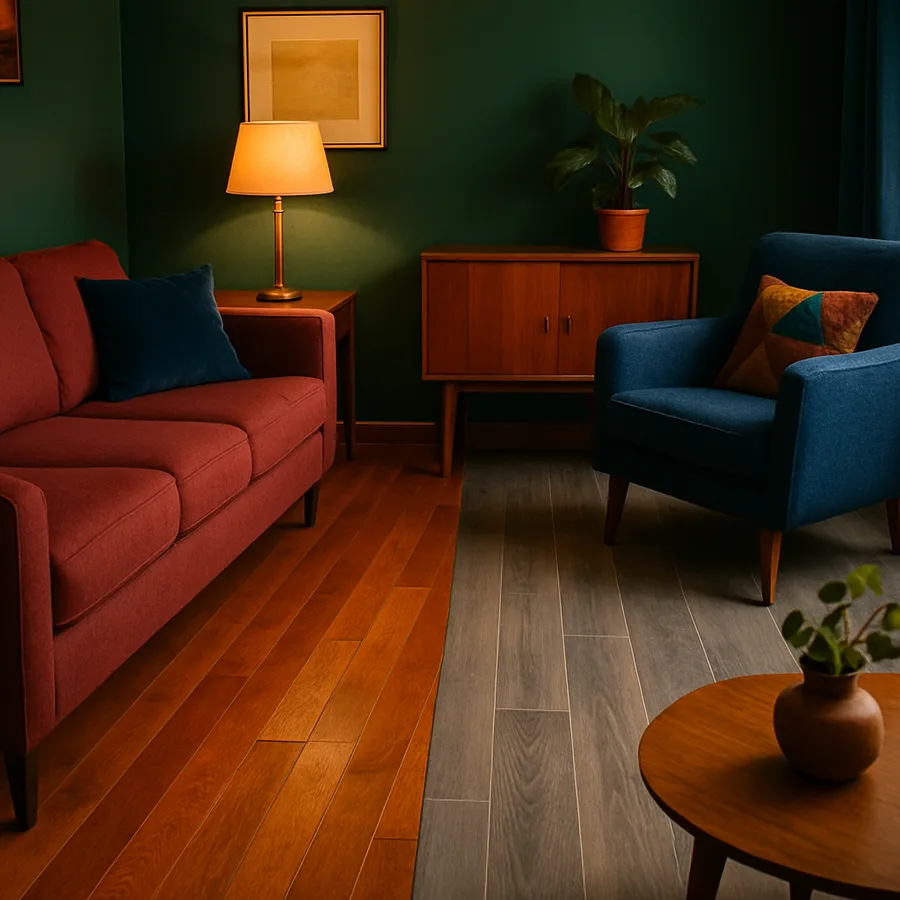
Few flooring decisions generate as much debate among homeowners as the choice between hardwood and luxury vinyl plank (LVP). Both materials can produce beautiful floors that anchor a room's design and withstand years of daily use, but they achieve those outcomes through fundamentally different means. Hardwood is a natural material with centuries of proven performance, genuine warmth underfoot, and a reputation that adds tangible value to a home. LVP is an engineered product that replicates wood's appearance with remarkable fidelity while offering moisture resistance, easier installation, and a significantly lower price point. Understanding exactly where each material excels and where it falls short is essential for making a decision you will not regret five or ten years from now.
The National Association of Realtors (NAR) reported that 54 percent of home buyers said they would pay more for a home with hardwood floors, a figure that has remained relatively stable for over a decade. Meanwhile, the Resilient Floor Covering Institute (RFCI) documented that luxury vinyl flooring sales grew by over 20 percent annually between 2018 and 2023, making it the fastest-growing flooring category in the residential market. These two statistics tell an important story: hardwood retains its prestige and resale value advantage, but LVP is winning the volume battle by offering a compelling combination of aesthetics, performance, and affordability that resonates with a broad range of homeowners.
This comparison does not declare a winner because there is no universal best choice. The right flooring depends on the specific room, the household's lifestyle, the local climate, the project budget, and the homeowner's tolerance for maintenance. What this guide does provide is an honest, side-by-side evaluation across the dimensions that matter most: appearance, durability, moisture performance, comfort, installation, cost, and long-term value. Every claim is grounded in industry data and practical experience rather than marketing language from either category's manufacturers.
Should you invest in the authenticity of real wood or choose the practical advantages of engineered vinyl? The answer becomes clearer as you work through each comparison point and weigh it against your specific circumstances. By the end of this guide, you will have the information needed to make a confident, informed decision rather than one based on assumptions, anecdotes, or incomplete comparisons.
Appearance and Authenticity Under Close Inspection
The visual gap between premium LVP and real hardwood has narrowed dramatically over the past decade, but it has not closed entirely. Modern LVP uses high-resolution photographic imaging and textured embossing to reproduce wood grain patterns, knot details, and color variations with impressive accuracy. At standing height and at a normal viewing distance, a well-made LVP floor can be virtually indistinguishable from hardwood. The textures are increasingly realistic, with embossed-in-register (EIR) technology that aligns the surface texture to the printed grain pattern, so the ridges you feel under your fingertips correspond to the grain lines you see. This tactile alignment is what separates convincing LVP from products that look right but feel wrong.
The difference reveals itself under closer inspection and in specific lighting conditions. Real hardwood has depth to its grain that comes from the physical structure of wood fibers, creating subtle variations in how light interacts with the surface from different angles. This optical depth, sometimes described as chatoyance, produces a liveliness that printed surfaces cannot fully replicate because the pattern is applied to the surface rather than existing within the material itself. Side lighting from a window or a low floor lamp accentuates this difference, revealing the three-dimensional quality of real wood grain versus the flatter, more uniform appearance of printed vinyl. Most visitors will never notice this distinction, but owners who spend time looking at their floors from seated or ground-level positions may perceive it.
Color variation between planks is another area where the two materials diverge. A box of hardwood planks displays natural variation in color, grain density, and figure because each board was cut from a different section of a tree. This variation gives hardwood floors their organic, one-of-a-kind character. LVP manufacturers address this by including multiple print patterns per production run, typically between 8 and 20 unique designs that repeat across the floor. Entry-level products may have fewer patterns, creating noticeable repetition that trained eyes can spot, while premium products use more patterns and randomized packaging to minimize visible repeats. Architectural Digest recommends that homeowners shopping for LVP prioritize products with at least 12 unique plank designs to avoid the pattern repetition that makes vinyl floors look artificial in large open rooms.
Both materials offer extensive style ranges, but hardwood provides options that LVP cannot replicate. Hand-scraped, wire-brushed, and skip-sawn textures in real wood carry an authenticity that comes from physical tool marks on a natural surface. Reclaimed and antique hardwood introduces genuine age, patina, and character marks accumulated over decades or centuries. While LVP versions of these styles exist and can look convincing, they are reproductions of surfaces rather than authentic expressions of material history. For homeowners to whom material authenticity is a core design value, this distinction is significant. For those who prioritize visual impact at a practical price point, premium LVP delivers remarkable results.
Durability and Resistance to Daily Wear
Hardwood durability is measured primarily by the Janka hardness scale, which quantifies a wood species' resistance to denting and surface damage. White oak, the most popular hardwood flooring species in North America, scores 1,360 on the Janka scale, which provides good resistance to everyday foot traffic, furniture movement, and light impacts. Softer species like pine (870) and Douglas fir (660) dent more easily but develop a lived-in patina that some homeowners prefer. Harder exotic species like Brazilian walnut (3,680) and Santos mahogany (2,200) offer extreme dent resistance but come at premium prices and can be more difficult to refinish due to their density.
LVP approaches durability through a different mechanism: a transparent wear layer measured in mils (thousandths of an inch) that sits above the printed design and protects it from scratches, scuffs, and abrasion. Entry-level LVP typically features a 6 to 12 mil wear layer suitable for low-traffic areas. Mid-range products offer 20 mil wear layers appropriate for most residential applications. Premium and commercial-grade LVP provides 28 to 40 mil wear layers that can handle heavy foot traffic, pets, and commercial use. The wear layer does not dent like wood because vinyl is a flexible material that absorbs impact rather than compressing permanently. This makes LVP inherently more resistant to denting from high heels, chair legs, and dropped objects than all but the hardest wood species.
Scratch resistance is a category where LVP holds a meaningful practical advantage for households with pets. Dog and cat claws that would leave visible scratches in hardwood's softer surface finish slide across LVP's wear layer without leaving permanent marks, provided the wear layer is at least 20 mils thick. The National Wood Flooring Association (NWFA) acknowledges that pet traffic is one of the leading causes of premature hardwood refinishing, with claw scratches accumulating over time and becoming visible in direct light. Hardwood manufacturers have responded with harder finish coatings, including aluminum oxide and ceramic-infused polyurethane, that improve scratch resistance significantly but cannot match the inherent toughness of a thick vinyl wear layer against sharp, repeated contact.
The critical durability difference is longevity and renewability. Hardwood floors can last over a century because they can be sanded and refinished multiple times, each refinishing removing accumulated damage and restoring the surface to like-new condition. A solid three-quarter-inch hardwood floor can typically withstand 7 to 10 refinishing cycles over its lifetime, effectively resetting the durability clock each time. LVP cannot be refinished. Once the wear layer is worn through, the plank must be replaced. Even premium LVP with a 40 mil wear layer has a finite lifespan that the manufacturer warranties typically frame as 25 to 30 years for residential use. For a home you plan to live in for decades, hardwood's ability to be renewed gives it a longevity advantage that no LVP warranty can match. For a home you may sell within 10 to 15 years, LVP's durability within its lifespan may be entirely sufficient.
Moisture Performance and Where Each Material Belongs
Moisture resistance is the category where LVP's advantage over hardwood is most decisive and least debatable. Luxury vinyl plank is waterproof. Its PVC core does not absorb water, swell, or warp when exposed to standing liquid, high humidity, or occasional flooding. This makes LVP suitable for bathrooms, kitchens, laundry rooms, basements, and entryways where water exposure is a routine occurrence rather than an exceptional event. A spill that sits on LVP for hours causes no damage to the material itself, though moisture that seeps between planks and reaches the subfloor can still cause problems in any flooring system.
Hardwood and moisture have a fundamentally adversarial relationship. Wood is a hygroscopic material that absorbs and releases moisture in response to the humidity of its surrounding environment. When humidity rises, hardwood planks absorb moisture and expand. When humidity drops, they release moisture and contract. This seasonal movement is normal and expected, and properly installed hardwood floors accommodate it through expansion gaps at perimeters and transitions. Problems arise when moisture exposure exceeds what seasonal adjustment can handle: standing water causes cupping and buckling, persistent high humidity causes swelling and warping, and rapid humidity swings cause checking and cracking. Basements, bathrooms, and below-grade installations are generally considered unsuitable for solid hardwood, though engineered hardwood with plywood cores offers better dimensional stability in moderately humid environments.
The National Kitchen and Bath Association recommends waterproof flooring materials for all full bathrooms and considers water-resistant materials acceptable for powder rooms and kitchens. This recommendation effectively excludes solid hardwood from full bathrooms and positions LVP as the more practical choice for any wet or moisture-prone room. Engineered hardwood occupies a middle ground, offering real wood aesthetics with improved moisture tolerance, but it remains vulnerable to standing water and is not classified as waterproof by any manufacturer.
For rooms without significant moisture exposure, such as bedrooms, living rooms, dining rooms, and hallways, hardwood performs reliably when the indoor environment maintains reasonable humidity levels between 35 and 55 percent. Whole-house humidification systems in dry climates and dehumidification in humid climates protect both the floors and the general comfort of the home. Is your home in a region with extreme seasonal humidity swings? If so, engineered hardwood or LVP may be more stable choices than solid hardwood, which demands a more controlled environment to perform its best over decades of service.
Comfort, Sound, and the Feel Underfoot
The physical experience of walking on a floor involves more than visual appearance, and this is a dimension where hardwood and LVP differ in ways that matter to daily comfort. Hardwood feels warmer underfoot than its actual temperature because wood is a poor thermal conductor, meaning it does not draw heat away from your feet the way tile or stone does. This natural thermal insulation makes hardwood comfortable for barefoot walking even in moderately cool rooms. LVP, made primarily from PVC and limestone powder, feels cooler than wood at the same ambient temperature because vinyl conducts heat more efficiently, though the difference is subtle compared to the stark cold of ceramic tile.
Underfoot resilience, meaning how forgiving the floor feels during extended standing, is an area where LVP can actually outperform hardwood. Vinyl has a slight natural flexibility that hardwood lacks, and many LVP products include a built-in cork or foam underlayment that adds cushioning. For households where people stand for extended periods in kitchens or workrooms, this resilience reduces leg and back fatigue compared to standing on a rigid hardwood surface. Anti-fatigue mats remain advisable at primary standing workstations regardless of flooring material, but the baseline comfort of LVP during casual standing and walking is marginally better than hardwood for many users.
Sound is a significant differentiator that is often underappreciated until after installation. Hardwood floors transmit impact sound, including footsteps, dropped objects, and pet nails, more readily than LVP when both are installed with appropriate underlayment. The rigid structure of wood acts as a sounding board that amplifies impact vibrations, which is why hardwood floors on upper stories can create noise issues for rooms below. LVP's flexible vinyl construction absorbs more impact energy before transmitting it, resulting in a quieter floor in most installations. However, entry-level LVP without integrated underlayment can produce a hollow, plasticky sound when walked on, which undermines the material's wood-mimicking intent. Better Homes and Gardens advises that LVP installations should always include quality underlayment, whether built-in or added separately, to achieve the solid, authentic sound that makes vinyl flooring convincing.
Temperature compatibility is another practical consideration. Hardwood is generally compatible with radiant floor heating systems, though the wood species and heating system type must be carefully matched to avoid excessive drying and gapping. LVP is also compatible with radiant heat, but most manufacturers impose a maximum surface temperature limit, typically 85 degrees Fahrenheit, above which the vinyl can soften, discolor, or release from its locking mechanism. For homes with radiant heating, both materials work but require attention to manufacturer specifications, and hardwood offers a wider operating temperature range. How important is the physical experience of your floor compared to its visual appearance? For some homeowners, the natural warmth and solid feel of real wood underfoot is the deciding factor, regardless of LVP's advantages in other categories.
Installation Complexity and Timeline Differences
LVP installation is one of the material's most compelling advantages, particularly for homeowners who want to minimize project duration, disruption, and labor costs. Most LVP products use a click-lock floating floor system that requires no adhesive, no nailing, and no specialized tools beyond a utility knife, a tapping block, and a pull bar. Planks snap together along their long and short edges and float as a unified sheet over the subfloor, held in place by gravity and friction. A competent DIY homeowner can install LVP in a standard room in a single day, and a professional installer can complete an entire single-story home in two to three days. No acclimation period is required because vinyl does not respond to humidity the way wood does, which means installation can begin the same day the material arrives.
Hardwood installation is a more involved process that typically requires professional expertise and a longer timeline. Solid hardwood installed with nails or staples requires a compatible subfloor, either plywood or oriented strand board, and cannot be installed directly over concrete slabs without intermediate framing. The material needs to acclimate in the installation space for 3 to 14 days, depending on species, moisture content, and local humidity, to reach equilibrium before installation begins. The installation itself involves careful layout planning, face-nailing or blind-nailing each plank, and precise cuts around obstacles and at transitions. A professional hardwood installer can complete approximately 200 to 300 square feet per day for nail-down installations, meaning a typical 1,500-square-foot project takes a full work week.
Engineered hardwood with click-lock profiles bridges some of the installation gap, offering a floating floor option that is faster and more DIY-accessible than nail-down solid hardwood. However, engineered hardwood still requires acclimation, demands more careful subfloor preparation than LVP, and produces more waste from cuts due to the material's rigidity and the need for staggered joints. The installation timeline for click-lock engineered hardwood falls between solid hardwood and LVP, typically requiring two to four days for professional installation of a whole-house project.
Subfloor tolerance is another installation variable where LVP is more forgiving. Luxury vinyl plank can be installed over most existing hard-surface floors, including tile, existing vinyl, and concrete, without removal, provided the surface is clean, flat, and structurally sound. Minor subfloor imperfections of up to 3/16 inch per 10 feet are typically acceptable. Hardwood demands a flatter subfloor, with most manufacturers specifying a maximum variation of 3/16 inch per 6 feet, and requires more aggressive leveling or sanding of the substrate before installation. For renovation projects where removing existing flooring is undesirable, LVP's ability to install directly over compatible existing surfaces saves both time and money. What is your project timeline, and does it accommodate the acclimation and installation pace that hardwood demands? If time is constrained, LVP's faster path from purchase to finished floor is a material advantage.
Cost Analysis and Long-Term Value Proposition
The upfront cost difference between hardwood and LVP is significant and represents the primary reason many homeowners choose vinyl over wood. Solid domestic hardwood typically costs between $6 and $12 per square foot for material alone, with installation adding $3 to $8 per square foot depending on method and region. A 1,000-square-foot hardwood project therefore ranges from $9,000 to $20,000 installed. Luxury vinyl plank ranges from $2 to $7 per square foot for material, with installation at $1.50 to $3 per square foot, putting a 1,000-square-foot LVP project between $3,500 and $10,000 installed. At the midpoint of each range, hardwood costs roughly twice what LVP costs for the same square footage, a difference that can be decisive for budget-conscious homeowners or investors renovating for resale.
The cost comparison shifts when you extend the analysis beyond the initial installation. Hardwood requires periodic refinishing, typically every 7 to 10 years in high-traffic areas, at a cost of $3 to $5 per square foot. Over a 30-year period, a hardwood floor might require two to three refinishing cycles, adding $6,000 to $15,000 in lifetime maintenance costs for a 1,000-square-foot installation. LVP requires no refinishing but will eventually need replacement, typically after 15 to 25 years. Replacing 1,000 square feet of LVP costs roughly the same as the original installation. Over 50 years, the total cost of ownership for hardwood (one installation plus refinishing) and LVP (two installations) converges more closely than the initial price gap suggests, though hardwood still runs higher overall.
Resale value is where hardwood recovers a portion of its cost premium. The National Association of Realtors estimates that hardwood flooring returns approximately 70 to 80 percent of its installation cost at resale, and homes with hardwood sell faster on average than comparable homes with other flooring types. LVP's resale impact is more variable and depends heavily on quality tier. Premium LVP in good condition is viewed positively by buyers, but it does not carry the same presale premium as real wood. In luxury and high-end markets, hardwood is expected rather than merely preferred, and its absence can be perceived as a shortcoming regardless of the quality of the LVP alternative.
For investment properties and rental units, LVP's cost-per-year-of-service equation is often more favorable than hardwood's because the flooring endures tenant wear without requiring expensive refinishing between occupants. Damaged LVP planks can be individually replaced at minimal cost, while damaged hardwood often requires sanding and refinishing the entire room to achieve a uniform appearance. Consider what the floor needs to accomplish over the time horizon that matters to you: if you are building a forever home, hardwood's permanence and refinishability may justify the premium. If you are optimizing for the next decade of practical use, LVP's upfront savings and maintenance simplicity make a strong financial case.
Conclusion
The hardwood versus luxury vinyl plank decision is not a question of which material is objectively better but which material is better suited to your specific situation. Hardwood offers authenticity, warmth, refinishability, and proven resale value that no synthetic product can fully replicate. LVP offers waterproof performance, easier installation, lower cost, and pet-friendly durability that hardwood cannot match without compromising its natural character. Both are legitimate choices that millions of homeowners live with happily, and both can produce floors that look beautiful and perform reliably for years.
The strongest recommendation is to let the room dictate the material rather than committing to one flooring type for the entire home. Hardwood in living rooms, bedrooms, and dining areas where its warmth and authenticity shine; LVP in bathrooms, basements, laundry rooms, and moisture-prone kitchens where its waterproof performance is essential. This mixed approach is increasingly common in new construction and major renovations, and when the LVP is chosen to closely match the hardwood's species and color, the visual transition between the two materials can be nearly seamless.
Whatever you choose, invest in quality within the material category. Budget hardwood with a thin veneer and budget LVP with a 6-mil wear layer will both disappoint within a few years. Mid-range and premium products in either category deliver the performance and appearance that justify the investment. Read manufacturer warranties carefully, understand what they actually cover versus what they exclude, and factor the total cost of ownership over your expected time in the home rather than focusing solely on the per-square-foot price at the point of purchase.
The floor beneath your feet is the largest continuous surface in your home and the one you interact with most directly and most frequently. It deserves a decision made with full information, honest comparison, and clear priorities. Take samples of both materials home, lay them on your actual subfloor, observe them in your actual lighting, walk on them in bare feet, and let the experience guide you toward the choice that feels right for your life, your home, and your budget.
More Articles You May Like



Comments
Post a Comment