Oversized Art Above the Sofa: Sizing and Hanging Height Rules
Why the Space Above the Sofa Demands Attention
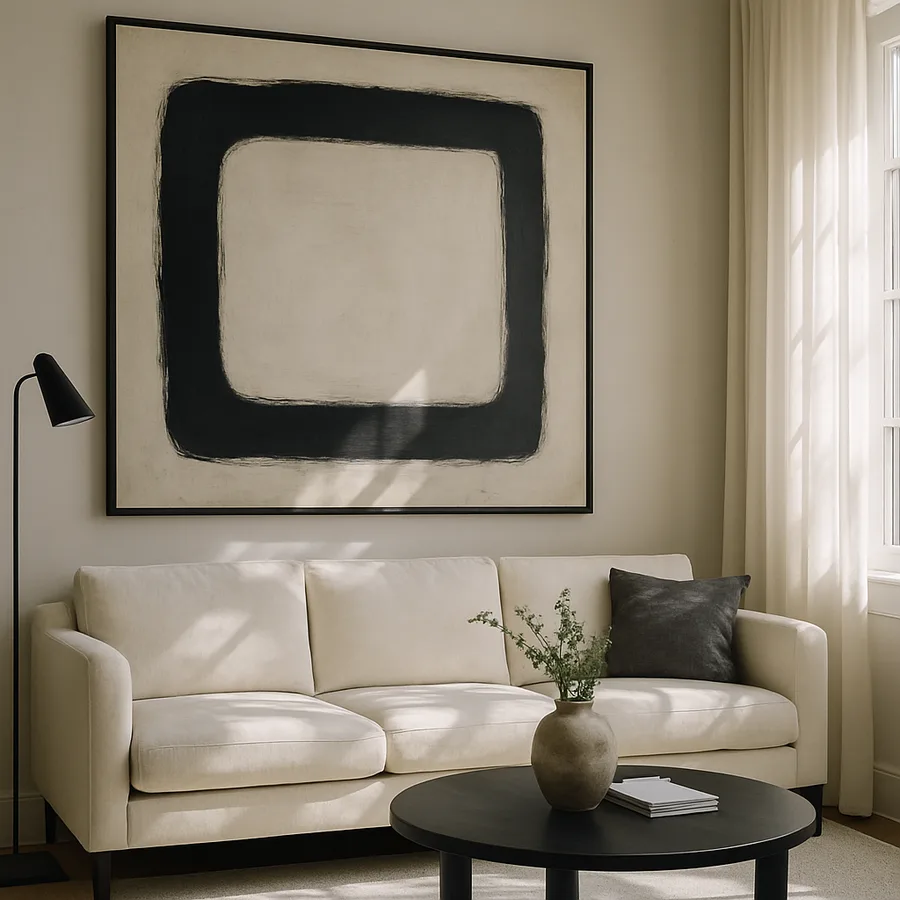
The wall above a sofa is the most prominent vertical surface in most living rooms, and it is almost always the first place the eye lands when entering the space. Left bare, this expanse of empty wall makes even a well-furnished room feel unfinished, as though the design stopped at furniture height and forgot to continue upward. A single oversized artwork in this position anchors the seating area, creates a focal point for the room, and establishes the aesthetic tone for everything around it. The visual weight of a large piece above the sofa communicates intentionality, suggesting that the room was designed rather than merely assembled.
Oversized art, generally defined as any piece wider than 40 inches or taller than 30 inches, carries a presence that smaller works and grouped arrangements cannot replicate. A single large canvas or framed print fills the eye's field of view from the seating position, creating an immersive visual experience that draws occupants into the artwork. This scale of art also simplifies the design decision: instead of curating a gallery wall with multiple pieces that must work together in size, color, and spacing, a single oversized work makes one bold statement. The American Society of Interior Designers (ASID) reports that oversized statement art consistently ranks among the top five most-requested living room design elements in residential projects.
Despite the visual impact that oversized art can deliver, many homeowners undersize their above-sofa artwork. A common scenario involves hanging a modest 16-by-20-inch print over a 90-inch sectional, creating a proportional mismatch that makes the art look like an afterthought and the wall feel even emptier. The opposite error, selecting art too wide for the sofa, creates an unbalanced composition where the artwork visually dominates and diminishes the furniture below. Getting the proportions right requires understanding a few straightforward sizing rules and hanging height guidelines that professional designers follow consistently.
This guide provides the specific measurements, ratios, and techniques you need to select and hang oversized art above your sofa with confidence. Whether you are working with a compact loveseat or an expansive sectional, the principles remain the same. By the end, you will have a clear framework for choosing the right size piece and positioning it at the exact height that creates a visually harmonious relationship between art, wall, and furniture.
The Two-Thirds Rule and Other Sizing Guidelines
The most widely used sizing principle for art above a sofa is the two-thirds rule: the artwork should be approximately two-thirds the width of the sofa beneath it. This ratio creates a visual relationship where the art is clearly associated with the sofa while maintaining enough wall space on each side to frame the composition naturally. For a standard 84-inch sofa, the two-thirds rule calls for artwork approximately 56 inches wide. For a 72-inch apartment-sized sofa, the target width is about 48 inches. This ratio works reliably across different sofa sizes because it maintains proportional harmony rather than targeting a fixed measurement.
Some designers prefer a slightly broader range, recommending that the artwork span between one-half and three-quarters of the sofa's width. The lower end of this range, around 50 percent, produces a more conservative look with generous wall space flanking the art, which can suit formal or minimalist interiors. The upper end, approaching 75 percent, creates a more dramatic, filled look that works well in casual or contemporary settings. Going below half the sofa width almost always looks undersized, while exceeding three-quarters risks overwhelming the furniture relationship. According to research published by the International Furnishings and Design Association (IFDA), the two-thirds proportion tested as the most visually pleasing ratio in consumer preference studies conducted across multiple room configurations.
Height proportions matter too, though they receive less attention than width. For horizontal (landscape) artworks, a height between 24 and 40 inches works well above most sofas, with taller pieces suiting rooms with higher ceilings. Vertical (portrait) oriented oversized art can work above a sofa, but it requires careful height management to avoid overwhelming the wall or placing the top of the artwork uncomfortably close to the ceiling. A vertical piece should still respect the two-thirds width rule, meaning it will typically be narrower than a horizontal alternative and may leave the flanking wall areas feeling sparse. Pairing a vertical artwork with flanking sconces or small decorative elements on each side can compensate for this.
When considering size, remember to account for the frame if applicable. A canvas with a 3-inch frame on each side adds 6 inches to the total width and height. If you are ordering a custom-framed piece, calculate your target dimensions as the outer frame measurement, not the image size. Frameless gallery-wrapped canvases simplify this calculation since the visible size equals the total size. Whichever format you choose, make the sizing decision based on the overall visual footprint of the piece as it will appear on the wall, frame included.
Finding the Perfect Hanging Height
The standard museum hanging height places the center of the artwork at 57 inches from the floor, which represents approximate eye level for a standing adult. However, this convention was designed for gallery spaces where visitors stand while viewing art. Above a sofa, the context changes: the primary viewing position is seated, and the artwork's relationship to the furniture below takes priority over the standing eye-level rule. Applying the 57-inch center height above a sofa often places the art too high, creating an awkward gap between the bottom of the frame and the top of the sofa back.
For art hung above a sofa, the critical measurement is the gap between the bottom edge of the frame and the top of the sofa back. This gap should measure between 6 and 12 inches, with 8 to 10 inches being the most commonly recommended range. A 6-inch gap creates a close, connected relationship that works well with very large pieces, while a 12-inch gap provides more breathing room that suits smaller works or rooms with very high ceilings. Going below 6 inches risks making the art feel cramped against the furniture, and exceeding 12 inches disconnects the art from the sofa, making them read as unrelated elements.
The National Gallery of Art and other major institutions have published extensive research on optimal viewing distances and angles for artwork display. While their recommendations target museum environments, the underlying principles apply to residential settings. Art should be hung so that the viewer's natural gaze, whether standing or seated, falls within the central portion of the piece without requiring uncomfortable upward craning. For someone seated on a sofa, this means the center of the artwork should typically fall between 55 and 62 inches from the floor, depending on the sofa height and the artwork's dimensions. This slightly lower center point keeps the art in comfortable visual range for both seated viewers and standing observers.
High-ceiling rooms present a special challenge. When the distance between the top of the sofa and the ceiling exceeds 5 feet, the 8-to-10-inch gap rule still applies, but the result can leave a large expanse of empty wall above the artwork. Resist the temptation to raise the art to "fill" this space; instead, consider choosing a taller piece that maintains the correct bottom gap while occupying more of the vertical wall area. Alternatively, adding a small architectural element like a picture rail or a subtle horizontal molding above the art can visually cap the composition without raising the artwork out of its optimal position.
How to Measure, Mark, and Hang Heavy Artwork Safely
Oversized art pieces can be surprisingly heavy, and improper hanging is both an aesthetic and safety concern. A large framed canvas or print with glass may weigh 30 to 60 pounds or more, well beyond the capacity of standard picture hooks and drywall anchors. Before hanging anything, weigh your artwork and select hardware rated for at least 150 percent of its actual weight to provide a safety margin. For pieces over 25 pounds, plan to anchor into at least one wall stud rather than relying solely on drywall anchors, even heavy-duty ones. The Consumer Product Safety Commission (CPSC) tracks injuries from falling wall-mounted objects and recommends stud mounting for any item weighing over 20 pounds.
To find the correct nail or screw position on the wall, you need to calculate the hanging point offset. With the artwork face-down on a padded surface, pull the hanging wire taut to its apex (the highest point the wire reaches when supporting the artwork's weight) and measure the distance from this apex to the top edge of the frame. This measurement is your offset. On the wall, mark the desired position for the top edge of the frame, then measure down by the offset distance to find where the nail or screw should go. Double-check by measuring up from the sofa top to confirm the bottom gap falls within your target range.
For pieces using D-ring hangers or sawtooth brackets instead of wire, the process is slightly different. With D-rings, measure the distance from the top of each D-ring to the top edge of the frame. Transfer these measurements to the wall, working from your desired top-edge position. Use a level to ensure the two hanging points are perfectly horizontal. D-ring systems are actually preferable to wire for oversized art because they prevent the side-to-side shifting that wire-hung pieces are prone to. Many professional installers and galleries have moved to D-ring or cleat mounting systems specifically because of their stability. Additional advice on secure art installation methods is available through Houzz's contractor resources.
For the heaviest pieces, consider a French cleat mounting system. A French cleat consists of a beveled strip of wood or metal attached to the wall and a matching strip attached to the back of the artwork. The artwork hooks onto the wall strip, distributing the weight across the entire length of the cleat rather than concentrating it at one or two points. French cleats can support hundreds of pounds when properly installed into studs and they allow precise leveling during hanging. They also make it easy to remove and rehang the artwork for repositioning or wall maintenance. The only drawback is that the wall-mounted cleat strip may be visible when the artwork is removed, so this system is best suited for pieces you intend to keep in place long-term.
Working with Different Sofa Configurations and Room Layouts
Standard sofas with a linear back present the simplest hanging scenario, but many living rooms feature L-shaped sectionals, curved sofas, or sofas positioned in front of windows or architectural features that complicate the art placement. For an L-shaped sectional, center the artwork above the longer section of the L, using that section's width as your reference for the two-thirds rule. The shorter return section does not factor into the sizing calculation because the art should relate to the primary seating surface rather than the entire sectional footprint. Have you measured your sectional's longer section specifically, or are you working with the total length including the return?
When a sofa sits in front of a window, hanging art on the wall above is obviously not an option. However, some designers position a large piece of artwork on a deep shelf or ledge that sits on the sofa table behind the furniture, leaning the art against the window frame. This approach works best with lightweight, unframed canvases that will not cause damage if they shift, and it requires a stable shelf or table with sufficient depth to support the piece safely. The visual effect is informal and gallery-like, and it avoids the need for wall mounting entirely. The International Interior Design Association (IIDA) has featured this leaning-art technique in several residential project showcases as a solution for challenging wall configurations.
Corner-positioned sofas, which are common in open-plan layouts, present a unique challenge because the wall behind the sofa may wrap around a corner. In this configuration, hang the art on the longer wall section behind the sofa and ensure it is centered on the visible wall area rather than the sofa itself. If the two wall sections are roughly equal, choose the one most visible from the room's primary entrance or the main viewing axis. Hanging separate pieces on each wall section that relate to each other in color or subject can also work, though each piece should be independently sized to its respective wall rather than treated as two halves of one composition.
Rooms with low ceilings under 8 feet require particular care with oversized art. A very tall piece can make a low ceiling feel even lower by drawing the eye upward and emphasizing the limited vertical space. In these rooms, choose horizontally oriented artwork that is wider than it is tall, and maintain the minimum 6-inch gap above the sofa to keep the art low and connected to the furniture. The horizontal orientation draws the eye sideways rather than upward, creating an impression of spaciousness. According to the ASID, horizontal art in low-ceiling rooms can make the space feel up to 10 percent wider, a meaningful perceptual shift in compact living areas.
Choosing the Right Art Style for Your Sofa and Room
Scale is only half the equation; the artwork's visual character must also harmonize with the sofa and room. Abstract art is the most versatile choice for above-sofa placement because its non-representational nature allows it to complement virtually any furniture style without competing with it. Large abstract canvases in muted tones suit modern and minimalist rooms, while bold, colorful abstracts energize eclectic or transitional spaces. The absence of recognizable subject matter also means the art does not date as quickly as representational pieces tied to specific trends or styles. For finding original and affordable oversized art, Architectural Digest's shopping guides review both online sources and gallery options.
Photographic prints, particularly large-format landscapes, cityscapes, and architectural images, are another strong choice for above-sofa display. The photographic medium has a contemporary sophistication that reads well at large scale, and the wide aspect ratio of landscape-oriented photographs aligns naturally with horizontal sofas. When selecting a photographic print, consider whether the image's color palette works with your existing room colors. A dramatic black-and-white photograph is a safe choice for almost any color scheme, while a color photograph needs to complement rather than clash with the room's existing tones.
The frame, or lack thereof, significantly influences the overall impression. Gallery-wrapped canvases with finished edges and no frame produce a clean, contemporary look that lets the artwork stand alone without visual interruption. Traditional framing with a mat and molding adds formality and works well with representational art, photography, and works on paper. Floating frames, where the canvas appears suspended within a slim frame with visible gaps, split the difference between framed and unframed aesthetics and have become one of the most popular choices for oversized art in the last several years. Choose a frame style that matches the room's overall formality level rather than defaulting to the cheapest or most ornate option.
Consider the artwork's visual weight in relation to the sofa's visual weight. A substantial, deeply tufted sofa in a dark color carries significant visual weight and can support an equally substantial piece of art with bold colors, dense textures, or high contrast. A sleek, low-profile sofa in a light neutral needs a lighter-weight artwork to maintain balance; a massive, dark painting over a delicate sofa will feel top-heavy and uncomfortable. Matching visual weights does not mean matching styles; a contemporary abstract above a traditional rolled-arm sofa can look fantastic if the visual weights are balanced. What visual character does your current sofa project, and have you considered how the art's density and color will interact with it?
Conclusion: Confidence in Every Measurement
Hanging oversized art above a sofa follows a straightforward set of proportional rules that remove the guesswork from what can feel like an overwhelming decision. The two-thirds width rule ensures the art and sofa read as a cohesive pair. The 8-to-10-inch bottom gap keeps the art connected to the furniture without crowding. Proper hardware rated for the artwork's weight provides safety and stability. With these three guidelines in hand, you can shop for oversized art knowing exactly what dimensions to look for and hang it knowing exactly where it should go.
The proportions and heights discussed in this guide are proven starting points, not rigid commandments. Every room has unique characteristics, ceiling heights, sight lines, and lighting conditions that may warrant small adjustments. Trust the rules as your foundation but also trust your eye: if a piece looks right at 7 inches above the sofa instead of 8, that 1-inch difference is well within the acceptable range. The goal is a finished result that looks intentional and balanced, not one that satisfies a measurement to the millimeter.
This weekend, measure your sofa width, calculate your two-thirds target, and visit a local art source or browse online galleries with those dimensions in mind. Bring a tape measure and a level when it is time to hang, use painter's tape to preview the position before drilling, and take your time with the installation. A single well-chosen, properly hung oversized artwork will transform your living room from a functional seating area into a space with genuine visual presence and personal character.
More Articles You May Like

Comments
Post a Comment