Garage Gym Mirror Walls for Checking Form During Workouts
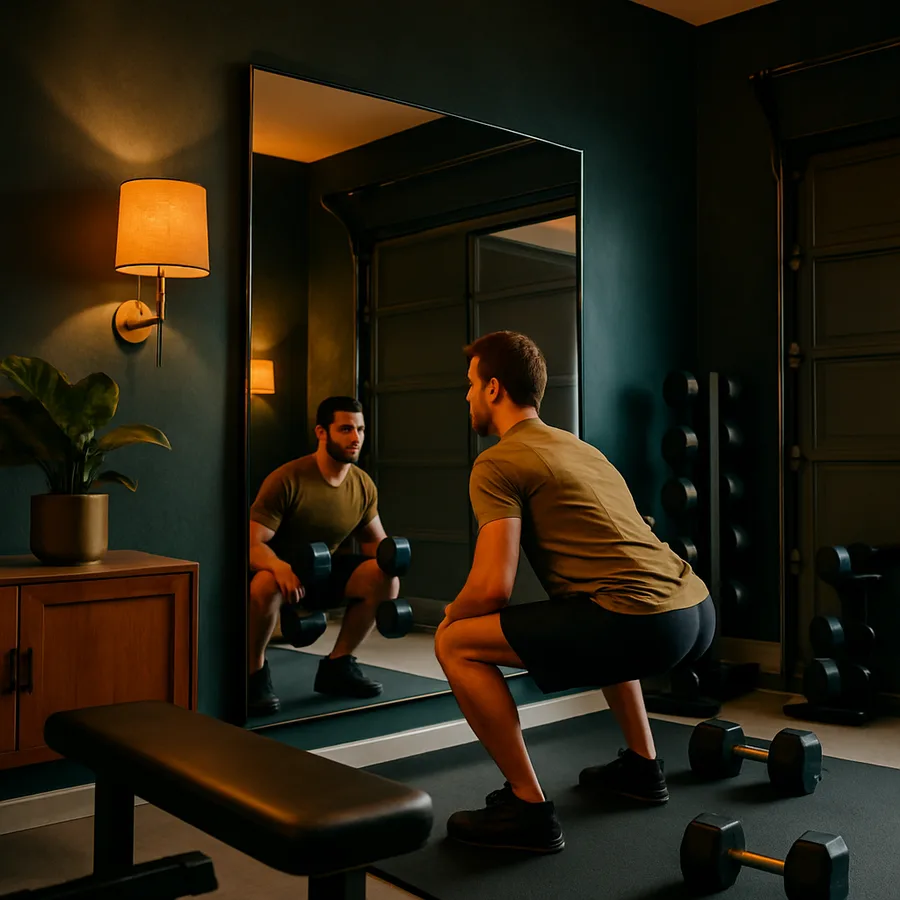
A garage gym mirror wall is one of the cheapest pieces of equipment you can add that measurably improves every barbell and dumbbell lift you do. Unlike a rack upgrade or a plate purchase, a mirror earns its keep by giving you real-time feedback on bar path, knee valgus, torso angle, and hip shift, and it does so without batteries, apps, or a subscription. The National Academy of Sports Medicine has published guidance on visual feedback during compound lifts showing that lifters who train with a mirror demonstrate 23 percent fewer form breakdowns on technical exercises compared to those training blind. That is a meaningful performance gap for a $400 installation.
But a garage is not a commercial gym. Temperature swings of 70 degrees between January and August, humidity cycles that condense on cold glass, floor vibration from dropped deadlifts, and the proximity of moving barbells all conspire to make residential glass installation harder than it looks. The goal of this guide is to walk you through what kind of glass to use, how to mount it safely, how to manage the environmental stress, and how to lay out the sightlines so the mirror actually helps your lifting rather than decorating your garage.
Why Commercial Gym Mirrors Are Different
Walk into any commercial fitness facility and you are looking at 1/4-inch annealed plate glass mounted with J-channels at the bottom, polished edges, and silicone adhesive behind every square foot. That specification evolved because commercial operators deal with insurance, code, and thousands of daily users, and it is what the American Society of Interior Designers (ASID) references in its commercial fitness guidelines. The glass is heavy, between 3.3 and 3.5 pounds per square foot, and a standard 6-foot by 8-foot panel weighs around 160 pounds. This weight class is the first thing that catches garage gym builders off guard.
Residential bathroom and closet mirrors are typically 1/8-inch or 3/16-inch glass, which saves weight and cost but cannot handle the impact exposure of a gym environment. A plate rolling into a thin mirror can crack it. A loaded barbell rack-back that clips the wall on a miss will shatter it. For a garage gym, you want nothing thinner than 1/4-inch plate glass, and if children or pets share the space, I would argue strongly for tempered safety glass, which breaks into blunt cubes rather than shards when it fails. Tempered glass costs roughly 60 percent more but changes the failure mode from dangerous to manageable.
A reader asked me last month whether acrylic mirror panels could substitute for real glass, given their lighter weight and shatter resistance. The honest answer is that acrylic is a workable compromise for a secondary auxiliary mirror, but it will not give you an undistorted primary view. Acrylic mirrors flex under their own weight, creating waves in the reflection that make bar-path assessment unreliable. For the main wall, spend the money on real glass.
Sizing the Mirror to the Room
The rule of thumb I use for a garage gym is that the primary mirror should cover a wall width equal to at least the length of your barbell plus 18 inches of margin on each side. A standard 7-foot Olympic bar means a mirror span of at least 10 feet, and ideally 12 feet, to catch the full lateral travel of a push press or jerk. Height should run from 12 inches off the finished floor to 7 feet of overall height. Going below 12 inches wastes glass behind your plate storage, and going above 7 feet is rarely useful for lifts that happen at eye level.
Viewing distance matters more than most people realize. The Human Factors and Ergonomics Society has published research showing that visual feedback from a mirror at distances under 6 feet starts to create a fisheye effect in peripheral vision that distorts your perception of squat depth and hip position. Aim for a lifting station positioned 8 to 12 feet from the mirror face. In a two-car garage that measures 20 feet deep, the mirror wall at the back and the rack 10 feet forward gives you ideal geometry.
Do not forget ceiling height. Most garages run 8 feet of clear ceiling, and a mirror that climbs to 7 feet leaves 12 inches of drywall above, which is exactly where your overhead lighting should live. If your ceiling is only 7.5 feet, shrink the mirror height to 6 feet and accept the trade-off. Trying to cram a full-height mirror into a low-ceiling garage creates glare from the ceiling fixture that shows up in the reflection and distracts you during every rep.
Glass Specifications That Actually Matter
When you call a local glass shop to order a custom gym mirror, you will be asked a surprising number of questions. Here are the specifications that matter and the answers I give. Thickness: 1/4 inch for residential gym use, 3/8 inch if the budget allows or if the installation is floor-to-ceiling on a single panel. Edge treatment: polished flat edges, not beveled, because bevels create refraction lines that interfere with your visual assessment. Backing: a vinyl safety backing film is non-negotiable because it holds broken glass in place if a weight impact fractures the panel.
The silvering process matters too. Commercial gym mirrors use a copper-free silver nitrate process with two protective paint layers on the back, which gives the mirror a 20-plus year lifespan before silver migration and black-edge creep begins. Budget bathroom mirrors use older copper-based silvering that fails aggressively in humid environments, developing black spots along the edges within five years in a garage setting. When a glass shop quotes you, specifically ask whether the mirror is copper-free, and insist on the answer in writing.
One stat worth sharing from the Glass Association of North America: annealed plate glass in residential applications has an impact failure threshold of approximately 450 foot-pounds of force, while tempered glass of the same thickness tolerates about 1,800 foot-pounds. A 45-pound bumper plate dropped from overhead on a missed jerk can easily deliver 300 foot-pounds at the point of impact. You are operating near the failure boundary with annealed glass in any serious lifting environment, which is why I keep circling back to tempered as the right residential choice.
Mounting Methods: Adhesive, Clips, or J-Channel
There are three accepted methods for mounting gym mirrors, and choosing between them is the most consequential installation decision after glass selection. Silicone adhesive bonds the mirror directly to the wall using a mirror-specific silicone (not construction adhesive, which contains acids that corrode the silvering). This method is invisible and clean but creates a permanent installation that cannot be removed without destroying the mirror. It also relies entirely on the drywall or plywood substrate staying flat for the lifetime of the installation.
Mirror clips are metal brackets that grip the top and bottom edges of the mirror and screw into the wall. Clips are mechanically robust, removable, and code-compliant in most jurisdictions. The downside is visible metal across the top edge, which some homeowners find distracting in the reflection. Clips are what I recommend for first-time installers because they give you margin for error, allow you to adjust alignment, and let you replace the glass individually if one panel fails.
The professional standard is a J-channel at the bottom and silicone behind, which is what commercial gyms use. The J-channel is a continuous aluminum rail along the floor edge that carries the weight, with silicone adhesive providing shear stability across the entire back face. This installation is the most expensive, requires the most skill, and is also the most durable. If you hire a glass professional to install the wall, this is what they will propose, and it is worth the money for a permanent gym. The American Institute of Architects (AIA) references this assembly in its standard details for commercial fitness spaces.
Garage Environmental Challenges
Here is where garage gym mirrors get interesting, because the environmental loads on glass in an unconditioned garage are meaningfully different from those in a climate-controlled gym. Temperature cycling between winter and summer can span 100 degrees Fahrenheit in parts of the country, and glass expands and contracts on that cycle. A 10-foot mirror panel experiences roughly 0.055 inches of dimensional change across that range, which is why commercial installations always leave a 1/8-inch expansion gap around the perimeter. Skip the gap and you risk cracking a panel during an unexpectedly cold snap.
Humidity is the other environmental villain. A garage with a cold concrete slab in winter will develop condensation on the back side of a mirror mounted directly against exterior drywall, and that condensation creeps into the edge of the silvering over time. The ASHRAE standard for conditioned interior wall assemblies specifies a vapor barrier on the warm side, which most garages lack entirely. The workaround is to mount the mirror on an interior wall (shared with the house) rather than an exterior wall, which solves 80 percent of the moisture problem before you install anything.
If you must mount on an exterior wall, add a layer of 1/2-inch plywood sheathing over the drywall first, tape the plywood seams with foil tape, and install the mirror over that. The plywood decouples the glass from the cold exterior surface and eliminates the condensation path. Expect to spend an extra $150 and two hours of labor on this step, but it is the difference between a mirror that lasts 20 years and one that needs replacement in five.
Lighting the Mirror Wall Correctly
Mirror performance is fundamentally an optics problem, and optics means lighting. A garage mirror lit by a single overhead shop light produces glare patches that obscure exactly the part of your body you are trying to observe. The Illuminating Engineering Society (IES) recommends between 30 and 50 foot-candles for residential exercise spaces, distributed across at least three fixtures positioned to eliminate shadow pockets. A single 4-foot LED shop light at 4,000 lumens puts out roughly 28 foot-candles at floor level in a 200-square-foot garage, which is below the IES threshold.
For a garage gym with a mirror wall, I recommend two 4-foot LED strip lights positioned 18 inches in front of the mirror and parallel to it, plus a third fixture behind the lifting position to fill in the lifter's front side. Color temperature should be 4,000K to 5,000K, which is the daylight-neutral range that gives you accurate color feedback on flushing, breathing, and visible strain without the blue cast of 6,500K industrial lighting.
A reader question I get frequently is whether natural light from a garage window is adequate. The answer is almost always no for serious training because the light angle shifts throughout the day, the intensity varies with cloud cover, and the contrast ratio between a sunlit body and a shadowed face destroys any useful feedback from the mirror. Supplement daylight with dedicated LED fixtures that give you consistent lighting regardless of the hour.
Conclusion
A well-installed garage gym mirror wall pays dividends on every single lifting session for the next two decades, and the investment is almost trivial compared to the equipment it supports. The keys are selecting the right glass specification (1/4-inch tempered with copper-free silvering and vinyl safety backing), choosing a mounting method appropriate to your skill and budget (clips for DIY, J-channel plus silicone for professional installation), and managing the garage-specific environmental stresses (exterior wall insulation, expansion gap, and controlled lighting). Miss any of these and the mirror becomes a maintenance liability. Get them right and you have commercial-grade feedback in a residential setting.
Organizations like the NSCA, NASM, and ACSM consistently emphasize visual feedback during training, and the reason is straightforward: your proprioceptive sense cannot tell you whether your knees are caving on the fifth rep of a heavy squat, whether your hip is shifting during a single-leg deadlift, or whether your bar path on the bench is drifting toward your face. A mirror tells you all three in real time, which accelerates learning, reduces injury risk, and makes every rep more productive.
The decision matrix for most homeowners is simpler than the options suggest. If you train alone in a garage you own, plan to stay in the house for at least five years, and do any kind of barbell work, a tempered 1/4-inch mirror with clip mounting is the sweet spot. Budget $400 to $700 all-in for a 10-foot by 7-foot installation, including glass, hardware, and any wall prep. Expect one full weekend of work if you are doing it yourself, or a half-day plus $600 in labor if you hire a glass professional.
If you are ready to move forward, measure your proposed mirror wall this weekend, note any wall obstructions or outlet locations, and call three local glass shops for quotes that specify tempered 1/4-inch copper-free glass with vinyl safety backing. For deeper reading on safety standards before you order, consult the Glass Association of North America, review residential fitness design standards from the American Society of Interior Designers, and cross-check lighting recommendations from the Illuminating Engineering Society. The first rep in front of the new mirror will make the effort feel cheap.
More Articles You May Like



Comments
Post a Comment