Limewash Paint Technique for Textured Old-World Walls
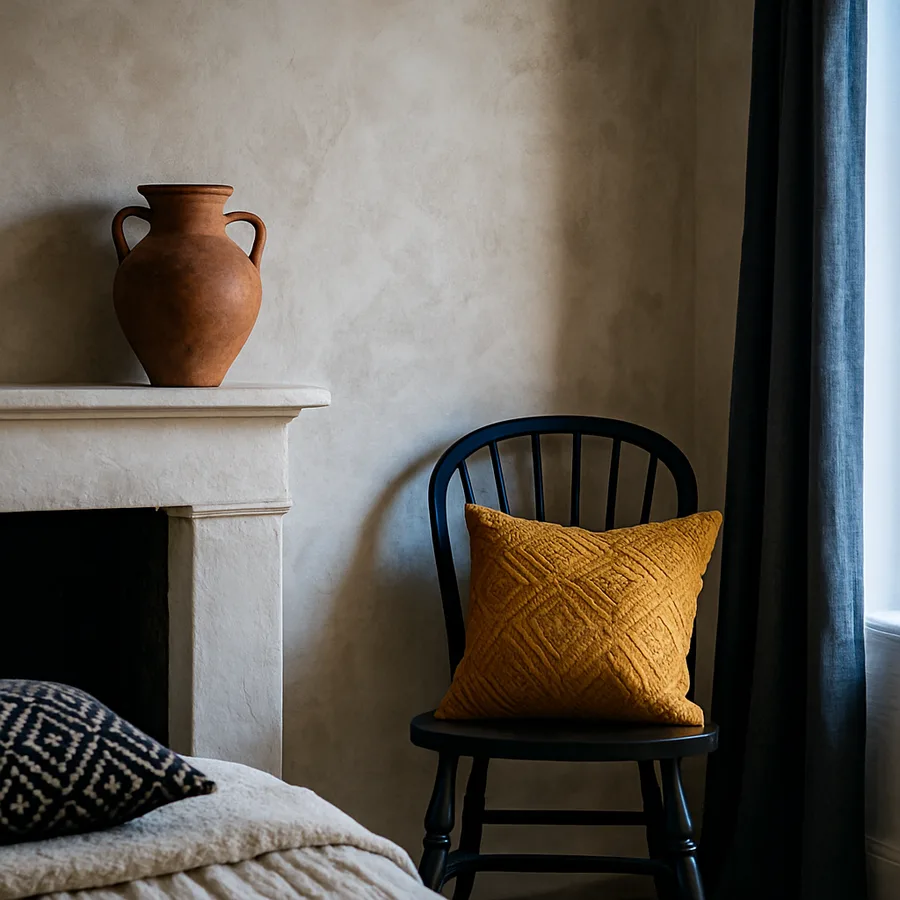
What Limewash Actually Is and Why It Looks Like Nothing Else
There is a quality to limewashed walls that photographs capture imperfectly and that no flat latex paint can replicate, no matter how carefully the color is matched. Limewash is not a coating that sits on top of a surface the way conventional paint does. It is a mineral finish made from slaked lime, which is limestone that has been heated in a kiln and then hydrated with water, producing calcium hydroxide. When this material is applied to a porous substrate and exposed to air, it undergoes a slow chemical reaction called carbonation, gradually converting back into calcium carbonate, which is essentially limestone reformed on your wall. The result is a finish that is literally part of the wall surface rather than a film adhered to it, and that fundamental difference accounts for the depth, movement, and luminous quality that makes limewash unmistakable.
The visual effect of limewash comes from the way light interacts with its crystalline surface structure. Because the finish is microscopically irregular and translucent rather than opaque, incoming light penetrates the surface layer, bounces among the calcite crystals, and exits at slightly different angles and intensities across the wall plane. This produces the characteristic mottled, cloud-like variation in tone and depth that gives limewashed rooms their atmospheric quality. The walls seem to glow from within rather than merely reflecting light off their surface, creating a softness and warmth that flat paint's uniform light reflection cannot achieve. It is this optical behavior, not simply the color, that connects limewash to the historic interiors of Tuscan villas, Provencal farmhouses, and Andalusian courtyard homes where the technique originated centuries ago.
The American Society of Interior Designers (ASID) has tracked a sustained increase in demand for textured wall finishes in residential projects, with limewash and related mineral finishes leading the category. According to ASID survey data, designer-specified textured wall treatments increased by 34 percent over a recent survey period, driven by homeowners seeking surfaces that feel handmade and organic in contrast to the flat, flawless walls that have dominated residential construction for decades. This movement reflects a broader cultural appetite for imperfection and authenticity in interior spaces, a rejection of the machine-perfect smoothness that makes rooms feel sterile rather than lived-in.
Have you ever walked into a room and felt that the walls themselves had presence, as if they were contributing something to the atmosphere beyond simply enclosing the space? That feeling is precisely what limewash achieves. Each wall becomes a surface with its own character, subtly different from every other limewashed wall because of the natural variation inherent in hand application. No two brushstrokes deposit the material identically, no two areas of the wall carbonate at exactly the same rate, and no two rooms develop exactly the same patina over time. This built-in uniqueness is what draws homeowners who have grown weary of the anonymous perfection of builder-grade paint and want their walls to tell a different kind of story.
Surface Preparation: The Foundation That Determines Everything
Limewash bonds through absorption, not adhesion, which means the substrate must be porous enough to draw the liquid lime into its surface layer. This requirement dictates which surfaces accept limewash successfully and which will reject it. Raw plaster, whether traditional lime plaster, gypsum plaster, or cement stucco, provides the ideal substrate because its open pore structure absorbs the limewash deeply and creates a strong mechanical bond as the calcium hydroxide carbonates within the surface pores. New plaster should cure for a minimum of 28 days before limewash application to allow excess moisture to evaporate and the plaster to develop its full porosity. Applying limewash to green plaster traps moisture beneath the finish and prevents proper carbonation, resulting in a weak surface that chalks, flakes, and fails prematurely.
Existing painted walls present the most common challenge for residential limewash projects because conventional latex and acrylic paints create a sealed, non-porous surface that limewash cannot penetrate. The solution is thorough preparation that restores porosity to the wall surface. Deglossing with a liquid deglosser or medium-grit sandpaper removes the paint's surface sheen, and a dedicated limewash primer formulated to create a receptive base coat provides the porous layer that the limewash needs. Several limewash manufacturers offer proprietary primers designed specifically for this purpose, and using the primer system matched to your limewash product is strongly recommended because the chemistry between primer and finish has been tested and validated by the manufacturer. Skipping the primer on painted surfaces is the single most common cause of limewash failure in residential applications.
Brick and natural stone accept limewash beautifully because their porous mineral surfaces are chemically compatible with the lime-based finish. Limewash on exposed brick produces a softened, whitened appearance that preserves the texture and dimensionality of the brick surface while adding the chalky, time-worn quality associated with European country homes. The application technique for brick differs from flat wall application: the limewash is brushed into the mortar joints and across the brick faces with a blocky masonry brush, working the material into the surface irregularities rather than stroking smoothly across a flat plane. Multiple thin coats build depth gradually, and the beauty of limewash on brick is that partial coverage and intentional inconsistency look entirely appropriate because they mimic the natural aging process that produces this effect on historic structures.
Regardless of the substrate, the wall surface must be clean, free of loose material, and uniformly dampened before the first coat of limewash is applied. Dust, grease, and efflorescence prevent proper absorption and create weak spots in the finished surface. Dampening the wall with a spray bottle or sponge immediately before application serves a critical function: it slows the rate at which the porous substrate absorbs water from the limewash, giving the lime particles time to penetrate the surface rather than being deposited entirely on top as the water is pulled away too quickly. Think of it as the difference between pouring water on dry sand, where it beads and runs off the surface, versus damp sand, where it soaks in evenly. The same principle governs limewash absorption, and controlling it through pre-dampening is a simple step that dramatically improves the quality of the finished result.
Application Technique: Building Depth Through Layers
The application of limewash is closer to watercolor painting than to house painting, and adjusting your expectations and technique accordingly is essential to achieving the textured, luminous finish that makes the effort worthwhile. Thin coats are the governing principle. Each coat should be mixed to the consistency of whole milk, thin enough to be translucent on the wall when wet, and applied with a large natural-bristle brush using random, crosshatch strokes that vary in direction and pressure. The temptation to apply thick, even coats the way you would with latex paint must be resisted, because thick limewash application produces a flat, chalky surface that lacks the depth and tonal variation that define the technique's beauty.
The characteristic old-world texture emerges from the interaction between multiple thin coats, each partially covering and partially revealing the layers beneath. The first coat on a properly prepared surface will appear streaky, uneven, and alarmingly imperfect. This is correct. The second coat, applied after the first has dried completely, which takes four to eight hours depending on temperature and humidity, fills in some of the variation while adding its own layer of inconsistency. By the third coat, the wall develops the cloudy, dimensional quality that distinguishes limewash from every other wall treatment. Some applications benefit from a fourth coat in areas where the coverage feels too thin or the substrate shows through more than desired, but restraint is important: too many coats flatten the variation and push the finish toward the uniform opacity that you chose limewash specifically to avoid.
Brush technique matters more than brush quality, although a good brush helps. The Better Homes and Gardens limewash guide recommends a large, flat masonry brush or a specialty limewash brush with thick natural bristles that hold a generous load of material. Apply with broad, sweeping strokes that change direction frequently, overlapping each stroke into the previous one while the edges are still wet. Work in sections of approximately four by four feet, maintaining a wet edge to prevent visible lap marks where dry and wet sections meet. The crosshatch stroke pattern, where consecutive strokes run at roughly 45 to 90 degrees to each other, creates the interlocking texture variation that reads as organic and handcrafted rather than mechanical.
Environmental conditions during application influence the final result significantly. Temperature between 50 and 85 degrees Fahrenheit and relative humidity between 40 and 70 percent provide the ideal curing window. Low humidity causes the limewash to dry too quickly, preventing adequate penetration and producing a powdery surface that rubs off when touched. High humidity slows carbonation and can cause the wet limewash to sag or drip on vertical surfaces. Direct sunlight on the wall being treated accelerates surface drying before the lime has time to absorb properly, so interior applications on sun-facing walls should be scheduled for times when the wall is in shade. If you are working in a room with strong directional sunlight, can you schedule the application for morning or late afternoon when that particular wall is not in direct sun?
Color Selection and the Unique Way Limewash Develops Tone
Choosing a limewash color requires a mental adjustment from the way you select conventional paint colors, because limewash does not produce the consistent, predictable coverage that a paint chip promises. The wet-to-dry color shift in limewash is dramatic: the material appears several shades darker when freshly applied and lightens substantially as it dries and carbonates. A limewash that looks like deep terracotta on the wall during application may dry to a soft, dusty rose that bears little resemblance to the wet color. This shift is normal and expected, but it catches first-time users off guard if they are not prepared for it. Always test your chosen color on a sample area of the actual wall, allow it to dry completely for 24 hours, and evaluate the dry color in both natural and artificial light before committing to the full room.
The traditional limewash palette draws from earth pigments that are chemically compatible with the alkaline lime base. Iron oxides produce the warm spectrum from pale cream through golden ochre, terracotta, and deep sienna. Umber pigments create the cooler brown-to-gray range that works beautifully in contemporary and transitional interiors. Titanium dioxide, the most common white pigment, intensifies the chalky whiteness that defines classic Mediterranean limewash. These mineral pigments are lightfast, meaning they do not fade under UV exposure the way some organic pigments do, which is important for limewash applications in sun-filled rooms where the walls receive sustained direct light. The National Trust for Historic Preservation specifies mineral-pigmented limewash for restoration projects because of its documented multi-century colorfastness in historic buildings.
Modern limewash manufacturers have expanded the available color range well beyond the traditional earth tone palette, offering blues, greens, soft blacks, and muted jewel tones that bring the limewash technique into contemporary design contexts. These expanded colors are achieved through carefully formulated pigment blends that maintain compatibility with the alkaline lime base while producing hues that traditional earth pigments cannot reach. A limewashed wall in sage green or dusty blue carries the same tonal depth and textural variation as a traditional ochre or white application, bringing the old-world technique into rooms where warm earth tones would clash with the existing design direction.
The layering of different color tones opens creative possibilities that single-color application does not offer. Applying a warm base coat followed by a cooler top coat, or vice versa, creates subtle color complexity where the underlying tone peeks through the surface layer in areas of thinner coverage. This technique is advanced and requires practice, but the results can be extraordinary, producing walls with a chromatic richness that seems to shift as the viewer moves through the room or as the light changes throughout the day. Designers working with ASID design principles often use this multi-tone layering approach to create feature walls that serve as the room's primary visual anchor, replacing the need for large-scale art on a wall that is itself a work of art.
Durability, Maintenance, and Living With Limewash Walls
Limewash durability depends on the quality of surface preparation, the number of coats applied, and the environmental conditions the wall faces during its service life. On properly prepared porous substrates with three or more coats, interior limewash finishes routinely last eight to fifteen years before requiring reapplication, and some historic examples have endured for centuries. The carbonation process that converts calcium hydroxide back to calcium carbonate produces a finish that is literally stone, a thin layer of limestone reformed on the wall surface. This mineral nature gives cured limewash inherent resistance to mold and mildew because the high pH of lime creates an alkaline surface environment that inhibits biological growth, a property that conventional paint does not share.
The maintenance requirements of limewash walls are minimal but distinct from painted surfaces. Light dusting with a soft cloth or vacuum brush attachment removes surface dust without disturbing the finish. Scuff marks and minor surface damage can often be addressed by dampening the area with a sponge and gently rubbing, which re-activates the lime and allows it to self-heal to a degree that no synthetic paint can match. For more significant damage, such as chips, deep scratches, or areas where the limewash has been worn away by repeated contact, spot touch-up with matching limewash blends seamlessly into the existing finish because the new material bonds chemically to the old through the same carbonation process. This ability to repair invisibly is one of limewash's most practical advantages over conventional paint, where touch-ups invariably show as slightly different in color or sheen.
There are honest limitations to acknowledge. Limewash is not washable in the way that satin or semi-gloss latex paint is. Scrubbing a limewash surface with wet cleaning products will damage and remove the finish, so it is not appropriate for surfaces that require regular wet cleaning, such as the area directly behind a kitchen cooktop or inside a children's bathroom. For these specific applications, a clear mineral sealer can be applied over the cured limewash to provide limited wash resistance, but this sealer reduces the matte, chalky texture that defines the limewash aesthetic. The better approach is to use limewash on walls that receive visual attention but minimal physical contact, and to specify conventional paint in the specific zones where wet cleaning is a practical necessity.
How does limewash age over the years, and is that aging a feature or a flaw? For homeowners who appreciate the evolution of natural materials, limewash walls develop a patina that enriches the surface over time. Areas of higher traffic may show slight wear that lightens the color, corners may accumulate subtle darkening from contact, and the overall surface develops a softened quality that reads as authenticity rather than neglect. This aging process is what gives genuine old-world interiors their irreplaceable atmosphere, and it happens naturally with limewash because the mineral finish responds to its environment the way any natural material does. If your aesthetic sensibility values the perfect-from-day-one appearance of fresh paint, limewash may challenge your expectations. If you find beauty in the way materials evolve with use, limewash will reward your patience with walls that grow more characterful with every passing season.
Practical Costs and Whether Limewash Suits Your Project
The material cost of limewash itself is competitive with premium interior paints, ranging from $40 to $90 per gallon for quality pre-mixed products from established manufacturers. Coverage rates run approximately 200 to 400 square feet per gallon per coat, depending on substrate porosity and application thickness, and three coats are standard for full coverage. A typical bedroom with 400 square feet of wall area requires three to six gallons of limewash at a total material cost of roughly $120 to $540. Adding the cost of primer for non-porous substrates, brushes, and drop cloths brings the total material investment for a single room to approximately $200 to $700, which is comparable to painting the same room with a high-quality designer paint.
Professional application costs elevate the total investment significantly because limewash is a specialty technique that most general painters have limited experience with. Skilled limewash applicators typically charge between $4 and $10 per square foot of wall surface, compared to $1.50 to $3 per square foot for standard interior painting. This premium reflects the technique-dependent nature of the finish: the same material applied by an experienced limewash specialist and by a general painter will produce vastly different results, because brush technique, coat thickness, and timing judgment account for as much of the final quality as the material itself. The NKBA designer resource directory can help locate qualified specialty finish applicators in your area, as can referrals from local interior designers who regularly specify limewash in their projects.
DIY limewash application is entirely feasible for homeowners with patience and willingness to practice. Unlike Venetian plaster, which demands advanced troweling skill, or specialty faux finishes that require artistic talent, limewash technique is forgiving precisely because imperfection is the goal. The crosshatch brush strokes, the inconsistent coverage, and the variation between coats that a professional painter would consider errors are exactly what produces the textured, organic quality that defines a successful limewash surface. Start with a closet interior or a small powder room to develop your technique before tackling a large living room or master bedroom, and mix enough material to complete each wall in a single session to avoid color batch variation between mixing loads.
Limewash is most impactful in rooms where walls are the dominant visual surface and where the textural quality will be appreciated up close. Living rooms, dining rooms, bedrooms, and entryways provide ideal canvases because these spaces are experienced at close range and benefit from the atmospheric warmth that limewash creates. Hallways and stairwells work well too, provided the walls are not subject to heavy physical contact that would wear the finish prematurely. Consider whether the specific room you have in mind receives enough natural light to reveal the tonal variation that defines the limewash effect, because in rooms with minimal natural light, the subtle depth differences between thick and thin coverage may be lost, reducing the visual impact to something closer to ordinary matte paint.
Conclusion: Walls That Breathe, Age, and Tell a Story
Limewash is not a paint substitute for people who want the same result with a different product. It is a fundamentally different approach to wall finishing that values texture over uniformity, depth over consistency, and the slow evolution of a natural mineral surface over the static perfection of a synthetic film. The technique demands more preparation, more patience, and more willingness to accept the inherent variability of a hand-applied mineral finish than rolling on a coat of latex, and it rewards that investment with walls that possess a quality of light, warmth, and presence that no manufactured paint can duplicate.
The old-world interiors that inspire contemporary limewash applications achieved their atmospheric beauty through centuries of use, repair, and natural weathering. Modern limewash condenses that process into a deliberate technique that can be mastered in a weekend and applied to any porous surface or properly primed wall in a contemporary home. The result is a room that feels older, warmer, and more layered than its actual age, connecting the present-day interior to a building tradition that stretches back thousands of years to the first lime-painted structures of the ancient Mediterranean.
If the idea of walls with visible texture, subtle color variation, and a chalky mineral surface appeals to your sense of how a room should feel, begin with a small test area in a room you use daily. Mix the limewash thin, apply it in loose crosshatch strokes, and resist the urge to make it even. Let it dry overnight, then see how the morning light plays across the surface. That moment of seeing the dried finish for the first time, with its soft glow and cloud-like tonal shifts, will tell you immediately whether limewash belongs on the rest of your walls.
More Articles You May Like



Comments
Post a Comment