Chalkboard and Magnetic Paint Walls for Creative Kids Rooms
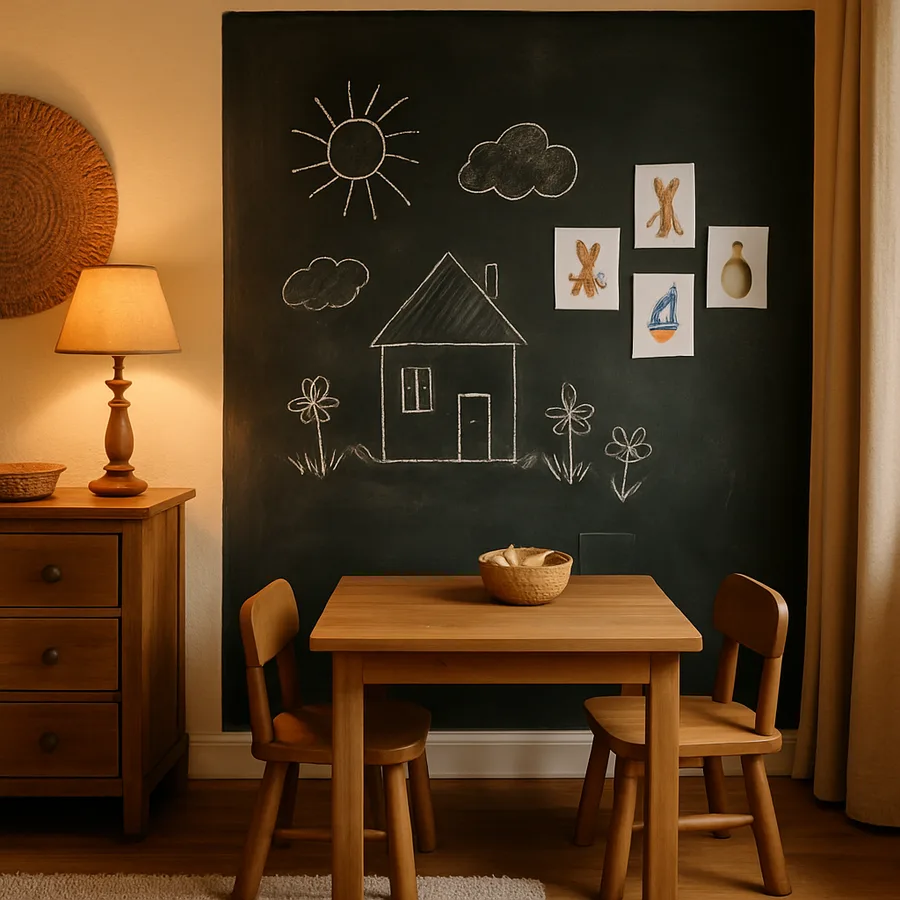
The Case for Walls That Invite Interaction
Most walls in a home exist to be looked at but not touched. Children, however, do not operate by those rules. They draw on walls with crayons, stick things to surfaces with tape that peels paint, and treat every flat plane as a potential canvas. Rather than fighting this instinct with constant correction, chalkboard and magnetic paint transform the wall itself into a sanctioned creative surface. The child gains a massive workspace for drawing, writing, and displaying artwork, while the parent gains a room that channels creative energy into a format that wipes clean in seconds. It is one of the rare design choices that makes a room both more beautiful and more functional while reducing daily conflict between parent and child.
The concept is not new, but the products available have improved dramatically over the past decade. Early chalkboard paints produced gritty, uneven surfaces that shed chalk dust in clouds and wore through within a year. Modern formulations from manufacturers like Rust-Oleum, Benjamin Moore, and Krylon cure to smooth, durable finishes that accept and release chalk cleanly and last five years or more under heavy use. Magnetic paints have undergone similar refinement, with higher iron content per coat that actually holds magnets firmly rather than allowing them to slide pathetically down the wall. These are no longer novelty products; they are legitimate finish options that professional painters and interior designers specify with confidence.
The American Society of Interior Designers (ASID) included interactive wall surfaces in its list of top ten children's room trends for the third consecutive year, reflecting sustained interest from both designers and homeowners. What drives the trend is not mere aesthetics but a growing recognition that children's environments should be participatory. A wall that a child can write on, rearrange, and personalize becomes part of their cognitive development rather than just a backdrop to it. Research from the University of Stirling's School of Education found that children in classrooms with interactive wall displays demonstrated 16 percent higher engagement in creative tasks than those in rooms with static decoration. The same principle applies at home.
Are you hesitant because you think chalkboard walls only work in modern or industrial interiors? That perception is outdated. Chalkboard paint is available in virtually every color, not just the classic blackboard green or slate gray. A deep navy chalkboard wall pairs beautifully with traditional furnishings, while a warm terracotta chalkboard surface complements bohemian and southwestern decor. Magnetic paint is applied as a base coat beneath any standard topcoat, meaning the wall can be any color at all while still holding magnets. The creative functionality becomes invisible until someone places a magnet on the surface, making it suitable for rooms where a subtle approach is preferred.
How to Apply Chalkboard Paint: A Step-by-Step Method
Surface preparation determines at least 80 percent of the final result with chalkboard paint. The wall must be clean, dry, smooth, and free of any loose paint, dust, or grease. Begin by washing the surface with a solution of trisodium phosphate and water, then rinse with clean water and allow it to dry completely for at least 24 hours. Fill any nail holes, dents, or cracks with lightweight spackle, sand the patches smooth with 150-grit sandpaper, and wipe away the dust with a tack cloth. If the existing wall has a glossy or semi-gloss finish, sand the entire surface lightly to create tooth for the chalkboard paint to grip. Skipping this preparation step is the single most common reason chalkboard paint projects fail, producing surfaces that look acceptable initially but develop bare spots and peeling within months.
Apply a high-quality primer suited to the wall material before the chalkboard paint goes on. For drywall, a standard latex primer works well. For previously painted surfaces with stains or strong existing colors, a shellac-based primer like Zinsser B-I-N prevents bleed-through that can discolor the chalkboard finish. Allow the primer to cure according to the manufacturer's instructions, typically two to four hours for latex and one hour for shellac. This step is not optional even though many chalkboard paint labels suggest direct application over existing paint. Professional painters will confirm that primer creates a more uniform and durable chalkboard surface every time.
The chalkboard paint itself should be stirred thoroughly before and during application. Do not shake the can, as this introduces air bubbles that create pinholes in the dried surface. Apply the first coat using a high-density foam roller for the smoothest finish, working in one direction to avoid lap marks. A foam roller produces a noticeably smoother surface than a nap roller, which matters because chalk glides more evenly across a flat surface and erases more cleanly. Allow the first coat to dry for the time specified on the label, typically three to four hours, before applying the second coat in the perpendicular direction. Most products require two coats for full opacity and durability, though darker colors may achieve satisfactory coverage in two while lighter shades occasionally benefit from a third.
The critical step that most DIY guides underemphasize is the curing period. Chalkboard paint must cure for a minimum of three days, and ideally five to seven days, before the first chalk touches the surface. During this period the paint undergoes a chemical hardening process that cannot be rushed with fans or heat. After curing, condition the surface by rubbing the side of a piece of white chalk across the entire wall, covering every square inch, and then erasing it with a felt eraser. This conditioning step fills the microscopic pores in the paint and prevents ghosting, the phenomenon where erased chalk leaves a permanent shadow on the surface. Skipping the conditioning will haunt you for the life of the wall, so treat it as non-negotiable.
Magnetic Paint: What It Is and What It Is Not
Magnetic paint is not magic, and understanding what it actually does prevents disappointment. It is a latex-based primer loaded with fine iron particles that create a surface magnets can grip. It does not turn the wall into an electromagnet that attracts objects from across the room. Standard refrigerator magnets, which are relatively weak, may struggle on a surface with only two coats of magnetic paint. Stronger neodymium magnets, which are inexpensive and available in bulk online, work reliably on properly applied magnetic paint. Setting realistic expectations before starting the project is essential, because a wall that holds lightweight paper with strong magnets is a tremendous asset, while a wall that drops everything stuck to it is a source of frustration.
The number of coats directly determines the magnetic strength of the finished wall. Most manufacturers recommend a minimum of three coats, but professional results typically require four to five coats. Each coat adds another layer of iron particles, and the cumulative effect is what creates enough magnetic pull to be functional. The National Kitchen and Bath Association (NKBA) has documented magnetic paint applications in residential kitchens for recipe display and organizational purposes, noting that four-coat applications consistently outperform three-coat applications in holding capacity by approximately 40 percent. Patience during the application process pays off in daily usability for years afterward.
Application technique differs from standard paint in important ways. Magnetic paint is significantly thicker and heavier than regular latex, with a consistency closer to pancake batter than milk. Stir it frequently during application to keep the iron particles suspended rather than settling to the bottom of the can. Use a short-nap roller, ideally three-eighths of an inch, and apply each coat in thin, even passes. Thick coats create drips and uneven magnetic zones where some spots hold magnets firmly and others barely register. Between coats, allow two hours of drying time and sand lightly with 220-grit sandpaper to smooth any texture before the next coat. The surface will feel slightly rough compared to standard paint even after sanding, which is normal and caused by the iron particles embedded in the film.
The most versatile approach combines magnetic paint as a base with chalkboard paint or standard colored paint as a topcoat. This dual-function wall accepts both chalk drawings and magnetic attachments, creating a surface that is simultaneously a canvas and a display board. Apply all magnetic paint coats first, sand smooth, then apply the chalkboard or decorative topcoat following normal procedures. The magnetic pull penetrates through up to two coats of topcoat without significant loss of strength. Going beyond two topcoats begins to attenuate the magnetic field enough to affect performance, so plan the color layer thickness accordingly. This combination approach is what designers most frequently recommend for children's rooms because it maximizes the interactive potential of a single wall surface.
Design Ideas Beyond the Full Accent Wall
While a floor-to-ceiling chalkboard accent wall makes a dramatic statement, it is not the only way to incorporate these surfaces into a child's room. A chalkboard panel framed with decorative molding creates a contained drawing zone that looks intentional and finished rather than like an unfinished project. Standard picture frame molding from any home center, mitered at the corners and painted to match the surrounding wall, transforms a four-by-six-foot rectangle of chalkboard paint into something that resembles a built-in feature. This framed approach works particularly well in traditional or transitional interiors where a full industrial-looking chalkboard wall would feel out of place.
Geometric shapes offer another refined alternative. A large circle, hexagon, or cloud shape painted in chalkboard paint on an otherwise standard wall creates a focal point that doubles as a creative surface. Use painter's tape and a steady hand, or cut a template from cardboard for curved shapes, to mask the shape before painting. The contrast between the matte chalkboard surface and the surrounding wall finish adds visual depth even when no chalk is present. Architectural Digest has featured several children's rooms where geometric chalkboard shapes serve as the room's primary decorative element, proving that functional surfaces and sophisticated design are not mutually exclusive.
Furniture-mounted chalkboard surfaces expand the concept beyond walls entirely. The flat panel of a wardrobe door, the side of a bookcase, or the surface of a toy chest lid can all receive chalkboard paint with proper preparation. A dresser with chalkboard-painted drawer fronts allows a child to label each drawer with chalk illustrations of the contents, turning organization into an art project. The inside of a closet door painted with chalkboard paint becomes a hidden message board visible only when the door is open, a delightful surprise that children love discovering and personalizing. These furniture applications are especially valuable in rental homes where painting walls may violate lease terms.
Have you considered using magnetic paint to create a gallery wall that changes with your child's output? A magnetic strip running horizontally at the child's eye level, approximately 12 inches tall and spanning the full width of the wall, provides a rotating display space for artwork, photographs, awards, and school papers. Strong magnets clip each item to the wall without tape, tacks, or frames, and the display can be updated in seconds as new work comes home. The National Art Education Association advocates for displaying children's artwork prominently in the home, citing research that visible recognition of creative output increases a child's willingness to take artistic risks and experiment with new media. A magnetic gallery wall makes that display effortless and endlessly renewable.
Maintenance, Durability, and Common Problems
A properly applied and conditioned chalkboard wall requires remarkably little ongoing maintenance. Regular chalk erases cleanly with a felt eraser, leaving behind only a faint ghosting that becomes part of the surface's patina over time. For a deeper clean that removes all ghosting and restores the surface to near-original condition, wipe the wall with a damp microfiber cloth and allow it to dry completely before using chalk again. Avoid using abrasive cleaners, magic erasers, or solvent-based products, as these can damage the chalkboard finish and create glossy patches that resist chalk adhesion. The Paint Quality Institute, an industry body representing major paint manufacturers, recommends cleaning chalkboard surfaces no more than once per month to preserve the cured finish.
Liquid chalk markers present a maintenance consideration that deserves specific attention. These markers produce brighter, more vivid lines than traditional chalk and are popular with older children and teenagers who want more precise artwork. However, liquid chalk is harder to remove than dry chalk and can leave permanent stains if left on the surface for extended periods. Some chalkboard paint formulations handle liquid chalk better than others, with Benjamin Moore's Studio Finishes chalkboard paint receiving consistently high marks in independent testing for liquid chalk erasability. Test any liquid chalk marker in an inconspicuous corner before handing it to a child for full-wall artwork.
Magnetic paint durability depends entirely on what sits on top of it. If the magnetic layer is covered with chalkboard paint, the maintenance is the same as any chalkboard wall. If covered with standard latex paint, it requires no special care beyond normal wall maintenance. The magnets themselves can leave small marks if dragged across the surface rather than lifted and repositioned, so teach children to pull magnets straight off the wall rather than sliding them. Over time, strong neodymium magnets can create faint circular impressions in the paint where they sit for extended periods. Rotating magnet positions periodically and using felt-backed magnets prevents this minor cosmetic issue.
The most common problem reported by homeowners is insufficient magnetic strength, which in nearly every case traces back to too few coats of magnetic paint or failure to stir the product adequately during application. If you have already painted and the magnets are not holding, the only remedy is to sand the surface lightly, apply additional coats of magnetic paint, and then reapply the topcoat. There is no shortcut or after-the-fact fix that avoids this recoating process. This is why professional painters counsel applying one more coat than the manufacturer recommends as insurance against under-performance. The marginal cost of an additional coat is trivial compared to the labor of stripping and starting over.
Cost Breakdown and Product Comparisons
Chalkboard paint pricing varies significantly by brand and formulation. At the budget end, Rust-Oleum Specialty Chalkboard Paint retails for approximately twelve to fifteen dollars per quart, which covers roughly 40 square feet in two coats, enough for a standard accent wall in most children's rooms. At the premium end, Benjamin Moore's Studio Finishes chalkboard paint runs approximately forty dollars per quart but offers superior smoothness, erasability, and color options. Between these bookends, Krylon chalkboard spray paint serves small projects and furniture applications at around eight dollars per can. For a typical eight-by-ten-foot accent wall requiring two coats, material costs range from thirty to eighty dollars depending on the product chosen.
Magnetic paint carries a higher price tag per square foot because multiple coats are required. MagicWall magnetic primer and Rust-Oleum Magnetic Primer are the two most widely available products, both retailing between twenty and thirty dollars per quart. A single quart covers approximately 50 square feet in one coat, but since four to five coats are recommended for functional magnetic strength, the actual coverage per quart drops to 10 to 12 square feet. A four-by-six-foot magnetic zone therefore requires approximately two to three quarts of magnetic primer, costing sixty to ninety dollars in materials alone. Add the chalkboard or decorative topcoat and the total materials bill for a dual-function magnetic chalkboard wall runs between ninety and one hundred seventy dollars.
Professional installation adds labor costs that vary by region. The Houzz cost estimator places the average professional installation of a chalkboard accent wall at three hundred to five hundred dollars including materials, preparation, and two coats of chalkboard paint. A dual-function magnetic plus chalkboard wall runs four hundred fifty to seven hundred fifty dollars professionally installed due to the additional coats and drying time required. These figures assume a standard eight-by-ten-foot wall in good condition with no major repair work needed. Walls requiring skim coating, extensive patching, or wallpaper removal will push the labor cost higher.
The return on investment extends beyond the dollar figures. A chalkboard wall eliminates the ongoing cost of paper, coloring books, and replacement crayons that a child goes through during the years of heaviest creative output. It also eliminates the cost of repainting walls damaged by unauthorized crayon, marker, or sticker applications, which any parent of a toddler can attest is not a hypothetical expense but an eventual certainty. When weighed against these avoided costs, the upfront investment in a chalkboard or magnetic wall typically pays for itself within the first two years of use. For a design element that stimulates creativity, reduces mess, and lasts five or more years, the value proposition is compelling for any family with young children.
Bringing It All Together for Your Child's Room
The decision to add a chalkboard wall, a magnetic wall, or a combination surface to your child's room is ultimately about creating a space that invites participation rather than demanding preservation. Children thrive in environments where they have permission to make their mark, literally and figuratively. A room with one interactive wall and three standard walls strikes the balance between creative freedom and visual calm, giving the child a sanctioned outlet for expression while maintaining enough quiet surface area for the eye to rest.
Before starting the project, decide on the scope. A full accent wall requires a weekend of work including preparation, priming, painting, and curing. A framed panel or a furniture application can be completed in an afternoon. A dual magnetic and chalkboard wall needs a full week to accommodate the multiple coats and drying times. Plan the project during a period when the room can be vacated, as the paint fumes during application and the need for undisturbed curing mean the child should sleep elsewhere for several nights.
Choose the wall location thoughtfully. The best position for a chalkboard or magnetic wall is typically the wall opposite the windows, where natural light illuminates the surface throughout the day and chalk drawings are visible without supplemental lighting. Avoid placing it behind the bed headboard, where chalk dust can drift onto pillows, or adjacent to closet doors that may bump magnetically attached items when opened. The wall beside or facing the child's desk is ideal because it doubles as a study aid where vocabulary lists, math formulas, and project brainstorming can happen at full wall scale.
If this guide has given you the confidence to commit to an interactive wall in your child's room, gather your materials this weekend and begin with the preparation steps. A well-executed chalkboard or magnetic wall will serve your family through years of drawings, homework sessions, birthday party messages, and growth chart markings. It is one of the few home improvements that becomes more valuable the more it is used. Take a photograph of the finished wall and share it with the community so other parents can see what is possible when a room is designed to be lived in rather than simply looked at.
More Articles You May Like



Comments
Post a Comment