Leather and Brass Drawer Pulls for a Warm Handcrafted Feel
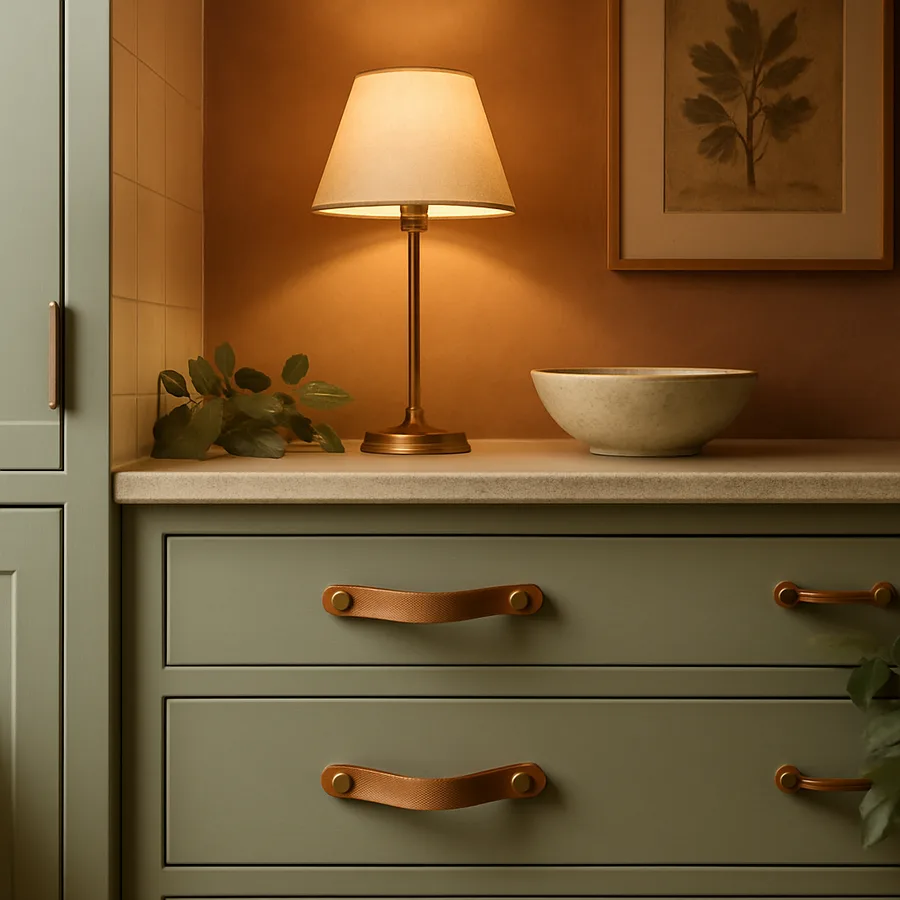
In an era when mass-produced hardware dominates the market and identical matte black bar pulls appear in millions of kitchens and bathrooms around the world, a growing number of homeowners and designers are reaching for materials that carry the unmistakable warmth and individuality of handcrafted objects. Leather and brass drawer pulls occupy a distinctive niche in this movement, combining two of the oldest worked materials in human history into a hardware form that feels fundamentally different beneath the hand than any stamped metal alternative. The leather wraps or loops provide a soft, warm grip that no metal or ceramic can replicate, while the brass mounting hardware ages with a living patina that records the passage of time on its surface. Together, they introduce a tactile and visual dimension to cabinetry that transforms functional storage pieces into furniture with genuine character. The resurgence of interest in these pulls tracks closely with the broader craft revival documented by organizations like the American Craft Council, which has reported sustained growth in consumer demand for handmade home goods across every price tier.
The Sensory Appeal of Natural Materials
The most immediate and compelling quality of leather and brass drawer pulls is how they feel in the hand, a characteristic that sets them apart from every other category of cabinet hardware. Leather is a warm material - it begins at room temperature and quickly absorbs body heat from the fingers, creating a sensation of contact that is fundamentally more comfortable than the cool, hard surface of metal or stone hardware. This thermal quality matters because cabinet hardware is touched dozens of times daily, often reflexively and without visual attention, making the tactile experience as important as the visual one in determining how the hardware contributes to the room's atmosphere.
The texture of leather adds another layer of sensory richness that manufactured materials cannot duplicate. Vegetable-tanned leather, the type most commonly used in high-quality drawer pulls, retains the natural grain pattern of the hide, creating subtle surface variations that the fingertips register even when the eye does not consciously see them. Over months of use, the leather develops a patina unique to its environment and the oils transferred from the user's hands, darkening gradually and acquiring a soft, burnished quality that leather enthusiasts call "break-in." This evolution means that leather and brass pulls at six months look noticeably different from the same pulls at six weeks, and at two years they look different still - a living quality that no static finish can offer.
Brass, the metal half of this partnership, contributes its own dynamic aging process. Unlacquered solid brass, which is the standard in artisan hardware production, begins as a bright golden surface and gradually develops a patina influenced by humidity, air composition, and the frequency and chemistry of hand contact. Pulls in a kitchen near a stove may darken faster than pulls in a bedroom, and pulls on frequently used drawers will develop hand-worn bright spots at the grip points while the surrounding brass continues to deepen. The Copper Development Association documents that brass patina is not degradation but a stable surface oxide that actually protects the underlying metal, meaning the aging process enhances rather than diminishes the pull's structural integrity.
How much does the feeling of a material in your hand influence your emotional response to the object it belongs to? Research in haptic perception published in the Journal of Consumer Psychology has demonstrated that touch significantly affects quality perception, with natural materials consistently rated as higher quality than synthetic alternatives even when the visual appearance is equivalent. Leather and brass pulls leverage this psychological dynamic every time a drawer is opened, subtly reinforcing the perception that the cabinet - and by extension, the room - is a place where quality and craft were prioritized over convenience and cost.
Design Configurations and Style Pairings
Leather and brass drawer pulls are manufactured in several configurations, each creating a distinct visual profile and ergonomic experience. The leather loop pull is the most recognizable form: a strip of leather looped through two brass mounting posts and secured with screws from behind the drawer face, creating a semicircular handle that lifts away from the surface when grasped. This configuration is strongly associated with Scandinavian design, where it appears across furniture lines from Danish and Swedish manufacturers who have used the leather loop as a signature detail for decades. The loop pull works best on drawers rather than doors because its soft form does not provide the lateral rigidity needed for the swinging motion of a hinged door.
The leather-wrapped bar pull adapts the familiar bar pull form by wrapping a section of the bar - usually the center grip area - in a stitched leather sleeve. The brass bar extends beyond the leather wrap at both ends, creating a visual composition where the warm leather center is bracketed by metallic endpoints. This configuration offers the rigidity needed for both drawers and doors, and it introduces the leather element without requiring the user to adopt the more distinctive loop form. For homeowners who appreciate leather's sensory qualities but want hardware that reads as familiar rather than avant-garde, the wrapped bar pull delivers the best of both priorities.
Flat leather tab pulls present the most minimal profile, consisting of a short leather strap secured beneath a brass cap or plate, extending just far enough from the drawer face to provide a finger grip. This low-profile configuration works well on small drawers, jewelry-box-style built-ins, and any application where a more prominent pull would overwhelm the furniture's proportions. Tab pulls are also the most forgiving option for DIY installation because they typically mount with a single screw through a brass cap, requiring only one hole in the drawer face.
Style pairings for leather and brass pulls extend across a broader range than many homeowners expect. The natural association with Scandinavian and mid-century modern interiors is well established, but leather pulls also complement rustic farmhouse kitchens, industrial loft spaces, and even transitional bathrooms where the warmth of the leather softens the harder edges of tile and stone. The key variable in these pairings is the leather color: natural tan leather reads as Scandinavian or bohemian, dark brown leather reads as masculine or British traditional, and black leather reads as contemporary or industrial. By selecting the leather tone that aligns with the room's existing palette, the same brass-and-leather hardware form adapts to surprisingly diverse design contexts.
Sourcing Artisan-Quality Pulls
The quality spectrum for leather and brass drawer pulls is wide, and understanding where a particular product sits on that spectrum prevents both overpaying for basic construction and underpaying for hardware that will deteriorate prematurely. At the foundation of quality is the leather itself. Vegetable-tanned full-grain leather, tanned using natural plant-based agents rather than synthetic chemicals, is the standard for hardware intended to develop an attractive patina over time. Chrome-tanned leather, which dominates the fashion and upholstery industries because of its lower cost and faster production, does not age as gracefully and may crack or peel when subjected to the repeated flexion that a drawer pull experiences. Genuine artisan hardware makers will specify their leather source and tanning method; products that describe the leather simply as "genuine leather" without further detail are typically using lower-grade materials.
The brass component demands similar scrutiny. Solid brass pulls are machined or cast from through-and-through brass stock, meaning the material is uniform from surface to core. Brass-plated pulls, in contrast, apply a thin layer of brass over a steel or zinc base through electroplating, and the plating will eventually wear through at contact points, revealing the dissimilar metal underneath. For hardware that is handled daily and intended to develop a natural patina, solid brass is the only appropriate choice because the patina process depends on the continuous brass surface reacting uniformly with its environment. Plated brass develops uneven patina and exposes base metal, creating a wear pattern that reads as deterioration rather than character.
Artisan hardware studios producing leather and brass pulls at the highest quality level include Walnut Studiolo in Portland, Oregon; Studiokyss in Copenhagen; and Buster + Punch in London. These makers hand-cut, dye, and stitch their leather components and machine their brass fittings in-house, producing pulls with a level of fit and finish that mass manufacturers do not match. Pricing for artisan pulls typically ranges from $15 to $40 per piece, compared to $5 to $12 for mid-range factory-produced alternatives from brands like Frolahouse and Ravinte available through Amazon and home improvement retailers. The mid-range options provide an acceptable entry point for homeowners testing the leather-and-brass aesthetic, though the leather quality and aging characteristics will differ from artisan-grade products.
When evaluating potential purchases, request close-up photographs showing the leather edge finishing and the brass joint where the leather meets the metal. Clean, burnished leather edges and tight, secure leather-to-brass connections indicate careful craftsmanship. Raw, fuzzy leather edges and gaps between the leather and brass components indicate production shortcuts that will become more visible as the hardware ages. This single inspection criterion reliably separates hardware that will improve with age from hardware that will simply deteriorate.
Installation Considerations Specific to Leather Hardware
Installing leather and brass drawer pulls follows the same basic process as conventional hardware installation - marking hole positions, drilling, and securing with screws - but several characteristics specific to leather require adjusted handling to achieve a professional result. The most important distinction is that leather loop pulls require precise screw tension. Over-tightening the mounting screws compresses the leather against the brass posts, which restricts the loop's natural drape and can leave permanent crush marks in the leather. Under-tightening allows the pull to wobble and gradually loosen further. The correct tension leaves the leather snug against the brass but not deformed, and a quarter-turn back from the point where the leather begins to compress is a reliable tactile guideline.
Drawer face material influences the installation approach. Solid wood drawer fronts accept screws directly and hold them securely over time. MDF and particleboard drawer fronts, common in factory-built cabinetry, may require longer screws or the addition of a thin backing plate on the interior side of the drawer face to distribute the clamping force across a larger area and prevent the screw from pulling through the panel over time. If the existing hardware holes need to be reused for the new pulls, confirm that the center-to-center measurement matches before opening any packaging, because leather pulls with non-standard spacing are more difficult to exchange than conventional metal hardware.
Leather's sensitivity to moisture makes placement selection relevant in bathrooms and kitchens. Pulls installed on vanity drawers directly adjacent to a sink or on kitchen drawers near a dishwasher discharge vent will be exposed to humidity and occasional water splashes that accelerate the leather's aging and may cause spotting. This exposure is not necessarily problematic - many leather pull owners welcome the accelerated character development - but homeowners who prefer their leather to age uniformly should consider positioning leather pulls on drawers away from direct water exposure and using conventional brass pulls on the hardware closest to water sources.
Maintenance for leather drawer pulls is minimal but differs from the zero-maintenance profile of metal-only hardware. A light application of leather conditioner - products like Leather Honey or Chamberlain's Leather Milk - every six months keeps the leather supple and prevents the surface from drying and cracking. Apply the conditioner with a soft cloth, allow it to absorb for ten minutes, and buff away any excess. This brief maintenance ritual is the only ongoing requirement, and it actually enhances the leather's appearance by deepening the color and enriching the surface sheen that develops with use.
Rooms Where Leather and Brass Pull Their Weight
While kitchens and bathrooms are the most common locations for hardware upgrades, leather and brass pulls deliver particularly strong impact in rooms where conventional hardware feels generic or insufficient. Home offices and studies benefit enormously from the library-like warmth that leather hardware introduces, connecting the desk drawers and credenza storage to the books, leather desk accessories, and warm task lighting that characterize well-designed work spaces. A built-in bookcase with leather loop pulls on its lower cabinet doors transforms from utilitarian storage into a piece of bespoke furniture, and the sensory pleasure of grasping a leather pull to retrieve a reference book adds a small but meaningful moment of quality to the work routine.
Bedroom furniture is another natural application. Dressers and nightstands equipped with leather pulls acquire the warmth and intimacy appropriate to a room designed for rest and comfort. The leather's quiet, non-reflective surface absorbs rather than reflects bedside lamp light, avoiding the glint that metal pulls create in a dimly lit bedroom. For nurseries and children's rooms, the soft edges and warm surfaces of leather pulls provide a safer, more inviting alternative to metal hardware with sharp profiles, and the developing patina records the years of small hands opening and closing drawers in a way that feels sentimental rather than worn.
Mudroom and entryway built-ins present a practical application where leather's durability is tested and proven. The hooks, bins, and cubbies of a well-designed mudroom see heavy daily use with wet hands, dirty gloves, and the general rough handling that entryway storage endures. Full-grain vegetable-tanned leather is a remarkably durable material - it is, after all, the same material used for saddles, work boots, and tool belts - and it withstands the mechanical stresses of daily entryway use without the scratching, chipping, or peeling that painted metal finishes frequently develop in these high-traffic locations. The patina that develops on mudroom pulls records the family's daily rhythm in the material's surface, becoming part of the home's lived history.
Are there pieces of furniture in your home that feel anonymous or unremarkable despite occupying prominent positions? A hardware swap to leather and brass can shift those pieces from background to foreground, transforming production furniture into something that feels collected and personal. The investment is modest - even a six-drawer dresser requires only six pulls at $15 to $30 each - and the return in visual and tactile warmth is disproportionate to the cost. Start with a single piece, live with it for a month, and let the leather develop its initial patina before deciding whether to extend the treatment to additional furniture. The material's evolving character makes the wait part of the pleasure.
Building a Home That Ages With Grace
The decision to incorporate leather and brass hardware into a home reflects a broader design philosophy that values materials aging gracefully over materials resisting change. In a consumer culture oriented toward newness, where trends cycle rapidly and "dated" is among the harshest criticisms that can be leveled at an interior, leather and brass pulls make a quiet argument for a different relationship with time. These materials do not fight aging; they incorporate it, becoming more beautiful as they record the evidence of daily use on their surfaces. A five-year-old leather pull looks better than a new one, and a ten-year-old brass post has more depth and character than a freshly machined one.
This philosophy aligns with the Japanese design concept of wabi-sabi, which finds beauty in imperfection, impermanence, and the marks of use. A leather drawer pull that has darkened at the grip point and lightened at the ends, a brass post that has developed a warm brown patina where hands touch it and retained its golden tone where they do not - these variations tell a story about how the object has been used and who has used it. They individualize mass-produced furniture, making it personal in a way that no factory finish can replicate. The Smithsonian American Art Museum has featured exhibitions exploring how craft materials develop meaning through use, and leather hardware in a home operates on exactly this principle.
The practical durability of both materials supports their long-term presence in the home. Brass is an alloy of copper and zinc that does not rust, corrode under normal indoor conditions, or lose structural integrity with age. Vegetable-tanned leather, properly maintained with occasional conditioning, retains its tensile strength for decades and only becomes softer and more supple with use. Together, these materials form hardware that will outlast the cabinetry it is mounted on, the finish on the walls behind it, and very likely the next three or four decorating cycles that the room undergoes. This longevity makes the initial investment in quality leather and brass pulls extraordinarily cost-effective when amortized over their true useful life.
If you are drawn to the idea of a home that develops richness and character over time rather than degrading toward eventual replacement, leather and brass drawer pulls are a tangible starting point. They introduce the vocabulary of natural aging into a room's design language and demonstrate that beauty and durability are not opposing qualities but complementary ones. Order a single pull, install it on a drawer you use daily, and let the material begin its transformation. Within weeks, you will understand why this combination has persisted across centuries of furniture making - and why it feels more relevant, not less, in an age of disposable design.
More Articles You May Like



Comments
Post a Comment