Labeling Systems for Linen Closets That the Whole Family Follows
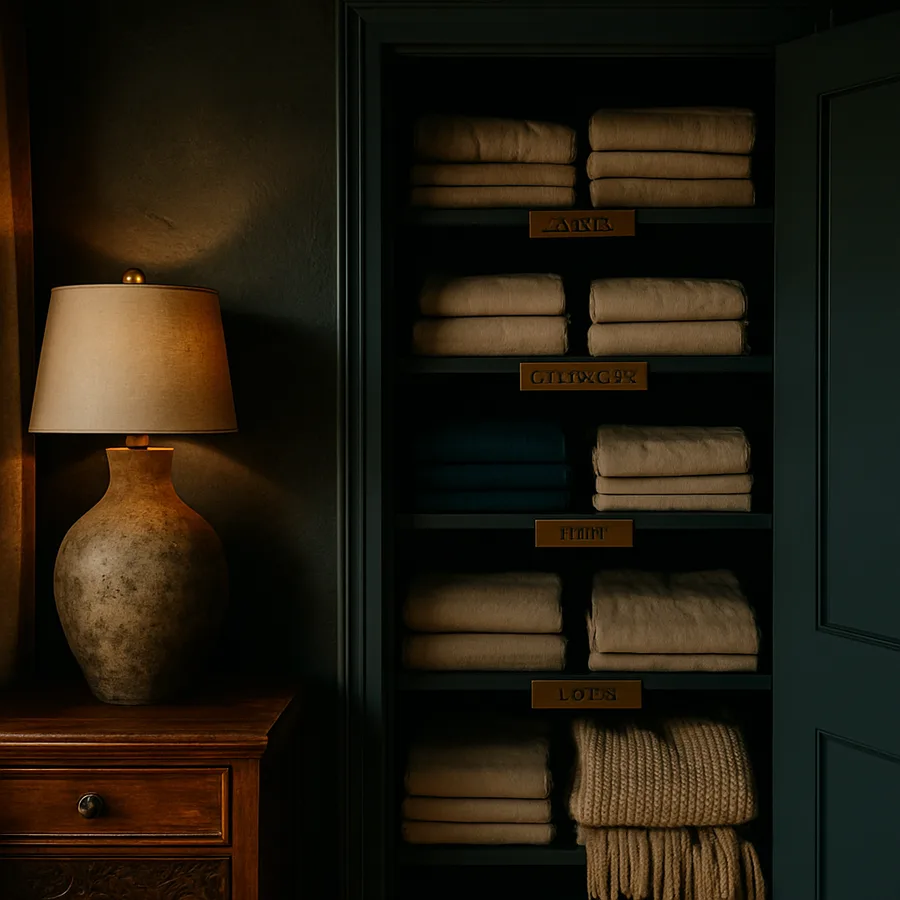
A beautifully organized linen closet that collapses within three weeks is one of the most common outcomes in home organization projects. The culprit is almost never the initial setup. It is the labeling, or the lack of it. When a system lives only in the head of the person who built it, anyone else in the household who puts a towel away is guessing, and over time their guesses drift the system into disorder. A strong labeling system eliminates guessing by making every zone readable at a glance, which means every family member, every guest, and even the cleaning person can return an item correctly on the first try. According to a 2024 survey by the National Association of Productivity and Organizing Professionals, households with visible labeling systems maintained their organization roughly 3.2 times longer than households without labels.
This guide walks through the labeling decisions that actually determine whether a family follows the system: category naming, material durability, placement and sightlines, accessibility for pre-readers and older family members, and the refresh cycle that keeps labels from becoming stale. It is written for the person who has already set up their closet once, watched it fall apart, and wants to understand why. If you have a spouse or roommate who cannot seem to remember where the washcloths go, that is a labeling problem, not a character flaw, and it is fixable this weekend.
Start With Category Names Your Family Already Uses
The worst labels are the ones imposed from outside the household. If your family has always called them big towels, a label reading Bath Sheets will cause friction every single time someone reaches for one. The first step in any labeling project is listening to how your family already talks about linens and using those exact words. This sounds obvious but it trips up most DIY organizers, who default to retail catalog language like Premium Bath Linens when the family reality is simply towels and extra towels.
Spend one week before labeling and listen for the vocabulary. Do your kids say boogie towels for washcloths? Do you say good sheets for guest bedding? Write down the exact words used and match them on the labels. The goal is a label that requires zero mental translation, because every translation step is a friction point where someone will give up and shove the item in the wrong spot. Real Simple has covered this principle in its home organization columns, noting that household vocabulary matters more than retail accuracy.
Once you have a vocabulary list, group items into three to seven categories. Fewer than three means the categories are too broad to be useful, and more than seven means the family will not remember the distinctions. Common working sets include: Bath Towels, Hand Towels, Washcloths, Sheet Sets, Blankets, Guest Linens, and Cleaning Supplies. Adjust for your household's actual needs, not for what a Pinterest photo looks like.
Durable Label Materials That Handle Humidity and Time
Linen closets are often near bathrooms or laundry rooms, which means labels have to survive steam, splashes, and the occasional wet hand. Paper labels slid into metal frames are the professional standard because the metal protects the paper from direct moisture and the paper can be printed at home or handwritten. The The Container Store sells these frames in packs of four to twelve for between 8 and 25 dollars, and they last indefinitely with periodic paper refreshes.
Laminated paper labels work nearly as well for less money. A standard home laminator, available at any office supply store for around 40 to 80 dollars, can turn printed paper labels into waterproof plastic tags that last 5 to 10 years. Pair the laminated label with a small binder clip or zip tie to attach it to a wire basket, and you have a system that costs pennies per label. The American Society of Interior Designers has featured laminated-label approaches in multiple residential storage guides, noting that the DIY cost advantage is significant over chalkboard or engraved alternatives.
Avoid adhesive vinyl stickers for any location that experiences humidity or temperature swings. Vinyl peels at the corners within 12 to 18 months even in climate-controlled interiors, and the ghost adhesive it leaves behind is frustrating to remove. Chalkboard labels look charming in photos but smudge and fade with ordinary handling, which creates a closet that looks worse after a year than it did on launch day. If your family has a member with sensory sensitivities, the dusty texture of chalk can also be a genuine comfort issue worth considering.
Placement and Sightlines That Catch the Eye
A label that exists but is never seen is no better than no label at all. The most common placement error is labels mounted on top surfaces or behind the basket rim, where they are invisible from the closet entry. Correct placement centers the label on the front face of the basket or bin, at a height between 30 and 60 inches from the floor, where the label hits eye level as someone stands in the doorway.
For shelves without baskets, attach the label directly to the shelf edge rather than to the items on the shelf. A 1-inch by 3-inch label strip on the leading edge of each shelf, visible from the doorway, tells users exactly what belongs there even when the shelf is momentarily empty during laundry day. This shelf-edge approach is promoted by the KonMari Method and by Martha Stewart Living in feature stories on pantry and linen organization.
Have you ever noticed that your family always puts the towels back in the wrong basket even though the labels are right there? The usual culprit is a sightline problem. Stand in your closet doorway, turn off any overhead lights, and see what is visible from the natural approach angle. If labels are shaded, angled away, or obscured by doorjamb geometry, people will not read them. Adjust placement or add a small battery-powered LED puck light to ensure every label is legible from the approach position.
Typography and Visual Clarity That Reads Fast
Label typography matters more than most people realize. A label has roughly half a second to communicate before the user gives up and opens the basket to check. That half second is won or lost on three variables: font choice, font size, and contrast.
Choose a sans-serif font like Helvetica, Arial, or Calibri for maximum legibility at small sizes. Serif fonts photograph beautifully in organizing magazines but add micro-friction to quick reading in low light. Set the font size at least 24 points, which produces letters roughly 1/4 inch tall on a standard label, and print in black on a white or cream background for maximum contrast. The American Printing House for the Blind has published legibility standards recommending minimum 3:1 contrast ratios for everyday signage, and household labels benefit from the same guidance.
For families that include pre-readers, non-English speakers, or older adults with declining vision, pair every word label with a small icon or photograph of the contents. A simple towel silhouette icon next to the word Towels reinforces the meaning without cluttering the label. Real Simple's accessible-home features have championed this dual-channel approach for over a decade, and the added visual cue roughly doubles the recognition speed. Do your kids help with laundry? Adding photos to the labels makes them full participants in the system rather than spectators.
Refreshing the System Before It Drifts
Every labeling system ages. Kids outgrow sheet sizes, guest towels migrate to primary use, seasonal rotations change the contents of baskets. A label that was accurate 18 months ago may now be subtly wrong, and subtle wrongness compounds into real disorder. Schedule a labeling audit twice a year, ideally aligned with seasonal wardrobe rotations in spring and fall.
The audit is simple. Open each basket, compare contents to the label, and update either the contents or the label to match reality. If more than half of the baskets need relabeling, the system itself may have drifted beyond minor corrections, and a full rebuild may be more efficient. Most professional organizers recommend a full rebuild every 3 to 5 years, particularly when household size changes due to new children, empty nest transitions, or elderly relatives moving in. According to a 2023 Good Housekeeping Institute survey, 62% of families with teenagers report that linen needs shift significantly within 18 months, which is faster than most parents anticipate.
Keep a small supply of blank labels and the tools to update them stored in the linen closet itself, not in a distant office drawer. When the activation energy to relabel is low, updates actually happen. A small clip-on container with five blank label inserts, a fine-tip permanent marker, and a pair of scissors costs under 10 dollars and transforms maintenance from a project into a two-minute task.
Consider a digital backup of your label system as well. A single photograph of the closet, or a simple list of categories saved in a shared family note, makes it easier to reproduce the system if you move, if labels are damaged, or if someone new moves in. This kind of lightweight documentation takes minutes to create and saves hours in future rebuilds.
Teaching the Family: Walkthroughs, Cheat Sheets, and Grace
The final, and most overlooked, piece of a family labeling system is the handoff. The person who built the system knows every label, every exception, and every rule. Other family members do not, and expecting them to absorb it through osmosis is the reason so many systems fail in the first month.
Schedule a 15-minute walkthrough with every household member old enough to fold and put away linens. Walk through each zone, explain the category, and demonstrate the correct placement. Keep it low-pressure. The goal is not perfect recall but building a mental map of where things live. For households with young children or frequent houseguests, post a small laminated cheat sheet inside the closet door that summarizes the zones with labels and a simple diagram. This reduces questions and makes the system self-teaching.
Be generous with grace during the first few weeks. Items will land in the wrong basket, and that is not failure, it is feedback. Each misplacement reveals either a labeling ambiguity or a sightline problem that can be corrected. Families that treat the first month as a pilot period rather than a performance tend to end up with much more durable systems. The NAPO family organization workshops emphasize this principle, noting that sustainable systems require an onboarding period of 2 to 4 weeks before habits stabilize.
Conclusion
A linen closet labeling system is not about making the closet look photogenic. It is about making the closet function reliably across every member of the household, over months and years, with minimal ongoing attention. The organizers who get this right focus on household vocabulary, durable materials, eye-level placement, fast-reading typography, and a refresh cycle that keeps the system current. The visual payoff is a nice bonus. The real win is the time and mental energy freed up when the closet runs itself.
If your system has collapsed once before, resist the urge to blame the family and instead audit the labels themselves. Were the categories named in household language or retail language? Were the labels visible from the doorway? Were they legible at arm's length? In most cases, one or two labeling corrections will bring a system back to life without a full redo. Start small with a single tier or shelf, prove the concept, and expand from there.
The labeling project is one of the highest-leverage weekend investments available in home organization, typically costing under 50 dollars in supplies and paying back in hours of saved time every month. Gather your family this Saturday morning, walk through the closet together, and build a labeling system that will still be working two years from now. The closet is a shared resource, and the system that governs it should be a shared agreement, not a one-person decree.
More Articles You May Like



Comments
Post a Comment