Kitchen Island Seating Arrangements: Overhang Depth and Stool Height
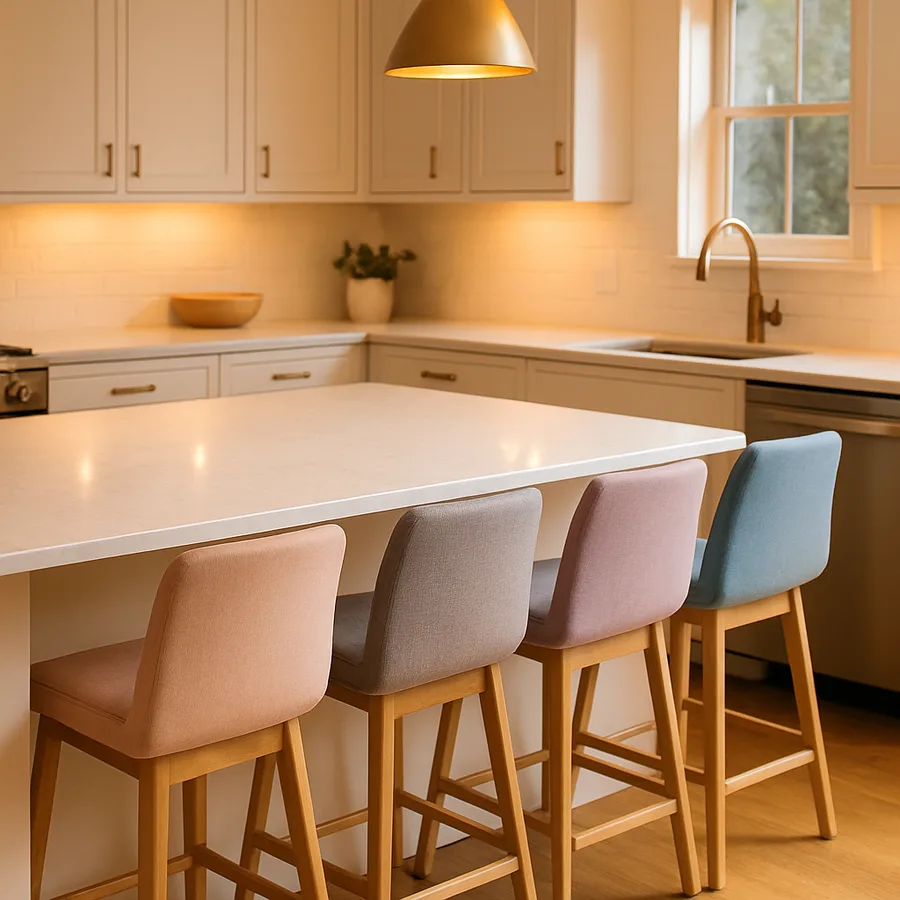
Kitchen island seating looks simple on a floor plan and feels complicated the moment you actually sit down. The two variables that determine whether seated guests are comfortable or miserable are overhang depth and stool height, and they are linked in ways most homeowners do not realize until their contractor is installing the counter. Get them right, and the island becomes the busiest seat in the house. Get them wrong, and the stools sit empty while everyone crowds the couch instead.
Research from the National Kitchen and Bath Association (NKBA) indicates that about 68% of new kitchen islands include dedicated seating, yet roughly one in four homeowners report dissatisfaction with their seating comfort within the first year. Most of that dissatisfaction traces back to three fixable errors: insufficient overhang, a stool height that does not match the counter height, and stools spaced so closely that elbows collide. This guide covers the ergonomic fundamentals, then layers in the practical decisions that separate comfortable seating from decorative seating.
The Three Standard Island Heights
Almost every kitchen island falls into one of three height categories, and each one implies a different stool, a different overhang, and a different comfort profile. Understanding the three categories is the foundation for every other seating decision.
The first category is standard counter height, which runs 36 inches from floor to countertop surface. This is the same height as your perimeter cabinets, which means a counter-height island reads as a continuous work surface and accepts the same appliances. Seating at this height requires a counter stool with a seat height of 24 to 26 inches. The second category is bar height, 42 inches from floor to countertop, which requires a bar stool with a 28- to 30-inch seat. The third is dining height, an unusual but growing choice at 30 inches from floor to countertop, which requires a standard dining chair with an 18-inch seat.
The American National Standards Institute (ANSI) publishes furniture dimensional standards that align closely with these ranges, and most reputable stool manufacturers adhere to them. When stool and counter heights are mismatched, the symptoms are immediate: either the seated person's knees hit the underside of the counter, or their arms have to reach up awkwardly to rest on the surface. A 12-inch gap between seat and counter is the comfort target; less than 9 inches cramps the thighs, and more than 13 inches feels like sitting at a child's table.
Overhang Depth: The Rule of 12, 15, and 18
Overhang is the horizontal distance the countertop projects beyond the face of the island cabinetry, and it exists specifically to create knee clearance for seated guests. The NKBA 31 design rules establish three overhang minimums that every homeowner should know before signing a cabinet order.
For a 36-inch counter-height island, the minimum seated overhang is 12 inches. For a 42-inch bar-height island, the minimum rises to 15 inches because taller stools place knees further from the island face. For a 30-inch dining-height island, designers generally specify an 18-inch overhang to accommodate the full thigh of a seated adult in a standard dining chair. These minimums are the point at which an average adult can cross their legs comfortably without contacting the cabinet face.
Exceeding the minimum is usually fine, up to a point. A 15-inch overhang on a counter-height island is more generous and accommodates taller guests well. Beyond about 18 inches, however, an unsupported stone countertop risks cracking under load, and you will need to add steel corbels or a concealed support bracket to the cabinet. The Natural Stone Institute publishes engineering recommendations that specify reinforcement for any overhang greater than one-third of the total counter depth.
Does your household include anyone who uses a wheelchair, or do you anticipate aging-in-place considerations? If yes, you may want to plan for a knee-space extension of 27 inches of clear height and 19 inches of depth at one section of the island, which exceeds standard overhangs. This meets ADA accessible work-surface guidelines and creates a station usable by a seated cook, not just a seated eater.
Stool Spacing and Elbow Room
Even with the right overhang and height, seating can feel cramped if stools are spaced too closely. The NKBA recommends a minimum of 24 inches of linear counter space per stool, measured center to center, with 30 inches preferred. That 24-inch minimum corresponds roughly to shoulder width plus modest elbow room; 30 inches gives each person space to set down a plate and a glass without overlapping their neighbor.
Apply the math to your island length honestly. A 7-foot island (84 inches) can comfortably seat three stools at 28-inch spacing; squeezing in four stools drops each person to 21 inches, which is tight enough that most adults will avoid those seats for anything longer than a snack. A 10-foot island (120 inches) can seat four comfortably or five tightly. When a client insists on seating five at a 9-foot island, designers usually suggest an L-shaped seating extension off one end to add capacity without compromising comfort.
Think about how you actually use the island. If seated guests are typically eating full meals there, err toward 30-inch spacing. If the island is primarily a homework spot or a morning-coffee perch, 24 inches works fine. A mix of uses can be handled with two primary seats at generous spacing plus a third pull-up stool that lives elsewhere most of the time and migrates in for company.
Stool Selection: Back Support, Swivel, and Return
Stool choice matters as much as stool height. The three key features are back support, swivel action, and memory return. A backless stool looks clean in photographs but fatigues quickly during a long meal; most adults report discomfort after about 20 minutes on a fully backless seat. A low-back stool, 6 to 10 inches of support above the seat, is the most common compromise and suits most kitchens. A full-back stool reads more like a chair and is worth the visual weight if the island is a primary eating spot.
Swivel stools are considerably more comfortable for island use because they allow a seated person to pivot between facing the counter and facing the room. Without swivel, getting in and out of a tight stool requires sliding sideways, which is awkward when neighboring stools are occupied. Memory-return swivel is a premium feature worth paying for if you intend to leave the stools visible from the living area; they always snap back to facing the island when you stand up, preserving the visual rhythm of the room.
Material choice affects both comfort and maintenance. Upholstered seats are warm and quiet but stain; leather and vinyl wipe clean but can feel cold; wooden seats are the most durable but the least forgiving over long meals. Crypton performance fabrics and similar commercial-grade upholstery, the kind used by many restaurant groups profiled on Houzz, give you the look of fabric with spill resistance closer to vinyl. Many ASID designers now default to these materials for kitchen applications.
Configurations: Linear, L-Shape, and Wraparound
The classic seating configuration is a linear run along one long side of the island. It is simple, predictable, and allows easy conversation between neighbors. Its limitation is that everyone faces the same direction, which can feel lecture-hall-like for four or more seats.
An L-shaped configuration wraps the seating around one corner of the island, typically with two or three seats on the long side and one or two on the short end. This arrangement improves conversation by letting corner-seated guests face each other slightly, and it fits asymmetric kitchens more gracefully than a straight run. The trade-off is that the corner seat has slightly compromised knee clearance and should not be used for the tallest guest.
A wraparound configuration with seating on three sides is rare but occasionally appears in very large islands. It works best when the island functions almost as a restaurant counter, with the cook on the fourth side and guests surrounding. This configuration demands a much longer island and careful attention to sightlines between seats. Industry data from Houzz shows wraparound seating in fewer than 4% of new islands, but among those installations, satisfaction scores are unusually high.
Lighting, Outlets, and Finishing Details
Seating requires lighting designed around the seated eye level rather than the standing eye level. Pendant lights over an island should hang 30 to 36 inches above the counter, which places the bottom of the fixture just above the seated sightline. Hanging pendants any lower forces seated guests to peer around the shade to see each other; hanging them higher sacrifices the intimate pool of light that defines a welcoming eating spot.
Electrical outlets matter too. A seated guest who wants to charge a phone or use a laptop needs access to power, and the cleanest solution is a pop-up outlet recessed into the countertop or a side-mounted outlet on the seating face of the island. Most modern electrical codes require that island outlets not be installed facing directly down at the floor, so plan the location during rough-in rather than retrofitting later. The NAHB publishes consumer guides to current residential electrical requirements.
Finally, consider the floor. Stools scrape. An unprotected hardwood floor beneath a row of stools will show wear patterns within a year, particularly in swivel installations. Felt pads on every stool foot are the minimum; a small area rug or a durable floor runner is better; engineered materials like luxury vinyl plank (LVP), which the Resilient Floor Covering Institute notes now account for roughly 22% of new residential flooring installations, hide wear even better. Small finishing choices like these determine how the seating area ages over the long term.
Conclusion
Island seating comfort is an ergonomics problem before it is a design problem. The overhang depth, stool height, and stool spacing are numerical decisions that either match your body dimensions and your use patterns or they do not, and no amount of attractive styling fixes a seat that is too shallow or too tight. Get the numbers right first, and then the visual choices fall into place naturally.
Bringing it all together, the winning formula is straightforward: match your counter height to the stool height category with a 12-inch gap, allow the correct overhang for that height, space stools at least 24 inches apart (30 for regular meals), and choose stools with swivel and appropriate back support for how long people actually sit. Add lighting at 30 to 36 inches above the counter, plan for power at the seating face, and protect the floor beneath the stools. Each element reinforces the others; skipping any one of them tends to produce seating that gets used less than expected.
If you are not sure whether your planned overhang and stool combination will be comfortable, test it before you commit. Prop a piece of plywood at the planned counter height with the planned overhang and pull up a stool of the intended height. Sit for ten minutes while pretending to eat. The test is cheap, and the feedback is honest in a way that renderings never are.
Book a seating-focused kitchen consultation with Interior Bliss to review your proposed overhangs, stool selections, and spacing against the full NKBA ergonomic guidelines. A short planning conversation now can save you from ordering eight stools that turn out to be the wrong height, or from living with an overhang that cramps your guests for the next twenty years.
Accessibility is a topic that deserves a closer mention. Beyond the ADA knee-space extension noted earlier, small choices such as contrasting counter edges, rounded rather than sharp corners on the overhang, and non-slip stool feet meaningfully improve comfort and safety for older adults and anyone with mobility limitations. Designers accredited by the NAHB Certified Aging-in-Place Specialist (CAPS) program can fold these considerations into a seating plan without compromising its appearance, and many households find the result more comfortable for every age group rather than only seniors.
Maintenance habits around the seating zone also affect long-term comfort. Countertop edges at the overhang tend to chip where stools bump them, and stool legs wear against floor finishes more than any other furniture in the home. A quarterly inspection of felt pads, stool joints, and the overhang underside catches small issues before they escalate. This is one of the few design areas where a simple routine meaningfully extends the useful life of the installation.
For additional reference, the NKBA publishes its 31 kitchen design rules with detailed overhang specifications, the ASID offers residential ergonomics guidance, and Houzz maintains filterable galleries of island seating configurations at every height.
More Articles You May Like



Comments
Post a Comment