How Cybertruck's Interior Redefines Modern Vehicle Aesthetics and Functionality
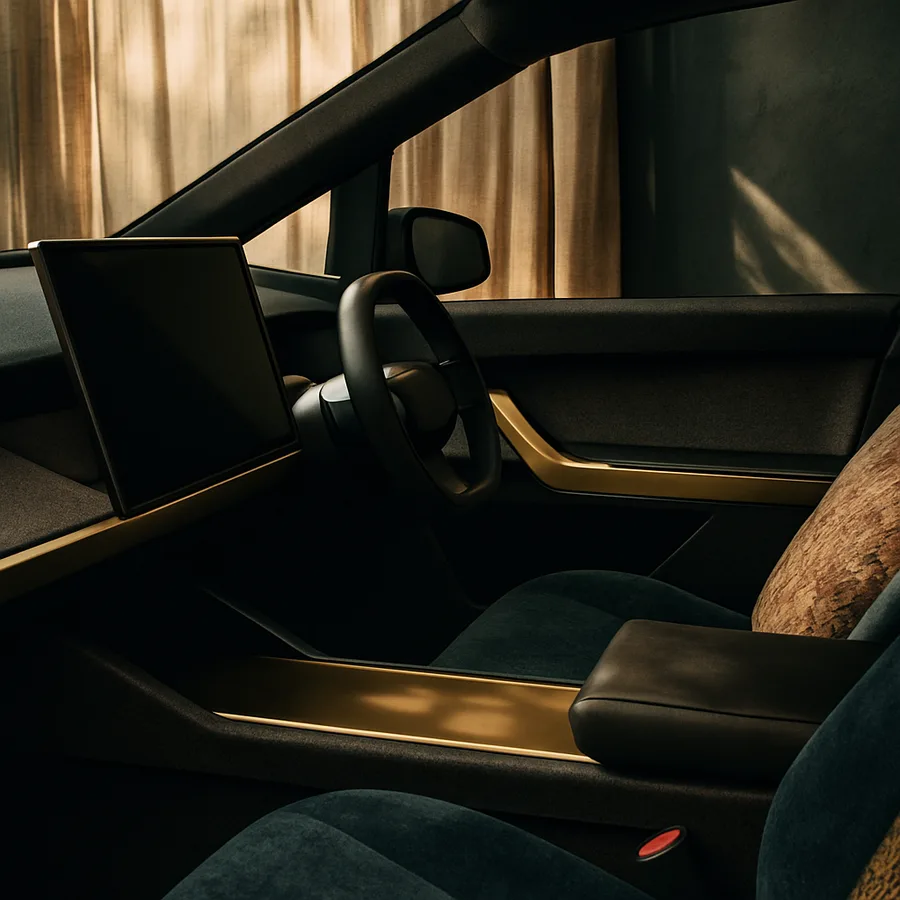
Rethinking the Dashboard as an Architectural Surface
The traditional vehicle dashboard has long served as a functional wall between driver and engine bay, layered with instruments, vents, and storage compartments that accumulate visual weight over decades of incremental design changes. The Tesla Cybertruck abandons this approach entirely, transforming the dashboard into a single architectural surface that stretches uninterrupted across the full width of the cabin. This horizontal plane creates a visual foundation for the entire interior, much like a well-designed countertop defines the character of a kitchen. The American Society of Interior Designers (ASID) frequently highlights horizontal continuity as a foundational principle in spatial design, and the Cybertruck applies it at a scale rarely attempted in automotive contexts.
This flat dashboard serves multiple functions simultaneously without revealing any of them through visible hardware. Climate vents are concealed within a narrow slot that runs along the base of the windshield, delivering air across the full width of the cabin without the circular or rectangular vent housings found in conventional vehicles. Audio speakers are hidden behind perforated sections of the door panels and dashboard surface, producing sound without revealing their locations. The effect is an interior where technology operates invisibly, a goal that high-end residential designers have pursued for years through concealed wiring, flush-mounted fixtures, and integrated automation systems.
The psychological impact of this clean dashboard cannot be overstated. When occupants enter the Cybertruck for the first time, the absence of visual clutter creates an immediate sense of calm and spaciousness that contrasts sharply with the information overload of typical truck interiors. Research from the International Interior Design Association (IIDA) suggests that simplified visual environments reduce cognitive load and improve occupant satisfaction over extended periods. For drivers who spend hours behind the wheel, this reduction in visual noise translates directly into reduced fatigue and improved focus on the road ahead.
Digital Controls and the Elimination of Physical Switches
The Cybertruck commits fully to a digital-first control philosophy that relocates virtually every vehicle function to its 18.5-inch central touchscreen. Side mirrors, headlights, windshield wipers, door locks, trunk releases, climate settings, and seat adjustments are all managed through the screen interface. This consolidation represents the most aggressive elimination of physical controls in any production vehicle, a design decision that sparks both admiration and debate among automotive reviewers and interior design professionals. The National Council for Interior Design Qualification (NCIDQ) has noted that the relationship between physical and digital interfaces is one of the most actively debated topics in contemporary design education.
The benefits of this approach are substantial from a design perspective. Without physical switches, the interior surfaces remain smooth and unperforated, preserving the geometric purity that defines the Cybertruck aesthetic. Manufacturing is simplified because switch assemblies, wiring harnesses, and mounting hardware are eliminated in favor of software-defined controls that can be updated and reconfigured remotely. According to Tesla engineering data, removing physical switchgear from the Cybertruck interior eliminated over 140 individual components compared to a conventional truck dashboard, reducing both weight and potential points of failure.
Critics argue that touchscreen-only controls introduce usability challenges, particularly for functions that drivers need to access quickly without looking away from the road. This tension between visual simplicity and tactile accessibility is familiar to interior designers who balance aesthetic goals against practical usability requirements in residential and commercial spaces. Have you ever reached for a light switch in a minimalist home and found only a smooth wall? The Cybertruck provokes the same momentary disorientation, followed by adaptation as muscle memory develops for the touchscreen interface. Tesla has mitigated this transition with voice commands and steering wheel scroll buttons that provide physical input for the most frequently used functions.
The long-term implications of this digital-first approach extend beyond the Cybertruck itself. As other manufacturers observe consumer adaptation to touchscreen-only interfaces, the industry is likely to follow Tesla's lead, gradually eliminating physical controls in favor of software-defined alternatives. This shift mirrors the broader transition happening in residential design, where smart home systems are replacing wall switches, thermostats, and dedicated remote controls with unified digital interfaces managed through phones and tablets.
How Industrial Materials Create a New Definition of Luxury
The Cybertruck interior rejects the traditional signifiers of automotive luxury, choosing industrial-grade materials over leather upholstery, polished wood, and chrome accents. This material vocabulary includes synthetic textiles engineered for extreme durability, exposed brushed metal surfaces, and hard composite panels with matte finishes. The seats resist puncture, the floor surfaces tolerate mud and water, and the trim panels endure impacts that would permanently damage conventional soft-touch plastics. Houzz trend reports consistently identify industrial chic as a leading aesthetic category in residential design, and the Cybertruck brings that same sensibility into the vehicle cabin.
This redefinition of luxury through durability rather than delicacy challenges assumptions that have governed automotive interior design for decades. Traditional luxury asks occupants to treat their vehicle gently, to avoid scuffing leather seats or scratching wood trim. The Cybertruck inverts this relationship by daring occupants to use the interior hard and watching it emerge unscathed. This functional confidence is itself a form of luxury, one that working professionals, outdoor enthusiasts, and families with children may find more genuinely valuable than fragile premium finishes. A survey by J.D. Power found that 72 percent of truck buyers rank durability as their top interior priority, well above the 31 percent who prioritize traditional luxury materials.
The color palette reinforces this industrial character through a restrained selection of gray, black, and metallic tones that resist dating and complement the stainless steel exterior. Unlike interiors that rely on contrasting colors and accent stitching to create visual interest, the Cybertruck generates texture and depth through material variation alone. Brushed metal reflects light differently than matte textile, which behaves differently than glossy touchscreen glass, and these material contrasts provide subtle visual richness without introducing additional colors. Architectural Digest has profiled numerous residential projects that achieve similar restraint, using monochromatic palettes animated by material variety rather than color contrast.
Acoustic Engineering Within Hard-Surface Environments
Designing a quiet cabin with predominantly hard interior surfaces presents a significant acoustic engineering challenge that the Cybertruck addresses through techniques borrowed from architectural acoustics. Hard surfaces reflect sound waves rather than absorbing them, creating potential issues with reverberation, road noise amplification, and speech intelligibility. Concert halls, recording studios, and modern office buildings face identical challenges when architects specify exposed concrete, glass, and metal finishes. The solutions developed for those environments translate directly into the Cybertruck cabin design.
Tesla conceals acoustic dampening materials behind the visible hard surfaces, creating a layered construction that presents an industrial face while managing sound behind the scenes. The door panels, headliner, and floor sections each contain hidden absorptive layers that target specific frequency ranges associated with road noise and wind buffeting. Double-pane acoustic glass in the windshield and side windows provides additional sound isolation at the cabin boundary. The IIDA has published guidelines for acoustic management in commercial interiors that recommend exactly this strategy: visible hard surfaces backed by hidden absorptive layers.
The result is a cabin that feels quieter than its visual character suggests. Occupants expect hard surfaces to produce a noisy, reverberant environment, and the Cybertruck defies that expectation with a sound level that competes favorably with premium sedans. This perceptual gap between visual expectation and auditory reality creates a sense of engineering sophistication that reinforces the vehicle's overall design narrative. How often do you find yourself surprised when a space sounds different than it looks? The Cybertruck deliberately cultivates that surprise as part of its occupant experience.
The electric drivetrain contributes significantly to cabin quiet by eliminating engine noise, exhaust rumble, and transmission whine that ICE vehicles must manage through additional insulation. This absence of mechanical noise allows the acoustic design to focus exclusively on road and wind noise, simplifying the engineering challenge and producing a more consistently quiet environment across all driving conditions. The combination of electric silence and strategic acoustic treatment creates a cabin ambiance that supports conversation, music listening, and concentration at levels that traditional trucks cannot match.
Adaptive Space Configuration for Work and Recreation
The Cybertruck interior treats its cabin as an adaptive environment that reconfigures to serve different purposes throughout the day. The front center console accommodates a fold-out work surface, the rear seats fold flat to create an extended cargo platform, and the overall cabin layout supports transitions between passenger transport, mobile workspace, and cargo hauling without requiring aftermarket modifications. This flexibility reflects design principles that ASID professionals apply to residential and commercial spaces where rooms must serve multiple functions within limited square footage.
The fold-flat rear seat mechanism deserves particular attention for its engineering elegance. Unlike most truck rear seats that fold upward against the front seatbacks or tumble forward awkwardly, the Cybertruck rear seats fold perfectly flat to create a continuous surface level with the bed floor when the tailgate is opened. This seamless transition from cabin to bed creates a single uninterrupted cargo surface that can accommodate objects longer than either space could handle independently. The design parallels the fold-flat guest bed solutions that residential designers specify for studio apartments and multi-use rooms.
The front cabin area includes storage solutions integrated into the flat dashboard and beneath the rear seat that remain accessible regardless of the cabin configuration. These storage areas are designed with specific use cases in mind: a slot for a laptop along the dashboard, pockets for tools and documents in the door panels, and a secure compartment beneath the rear seat for valuables. Each storage solution is concealed when not in use, maintaining the visual minimalism of the interior while providing practical utility that working professionals require. This hidden-storage approach mirrors the design of high-end residential kitchens where every appliance and utensil has a dedicated concealed home.
The Broader Impact on Vehicle Interior Design Standards
The Cybertruck interior has established a new reference point against which all future truck interiors will be measured, regardless of whether competitors choose to emulate or reject its aesthetic direction. By demonstrating that a production vehicle can commit fully to geometric minimalism, digital controls, and industrial materials without sacrificing functionality, Tesla has expanded the boundaries of acceptable automotive interior design. The Architectural Digest design team identified the Cybertruck as one of the most architecturally significant product designs of recent years, noting its potential to influence built environments far beyond the automotive sector.
Competing manufacturers are already responding with interior designs that incorporate elements pioneered by the Cybertruck. Flat dashboards, reduced switch counts, expanded touchscreen interfaces, and industrial material palettes have appeared in concept vehicles and production models from multiple manufacturers. While none have matched the Cybertruck's radical commitment to geometric purity, the direction of the industry is clear. The NCIDQ body of knowledge now includes automotive interior design as a legitimate area of cross-disciplinary study, acknowledging that the boundaries between vehicle interiors and architectural interiors continue to blur.
For consumers and design enthusiasts, the Cybertruck interior offers a glimpse of a future where the spaces we occupy, whether residential, commercial, or vehicular, share a common design language defined by digital interfaces, honest materials, and geometric clarity. This convergence suggests that the skills and sensibilities developed in architectural interior design will become increasingly relevant to automotive and product design, and vice versa. The professionals who can work across these boundaries, applying spatial thinking to products and industrial rigor to rooms, will define the next generation of designed environments.
Curious about bringing this design philosophy into your own spaces? Begin by evaluating one room in your home through the lens of functional minimalism. Identify every physical control, decorative element, and surface treatment, then ask which ones genuinely serve your daily needs and which simply occupy visual bandwidth. The Cybertruck teaches that removing the unnecessary can be the most powerful design decision of all.
More Articles You May Like



Comments
Post a Comment