Glow-in-the-Dark Ceiling Stars and Other Nursery Ceiling Ideas
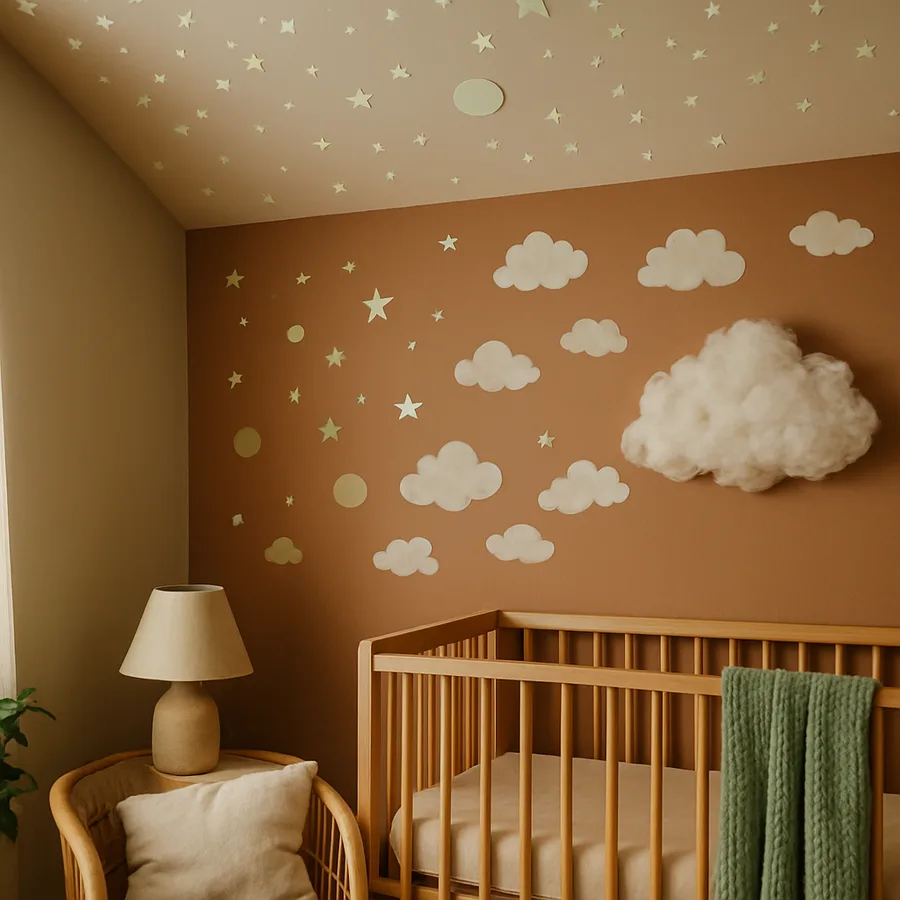
The Forgotten Fifth Wall in Nursery Design
Parents spend weeks agonizing over wall color, crib bedding, and rug texture for the nursery, yet the ceiling receives almost no attention. It stays builder-grade white with a basic flush-mount light fixture, and nobody questions it. This is a missed opportunity of remarkable proportions. The ceiling is the surface a baby stares at most. An infant lying in a crib, on a changing table, or on a play mat spends the majority of waking hours looking upward. A toddler falling asleep at night fixes their gaze on the overhead plane for the fifteen to forty minutes it takes to drift off. If any surface in the nursery deserves thoughtful design, it is the one that occupies the most visual real estate in a child's daily experience.
The American Academy of Pediatrics (AAP) has published guidelines emphasizing the importance of a calming sleep environment for infants, noting that visual stimulation in the immediate sleep zone should be gentle rather than activating. A ceiling treatment that provides soft, ambient visual interest without harsh light or overwhelming pattern aligns perfectly with this guidance. Glow-in-the-dark stars, subtle painted gradients, and low-intensity fiber optic points all fall within the range of soothing stimuli that can help a baby transition from wakefulness to sleep. The goal is not to create a spectacle overhead but to offer the infant's developing visual system something pleasant and predictable to settle on as drowsiness takes hold.
According to a residential design survey published by Houzz, nursery and children's room renovations increased by 22 percent between 2022 and 2025, with ceiling treatments ranking as the fastest-growing subcategory within that segment. Designers attribute this growth to social media exposure, where overhead nursery installations photograph dramatically and generate high engagement. But the appeal runs deeper than aesthetics. Parents are increasingly aware that the sensory environment of the first years shapes neural development, and the ceiling is a controllable variable in that environment. When you invest thought into what your baby sees above, you are not decorating; you are contributing to the quality of their earliest sensory experiences.
What makes ceiling design particularly rewarding in a nursery context is its longevity. Wall decor, furniture, and textiles cycle through styles and age-appropriateness quickly, but a well-executed ceiling treatment remains relevant from infancy through the preschool years and often well beyond. A starfield ceiling that soothes a newborn becomes a source of wonder for a curious three-year-old learning to identify constellations, and later a comforting constant for a school-age child who has outgrown every other element of their baby room but still loves falling asleep under their stars. Few design investments offer that kind of emotional and functional endurance.
Glow-in-the-Dark Stars: Products, Placement, and Realism
The humble glow-in-the-dark star sticker has been a nursery staple for decades, but the gap between the cheap packs sold at dollar stores and the premium astronomical sets available from specialty retailers is enormous. Budget stickers use zinc sulfide phosphors that glow weakly for twenty to thirty minutes before fading to invisibility. Premium stickers use strontium aluminate phosphors that glow six to ten times brighter and sustain visible luminescence for eight to twelve hours, meaning they remain visible throughout the entire night. The price difference is modest, typically fifteen to thirty dollars for a set of two hundred premium stars versus three to five dollars for the same count in zinc sulfide. Given that both products require identical installation effort, the premium option is one of the most cost-effective upgrades in the entire nursery.
Placement determines whether the ceiling looks like a realistic night sky or a random scattering of green dots. Astronomy enthusiasts can replicate actual constellations using star chart templates printed from free online resources. The International Dark-Sky Association provides downloadable constellation maps scaled for ceiling application, and several Etsy sellers offer pre-cut constellation kits with stars sized proportionally to actual stellar magnitudes. For parents who prefer a more impressionistic approach, clustering stars in irregular groups with varying densities across the ceiling mimics the natural distribution of stars in the Milky Way far more convincingly than an evenly spaced grid pattern.
The adhesive on most star stickers is a pressure-sensitive material that bonds to smooth painted surfaces without damaging the finish. However, textured ceilings such as popcorn, knockdown, or orange peel finishes reduce adhesive contact area and cause stars to fall within weeks or months. If your nursery ceiling has texture, two options exist. The first is to apply the stars using a tiny dot of removable mounting putty on each one, which fills the texture gaps and holds firmly without leaving residue on removal. The second is to mount the stars on a lightweight fabric panel that attaches to the ceiling with command strips, creating a smooth surface for the stars regardless of the ceiling texture beneath. This panel approach also simplifies removal if you move or repurpose the room later.
Size variation adds depth and realism to the installation. Mix large stars representing bright celestial objects like Sirius or Vega with medium stars for second-magnitude bodies and tiny pinpoints for the background field. A ratio of roughly 5 percent large, 20 percent medium, and 75 percent small produces a natural-looking distribution. Some kits include crescent moon shapes, planet discs, and shooting star trails that add narrative elements to the ceiling. Have you ever watched a child discover that their ceiling glows after the lights go out for the first time? The quiet awe in that moment is worth every minute spent arranging the stars thoughtfully rather than slapping them up at random.
Painted Ceilings: Murals, Gradients, and Night Sky Scenes
For families who want a more permanent and visually sophisticated ceiling treatment, painted murals offer limitless creative potential. A professional mural artist can transform a nursery ceiling into a daytime sky with wispy clouds, a twilight gradient that shifts from deep blue at the edges to pale peach near the center light fixture, or a full astronomical scene with planets, nebulae, and the arc of the Milky Way. The cost varies widely depending on complexity and the artist's reputation, but a simple cloud mural on a standard ten-by-twelve nursery ceiling typically runs between four hundred and eight hundred dollars, while a detailed night sky with realistic star painting costs one thousand to two thousand five hundred dollars.
DIY painted ceilings are achievable for parents with moderate painting skills and a willingness to work from a ladder for extended periods. A gradient wash, which transitions from a deeper hue at the walls to a lighter shade at the center, is one of the most forgiving techniques for beginners. Start by painting the entire ceiling in the lighter base color. Once dry, mix the deeper color into a glaze medium at a ratio of one part paint to four parts glaze, and apply it with a large damp sponge in overlapping circular motions, working from the edges inward and feathering the color as you approach the center. The glaze medium extends the working time so you can blend without hard lines. Better Homes & Gardens has published multiple tutorials on this technique, consistently rating it as one of the most accessible decorative painting methods for non-professionals.
Color selection for a painted nursery ceiling should prioritize calming tones that recede visually. Deep blues, soft grays, muted lavenders, and warm charcoals all create the impression of depth and distance overhead, making the room feel taller while providing a soothing background for the infant's gaze. Avoid bright whites, which can feel stark and clinical under overhead lighting, and saturated primaries, which are stimulating rather than calming. The Color Marketing Group, an international association of color design professionals, has noted that desaturated cool tones on ceilings consistently test highest for perceived relaxation in residential sleep environments, a finding that applies equally to nurseries and adult bedrooms.
Combining painted surfaces with glow-in-the-dark elements produces the most dramatic results. A ceiling painted in deep navy or charcoal during the day reads as a sophisticated design choice. At night, the glow stars emerge against the dark background with far greater contrast and visual impact than they would against a white ceiling. Some artists incorporate phosphorescent paint directly into the mural, painting star clusters and the Milky Way band with glow paint that is invisible during the day but illuminates after dark. This hidden-by-day, revealed-by-night effect delights children and adults alike and makes the nursery ceiling a room feature that genuinely transforms between daytime and nighttime modes.
Fiber Optic Star Ceilings for Maximum Impact
If budget and ambition permit, a fiber optic star ceiling produces the most realistic and controllable night sky effect available for residential installation. The system consists of a light engine, typically an LED unit the size of a shoebox, connected to hundreds of thin fiber optic strands that terminate at tiny points distributed across the ceiling surface. Each strand carries light from the engine to its endpoint, creating a pinpoint of light that mimics a star. The light engine sits above the ceiling in the attic space or inside a recessed housing, and the fibers pass through small holes drilled in the ceiling drywall. When illuminated, the effect is strikingly similar to looking at a clear night sky from a rural location.
The National Association of Home Builders (NAHB) has documented a 45 percent increase in fiber optic ceiling installations in new construction nurseries and children's rooms between 2021 and 2025, making it one of the fastest-growing specialty electrical features in residential building. Professional installation typically costs between one thousand five hundred and four thousand dollars depending on the number of fiber points, the size of the ceiling, and whether the light engine includes color-changing and twinkle effects. A basic single-color system with three hundred fiber points covers a standard nursery ceiling adequately, while premium installations may include six hundred or more points with multiple colors, twinkle sequencing, and shooting star effects.
DIY fiber optic ceiling kits have made this technology accessible to handy homeowners willing to invest a weekend of labor. Kits from manufacturers like Wiedamark and SanLiTun range from one hundred fifty to five hundred dollars and include the light engine, pre-cut fibers, and a drilling template. The installation process involves marking the hole positions on the ceiling, drilling tiny holes with a one-millimeter bit, threading each fiber through from above, and securing them with a drop of clear epoxy on the back side. The light engine mounts in the attic space and connects to a standard wall switch or a remote-controlled dimmer. The process is tedious but not technically difficult, and the result rivals professional installations at a fraction of the cost.
One significant advantage of fiber optic systems over passive glow stickers is controllability. The light engine can be dimmed to the faintest glimmer for an infant who needs near-darkness to sleep, brightened for a toddler who wants a nightlight effect, or set to a gentle twinkle pattern that provides the visual rhythm some children find hypnotic. Color-changing engines cycle through warm whites, blues, purples, and soft greens, allowing the ceiling to match the mood or the season. A remote control or smart-home integration lets parents adjust the settings without entering the room and risking waking the child. For families who intend to keep the house long-term, the fiber optic ceiling becomes a legacy feature that serves the nursery, transitions through childhood, and ultimately adds genuine value to the home.
Cloud Installations, Fabric Canopies, and Hanging Elements
Not every nursery ceiling treatment requires paint or permanent modification. Three-dimensional cloud installations made from polyester fiber fill stretched over wire frames and suspended from the ceiling with clear fishing line create a whimsical overhead landscape that is entirely removable. Each cloud is lightweight, typically under a pound, and can be positioned at varying heights to create a layered sky effect. LED fairy lights threaded through the fiber fill add a warm inner glow that transforms the clouds into softly illuminated formations at bedtime. This installation works especially well in rooms with higher ceilings where the clouds can hang at different levels without crowding the space below.
Fabric canopy drapes anchored to a central ceiling point and extending outward to the walls create a tent-like enclosure that dramatically alters the overhead view from anywhere in the room. A sheer fabric like organza or tulle filters overhead light into a soft diffusion that is gentle on an infant's developing eyes. The American Society of Interior Designers has noted that canopy installations in nurseries consistently rank among the most photographed and shared elements on design platforms, suggesting broad aesthetic appeal across style preferences. From a practical standpoint, the canopy also conceals an unattractive ceiling fixture or covers imperfections in the ceiling surface without the labor of repair and repainting.
Mobiles remain relevant as ceiling-adjacent design elements despite their association with an earlier era of nursery decoration. Modern mobiles have evolved far beyond the plastic wind-up versions of previous decades. Handcrafted felt mobiles, geometric wooden mobiles, and minimalist wire sculptures provide visual stimulation calibrated to an infant's developing depth perception and tracking abilities. The Montessori approach specifically recommends high-contrast black-and-white mobiles for the first eight weeks of life, followed by mobiles with gentle movement and muted colors as the infant's visual acuity matures. Positioning the mobile so it hangs within the infant's focal range, approximately twelve to fourteen inches from their face, maximizes its developmental benefit during the months when it is most relevant.
Hanging elements require secure ceiling anchoring that many parents underestimate. A cloud installation, canopy, or heavy mobile must be fastened to a ceiling joist or a toggle bolt rated for the suspended weight, not simply screwed into drywall, which will eventually pull free. Use a stud finder to locate joists and mark them before committing to element positions. If the desired location falls between joists, a toggle bolt rated for at least fifty pounds provides adequate support for most lightweight installations. For heavier elements like large canopy structures, install a ceiling hook screwed directly into a joist with at least two inches of thread engagement. Taking these precautions prevents the frightening scenario of a ceiling-mounted object falling into the crib, which is a safety risk that no amount of visual charm justifies.
Practical Considerations: Safety, Sleep Science, and Longevity
Every nursery ceiling treatment must be evaluated through the lens of infant safety before aesthetic considerations enter the conversation. The Consumer Product Safety Commission (CPSC) does not specifically regulate ceiling decorations, but its general guidance on nursery safety applies. Nothing should be within reaching distance of a child standing in the crib, which means hanging elements must maintain a minimum clearance of twelve inches above the highest crib rail setting. Glow stickers must use non-toxic adhesives, and any paint applied to the ceiling must be zero-VOC or low-VOC to protect indoor air quality during the critical first months of an infant's life. Benjamin Moore Natura, Sherwin-Williams Harmony, and Behr Premium Plus are all zero-VOC lines that include colors suitable for ceiling painting.
Sleep science informs which ceiling treatments help versus hinder a child's rest. The National Sleep Foundation recommends that the sleep environment for infants provide minimal visual stimulation during sleep hours, which might seem to argue against any ceiling treatment at all. However, the distinction lies between active stimulation and passive ambient comfort. A ceiling covered in bright, high-contrast patterns is stimulating and counterproductive. A ceiling with faint glow stars or a barely perceptible fiber optic twinkle provides the kind of low-level ambient visual anchor that many infants find soothing, similar to the effect of a traditional nightlight but distributed across the overhead field of view rather than concentrated in a single point. The key is keeping brightness below the threshold that triggers alertness, which for most glow products means the natural luminescence of phosphorescent materials rather than powered light sources at full intensity.
Longevity planning determines whether a ceiling treatment serves one child or multiple. Painted murals and fiber optic installations are effectively permanent features that remain relevant through a child's entire bedroom tenure and potentially serve subsequent children or add resale value to the home. Glow stickers have a functional lifespan of three to five years before the phosphorescent material degrades and glow intensity diminishes noticeably, though premium strontium aluminate products degrade more slowly than zinc sulfide alternatives. Cloud installations and fabric canopies can be removed and stored when not needed, then reinstalled for a new baby, giving them indefinite functional life if the materials are handled carefully.
Does the ceiling treatment you are considering work with the room's existing lighting? This question is more important than it initially appears. Glow-in-the-dark products require a charging period under bright light before they can glow in darkness, so a nursery with dim ambient lighting and blackout curtains may not charge the stars sufficiently during the day. A fiber optic system operates independently of ambient light and performs identically regardless of room brightness. Painted murals are visible only when the room has sufficient light, making them primarily a daytime feature unless supplemented with accent lighting. Matching the ceiling treatment to the room's lighting conditions and the family's typical light-use patterns ensures the investment delivers its intended effect rather than sitting invisible in the dark.
Choosing the Right Ceiling Treatment for Your Nursery
The ideal nursery ceiling treatment depends on three factors: your budget, your commitment to permanence, and the age range you want the treatment to span. For families renting or planning to move within two years, removable glow stickers and hanging cloud installations deliver high visual impact with zero permanent modification and total material costs under one hundred dollars. For homeowners who plan to raise their children in the current home, a painted ceiling with embedded phosphorescent elements or a fiber optic system provides a lasting feature that appreciates in emotional and functional value as the child grows. The middle ground is a combination approach: a painted gradient ceiling with premium glow stickers that can be replaced every few years as they fade, offering permanence in the base treatment and flexibility in the luminous details.
Consider the room's other design elements when selecting a ceiling treatment. A nursery with busy wallpaper, patterned textiles, and colorful furniture benefits from a simple, understated ceiling that provides visual relief. A minimalist nursery with clean walls and neutral furnishings can support a more elaborate overhead treatment without the room feeling overstimulating. The ceiling should complement the walls and furnishings, not compete with them. Think of it as the closing chord in a musical composition: it should resolve the visual harmony of the room rather than introducing a dissonant new theme.
Installation timing matters for nursery ceiling projects. Any work involving paint, adhesives, or construction should be completed at least two weeks before the baby arrives or before the room is put into active use. This buffer allows paint fumes to fully dissipate, adhesives to cure completely, and any installation flaws to be identified and corrected without the pressure of a newborn's immediate needs. Pregnant parents often feel the urgency of the nesting instinct pushing them to finish the nursery at the last moment, but ceiling work in particular benefits from an early start because it requires working overhead, which becomes increasingly difficult as pregnancy progresses.
Your child's nursery ceiling is an opportunity that most parents overlook and later wish they had seized. Whether you choose a fifteen-dollar pack of glow stars or a three-thousand-dollar fiber optic installation, the principle is the same: give your baby something beautiful to look at during the thousands of hours they will spend gazing upward in their first years of life. Start with the option that fits your budget and your room today, knowing that the ceiling can always be enhanced later as the child grows and the room evolves. Pick up a pack of premium glow stars this week, map out a constellation on the ceiling this weekend, and watch your child's face the first time the lights go out. That reaction will tell you everything you need to know about whether the fifth wall was worth the attention.
More Articles You May Like



Comments
Post a Comment