Gas Range vs Induction Cooktop and Wall Oven Combo Compared
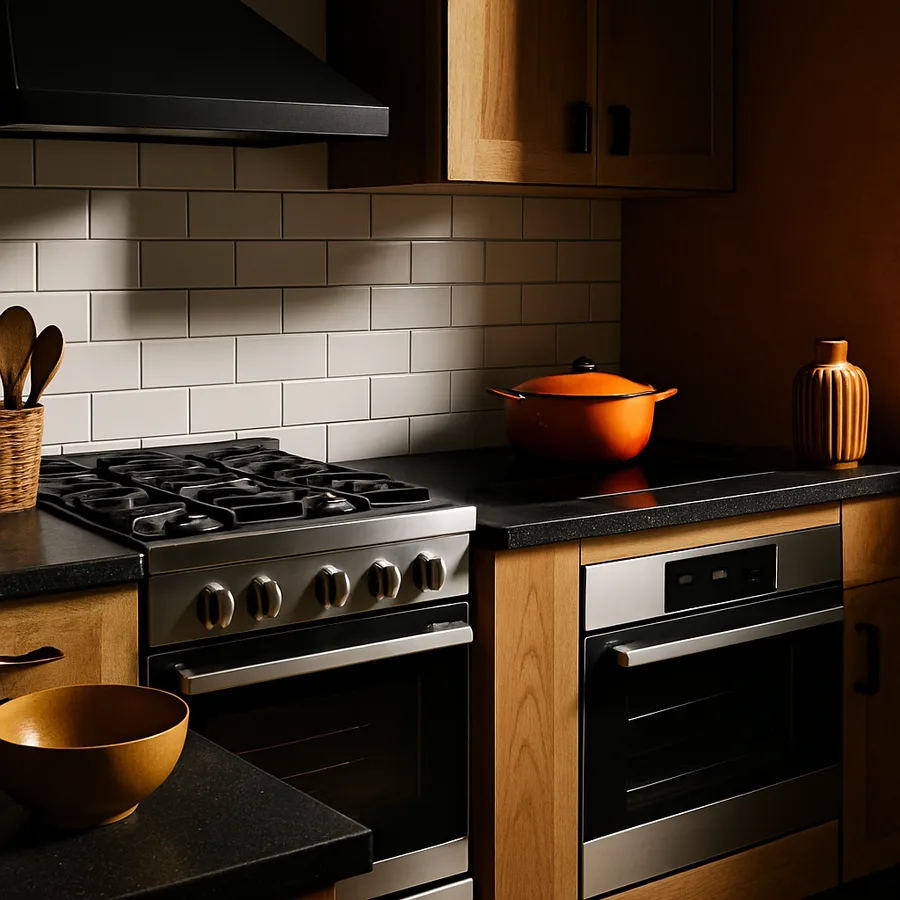
Choosing between a traditional gas range and the increasingly popular combination of an induction cooktop paired with a separate wall oven represents one of the most consequential decisions in any kitchen renovation. The choice affects not only how you cook but also how your kitchen is laid out, how much energy you consume, and how much you spend both upfront and over the lifetime of the appliances. According to the Association of Home Appliance Manufacturers (AHAM), sales of induction cooktops in the United States grew by 38 percent between 2021 and 2024, signaling a significant shift in consumer preferences away from the all-in-one gas range that dominated American kitchens for decades. This guide provides a thorough, side-by-side comparison of both configurations across the dimensions that matter most to homeowners planning a kitchen upgrade.
How Each Configuration Affects Kitchen Layout Flexibility
A gas range occupies a single footprint in your kitchen, typically 30 or 36 inches wide, combining the cooking surface and the oven cavity into one appliance that slots into a gap between base cabinets. This consolidated design simplifies installation because only one utility connection is needed, a gas line and a standard electrical outlet for the igniter and clock. The trade-off is that the oven is locked to the same location as the cooktop, which means you must bend down to floor level every time you check on a roast or pull out a sheet pan of cookies. For kitchens with limited linear counter space, however, the single-footprint advantage of a range can be decisive.
Splitting the cooking function into a countertop-mounted induction cooktop and a separately installed wall oven opens up layout possibilities that a range simply cannot offer. The cooktop can sit on an island, a peninsula, or along any run of cabinetry with adequate electrical service, while the wall oven can be installed at a comfortable ergonomic height in a tall cabinet anywhere in the kitchen. This separation lets designers create work triangles that are genuinely optimized for cooking efficiency rather than constrained by the physical marriage of cooktop and oven in a single box. The National Kitchen and Bath Association (NKBA) recommends placing the oven within 48 inches of a landing counter for safe transfer of hot dishes, a guideline that is easier to satisfy when the oven is an independent unit.
The flexibility of the split configuration does come with added complexity. Two separate appliances require two separate installation locations, which means more cabinetry modifications, potentially more electrical work, and a more involved design process. In a galley kitchen or a compact L-shaped layout under 100 square feet, fitting both a cooktop and a wall oven can consume valuable cabinet storage space that a single range would leave available. Kitchens with generous footprints, open floor plans, and island configurations tend to benefit most from the split approach, while smaller kitchens may find the all-in-one range more practical.
Have you measured your kitchen's available linear footage and identified where both a cooktop and a wall oven could be positioned without sacrificing critical storage? Sketching the two configurations onto your floor plan before committing to either approach reveals spatial trade-offs that are difficult to appreciate in the abstract. Many homeowners discover that the split layout works beautifully in one orientation but creates awkward dead zones in another, making this early planning step invaluable.
Cooking Performance: Heat Control, Speed, and Precision
Gas ranges deliver heat through an open flame that is visible, instantly adjustable, and familiar to most home cooks. The flame wraps around the base of a pan, providing relatively even heat distribution on round-bottomed cookware like woks, and the response to knob adjustments is immediate. Professional chefs have long favored gas for its tactile feedback and its ability to perform techniques like charring peppers directly over the burner or flambeing with the open flame. High-output gas burners on premium ranges can exceed 20,000 BTUs, delivering the intense heat needed for restaurant-style searing and stir-frying at home.
Induction cooktops generate heat through an entirely different mechanism, using electromagnetic fields to excite the iron molecules in compatible cookware so that the pan itself becomes the heat source. This approach is dramatically more efficient than gas, which loses roughly 60 percent of its energy to the surrounding air rather than the pan. The U.S. Department of Energy rates induction cooktops at approximately 85 percent energy transfer efficiency compared to roughly 40 percent for gas burners. In practical terms, this means a pot of water boils in about half the time on induction, and the cooktop surface remains cool to the touch except where the pan sits, reducing burn risk significantly.
Precision temperature control is where induction truly distinguishes itself. Digital induction controls can maintain specific temperatures with a consistency that gas burners, governed by mechanical valves and flame dynamics, cannot match. Delicate tasks like melting chocolate, simmering a reduction, or holding a sauce at precisely 180 degrees become remarkably easier on induction. Some premium induction units offer sous vide modes and temperature probe integration, blurring the line between cooktop and precision cooking appliance. For baking enthusiasts, the wall oven in a split configuration typically offers superior temperature consistency compared to the oven cavity in a range, because wall ovens benefit from better insulation and more precise convection fan engineering.
The one area where gas retains a meaningful advantage is in cooking techniques that require an open flame or extremely high heat concentrated on a small area. Charring, toasting tortillas directly on a grate, and high-heat wok cooking are all easier on gas. Induction requires flat-bottomed, ferromagnetic cookware, which excludes copper, aluminum, and some stainless steel pans unless they have a magnetic base layer. If your existing cookware collection is predominantly non-magnetic, the cost of replacing it should be factored into the total cost of switching to induction.
Installation Requirements and Utility Considerations
Installing a gas range is straightforward in a home that already has a gas line routed to the kitchen. The appliance connects to the existing gas supply with a flexible connector, plugs into a standard 120-volt outlet for its electronic controls, and slides into position between the base cabinets. If the home does not have an existing gas line to the kitchen, extending one from the main supply adds $500 to $2,000 depending on distance and local code requirements. Running a new gas line also requires a licensed plumber or gas fitter, a pressure test, and a municipal inspection in most jurisdictions.
An induction cooktop requires a dedicated 240-volt, 40- to 50-amp circuit, the same electrical service that a standard electric range uses. If the home already has this circuit in the kitchen, the cooktop connects directly. If not, an electrician must run a new circuit from the main panel, a project that typically costs $300 to $800 depending on panel capacity and the distance of the run. The wall oven requires its own separate 240-volt circuit, typically 30 to 40 amps, meaning the split configuration demands two high-voltage circuits where a range requires only one. Homes with older 100-amp electrical panels may need a panel upgrade to accommodate the additional load, an expense that can reach $2,000 to $4,000.
Ventilation requirements differ between the two configurations as well. Gas cooking produces combustion byproducts including nitrogen dioxide, carbon monoxide, and formaldehyde, which the American Lung Association has identified as indoor air quality concerns. Effective venting with an externally ducted range hood rated at 400 CFM or higher is strongly recommended for gas cooking. Induction cooking produces no combustion byproducts, so ventilation needs are limited to managing steam and cooking odors, though a range hood is still advisable for removing airborne grease particles. A recirculating hood, which does not require exterior ductwork, is a viable option with induction but insufficient for gas.
Local building codes and municipal regulations are increasingly relevant to this decision. Several municipalities in California, New York, and Washington have enacted policies that restrict or discourage gas hookups in new construction, part of a broader electrification trend aimed at reducing residential carbon emissions. If you are building new or performing a major renovation in one of these jurisdictions, confirming the current gas connection policy before specifying a gas range can prevent costly mid-project changes. Even in jurisdictions without restrictions, the direction of regulatory momentum favors electric and induction cooking, which some homeowners weigh as a factor in their long-term appliance investment.
Total Cost of Ownership Over a Decade
The upfront cost of a gas range varies enormously by brand and feature set, from approximately $800 for a reliable entry-level model to $8,000 or more for a professional-style unit with six burners and a double oven. The sweet spot for a quality 30-inch gas range with sealed burners, continuous grates, and a convection oven sits around $1,200 to $2,500. Installation costs are minimal if a gas line already exists, typically $100 to $300 for connection and testing. The total initial investment for most homeowners choosing a gas range falls between $1,300 and $2,800.
The split induction cooktop and wall oven configuration carries a higher upfront cost. A quality 30-inch induction cooktop ranges from $1,200 to $3,000, and a single wall oven adds another $1,500 to $4,000, depending on size, features, and brand. Combined, the appliance cost alone is $2,700 to $7,000 before installation. Adding the electrical work for two dedicated 240-volt circuits, the cabinetry modifications for the wall oven installation, and the countertop cutout for the cooktop brings the total initial investment to roughly $4,000 to $10,000 for most projects.
Operating costs, however, shift the equation over time. Natural gas prices vary regionally but average approximately $1.20 per therm nationally. Electricity costs average about $0.16 per kilowatt-hour. Because induction transfers roughly twice the energy per dollar compared to gas, the annual cooking energy cost for a household that cooks daily drops from approximately $80 to $100 with gas to $50 to $65 with induction, a savings of roughly $30 to $35 per year. Over a ten-year appliance lifespan, this produces $300 to $350 in energy savings, which offsets only a fraction of the higher initial cost. The financial case for induction rests more on performance, safety, and air quality benefits than on pure energy cost savings.
Maintenance and repair costs are comparable between the two configurations, though the failure modes differ. Gas ranges can develop igniter problems, thermocouple failures, and gas valve issues that typically cost $150 to $400 to repair. Induction cooktops have fewer mechanical parts but can experience control board failures that are expensive to fix, often $300 to $600 for the board plus labor. Wall ovens share the same repair profile as range ovens. The Consumer Reports reliability surveys consistently show induction cooktops and gas ranges with comparable overall reliability ratings, suggesting that neither configuration holds a decisive advantage in long-term dependability.
Safety, Air Quality, and Environmental Impact
Safety is one of the most compelling arguments in favor of induction over gas cooking. An induction cooktop generates heat only when a compatible pan is placed on the cooking zone and stops generating heat the moment the pan is removed. There is no open flame, no hot coil, and no residual surface heat beyond what the pan has transferred to the glass. This characteristic dramatically reduces the risk of kitchen fires, accidental burns, and clothing or towel ignition, making induction particularly appealing in households with young children, elderly residents, or anyone with cognitive impairments that affect safe stove use. The National Fire Protection Association (NFPA) reports that cooking equipment is the leading cause of home fires in the United States, responsible for 49 percent of all residential fires, and that gas ranges are involved in a disproportionate share of fatal cooking fires relative to their market share.
Indoor air quality represents another significant differentiator. A Stanford University study published in the journal Environmental Science and Technology found that gas stoves in American homes emit methane even when turned off, through minor leaks at pipe fittings and valve seals, and that the nitrogen dioxide produced during gas combustion frequently exceeds World Health Organization indoor air quality guidelines in homes without adequate ventilation. These findings have informed policy discussions at the municipal and state level and have contributed to growing consumer interest in eliminating gas combustion from the kitchen entirely.
The environmental footprint of each cooking method extends beyond the kitchen. Natural gas is a fossil fuel whose extraction, distribution, and combustion contribute to greenhouse gas emissions. Electricity can be generated from renewable sources including solar, wind, and hydroelectric power, and as the electrical grid continues to decarbonize, the environmental advantage of electric cooking increases over time. Homeowners who have installed rooftop solar panels can power an induction cooktop with energy generated on their own property, effectively eliminating the ongoing carbon footprint of cooking entirely. This alignment with residential electrification goals is a motivating factor for many environmentally conscious homeowners choosing induction.
Is indoor air quality a priority in your household, particularly if anyone in the home has asthma, allergies, or respiratory sensitivity? The combustion byproducts from gas cooking can exacerbate these conditions, and switching to induction eliminates this exposure pathway entirely. For households where respiratory health is a concern, the air quality benefit alone may justify the higher upfront cost of the induction and wall oven configuration.
Resale Value and Market Perception
The impact of appliance choices on resale value depends heavily on the local real estate market and the expectations of likely buyers. In premium markets where kitchen renovations are a primary driver of home value, a well-designed split cooktop and wall oven configuration signals a thoughtfully designed kitchen and often contributes to higher appraised values. The National Association of Realtors reports that kitchen renovations recoup an average of 75 percent of their cost at resale, with the highest returns in projects that incorporate current design trends and high-performance appliances. Induction cooktops have crossed from niche to mainstream in many metropolitan markets, and their presence in a listing is increasingly viewed as a positive feature rather than an unfamiliar technology.
In markets where gas cooking is deeply ingrained in buyer expectations, a home without a gas range can face buyer resistance. Parts of the South and Midwest where natural gas is abundant and inexpensive maintain strong buyer preferences for gas cooking, and removing a gas range in favor of induction in these markets may narrow the buyer pool. A practical middle-ground strategy is to install the induction cooktop and wall oven while preserving the gas line capped behind the cooktop, so a future owner who prefers gas can convert back without running new utility lines. This approach costs almost nothing extra and preserves maximum flexibility.
The broader trend, however, favors induction. As municipal gas restrictions expand, as younger buyers who grew up with environmental awareness enter the housing market, and as induction technology continues to improve and drop in price, the market perception is shifting decisively. What was considered an exotic European technology a decade ago is now featured in mainstream home improvement shows and recommended by the majority of kitchen design professionals. Making the switch during a planned renovation positions the home favorably for a market that is moving toward all-electric kitchens at an accelerating pace.
Consider consulting with a local real estate agent who specializes in your neighborhood before finalizing your appliance configuration. Their insight into what buyers in your specific market value, and what they resist, can inform a decision that protects your renovation investment. Contact a certified kitchen designer to discuss which configuration best suits your cooking habits, kitchen layout, and long-term plans for the home.
Conclusion
The choice between a gas range and an induction cooktop with wall oven combo is not a simple matter of one being universally better than the other. Each configuration excels in different dimensions, and the right choice depends on your kitchen's physical constraints, your cooking style, your budget, and your priorities regarding safety, air quality, and environmental impact. Gas ranges offer simplicity, lower upfront cost, and compatibility with every type of cookware, while the induction and wall oven combination delivers superior energy efficiency, precise temperature control, enhanced safety, and greater layout flexibility.
For homeowners undertaking a significant kitchen renovation with adequate space and electrical capacity, the split induction cooktop and wall oven configuration represents the more forward-looking investment. The cooking performance is objectively superior in most measurable dimensions, the safety advantages are substantial, and the trajectory of both technology and regulation favors electric cooking. The higher upfront cost is real but is partially offset by lower operating costs and is amortized over the decade or more that these appliances will serve the household.
For homeowners with smaller kitchens, limited electrical capacity, or strong personal preferences for flame-based cooking, a quality gas range remains an excellent choice that delivers reliable performance at a lower price point. The key is to make the decision deliberately, with full awareness of the trade-offs in each direction, rather than defaulting to the familiar option without considering what the alternative offers. Whichever path you choose, investing in quality appliances that match your actual cooking habits will deliver more satisfaction than chasing specifications that look impressive on paper but do not align with how you actually use your kitchen.
Both configurations benefit enormously from professional kitchen design input. The placement of the cooktop relative to the sink and refrigerator, the height and location of the oven, the ventilation strategy, and the integration with surrounding cabinetry all influence how well the appliances perform in daily use. A certified kitchen designer can evaluate your specific space and cooking patterns to recommend the configuration that will serve you best, ensuring that your investment delivers maximum return in both daily functionality and long-term home value.
More Articles You May Like



Comments
Post a Comment