Floating Vanity Ideas for Half Baths Under 25 Square Feet
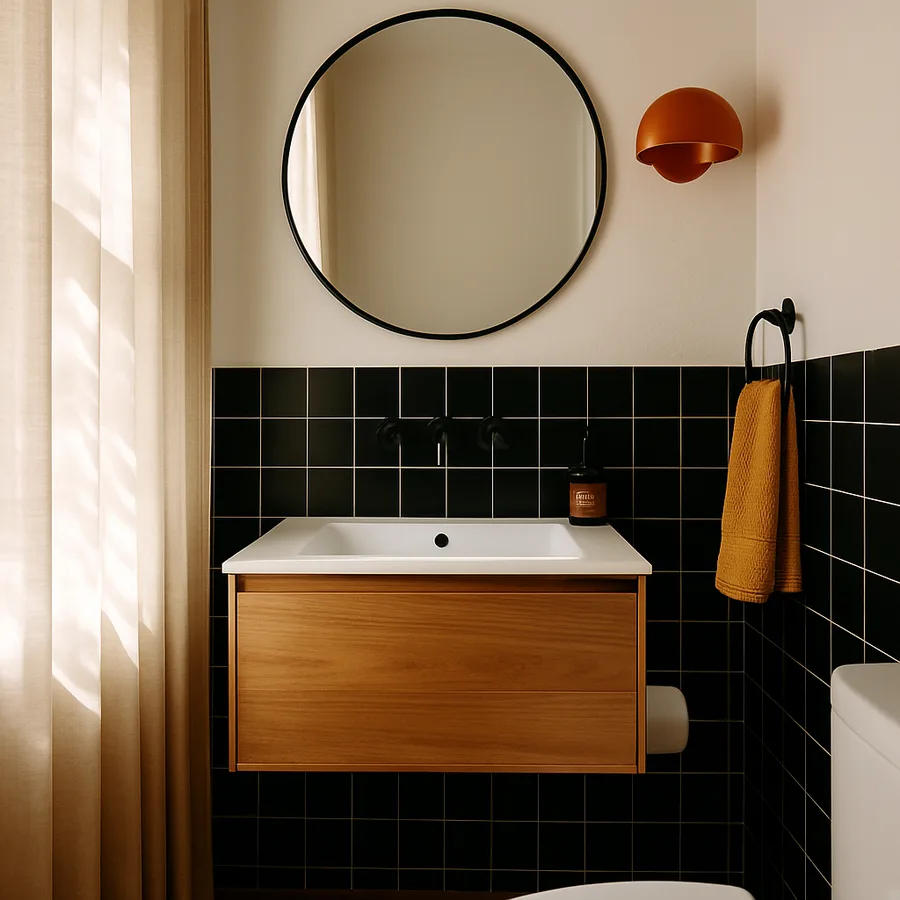
Twenty-five square feet is not much room. It is roughly the size of a queen mattress footprint, and once a toilet, a door swing, and a sink are added, the walkable floor often shrinks to six or seven square feet. In that compressed footprint, every inch of visible floor matters. That is the single biggest reason floating vanities, sometimes called wall-mounted vanities, have become the dominant choice for new and renovated half baths in the United States. By lifting the cabinet off the floor, a floating vanity lets the eye travel under and through the piece, which tricks the brain into reading the room as larger than it is.
But floating vanities are not a single product category. They range from simple slab-front boxes to elaborate custom millwork with integrated lighting, and choosing the right one for a half bath under 25 square feet is a layered decision. Depth, width, mounting height, material, and plumbing all interact in ways that matter more in a tiny room than in a primary bath. This guide walks through the decisions in order, and includes layout ideas for the three most common half bath shapes.
Why Floating Vanities Work Harder in Small Rooms
The math of small-room design is brutal: every object you can see eats perceived volume. A traditional floor-standing vanity, even a compact 24-inch one, presents a solid block from floor to countertop. That block reads as a wall. A floating vanity of the same width, by contrast, shows its legs-free belly and the baseboard behind it, which lets the eye continue past the cabinet. The National Kitchen and Bath Association (NKBA), in its most recent Bathroom Trends Report, noted that wall-mounted vanities were specified in 58% of new small-bathroom projects among surveyed designers, up sharply from a decade ago.
Floating vanities also solve a second problem: cleaning. Half baths accumulate dust, hair, and floor splash under floor-mounted cabinetry in ways that are hard to reach. A wall-mount makes the whole floor a single wipeable plane. In a room this small, that is not a minor benefit. Finally, floating vanities let you place the toe-kick zone at any height you want, which means you can match the vanity mounting to the user group. A guest bath in a family with young children might mount at 30 inches; a bath intended for adults might mount at 34 or 36.
There is one tradeoff. Floating vanities put all of their weight into the wall, and not every wall in a half bath is built to carry that load. Older homes with plaster walls, 2x3 stud walls, or plumbing walls stuffed with old cast iron may need blocking or reinforcement before installation. ASID recommends consulting a licensed contractor any time a wall-mounted fixture is planned on a wall that has not been opened or inspected in the last twenty years.
Sizing: Matching Width and Depth to Square Footage
For half baths under 25 square feet, the vanity width is almost always between 18 and 30 inches. Narrower than 18 feels like a shelf rather than a vanity; wider than 30 begins to crowd the toilet or the door swing. The most common sweet spot is 24 inches, which accommodates a standard undermount or vessel sink, leaves room for a soap dispenser, and fits through standard interior doorways during installation.
Depth is where most homeowners over-order. A standard bathroom vanity is 20 to 22 inches deep, which is fine in a primary bath but steals inches of walking space in a half bath. For rooms under 25 square feet, consider a shallow-depth floating vanity of 14 to 16 inches. That depth accepts most rectangular undermount sinks and leaves an extra four to six inches of floor clearance, which is often the difference between a comfortable room and a cramped one. A 2022 study by Houzz found that homeowners who specified shallow-depth vanities in half baths reported 22% higher satisfaction with the finished room than those who installed standard-depth cabinets.
A reader's question worth pausing on: do you actually need storage in your half bath, or would a shelf be enough? Guests rarely open drawers, so the main function of half-bath storage is household overflow, extra toilet paper, hand towels, a small basket of cleaning supplies. If that is all, a 14-inch-deep vanity with a single drawer is plenty. Deeper cabinets mostly store air.
Material and Finish Choices That Read Well at Close Range
In a room this small, you are always within arm's length of the vanity. That changes which materials look good. Thermofoil and low-quality laminate, which can pass at six feet, reveal their plastic edges at two feet. Conversely, real wood veneer, paint-grade hardwood, and honed stone all reward close inspection. If the budget is tight, paint-grade MDF with a high-quality finish often looks better up close than cheap veneer.
Warm woods, especially white oak, walnut, and rift-cut ash, have dominated half-bath design for several years, and for good reason. A warm wood tone reads as furniture rather than fixture, which softens a small bathroom's clinical edge. For homeowners who want a more modern read, matte lacquer in off-white, putty, or a muted sage keeps the room light and lets the countertop and mirror carry the drama. High-gloss finishes, while striking, show every water spot and fingerprint, which is a problem at this distance.
Countertop choice is simpler than it looks. A half bath vanity top gets minimal water exposure, so the material decision is primarily aesthetic. Quartz is the most forgiving, with no sealing required and near-infinite color options. Natural stone, especially a small offcut of marble or quartzite, can be surprisingly affordable because a half-bath vanity only needs six to eight square feet of material, and many fabricators sell remnants at deep discounts. Houzz maintains an updated guide to bathroom countertop pros and cons that is useful for comparing materials side by side.
Mounting Height and Plumbing Realities
The most overlooked detail in floating vanity design is mounting height, and getting it wrong is expensive. The standard bathroom countertop height in the U.S. is 34 to 36 inches. For a floating vanity, that means the bottom of the cabinet usually lands at 20 to 26 inches off the floor, depending on cabinet height. Go too low and the floating look disappears; go too high and the sink becomes uncomfortable. A good rule of thumb is to measure from the floor to the user's wrist when they stand relaxed with arms hanging, then set the countertop two inches below that.
Plumbing is the second reality check. A floating vanity requires the drain and supply lines to enter through the wall, not the floor, which is easy in new construction but a real project in older homes. If the existing plumbing comes up through the floor, either the plumbing must be re-routed or the vanity must have a decorative panel to hide the pipes. Most designers recommend moving the plumbing, because an exposed drain pipe visually defeats the floating effect.
Ventilation and the toilet supply line also interact with vanity placement in ways that surprise homeowners. A 24-inch vanity centered on a wall may look perfect on paper but crowd a toilet whose rough-in is 12 inches off the adjacent wall. Measure the actual toilet, not the drawing, and leave at least 15 inches of clear space from the vanity center to the nearest obstruction. International Residential Code guidelines recommend a minimum of 15 inches from a toilet's centerline to any side obstruction, which many half baths violate in the name of fitting a larger sink.
Storage and Organization Inside a Small Vanity
Because half-bath storage is overflow rather than primary, it should be organized around a few specific objects rather than general capacity. Most homeowners need room for: one to two extra rolls of toilet paper, a small stack of hand towels, a backup bottle of hand soap, and occasionally cleaning supplies. That is it. A single shallow drawer, or a single drawer plus a slim cabinet, handles the entire inventory comfortably.
The design choice is between drawers and doors. Drawers are easier to access but limit the height of stored items. Doors allow taller items but often leave wasted vertical space. For a 24-inch shallow-depth vanity, the best combination is usually one top drawer for small items and an open lower shelf for a woven basket. The basket hides visual clutter and can be pulled out for cleaning.
Ask yourself this: when a guest visits, what do you want them to see when they glance at your vanity? A clean top with a single soap dispenser and a small plant signals care; a vanity top covered with everyday toiletries signals that your primary bath is elsewhere. In a half bath, visual restraint on the counter matters more than storage volume inside the cabinet. Architectural Digest has published multiple case studies showing that the most photographed half baths tend to have fewer than three objects on the vanity top.
Three Layout Ideas for Rooms Under 25 Square Feet
The first layout is the galley: a long, narrow room with the door on one short end, the toilet against one long wall, and the floating vanity against the other long wall. In this shape, a 24-inch shallow-depth vanity centered on the wall opposite the toilet keeps sight lines clean and leaves usable floor space on both sides. A vertical mirror above, running nearly floor to ceiling, exaggerates the room's length and counters the tunnel feeling.
The second layout is the corner: a square room with the door in one corner, the toilet in the far corner, and the vanity along a third wall. Here, a slightly wider 28- or 30-inch floating vanity works if the plumbing allows, because the square geometry gives it room to breathe. A round mirror above softens the corners and brings curves into a box-shaped room.
The third layout is the tucked-under-stairs half bath, a common retrofit in older homes. These rooms often have a sloped ceiling over part of the footprint, which forces the vanity into the low-ceiling zone. A 20-inch-wide, 14-inch-deep floating vanity fits almost anywhere, and a floor-mounted mirror leaned against the wall above it makes the low ceiling feel intentional rather than a constraint. House Beautiful regularly showcases under-stair half baths in its small-space issues, and many of those projects hinge on a well-chosen shallow floating vanity.
Conclusion
A floating vanity is not a luxury in a half bath under 25 square feet; it is a working solution to a real spatial problem. By lifting the cabinet off the floor, it gives the eye room to move, makes the floor easier to clean, and lets the homeowner control mounting height rather than accept a default. Those benefits compound in a tiny room where every visual trick matters more than it would elsewhere.
The decision tree is simpler than it looks. First, confirm the wall can carry the load, and plan any necessary blocking or reinforcement before finishes go in. Second, pick a width and depth based on actual room geometry, not standard catalog sizes. For most rooms under 25 square feet, that means 24 inches wide and 14 to 16 inches deep. Third, choose a material and finish that rewards close-range viewing, because everyone in a half bath is within arm's length of the vanity.
Finally, remember that a half bath's storage needs are modest. Do not oversize the cabinet to impress; size it to handle overflow and call it done. That discipline keeps the room feeling open, which is the whole point of choosing a floating vanity in the first place. A small bath that feels generous is almost always better than a small bath that stores more. Designers repeatedly describe the floating vanity as a tool for perception, not capacity, and that framing is the right one for any room under 25 square feet. If you remember only one rule from this guide, remember that shallow beats deep, narrow beats wide, and open beats stuffed, every time, in a half bath this small. If you are planning a half-bath renovation, download our free floating-vanity planning checklist on Interior Bliss to size and spec your vanity before you shop.
More Articles You May Like



Comments
Post a Comment