Reading Nook Ideas for Children's Bedrooms Under 100 Sq Ft
Why Every Child Deserves a Reading Nook, Even in a Tiny Room
Small bedrooms force parents into triage mode. The bed takes priority, a dresser claims the next slice of space, and whatever square footage remains goes to a desk or a toy bin. A dedicated reading area rarely survives this prioritization, dismissed as a luxury that only large rooms can accommodate. Yet the children who benefit most from a reading nook are precisely those in smaller rooms, where the nook becomes one of the few spaces the child can claim as entirely their own. A reading nook in a compact bedroom is not an indulgence; it is an anchor point that gives a child a sense of ownership and calm in a room that might otherwise feel like a dense arrangement of necessary furniture with no breathing room between pieces.
The data supporting early reading habits is unambiguous. A landmark study by the National Institute of Child Health and Human Development found that children who read for pleasure at least twenty minutes per day score in the 90th percentile on standardized reading assessments, while those who read fewer than five minutes per day fall to the 50th percentile. Creating a physical space that invites and rewards reading behavior is one of the most effective strategies parents have for cultivating this habit. A child who has a designated, comfortable, well-lit spot for reading is significantly more likely to reach for a book during free time than a child whose only option is to read on the bed where they also sleep, play, and do homework.
The rooms this article addresses measure under 100 square feet, which encompasses the standard nine-by-ten, eight-by-twelve, and ten-by-ten configurations found in apartments, townhouses, older homes, and secondary bedrooms in newer construction. These dimensions leave roughly 20 to 30 square feet of usable floor space after a twin bed and a basic dresser are placed, and it is within that remaining area, or in overlooked zones like closets, window recesses, and under-bed cavities, that a reading nook can be carved. The solutions that follow are not theoretical suggestions for aspirational spaces; they are practical builds tested in real rooms where every inch is already spoken for.
Have you walked into your child's bedroom and felt that there was simply no room left for anything beyond the essentials? That feeling is valid but often based on a two-dimensional assessment that ignores vertical space, underutilized niches, and furniture that could serve dual purposes. The reading nook ideas in this guide exploit exactly those overlooked dimensions. None require removing existing furniture. None demand construction permits or structural modification. All can be completed in a single weekend with tools and materials available at any home improvement store, and most come in under three hundred dollars in total cost.
The Closet Conversion: Reclaiming Dead Space
The single most effective reading nook strategy for a small bedroom is converting part or all of the closet into a seated reading alcove. A standard reach-in closet measures 24 inches deep and 48 to 72 inches wide, dimensions that comfortably accommodate a child-sized bench seat with book storage on the surrounding walls. The closet doors are either removed entirely, replaced with a curtain, or left in place so the nook can be hidden when not in use. What was previously dead storage space consumed by a hanging rod and a jumble of shoes becomes the most intimate and appealing zone in the entire room, a cave-like retreat that children find irresistible.
The conversion begins with clearing the closet and assessing the interior surfaces. Remove the hanging rod and any wire shelving, patch the screw holes with spackle, and sand the walls smooth. Paint the interior a color that differs from the bedroom walls to signal that this space has a distinct identity. Deep, warm tones like navy, forest green, or burgundy create a cocoon-like atmosphere, while lighter shades like pale coral or soft gold make the small space feel more open. The Houzz design community overwhelmingly favors deeper colors for closet reading nooks, with 73 percent of featured projects using saturated hues that contrast with the lighter bedroom beyond.
The seat itself can be as simple as a piece of three-quarter-inch plywood cut to fit the closet width, supported on two short bookcases or storage cubes positioned at each end. This creates a bench approximately 16 to 18 inches above the floor, the ideal seated height for children ages four through ten, with open storage beneath for book bins or baskets. Top the plywood with a four-inch foam cushion wrapped in a washable cover, add two or three throw pillows against the back wall, and the seating is complete. Total material cost for the bench, cushion, and pillows typically runs between eighty and one hundred fifty dollars, making this one of the most affordable dedicated reading spaces possible.
Book storage within the converted closet should prioritize forward-facing display rather than spine-out shelving. Children, especially pre-readers and early readers, select books based on cover art rather than title text. Narrow ledge shelves mounted on the closet side walls at the child's eye level display book covers like artwork and make selection intuitive. Three ledges per side wall, each holding four to six books, provide a rotating library of 24 to 36 titles within arm's reach of the seated child. The American Library Association (ALA) recommends maintaining a curated selection of books accessible to children rather than overwhelming them with an entire collection, noting that a smaller, regularly rotated display encourages broader reading choices and more frequent engagement with individual titles.
Window Seat Nooks: Using the Recess You Already Have
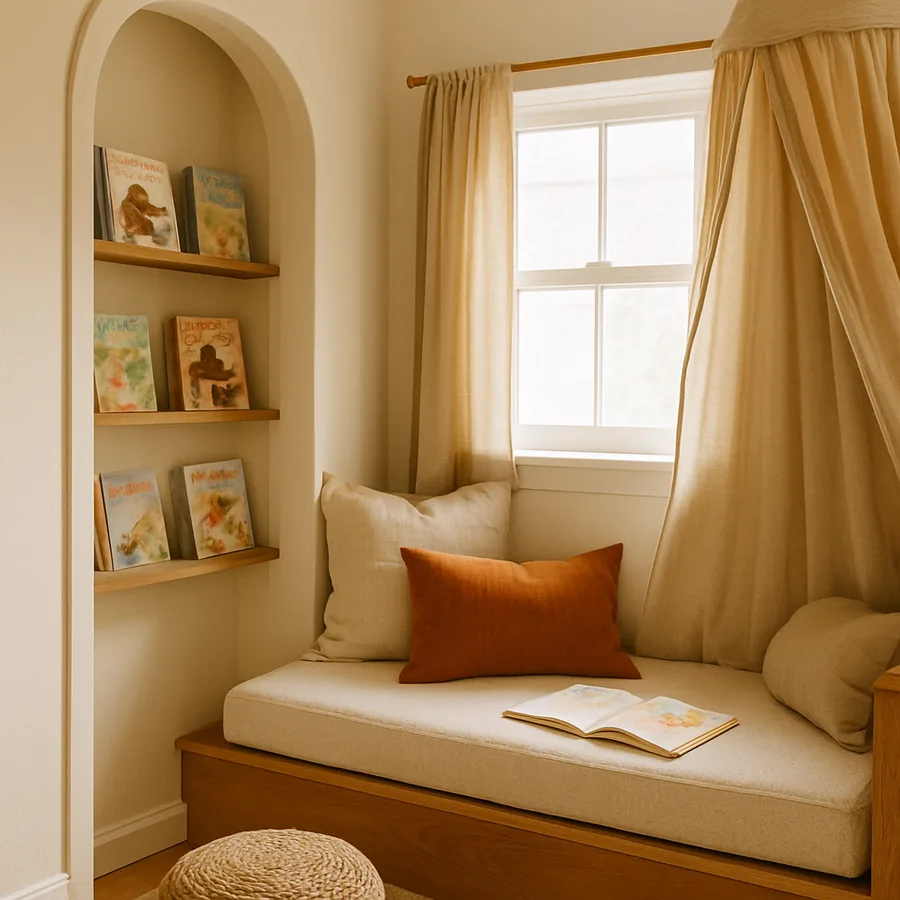
Bedrooms with windows that sit in a recessed wall section, even a recess as shallow as six inches, present a natural reading nook opportunity that requires minimal construction. A window seat bench built across the width of the window recess provides a perch where the child reads by natural light during the day and under a clip-on lamp at night. The bench can be constructed from the same plywood-on-supports method described for closet conversions, with the added advantage of a window behind the seat that provides light, ventilation, and a view that makes the nook feel spacious despite its compact footprint.
For windows without a natural recess, a freestanding window seat can be created using a low storage bench positioned directly beneath the window sill. IKEA's Kallax shelving units turned on their sides, fitted with cushion tops, are one of the most popular ready-made solutions for this application. A two-by-two Kallax unit measures 30 inches wide by 30 inches tall, which when oriented horizontally provides a bench surface 30 inches wide and 15 inches deep with four open cubbies beneath for book storage. Two units placed side by side create a generous 60-inch bench under a standard window. The National Association of Home Builders has noted that window seat installations, whether built-in or modular, consistently appear in the top ten most-desired bedroom features in their annual homeowner preference surveys.
Light management is the primary design challenge with window seat nooks. Direct sunlight creates glare on book pages and overheats the seating area during summer months. A sheer Roman shade or a light-filtering cellular shade mounted inside the window frame diffuses incoming light to comfortable reading levels while maintaining the bright, airy quality that makes window seats appealing. For bedrooms that face west and receive intense afternoon sun, a combination of a sheer shade for daytime diffusion and a blackout shade for nap time provides maximum versatility. The two shades can be mounted on a single double bracket, with each operating independently.
Safety must govern every window seat design decision in a child's bedroom. The window behind the seat must have a functioning lock that the child cannot easily defeat, and if the window opens, a window guard or stop device should limit the opening to four inches or less, the maximum gap that prevents a child from falling through. The Consumer Product Safety Commission (CPSC) reports approximately 3,300 emergency department visits annually related to children falling from windows, and bedrooms are the most common room of origin for these incidents. A window seat that places a child directly beside a window increases this risk unless proper safeguards are installed. Never omit the window guard, regardless of the floor level, because even a first-floor fall onto hard ground or a basement window well can cause serious injury.
Under-Loft and Under-Bed Reading Dens
Children who sleep in loft beds or raised platform beds have a gift that standard-bed configurations do not offer: usable floor space beneath the sleeping surface. A twin loft bed with a 54-inch clearance underneath provides enough vertical room for a child up to about age ten to sit comfortably on a floor cushion or a low beanbag with a book. Enclosing three sides of this under-loft space with curtains or fabric panels transforms it from a dusty dead zone into a private reading den that feels separate from the rest of the bedroom. The bed above acts as a ceiling, the curtains form walls, and the result is a room-within-a-room that consumes zero additional floor space because it occupies area that would otherwise go unused.
Lighting is the critical factor in making an under-loft den functional for reading. The space is naturally dim, shaded by the bed platform above, so dedicated task lighting is essential. Battery-operated LED puck lights adhered to the underside of the bed frame provide overhead illumination without any wiring. A clip-on book light or a small rechargeable desk lamp on a low side table supplements the ambient light with focused beam for the page. Avoid floor lamps, which consume too much of the limited floor area, and avoid any lighting with exposed hot surfaces, since the proximity of bedding and fabric curtains requires all light sources to be cool-running LED or battery-powered. The Architectural Digest kids' room features regularly showcase under-loft reading setups with string lights draped along the perimeter, which provide a warm ambient glow that makes the enclosed space feel magical rather than claustrophobic.
Floor treatment inside the den deserves particular attention. The floor beneath a loft bed is typically bare and hard, which is uncomfortable for extended seated reading. A thick floor cushion measuring approximately 30 by 40 inches, a futon-style folding mattress, or a stack of large floor pillows provides the seated comfort necessary for a child to stay engaged with a book for twenty minutes or more. Washable covers are non-negotiable in a space where children will eat snacks, spill drinks, and occasionally fall asleep on the cushion instead of climbing up to the bed above. A small washable area rug beneath the cushion protects the flooring and adds another layer of softness underfoot.
Book storage in an under-loft den works best when it stays low and accessible. A single row of forward-facing book ledges mounted on the wall at the child's seated eye level, approximately 18 to 24 inches above the floor, provides the display-style storage that encourages browsing and selection. Alternatively, a low basket or fabric bin beside the reading cushion holds the current rotation of library books and favorites. The storage should hold no more than 15 to 20 books at a time; a curated selection prevents decision fatigue and keeps the space from feeling cluttered. Rotate titles monthly by swapping books between the den and a main bookshelf or storage bin elsewhere in the room, keeping the reading nook's selection fresh and enticing.
Corner Canopy Nooks: The Minimalist Approach
When the closet is full, the window wall is occupied by the bed, and there is no loft to build beneath, the corner canopy nook remains available as the most space-efficient reading spot possible. This approach requires nothing more than two to three square feet of floor space in any corner of the room, a ceiling hook, a length of sheer fabric, and a floor cushion. The fabric drapes from the ceiling hook in a cone shape, touching the floor in a circle approximately four feet in diameter. Inside this fabric enclosure sits a thick cushion, a small pillow, and a basket of books. The total material cost is typically under fifty dollars, and installation takes less than thirty minutes.
The psychology of the canopy nook is disproportionate to its physical simplicity. Children are drawn to enclosed, scaled-down spaces that feel proportioned to their bodies rather than to adult dimensions. Developmental psychologists at the University of Minnesota's Institute of Child Development have published research showing that children between ages three and eight voluntarily seek out small enclosed spaces for solitary activities at significantly higher rates than open areas, a behavior researchers attribute to the sense of security and autonomy that bounded spaces provide. A canopy nook taps directly into this instinct, creating a designated reading environment that a child perceives as a personal retreat rather than simply a corner of the room where they have been told to sit and read.
Fabric selection affects both the visual appeal and the practical durability of the canopy nook. Sheer fabrics like chiffon, voile, or mosquito netting create an ethereal, translucent enclosure that filters light beautifully and allows the child to see out while still feeling sheltered. Heavier fabrics like cotton canvas or linen provide more complete visual privacy and block more light, which suits children who prefer a darker, quieter reading environment. The fabric should be washable, as it will accumulate dust and the occasional juice stain. A single flat sheet from a standard twin bed set, folded in half lengthwise and gathered at the top with a rubber band over the ceiling hook, creates a perfectly serviceable canopy at effectively zero cost using materials most families already own.
Enhancing the canopy nook with a few targeted additions transforms it from a simple fabric drape into a beloved daily destination. A battery-operated fairy light strand wound around the inside perimeter of the canopy creates a warm glow that makes the interior feel enchanted. A small wall-mounted pocket organizer inside the canopy holds bookmarks, a small flashlight, and a pencil for a reading journal. A personalized name sign or a painted initial on the wall above the hook claims the space as the child's own territory. These additions cost little individually but collectively communicate that the reading nook is a thoughtfully created space, not an afterthought, and children respond to that intentionality by treating the nook with corresponding respect and regular use.
Lighting, Book Storage, and Comfort Details That Matter
The difference between a reading nook that a child uses daily and one that becomes a neglected pile of cushions within a month comes down to three elements: lighting quality, book accessibility, and sustained physical comfort. Lighting must be bright enough for comfortable reading without straining young eyes, which means a minimum of 30 foot-candles measured at the reading surface. A standard 60-watt equivalent LED bulb positioned within two feet of the book achieves this easily. Natural light from a nearby window exceeds this threshold during daytime hours but must be supplemented after sunset with a dedicated reading lamp. Avoid relying solely on overhead room lighting, which casts shadows on the book when the child's head and body block the downward beam.
Color temperature of the reading light influences both comfort and alertness. Warm white light in the 2700K to 3000K range creates a cozy atmosphere that suits bedtime reading, while neutral white at 4000K provides clearer contrast for daytime study reading. An LED reading lamp with adjustable color temperature gives parents the option to shift between modes depending on the time of day and the purpose of the reading session. The American Academy of Ophthalmology recommends that children take a 20-second break from focused near-work every 20 minutes to look at something 20 feet away, a guideline known as the 20-20-20 rule. A reading nook positioned where the child can look up from their book and gaze across the room or out a window facilitates this habit naturally.
Book storage within the nook should follow the principle of curation over accumulation. A reading nook stuffed with sixty books becomes a storage unit rather than an inviting reading space. The optimal number for a compact nook is ten to fifteen titles, selected to represent a mix of current favorites, new acquisitions, and books the child has not yet tried. Forward-facing display, where the book cover faces outward rather than showing only the spine, is worth the reduced capacity because it dramatically increases the likelihood that a child will pick up a particular title. Spines communicate nothing to a pre-reader and very little to an early reader; covers communicate everything. Wall-mounted picture ledges from IKEA or similar retailers cost under ten dollars each and hold five to seven books in forward-facing orientation, making them the most cost-effective book display solution for reading nooks.
Physical comfort sustains reading sessions beyond the first five minutes. A child who shifts, squirms, and repositions constantly is responding to inadequate cushioning or poor ergonomic support, not to boredom with the book. The reading surface should be soft enough to remain comfortable for at least twenty minutes of seated use, which rules out bare wooden benches and thin decorative pillows. A minimum of three inches of high-density foam covered in soft fabric provides adequate cushioning for extended reading. A backrest, whether a wall, a pillow stack, or a built-in panel, supports the child's spine and reduces fatigue. Armrests are a bonus in wider nooks, as they provide a natural resting position for the hands and arms while holding a book. Investing in comfort details at the outset prevents the common outcome where a beautifully designed reading nook goes unused because sitting in it is simply not pleasant enough to sustain the activity it was designed for.
Building Your Child's Reading Nook This Weekend
The reading nook that will change your child's relationship with books is not the Pinterest-perfect installation that costs two thousand dollars and requires a contractor. It is the one you actually build, this weekend, with materials you can carry in a single trip from the hardware store. Start by walking into your child's bedroom and identifying the most promising location using the hierarchy in this guide: closet first, window recess second, under-loft space third, open corner fourth. Measure the available dimensions, sketch a rough plan on a piece of paper, and list the materials you need. For most implementations, that list includes a piece of plywood or a repurposed shelf, a foam cushion, fabric for a cover, a few book ledges, a reading lamp, and some throw pillows.
Involve your child in every step of the process. Let them choose the cushion fabric from three or four parent-approved options. Let them decide which books populate the nook's initial collection. Let them name the space if they want to. This participation is not mere parenting strategy; it is a design principle. A child who helped build and personalize a reading nook feels ownership over it in a way that a child presented with a finished product does not. That ownership translates directly into usage frequency, and usage frequency translates into reading minutes, and reading minutes translate into the vocabulary growth, comprehension skills, and imaginative development that every parent hopes books will foster.
Maintain the nook as an evolving space rather than a static installation. Rotate the book selection monthly. Replace the cushion cover seasonally or when it shows wear. Add a new element occasionally, like a small plant, a framed quote, or a new reading lamp, to keep the space feeling fresh and valued. Ask your child periodically what they would change about the nook, and act on reasonable suggestions. A reading nook that grows with the child and responds to their evolving preferences remains relevant through the elementary years, the middle school years, and often into adolescence, long after the original foam cushion has been replaced and the fairy lights swapped for a proper sconce.
If your child's bedroom is under 100 square feet, you do not have less room for a reading nook than families with larger spaces. You have more reason to create one. In a small room where every zone competes for floor space, a dedicated reading nook tells your child that reading matters enough to earn its own territory. That message, embedded in the physical structure of the room itself, speaks louder than any verbal encouragement. Gather your materials, clear a Saturday morning, and build the space where your child's reading life takes root. Then tell us which approach you chose and how your child responded, because every family that shares their solution helps another family believe a reading nook is possible in their small room too.
More Articles You May Like



Comments
Post a Comment