Covered Patio Ceiling Ideas: Tongue and Groove vs Beadboard
Why the Patio Ceiling Deserves Real Attention
Most homeowners pour their outdoor budget into flooring, furniture, and landscaping while leaving the patio ceiling as an afterthought. That exposed plywood or bare joist underside above your head becomes the dominant visual surface whenever you sit down and look around, which is exactly what guests do when they settle into your covered patio for conversation. The ceiling is the largest uninterrupted plane in most covered patios, and its finish sets the tone for the entire space more powerfully than any single piece of furniture or decorative element you might add at eye level. Treating the patio ceiling with the same design intention you bring to interior rooms transforms a utilitarian shelter into an outdoor room that feels genuinely finished and inviting.
The two most popular wood-based ceiling treatments for covered patios are tongue and groove planks and beadboard panels, and the choice between them involves more than visual preference. Each material brings different structural characteristics, installation requirements, moisture tolerance profiles, and long-term maintenance demands that affect both the building process and your experience with the finished ceiling for the next decade or more. According to the National Association of Home Builders (NAHB), outdoor living spaces rank among the top three most-desired features in new residential construction, with covered patios and porches appearing on approximately 82 percent of buyer wish lists. That demand has pushed ceiling finish options and techniques well beyond the basic painted plywood that sufficed in previous generations.
Understanding the fundamental differences between tongue and groove and beadboard requires looking past their surface appearance, which can be surprisingly similar from a distance. Tongue and groove refers to a milling profile where each plank has a protruding ridge on one edge and a corresponding channel on the opposite edge, allowing planks to interlock during installation. Beadboard is a style designation referring to narrow planks or sheets featuring a decorative bead, which is a small rounded ridge running along each joint line. Beadboard can be milled as individual tongue and groove planks with a bead profile, or it can come as four-by-eight sheet goods with the bead pattern routed into the surface. This distinction between individual planks and sheet products is the most consequential practical difference, and it drives most of the cost, installation, and appearance differences that follow.
The climate where you live should exert significant influence over your material choice. Patios in humid subtropical regions face different challenges than those in arid desert environments, and the moisture behavior of your ceiling material directly determines how long it lasts and how much maintenance it demands. The American Wood Council publishes moisture exposure guidelines that classify covered outdoor ceilings as partially sheltered environments, meaning they avoid direct rainfall but still experience high humidity, temperature swings, and potential condensation that interior ceilings never encounter. Selecting the right material for your specific climate zone prevents premature warping, cracking, or finish failure that can turn a beautiful ceiling into a maintenance headache within just a few seasons.
Tongue and Groove Planks: Character Through Individual Boards
Tongue and groove plank ceilings deliver a visual warmth and authenticity that comes from installing real, individual pieces of wood one board at a time. Each plank is typically three and a half to five and a half inches wide, and the natural variation in grain pattern, color, and character marks across dozens of individual boards creates a rich, textured surface that never looks manufactured or uniform. Western red cedar is the most popular species for outdoor tongue and groove ceilings because of its natural resistance to decay and insects, its dimensional stability in changing humidity, and its beautiful reddish-brown color that weathers gracefully to silver gray if left unfinished. Other suitable species include cypress, white cedar, and redwood, all of which contain natural oils and extractives that provide some inherent protection against the biological degradation that destroys less durable woods in outdoor applications.
The installation process for tongue and groove planks requires more time and skill than sheet beadboard but offers superior results in terms of fit and long-term performance. Each plank is blind-nailed through the tongue at an angle, which conceals the fasteners behind the groove of the adjacent plank and produces a clean surface with no visible nail heads. A typical covered patio ceiling of 200 square feet requires approximately 60 to 80 individual planks, and the installer must maintain consistent spacing, check alignment every several courses, and cut planks precisely to fit against walls, posts, and any penetrations for lighting or fans. Professional installation of tongue and groove patio ceilings typically costs between eight and twelve dollars per square foot for labor alone, according to estimates compiled by the Houzz contractor network, with material costs adding another four to ten dollars per square foot depending on species and grade.
The individual plank format provides an important structural advantage in outdoor environments where seasonal movement is unavoidable. Each board can expand and contract independently within its tongue and groove joint, which is engineered to accommodate a small amount of dimensional change without opening visible gaps or buckling. Sheet products, by contrast, move as a single large unit and concentrate stress at seam locations, which can produce visible joint separation over time. For covered patios in regions with significant humidity swings between seasons, the individual plank approach distributes wood movement across many small increments rather than a few large ones, producing a ceiling that stays tight and attractive through years of seasonal cycling.
Have you considered how different wood grain orientations might change the perceived proportions of your patio? Running tongue and groove planks parallel to the longest dimension of the patio creates a sense of visual length and openness, while running them perpendicular to the long axis makes the space feel wider and more intimate. Diagonal installation adds dynamic visual energy but generates more material waste due to angled cuts at the perimeter and requires more precise layout planning. The Architectural Digest outdoor design portfolio demonstrates each orientation in real installations, and the directional impact on perceived space is substantial enough to warrant careful consideration before the first plank goes up.
Beadboard Panels: Efficiency and Cottage Character
Beadboard sheet panels bring a distinct visual character to patio ceilings that evokes cottage, farmhouse, and traditional coastal architecture. The evenly spaced bead lines running across the surface create a rhythmic pattern that reads as detailed and intentional without being busy, and the uniformity of machine-routed beads produces a more polished, consistent appearance than the natural variation found in individual tongue and groove planks. PVC beadboard panels have become the dominant choice for outdoor patio ceilings because they are completely immune to moisture damage, insect attack, and rot, eliminating the primary failure modes that threaten wood products in exterior applications. Cellular PVC beadboard from manufacturers like Azek, Royal, and Versatex can be painted any color, holds paint exceptionally well, and never needs to be sealed or stained against moisture penetration.
The installation speed advantage of beadboard sheet panels is their most compelling practical benefit. A four-by-eight sheet of beadboard covers 32 square feet in a single piece, compared to the six or seven individual tongue and groove planks needed to cover the same area. An experienced two-person crew can install a beadboard panel ceiling on a 200-square-foot patio in a single day, while the same area in individual tongue and groove planks typically requires two to three days. This labor reduction translates directly into lower installation costs, with professional beadboard panel installation typically running five to eight dollars per square foot for labor. For homeowners working within a fixed budget, the labor savings on beadboard often free up enough money to invest in better lighting, a ceiling fan, or upgraded furniture that enhances the finished space.
Sheet beadboard's primary limitation is visible at the seam lines where panels meet. Even with careful installation and caulking, the joints between four-by-eight sheets can telegraph through paint over time, particularly as the supporting structure experiences minor seasonal movement. Tongue and groove beadboard planks, which combine the bead profile aesthetic with the individual plank installation method, solve this problem by eliminating sheet seams entirely while retaining the decorative bead pattern. These planks cost more than sheet beadboard and require the same installation time as plain tongue and groove, but they represent an effective compromise for homeowners who want the beadboard look without the visible panel seams. The North American Deck and Railing Association (NADRA) reports that PVC beadboard planks have grown to approximately 35 percent of the outdoor ceiling market, reflecting their position as a middle-ground option between fast sheet installation and premium plank quality.
The paint-holding characteristics of different beadboard materials deserve attention because most beadboard patio ceilings are painted rather than left in a natural finish. PVC beadboard accepts and holds exterior latex paint beautifully, with no primer required on most products and excellent adhesion that resists peeling and flaking for five to seven years between repainting. MDF beadboard, sometimes chosen for its lower cost, must be thoroughly primed on all surfaces including edges and the back face before installation in any outdoor environment, and even with proper preparation it remains vulnerable to moisture intrusion at cut edges and fastener holes. Plywood beadboard panels fall between these extremes, accepting paint reasonably well when properly primed but requiring more diligent moisture protection than PVC. For a patio ceiling that you want to paint white and forget about for several years, PVC beadboard is the most forgiving substrate.
Durability and Maintenance in Outdoor Conditions
The covered patio ceiling occupies an environmental middle ground between a fully interior surface and a fully exposed exterior surface, and this in-between status creates specific durability challenges that differ from either extreme. Direct rainfall is blocked by the roof structure, but wind-driven moisture, ambient humidity, condensation from temperature differentials between the roof surface and the ceiling underside, and occasional insect pressure all test the ceiling material continuously. Cedar tongue and groove performs well in this environment when properly finished, with an expected lifespan of 20 to 30 years before structural replacement becomes necessary, though the finish itself needs refreshing every three to five years. PVC beadboard is essentially permanent in terms of material degradation, with manufacturers offering limited lifetime warranties against rot, cracking, and insect damage, though the paint finish still requires periodic renewal.
Condensation is the most underestimated threat to patio ceiling longevity. When warm humid air contacts a ceiling surface cooled by nighttime temperatures or air conditioning from the adjacent interior space, moisture condenses on the ceiling surface and, over time, saturates unprotected wood fibers. This condensation cycle is invisible during daylight hours and often goes unnoticed until staining, mildew, or warping reveals the cumulative damage. Ensuring adequate ventilation in the space between the roof structure and the ceiling surface is the most effective countermeasure, and most building codes require continuous soffit ventilation or equivalent airflow provisions for any enclosed patio ceiling. According to the Building Science Corporation, maintaining a minimum of one square inch of net free ventilation area per square foot of enclosed ceiling prevents moisture accumulation in most North American climate zones.
The maintenance routines for tongue and groove versus beadboard diverge primarily around finish care and joint behavior. Tongue and groove cedar ceilings finished with a penetrating oil stain require reapplication every two to three years, which involves cleaning the surface, lightly sanding any rough areas, and brushing on a fresh coat of stain. This is manageable work for a homeowner with a stepladder and a free weekend. Painted beadboard ceilings need repainting every five to seven years, but the preparation is more involved because old paint must be scraped or sanded where it has begun to fail, and any caulked seams between panels may need to be recaulked before the new paint goes on. Both materials benefit from an annual cleaning with a mild detergent solution and soft brush to remove the cobwebs, pollen, and airborne cooking residue that accumulate on any outdoor ceiling surface.
What happens when a section of your patio ceiling is damaged by a fallen branch, a plumbing leak from above, or simple wear concentrated in a high-traffic area near the door? Tongue and groove planks offer a significant repair advantage because individual boards can be removed and replaced without disturbing the surrounding ceiling. The damaged plank is cut out, the tongue is trimmed from the replacement plank so it can drop into place, and the repair blends invisibly with the existing ceiling after a touch-up coat of finish. Beadboard sheet panels are far more difficult to repair in sections because cutting out a damaged area and patching it with new material creates visible seam lines that are nearly impossible to disguise completely. The practical implication is that tongue and groove ceilings get repaired while beadboard panel ceilings often get entirely re-sheeted when significant damage occurs, which is a much larger and more expensive project.
Cost Breakdown and Value Comparison
A realistic cost comparison between tongue and groove and beadboard patio ceilings must account for materials, labor, finishing, and projected maintenance over at least a ten-year horizon to provide a meaningful picture. For a representative 250-square-foot covered patio ceiling, cedar tongue and groove planks in a standard and better grade currently cost approximately $1,500 to $2,500 for materials, with professional installation adding $2,000 to $3,000 and initial stain or finish adding $300 to $500. The total installed cost ranges from approximately $3,800 to $6,000, or $15 to $24 per square foot all-in. Over ten years, two to three restaining cycles at $400 to $600 each add $800 to $1,800 in maintenance, bringing the decade cost to roughly $4,600 to $7,800.
PVC beadboard sheet panels for the same 250-square-foot ceiling cost approximately $800 to $1,400 for materials, with professional installation at $1,250 to $2,000 and initial painting at $250 to $400. The total installed cost ranges from approximately $2,300 to $3,800, or $9 to $15 per square foot. Over ten years, one repainting cycle at $400 to $600 brings the decade cost to approximately $2,700 to $4,400. The cost advantage of beadboard panels is substantial, typically 35 to 45 percent less than tongue and groove cedar for the initial installation and an even larger percentage difference when maintenance is included. However, this comparison assumes the beadboard panel seams remain acceptable, which is not always the case in climates with significant seasonal movement.
The value equation shifts when you consider the impact on home resale. Real estate appraisers and agents consistently report that real wood ceiling treatments on covered patios command a premium perception that PVC or composite alternatives do not match. The Better Homes & Gardens outdoor living survey found that 67 percent of prospective home buyers rated natural wood patio ceilings as significantly more appealing than painted panel alternatives when viewing listing photographs, suggesting that the visual warmth and authenticity of real wood translates into measurable buyer interest. Whether this perception difference justifies the cost premium depends on your timeline and priorities, but it is a real factor worth acknowledging for homeowners who may sell within the ceiling's lifespan.
For budget-conscious homeowners who want the look of individual planks without the full cost of solid cedar, engineered tongue and groove products offer a middle-ground option worth investigating. These products feature a wood fiber or composite core with a real wood veneer or high-quality laminate surface, delivering plank-level appearance at material costs closer to beadboard panels. The long-term moisture performance of engineered products in outdoor environments is less established than solid wood or PVC because these products are relatively new to the market, so checking manufacturer warranties specifically for outdoor ceiling applications is essential before committing to this category.
Design Combinations and Creative Ceiling Treatments
The most compelling covered patio ceilings often combine multiple materials or techniques rather than relying on a single treatment across the entire surface. A popular approach pairs a tongue and groove plank field with exposed decorative beams that divide the ceiling into sections and add architectural depth to what would otherwise be a flat plane. These beams can be structural members that are intentionally left exposed, or they can be hollow beam wraps installed purely for visual effect over the finished plank ceiling. The contrast between the smooth plank surface and the heavier beam elements creates visual interest and provides a framework for mounting ceiling fans, pendant lights, or hanging planters without penetrating the ceiling plane.
Mixing beadboard panels between beams is another design strategy that uses the strengths of each material effectively. The beams define sections and hide the panel edges, which eliminates the visible sheet seams that are beadboard's primary aesthetic weakness. Between the beams, the beadboard's uniform bead pattern creates a crisp, detailed surface that contrasts attractively with the larger scale of the beam elements. This approach is particularly effective on larger patios where uninterrupted beadboard panels would create an institutional appearance and where the cost of tongue and groove across the entire surface would be prohibitive. The beams serve as both design elements and practical seam-concealers, making this combination genuinely better than either material used alone in many situations.
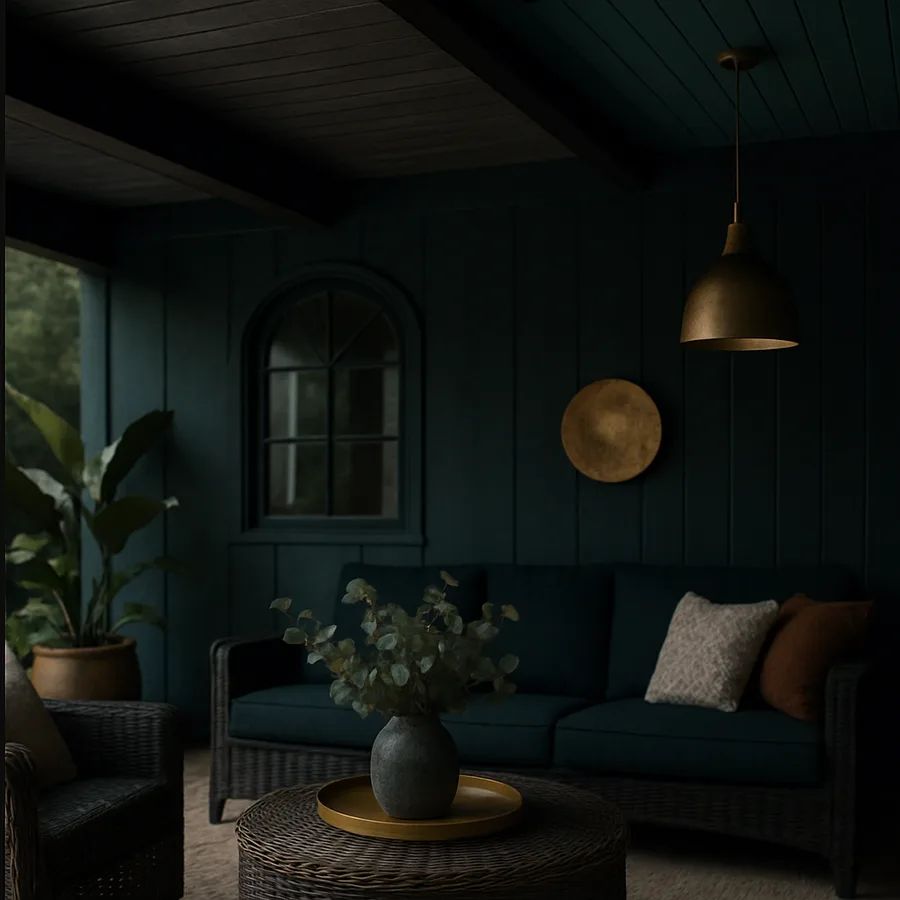
Color selection for painted patio ceilings follows conventions that have evolved from practical experience rather than arbitrary taste. The traditional haint blue porch ceiling, a pale blue-green shade rooted in Southern and Lowcountry architectural tradition, remains the most enduringly popular choice because the soft blue tone mimics sky color, visually extends the outdoor space upward, and creates a fresh, relaxed atmosphere that complements both traditional and contemporary patio furniture. White and off-white ceilings maximize light reflection and make covered patios feel more open, which benefits patios with limited ceiling height or heavy shade. Darker tones like charcoal, deep navy, or rich brown create a dramatic, intimate atmosphere that works best on patios with generous ceiling heights of nine feet or more, where the dark surface adds coziness without feeling oppressive.
Consider incorporating recessed lighting or flush-mounted fixtures into your ceiling plan from the beginning rather than adding them as an afterthought. Running electrical wiring behind tongue and groove planks or beadboard panels is straightforward during installation but becomes a destructive retrofit once the ceiling is complete. Planning fixture locations, wiring runs, and junction box positions before the first ceiling piece goes up ensures that the finished ceiling integrates lighting seamlessly. A covered patio with thoughtfully placed recessed downlights, a statement ceiling fan with an integrated light kit, and perhaps a pendant fixture over a dining area creates an outdoor room that functions comfortably well into the evening hours, which is when most patio entertaining actually happens.
Selecting the Right Ceiling for Your Specific Patio
The decision between tongue and groove and beadboard ultimately rests on a handful of practical factors that vary by project. If your patio is in a humid climate, has limited ventilation above the ceiling plane, and needs to survive decades with minimal intervention, PVC beadboard offers the most durable and lowest-maintenance solution regardless of aesthetic preference. If your patio is in a moderate climate, has good airflow, and the architectural style of your home calls for natural materials and visible wood character, cedar tongue and groove delivers a quality of appearance and tactile warmth that no synthetic product has successfully replicated. Budget constraints legitimately push many projects toward beadboard panels, and there is no shame in choosing the more economical option when the cost difference funds other improvements that make the patio more enjoyable overall.
Installation skill level matters for homeowners considering a DIY approach. Beadboard sheet panels are genuinely manageable for a handy homeowner with basic carpentry tools, a helper to hold panels in position, and a willingness to work carefully on a ladder or scaffolding. The panels are lightweight, cut easily with a circular saw, and forgive minor measurement errors that caulk and paint can conceal. Tongue and groove plank installation demands more precision, more patience, and more comfort with blind-nailing techniques that require practice to execute cleanly. A homeowner who has never installed tongue and groove should practice on a small project like a closet interior before tackling a patio ceiling that will be permanently visible and expensive to redo if the results are unsatisfactory.
Do you envision your patio ceiling as a statement feature or a background surface that supports the overall design without drawing primary attention? This question cuts through much of the analysis and points toward the right material with surprising reliability. Statement ceilings that you want guests to notice and admire favor tongue and groove planks in a natural finish that showcases the wood's inherent beauty. Background ceilings that should look clean, finished, and attractive without dominating the space favor painted beadboard in a neutral color that recedes visually and lets the furniture, landscaping, and other design elements take the lead. Both approaches produce beautiful results; they simply assign different roles to the ceiling within the overall design composition.
Ready to transform that bare ceiling into the finishing element your covered patio deserves? Start by measuring your ceiling area carefully, deciding whether natural wood character or painted uniformity better serves your design vision, and requesting material samples from at least two suppliers so you can hold the actual products against your existing patio elements before committing. The ceiling you install this season will frame every outdoor meal, every evening conversation, and every quiet morning coffee for many years to come, and investing the time to choose well pays dividends in daily satisfaction that far outlast the installation process.
More Articles You May Like



Comments
Post a Comment