Double Kitchen Island Layouts for Large Open Concept Homes
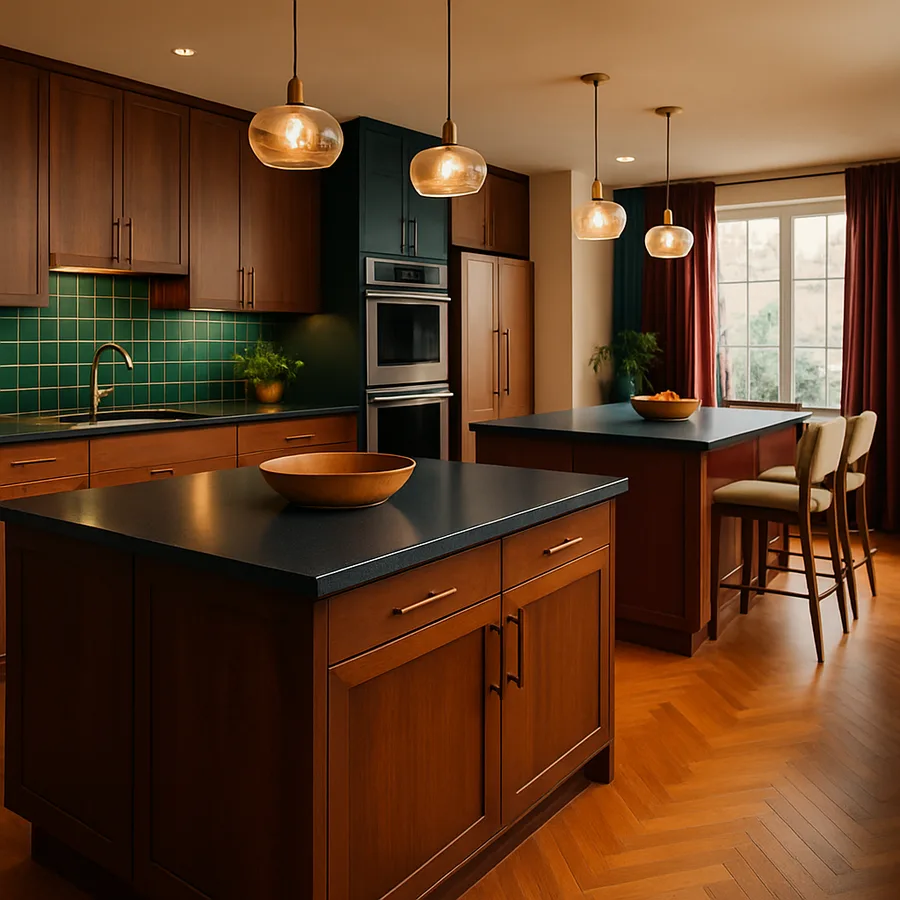
In kitchens above roughly 350 square feet, a single island can start to feel undersized no matter how aggressively you stretch its length. That is the size range where double kitchen islands begin to make sense, and over the last several years they have become one of the defining features of large open-concept homes. Rather than asking one slab of countertop to serve every function, a two-island layout splits responsibilities so that prep, storage, cleanup, and seating each get dedicated real estate.
The National Kitchen and Bath Association (NKBA) reports that double-island layouts now appear in approximately 18% of luxury kitchens over 400 square feet, up from under 6% a decade ago. Interior designers affiliated with the American Society of Interior Designers (ASID) cite improved traffic flow and clearer work zones as the primary reasons clients request them. This article walks through the planning decisions that separate a useful double-island kitchen from one that feels like two mismatched pieces of furniture sharing a room.
When Two Islands Actually Make Sense
The first question is honestly whether you need a second island at all. A good rule of thumb comes from the NKBA 31-point planning guidelines: if your single-island design forces a countertop longer than about 10 feet, the island is already doing too much. At that length, walking from one end to the other wastes motion, and the single surface inevitably collects clutter. Splitting that run into two shorter islands creates natural endpoints and reduces the distance between stored items and the spot where you use them.
A second trigger is household composition. Homes with multiple regular cooks, or homes that host frequently, benefit from physical separation between the working zone and the social zone. One island becomes the prep-and-cleanup station; the other becomes the seating, serving, and conversation surface. That split protects hosts from having guests hover directly over the cutting board, which is something almost every open-plan host has complained about at least once.
Room geometry is the third factor. Long, wide kitchens adjacent to great rooms tend to accept double islands gracefully because traffic can flow on all four sides. Narrow galley-style kitchens, even very long ones, rarely have room for two parallel islands without choking the aisles. Before committing, mock the layout out with painter's tape on the floor and walk the route from refrigerator to sink to range several times. If the walk feels longer or more awkward than with a single island, the plan needs revision.
Zoning: Prep Island vs Social Island
The cleanest mental model for a double-island layout is to assign each island a primary job. The prep island sits closest to the refrigerator and range, typically housing the primary sink, a built-in cutting surface, and the trash and recycling pullouts. The social island sits closer to the dining or living area, housing seating, a secondary beverage sink or prep sink, and open display shelving on its outward-facing end.
Once each island has a job, the cabinetry decisions become much easier. The prep island can be treated as deep storage: tall drawers for pots, pullout pantry units, a spice rack under the counter overhang. The social island can be treated more like furniture: a wine fridge, a warming drawer, a pair of decorative pendant lights, and possibly a different countertop material to visually distinguish the two. Designers who hold the NKBA Certified Kitchen Designer (CKD) credential often lean into this contrast rather than trying to match every surface.
Ask yourself how meals actually happen in your home. If you routinely cook while someone else sets the table, the prep-plus-social split works beautifully. If you tend to cook alone and mostly eat takeout on the island, you might be better served by two equally-equipped prep islands flanking a central range. There is no single correct allocation; the allocation simply needs to match your real habits rather than an aspirational version of them.
Aisle Widths and Traffic Flow
The single most common double-island mistake is underestimating aisle width. When two islands sit parallel to each other, you create a corridor between them that has to handle cooks, guests, open oven doors, open dishwasher doors, and occasional pet traffic all at once. The NKBA recommends a minimum of 42 inches between parallel work surfaces in a single-cook kitchen and 48 inches in a multi-cook kitchen. For double islands, aim for the multi-cook minimum even if only one person typically cooks, because the second island changes how the space is used.
Perpendicular aisles matter just as much. The path from the refrigerator to the prep island should also hit the 42- to 48-inch range, and the path from the prep island to the range should be no more than about 6 feet of work triangle distance. If your second island forces the refrigerator-to-range path to snake around it, the kitchen will feel slower no matter how beautiful it looks. Walk the triangle on the taped mockup before finalizing.
Have you thought about how an open dishwasher interacts with the second island? A dishwasher door swings out roughly 24 inches, and if that swing lands in the main aisle between the two islands, your clearance drops below the minimum the moment someone starts unloading. Placing the dishwasher on the outer face of the prep island, facing away from the social island, usually solves this. Ignoring it creates a daily mini-obstacle.
Sizing and Proportion Across Two Islands
Double islands do not need to be identical in size, and in fact matching sizes often look worse than a deliberate asymmetry. A common and effective ratio is to make the prep island roughly 20 to 30% larger than the social island, giving the working surface the storage capacity it needs while keeping the social island scaled to its seating count. A 9-foot prep island paired with a 7-foot social island, for example, reads as intentional rather than accidental.
Height can vary too. A level prep island at standard 36-inch counter height paired with a social island that steps up to 42-inch bar height creates a visual rhythm and a natural place for stools. Alternately, a continuous 36-inch height across both islands keeps the space open and allows the eye to travel freely from one end of the kitchen to the other. According to data compiled by Houzz, the all-36-inch approach now appears in roughly 55% of double-island designs, reflecting a broader trend toward continuous, unbroken sightlines.
Width deserves attention too. A standard island is 24 to 27 inches deep front to back, expanding to about 42 inches with a seating overhang. For a double-island layout, consider making the prep island slightly deeper, perhaps 30 inches, to accommodate a larger prep sink and integrated cutting boards. The social island can stay at standard depth. Varying depth by a few inches is rarely noticed visually but makes a real difference functionally.
Lighting and Visual Hierarchy
Two islands means two lighting decisions, and the temptation is to hang identical pendants over both. Resist it. Identical pendants strung in a long row can make a large kitchen feel like a hotel lobby. A better approach is to differentiate: three smaller pendants over the prep island, a single large statement pendant or a linear fixture over the social island. This reinforces the zoning you established in the cabinetry and helps guests unconsciously read the room correctly.
The Illuminating Engineering Society (IES) recommends roughly 40 to 50 foot-candles of task-level lighting over primary kitchen work surfaces. For a double-island layout, the prep island should sit at the high end of that range while the social island can drop to 20 to 30 foot-candles with warmer color temperature, helping it feel inviting rather than clinical. Dimmers on both circuits are essentially mandatory in open-plan homes where the kitchen needs to transition between cooking mode and entertaining mode.
Pendant height matters with double islands. Hang each fixture 30 to 36 inches above the countertop to provide task illumination without blocking sightlines across the room. When fixtures hang too low, they fragment the open-concept space into two visually walled-off zones, defeating the reason you opened up the floor plan in the first place. Test with a cardboard mockup taped to a broomstick before the electrician commits to the rough-in location.
Budget, Utilities, and Practical Constraints
Double-island kitchens cost meaningfully more than single-island kitchens, but not usually double. Research from the National Association of Home Builders (NAHB) suggests that adding a second island to a planned kitchen renovation typically increases total kitchen cost by 22 to 35%, depending on plumbing and electrical requirements. The biggest cost drivers are running plumbing and electrical under the slab to the second island and the additional cabinetry itself.
Plumbing is the decision that causes the most surprises. If your home sits on a slab foundation, adding a sink or dishwasher to a second island requires trenching the slab, which is noisy, dusty, and expensive. A crawl space or basement foundation makes the plumbing substantially easier. Before committing to a second island with a sink, have a licensed plumber confirm what is beneath your floor; the answer changes the budget dramatically. The NAHB publishes remodeling cost guides that reflect these regional variations.
Ventilation is another real constraint. If either island houses a cooktop, it needs a downdraft ventilation system or an overhead hood ducted to the exterior. Downdraft systems are simpler to install but are widely considered less effective at capturing grease and steam. An overhead hood over an island requires ceiling structural support and a duct run that may need to travel across the ceiling to reach an exterior wall. Each of these decisions has cascading implications, which is why an early consultation with a CKD tends to pay for itself many times over.
Conclusion
A double kitchen island is less a luxury upgrade than a space-planning tool. It solves specific problems, namely long working surfaces, crowded hosts, and mismatched cook-versus-guest traffic, that single islands struggle with in very large rooms. When the layout is done thoughtfully, with distinct zones, generous aisles, proportional sizing, and deliberate lighting, a double-island kitchen becomes one of the most functional configurations possible in an open-concept home. When it is added without that planning, it becomes an expensive visual feature that complicates everyday use.
The biggest lesson from the double-island kitchens that work best is that they were designed around real daily routines rather than around entertaining fantasies. The prep island handles the unglamorous daily work; the social island handles the weekly and monthly gatherings. That role clarity is what prevents the two islands from feeling redundant, and it is what keeps the layout from aging awkwardly as your life evolves.
If you are considering a double-island layout, do not trust the 3D render alone. Tape the footprint on your actual floor, walk it for a week, open the dishwasher you do not yet own, and imagine a friend cooking next to you. Schedule a kitchen planning session with Interior Bliss to pressure-test your layout against NKBA guidelines and get an honest read on whether a second island will help or complicate your routine. The right double-island kitchen feels inevitable; the wrong one feels cluttered, and the difference is almost entirely in the planning.
One more consideration worth flagging is resale. Double-island kitchens appeal to a narrower buyer segment than single-island kitchens, because most buyers looking at homes below the luxury tier read two islands as excess rather than as a feature. If you anticipate selling within five years, check comparable sold-home data for your market before committing to the upgrade. Industry data from the National Association of Realtors suggests double-island kitchens add clear value in homes priced above the local 80th percentile but often fail to recover their incremental cost in homes priced below the median.
Another long-horizon question is how the layout will adapt as your family changes. A double-island kitchen designed around daily-family cooking will feel oversized if the children move out and daily cooking volume drops. Conversely, a layout designed for empty-nest entertaining may feel underpowered if the household expands with a multigenerational arrangement. Good double-island layouts have a certain generosity to them that tolerates changing uses over time rather than locking in a single pattern of life.
Helpful resources for further research include the NKBA planning guidelines, the American Society of Interior Designers resource library, and the National Association of Home Builders remodeling cost reports, each of which covers kitchen space planning from a different professional angle.
More Articles You May Like



Comments
Post a Comment