Accent Wall Placement Rules for Open Concept Floor Plans
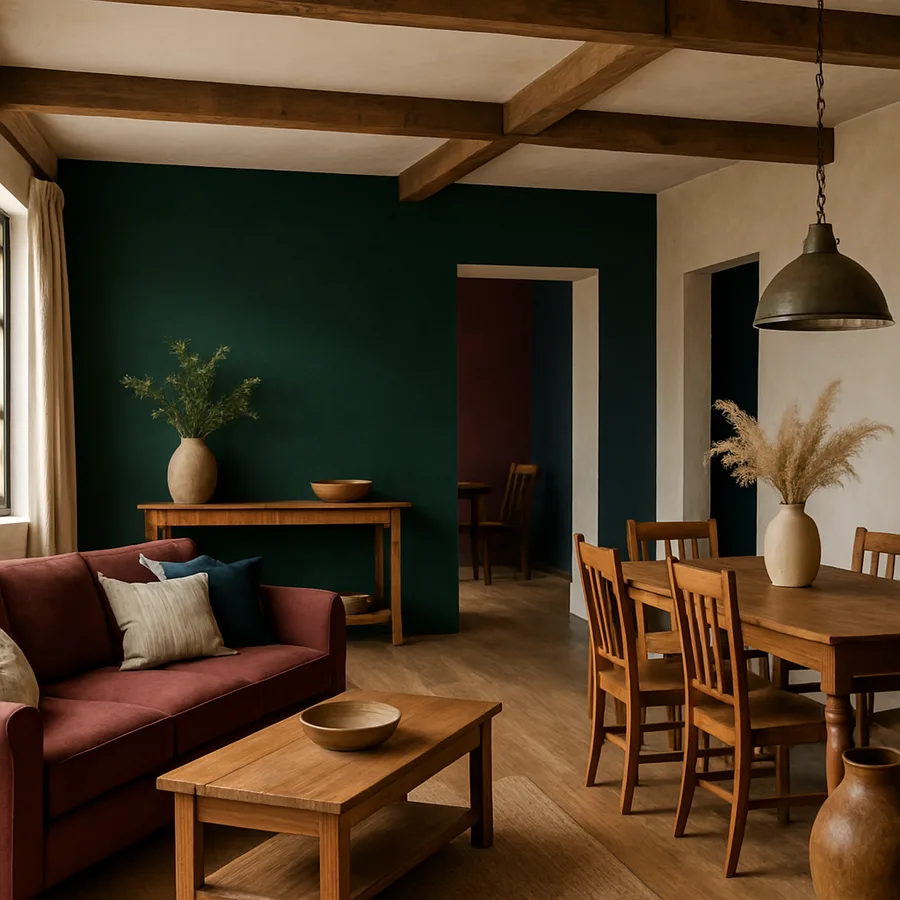
Why Open Layouts Demand a Different Approach to Accent Walls
An accent wall in a traditional room with four clearly defined walls and a single doorway is a relatively straightforward decision. You pick the wall that draws the most attention, paint it a contrasting color or apply a distinctive material, and the room's boundaries do the rest of the work framing your choice. Open concept floor plans shatter that simplicity because the absence of partition walls means every surface is visible from multiple vantage points simultaneously. A color choice that looks balanced from the kitchen might feel jarring from the living area, and a texture that anchors one zone could visually compete with another zone thirty feet away.
The American Society of Interior Designers (ASID) reports that open floor plans remain the dominant layout preference in residential construction, with over 60 percent of new single-family homes built since the mid-2010s featuring some form of combined living, dining, and kitchen space. This sustained popularity means that millions of homeowners face the specific challenge of adding visual interest to a layout that, by design, resists the compartmentalized logic of traditional decorating. The accent wall remains one of the most effective tools for creating focal points and defining zones within these expansive spaces, but only when placed with deliberate consideration for how the entire floor plan reads as a connected whole.
The fundamental principle that governs accent wall placement in open layouts is sightline management. Unlike enclosed rooms where you experience walls sequentially as you move through a doorway, open concept homes present multiple walls at once from almost every standing and seated position. This means your accent wall must work not just on its own terms but in visual relationship with every other surface visible alongside it. Have you ever walked into an open layout home and felt that something was visually off without being able to pinpoint exactly what? In many cases, the issue is an accent wall that was chosen for one zone without accounting for its impact across the broader space.
The good news is that open floor plans actually offer more opportunities for dramatic accent walls than enclosed rooms do, precisely because the longer sightlines create a larger visual stage. A well-placed accent wall in an open layout can serve as a landmark that orients movement through the space, establishes hierarchy between zones, and provides the visual weight that prevents a large room from feeling like an undifferentiated box. The rules that follow are not restrictive so much as clarifying: they help you identify which wall will do the most work for the least visual cost.
Identifying the Primary Sightline and Anchor Wall
Every open concept floor plan has a primary sightline, which is the longest uninterrupted line of vision from the most commonly used entry point to the far wall or window. This sightline is the visual backbone of the space, and the wall that terminates it carries disproportionate importance because it is the first thing most people register when they enter. In many homes, this is the far wall of the living area as viewed from the front entry or the main hallway. In others, it might be the wall behind the dining table or even a prominent section of the kitchen. Walking through your front door and noting exactly where your eyes land first will reveal your primary sightline with remarkable clarity.
The wall that terminates this primary sightline is your strongest candidate for an accent treatment. Placing your accent wall here leverages the natural focal hierarchy of the space, working with the architecture rather than against it. The Architectural Digest design guide emphasizes that successful accent walls in open plans almost always align with the dominant sightline because this placement feels instinctive to occupants and visitors alike. When the accent wall sits at the natural resting point of the eye, it reads as intentional and grounded rather than arbitrary.
Resist the temptation to place the accent wall on a side wall that runs parallel to the primary sightline, especially in long, narrow open layouts. A lateral accent wall in this configuration fragments the visual flow by pulling attention sideways, creating a sense of imbalance that makes the space feel wider on one side than the other. There are exceptions, particularly when a fireplace, built-in shelving, or other architectural feature occupies a side wall and deserves emphasis. But in the absence of such a feature, the anchor wall at the end of your longest view will almost always be the most effective choice. This wall grounds the entire layout and gives the open space a sense of destination.
For L-shaped and irregularly configured open floor plans, identifying the primary sightline requires a bit more nuance. Stand at each major entry point, the front door, the garage entry, the hallway from bedrooms, and map where your gaze naturally settles. If multiple entry points converge on the same wall, that convergence confirms it as the dominant anchor. If different entries point toward different walls, prioritize the entry that receives the most daily traffic. The accent wall should serve the experience you have most often, not the one that happens occasionally when guests arrive through a secondary entrance.
Using Color Weight to Define Zones Without Closing Them Off
One of the primary functions of an accent wall in an open floor plan is zone definition, visually distinguishing the living area from the dining area or the kitchen from the family room without erecting physical barriers. Color is the most powerful tool for achieving this, but the wrong color choice can make a zone feel severed from the rest of the space rather than gently differentiated. The key is understanding color weight: how heavy or light a color feels relative to the surrounding walls, and how that weight shifts the perceived boundaries of the zone it occupies.
Dark, saturated colors like charcoal, deep navy, or forest green carry significant visual weight and will make the wall they occupy appear to advance toward the viewer. This advancing quality is useful when you want to create a sense of intimacy within a larger space, such as making a living room seating area feel cozier within a vast open layout. According to a survey conducted by the Paint Quality Institute, homeowners who use dark accent walls in open concept spaces report higher satisfaction when the accent color is limited to a single wall within a defined zone, rather than wrapping around a corner into an adjacent zone. The containment prevents the heavy color from overwhelming the flow of the broader space.
Lighter accent colors, including muted pastels, warm terracottas, and soft sage greens, offer zone definition with less visual disruption. These colors create differentiation that you register subconsciously rather than something that demands immediate attention. In a home where the open layout flows between three or more functional zones, lighter accent tones maintain the sense of spaciousness that the floor plan was designed to achieve. The Houzz community polls consistently show that mid-tone accent walls in open plans receive higher approval ratings than very dark or very bright options, suggesting that most people instinctively prefer moderation when there are no walls to contain the visual impact.
Whatever color you choose for the accent wall, the surrounding walls should share a cohesive base tone that runs continuously through all zones of the open layout. This continuous base creates the visual thread that holds the space together, making the accent wall read as a deliberate punctuation mark rather than an error. If the living zone features a deep blue accent wall, the kitchen, dining, and hallway walls should all wear the same neutral to maintain unity. Introducing different neutrals in different zones, even subtle variations, risks making the open plan look like several rooms awkwardly stitched together rather than a single cohesive space with intentional moments of emphasis.
Architectural Features That Dictate Accent Wall Placement
Before choosing an accent wall based purely on sightlines and color strategy, take inventory of the architectural features already present in your open layout. Fireplaces, built-in shelving units, large window banks, exposed beams, and structural columns all create pre-existing focal points that your accent wall must either reinforce or respectfully avoid competing with. In most cases, the wisest approach is to let these features guide your placement rather than fighting against the visual hierarchy the architecture has already established.
A fireplace wall is almost always the correct accent wall in any room where a fireplace exists, and this principle becomes even more important in open concept spaces. The fireplace already functions as a gathering point and a natural break in the wall plane, giving it inherent visual authority that an accent treatment amplifies beautifully. The National Kitchen and Bath Association (NKBA) notes that fireplace walls in open concept homes serve as the strongest zone anchors available, defining the living area more effectively than any furniture arrangement alone. Painting or cladding the fireplace wall in a contrasting color or material, such as stone veneer, shiplap, or limewash brick, reinforces its natural dominance and gives the living zone a clear center of gravity.
Large window walls present an interesting exception to typical accent wall logic. A wall composed primarily of glass already commands attention through the light and views it offers, making it a powerful focal point without any color treatment. Adding a bold paint color to a window wall is usually unnecessary and can create an awkward visual competition between the color and the view beyond it. Instead, consider the wall directly opposite the window bank as your accent candidate. This placement means the accent wall receives the most natural light in the room, which intensifies the color and draws the eye away from the architecture of the windows themselves toward a surface you have deliberately chosen to emphasize.
Structural columns and partial walls that remain in open concept layouts after walls have been removed during renovation deserve careful consideration. These elements often create natural boundaries between zones, and the surfaces adjacent to them are logical accent wall candidates. A partial wall or half-height pony wall separating the kitchen from the living area can receive an accent treatment on the living room side, marking the transition between zones without fully enclosing either one. Are there any structural remnants in your open layout that you have been treating as obstacles rather than opportunities? Often these elements, when embraced with color or material, become the most characterful features in the home.
Material Accent Walls and Their Spatial Impact
Paint is the most accessible accent wall treatment, but material-based accent walls using wood, stone, tile, or textured panels bring a dimensional quality that flat color cannot replicate. In open concept spaces, the three-dimensional texture of a material wall creates visual depth that helps compensate for the flatness inherent in large, unbroken interior volumes. A reclaimed wood plank wall, for instance, introduces warmth, pattern variation, and tactile interest that registers from across the room and rewards closer inspection when you sit near it. This dual-distance appeal makes material walls particularly effective in open layouts where the accent surface must read well from both far and near vantage points.
The acoustic properties of material accent walls are an underappreciated benefit in open concept homes. Hard surfaces and large volumes combine to create significant echo and noise transfer between zones, which is one of the most common complaints about open floor plans. The Acoustical Society of America has documented that textured wall treatments, particularly wood planks with gaps, fabric panels, and dimensional stone, measurably reduce sound reflection compared to flat painted drywall. A wood accent wall in the living zone can soften the sound of kitchen conversation and cooking noise, improving the acoustic comfort of the space while serving its aesthetic purpose. According to industry data, roughly 40 percent of homeowners with open layouts report dissatisfaction with noise levels, making acoustic benefits a meaningful secondary advantage of material accent walls.
Scale and proportion matter enormously when selecting materials for an accent wall in an open layout. Large-format materials like oversized stone tiles or wide wood planks suit expansive walls and high ceilings, while smaller-format materials like mosaic tiles or narrow shiplap can feel busy and overwhelming at the distances from which they will be viewed in an open plan. The general guideline is to match material scale to viewing distance: the farther away most people will be when they look at the accent wall, the larger the individual material units should be. This principle ensures that the pattern reads clearly rather than dissolving into visual noise from across the room.
Cost is a practical reality that influences material selection. A full stone veneer accent wall can run between 25 and 50 dollars per square foot installed, while reclaimed wood planks typically fall between 10 and 30 dollars per square foot depending on species and sourcing. Peel-and-stick wood panels and faux stone veneers have improved dramatically in quality and now offer convincing alternatives at a fraction of the cost of genuine materials. If budget constraints limit your material options, consider a hybrid approach: apply the material treatment to the lower two-thirds of the accent wall and paint the upper third in a complementary tone. This wainscot-style division reduces material costs while still delivering significant visual and textural impact.
Common Placement Mistakes and How to Correct Them
The single most common accent wall mistake in open concept homes is placing the accent on a wall that is only partially visible from the primary living zones. A wall that disappears behind a kitchen island or gets cut off by a hallway opening reads as incomplete from most positions in the room, creating visual frustration rather than satisfaction. Before committing to a wall, stand in every seated position, the sofa, dining chairs, kitchen bar stools, and confirm that the full accent wall is visible from each one. If any primary seating position cannot see the complete wall, that wall is not the right choice. The accent must be fully appreciable from where people actually spend time, not just from the spot where you happened to be standing when the idea occurred to you.
Another frequent error is creating multiple accent walls within the same open layout. In an enclosed room, a single accent wall works because the other three walls provide a consistent backdrop that frames it. In an open floor plan, the absence of separating walls means that two accent walls in different zones will be visible simultaneously, and they will compete for attention rather than complementing each other. The visual result is confusion about where to look and a loss of the focal hierarchy that makes spaces feel organized. Restrict yourself to one accent wall per open layout, and let it be strong enough to anchor the entire space on its own.
Wrapping an accent color around a corner is a subtler mistake that nonetheless undermines the impact of the treatment. When a wall turns a corner, the two surfaces created by that corner have different light exposures and are viewed at different angles, which makes the same color look like two different colors depending on where you stand. This inconsistency weakens the accent rather than strengthening it. Stop the accent color cleanly at inside corners, using the natural edge of the wall plane as your boundary. If a wall turns an outside corner, as in a fireplace bump-out or a column surround, wrapping the color around that outside corner can work because the surfaces share similar light exposure and the wrap emphasizes the three-dimensional form of the projection.
Finally, neglecting the ceiling plane is a missed opportunity in open concept homes with standard eight-foot ceilings. The National Association of Home Builders (NAHB) data shows that average ceiling heights in new construction have increased over the past two decades, but many existing homes still feature lower ceilings that can make open layouts feel compressed. Extending the accent wall color onto the ceiling directly above it, creating a color-drenched alcove effect, adds vertical drama and makes the accent zone feel more immersive without adding any physical boundaries. This technique works best with darker colors and in zones where a sense of enclosure is desirable, such as a living room seating area surrounded by higher-ceilinged kitchen and dining zones. If your open layout suffers from visual monotony across a flat, continuous ceiling, this ceiling extension is one of the most transformative moves available.
Conclusion: Letting the Architecture Guide Your Boldest Decision
Accent wall placement in an open concept floor plan is fundamentally an exercise in reading the space before acting on it. The primary sightline, the architectural features already in place, the functional zones that need definition, and the way light moves through the layout across the day all provide guidance that, when followed, makes the accent wall feel inevitable rather than imposed. The best accent walls in open homes look as though they could not have been placed anywhere else, and that sense of rightness comes from listening to what the space is already telling you.
The rules outlined here, anchor to the primary sightline, respect existing focal points, limit yourself to one accent wall, match color weight to the zone's intended mood, are not arbitrary design dogma. They emerge from the practical reality that open layouts present every surface simultaneously, leaving no room for choices that only work from one angle. When you honor that simultaneous visibility, your accent wall becomes a powerful organizing element that gives shape and character to a space that might otherwise feel sprawling and undefined.
Start your planning process by spending a full day noticing where your eyes go as you move through your open layout. Sit in every chair, stand at the kitchen counter, pause in the hallway entry, and pay attention to which wall surfaces consistently draw your gaze. That observation period will reveal the natural focal hierarchy of your home more reliably than any design rule or trend forecast. Once you know where the space wants you to look, applying color or material to that wall becomes a confident decision rather than a nervous gamble. Trust the architecture, commit to a single bold move, and let the rest of the space support it quietly.
More Articles You May Like



Comments
Post a Comment