Arched Interior Doorways: Adding Curves to a Boxy Home
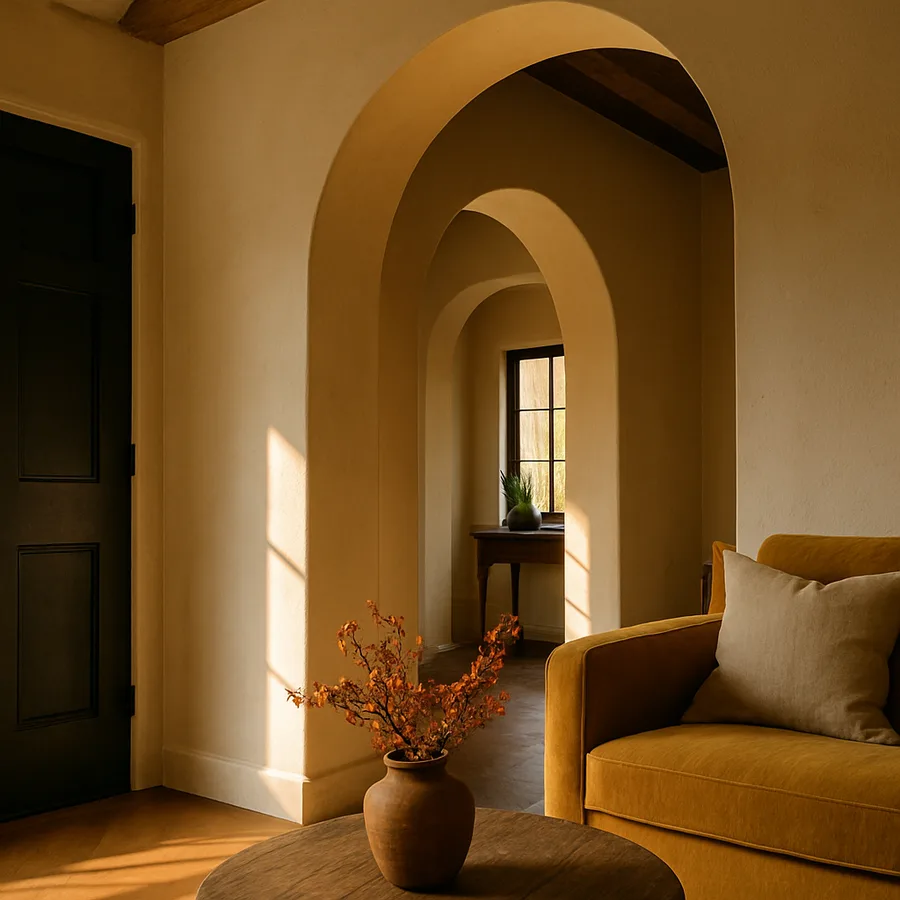
Why Boxy Rooms Feel Stiff and How Arches Fix It
Most residential construction relies almost exclusively on right angles. Walls meet ceilings at ninety degrees, doorways form perfect rectangles, and window openings follow the same rigid geometry. This approach is efficient to build and economical to frame, which is why it dominates standard home construction. But efficiency comes at an aesthetic cost. Rooms composed entirely of straight lines and sharp corners can feel clinical, repetitive, and devoid of the organic warmth that makes a space feel genuinely inviting. The eye moves through a rectilinear room in predictable straight paths, and the resulting visual experience is monotonous even when the furnishings are beautiful.
Arched doorways interrupt that monotony with a single powerful gesture. The curve of an arch introduces a line that no other element in a standard home provides, drawing the eye upward and creating a moment of visual interest at every transition between rooms. This upward pull also makes ceilings feel taller, because the eye follows the curve past the point where a rectangular header would have stopped. According to research discussed by the American Institute of Architects (AIA), curved architectural elements consistently rank among the top three features homebuyers associate with premium construction quality, even when the actual build cost difference is modest.
The psychological effect of curves in interior architecture has been studied with increasing rigor. A frequently cited study conducted at the University of Toronto found that participants rated rooms with curved architectural features as significantly more pleasant and calming than rooms composed entirely of straight lines and sharp angles. The curved forms activated brain regions associated with reward and aesthetic appreciation more strongly than their angular counterparts. While a single archway will not transform a space on its own, it contributes to an overall sensory experience that most people find more comfortable without being able to articulate exactly why.
Beyond the visual and psychological benefits, arches serve a practical spatial function. In open-concept homes, where rooms flow into one another without full partition walls, an archway creates a sense of transition and boundary without blocking sightlines or light. It says "you are entering a different zone" in a way that a rectangular opening does not, because its distinctive shape registers as a threshold. This subtle delineation helps large, open floor plans feel organized and intentional rather than like a single undifferentiated volume. Have you ever walked through an open-plan home and struggled to identify where the living room ends and the dining room begins? An arch solves that problem elegantly.
Arch Styles and How to Match Them to Your Home
The Roman arch, also called a semicircular arch, is the most classic and widely recognized form. Its curve describes a perfect half-circle, creating a bold, symmetrical shape that works in traditional, Mediterranean, and Spanish Colonial interiors. The proportions are generous and the effect is distinctly architectural, making this style best suited to wider openings of at least 36 inches where the semicircle has room to express itself fully. In narrow doorways, a full semicircle can feel compressed and awkward, so reserve this style for passages where the width-to-height ratio allows the curve to breathe.
The segmental arch uses a shallower curve, an arc that is less than a semicircle, and is the most versatile option for residential retrofits. Because the curve is subtle, it integrates easily into contemporary, transitional, and even modern farmhouse interiors without feeling overtly historical. The segmental arch also requires less vertical clearance than a semicircular arch, making it practical for homes with standard eight-foot ceilings where a full half-circle would crowd the header. The Houzz design community consistently identifies the segmental arch as the most popular choice among homeowners adding arches to existing construction, precisely because of this adaptability.
The Tudor arch, sometimes called a four-centered arch, features a pointed peak that flattens into gentle curves on either side. This style carries strong associations with English cottage and Arts and Crafts architecture. It reads as historical and somewhat formal, making it appropriate for homes that already feature exposed timber, leaded glass, or other period details. In a thoroughly modern home, a Tudor arch would feel like a costume piece, but in the right context it adds unmistakable character. Designers at ASID recommend matching arch style to the home's existing architectural vocabulary rather than importing a style that contradicts the building's fundamental character.
The elliptical arch stretches horizontally, creating an oval-shaped curve that is wider than it is tall. This form works exceptionally well above extra-wide openings, such as the passage between a kitchen and a great room, where a semicircular arch would require impractically tall clearance. The elliptical shape feels contemporary and relaxed, carrying less historical weight than the Roman or Tudor forms. It also pairs naturally with modern furnishings and clean-lined cabinetry, making it a strong choice for newly built or recently renovated homes pursuing a current aesthetic without abandoning warmth.
Structural Considerations Before You Build
The first and most critical question is whether the wall containing the target doorway is load-bearing. Load-bearing walls support structural weight from above, which means any modification to the opening requires engineering analysis and potentially a new header beam. Non-load-bearing partition walls are far simpler to modify because they carry only their own weight. A structural engineer or experienced contractor can determine a wall's load-bearing status through visual inspection of the framing, and this assessment should always precede any design planning. The National Association of Home Builders (NAHB) strongly advises against DIY modifications to load-bearing walls without professional engineering oversight.
Ceiling height determines which arch styles are feasible. In homes with standard eight-foot ceilings, the space between the top of a standard 80-inch door frame and the ceiling is only 16 inches, which constrains the height of any curved addition. A segmental arch with a rise of four to six inches fits comfortably within this constraint. A full semicircular arch on a 36-inch-wide opening would require 18 inches of rise, which would crowd against the ceiling unless the opening is narrowed or the ceiling is unusually high. Homes with nine-foot or ten-foot ceilings have significantly more freedom, and the additional vertical space allows grander arch proportions that make a correspondingly stronger visual statement.
Framing the arch itself involves building a curved structure within the rectangular rough opening. The most common method uses thin plywood or hardboard cut into the desired curve, attached to the existing framing, and then covered with drywall or plaster. The drywall must be thin enough to bend, typically quarter-inch flexible drywall, or scored on the backside to accept the curve without cracking. Finishing the curved surface to a smooth, seamless result is the most skill-intensive part of the project and the step where amateur execution most often falls short. A visible seam, a bumpy curve, or inconsistent radius will undermine the entire effect.
Permits and code compliance vary by municipality but generally apply whenever you alter a structural opening. Even for non-load-bearing walls, some jurisdictions require a permit for any work that changes the dimensions of a doorway. Check with your local building department before beginning work. The permit process, while sometimes tedious, protects you by ensuring the work is inspected and documented, which matters when you eventually sell the home. Unpermitted structural modifications can surface during a buyer's inspection and create significant complications in the transaction. Is a potential sale years away? Permits still matter, because the cost of retroactive compliance always exceeds the cost of doing it right initially.
Surface Finishing Options for Your Arch
Smooth plaster is the most traditional and arguably the most elegant finish for an arched doorway. A skilled plasterer applies multiple thin coats, sanding between each, to create a seamless curve that transitions imperceptibly from the flat wall surface into the arc. The result feels monolithic, as though the arch and the wall were carved from a single mass of material. This technique is labor-intensive and requires genuine craft skill, but the finished product has a quality that no other method fully replicates. In regions with strong plasterer traditions, like the American Southwest and parts of Southern California, this remains the default approach.
Drywall finishing is more common and more affordable than traditional plaster. Flexible drywall bends to the arch's curve and is then taped, mudded, and sanded like any flat drywall joint. The challenge is achieving a perfectly smooth curve at the transition point where flat wall meets curved arch. Multiple coats of joint compound, each feathered wider than the last, build up the transition gradually. Patience at this stage is non-negotiable; rushing the mudding and sanding produces visible ridges that catch light and reveal the underlying construction. A quality drywall finish, once painted, is visually indistinguishable from plaster to all but the most trained eyes.
Exposed brick or stone around the arch creates a dramatically different effect, one that reads as rustic, Mediterranean, or industrial depending on the material and the surrounding context. Thin brick veneer or manufactured stone veneer can be applied over a standard drywall arch to achieve this look without the weight and complexity of full masonry. The Architectural Digest archives include numerous examples of veneered arches that convincingly evoke centuries-old construction. This treatment works particularly well when limited to a single archway that serves as a focal point, rather than applied uniformly throughout the home, which can feel thematically heavy.
Wood casing and trim offer yet another direction. A shaped wood molding that follows the arch's curve, installed in the same profile as the home's existing door casings, creates a finished look that integrates the new arch into the home's trim vocabulary. This approach is especially effective in Craftsman, colonial, and traditional homes where robust wood trim is already a defining feature. Curved moldings can be purchased pre-bent from specialty millwork suppliers or custom-bent using kerf-cutting techniques that allow straight molding stock to follow a curve. The casing choice should match the existing trim species and profile exactly for seamless integration.
Where Arches Make the Biggest Impact
The entry from foyer to main living space is the single highest-impact location for an arched doorway. This is the first major transition a visitor experiences upon entering the home, and an arch at this threshold immediately communicates intentional design. The effect is one of welcome and ceremony; stepping through an arch feels like an arrival in a way that walking through a rectangular opening does not. If you plan to add only one arch to your home, this is the placement that will deliver the most dramatic return on investment, both visually and in terms of perceived home value.
Passages between kitchens and dining rooms benefit enormously from arched openings. These two spaces share a functional relationship centered on meals and gathering, and an arch between them reinforces that connection while maintaining a sense of separate identity for each room. The arch frames views of the dining table from the kitchen and vice versa, creating visual depth and encouraging the sense that the two rooms are in dialogue. According to the National Kitchen and Bath Association, arched transitions between kitchen and dining spaces appear consistently in the organization's annual design trend reports as a feature associated with high-end residential projects.
Hallway openings are often overlooked as arch candidates, but they offer excellent opportunities for relatively low-cost, high-impact modifications. Long, narrow hallways are among the least architecturally interesting spaces in any home, and an arch at the hallway entrance or at a midpoint along its length breaks the tunnel effect and introduces a moment of visual relief. The arch does not need to be grand; a modest segmental curve is enough to transform the hallway from a purely utilitarian passage into something worth noticing. Pairs of arches, one at each end of a hallway, create a rhythmic repetition that gives the corridor genuine architectural character.
Master bedroom suites increasingly feature arched openings between the sleeping area and an attached sitting room or closet vestibule. This application brings the soft, calming quality of curves into the most personal room in the home. The arch signals a shift in function, from sleeping to dressing, from rest to preparation, without the hard interruption of a closed door. It is a particularly effective choice in bedrooms designed around relaxation and comfort, where every design decision should contribute to a feeling of calm enclosure. What would it feel like to walk through a graceful curve every morning on your way to start the day?
Cost, Timeline, and Hiring the Right Contractor
Costs for adding an arched doorway vary significantly based on whether the wall is load-bearing, the complexity of the arch style, and the chosen finish. A simple segmental arch in a non-load-bearing partition wall, finished with drywall and paint, typically runs between $800 and $2,500 including materials and labor. Load-bearing walls add the cost of a structural engineer's assessment, usually $300 to $600, plus a properly sized header beam and its installation, which can push the total to $3,000 to $6,000 or more. These figures reflect national averages reported by the National Association of Home Builders and will vary by region and contractor.
Timeline for a single non-load-bearing arch is typically two to four days from demolition to finished paint. Day one involves removing the existing casing, modifying the framing, and installing the curved form. Day two covers drywall application and the first coat of joint compound. Days three and four are consumed by additional coats, sanding, priming, and painting, with dry time between coats determining the pace. Load-bearing modifications add one to three days for the structural work and inspection. These timelines assume a single arch; multiple arches in the same project benefit from economies of scale, as setup and finishing tools are already on site.
Hiring the right contractor matters more for arch work than for many other home improvements because the finishing quality is so visible. A straight wall can tolerate minor imperfections that paint conceals, but a curved surface reveals every bump, ridge, and inconsistency under raking light. Ask potential contractors specifically about their experience with curved drywall or plaster work, and request photographs of completed arch projects. A contractor who primarily builds decks and replaces windows may be perfectly competent in their specialty but unprepared for the finishing precision an arch demands.
For homeowners considering a DIY approach, non-load-bearing arches in standard-width doorways are within the reach of experienced do-it-yourselfers who have solid drywall finishing skills. The framing and form construction are straightforward carpentry, and numerous detailed video tutorials from reputable sources walk through each step. Where most DIY arch projects stumble is in the compound curves at the transition from wall to arch, where joint compound must be applied, dried, and sanded in multiple passes to achieve smoothness. If you have mudded and sanded flat drywall joints successfully, you have the foundational skill; the curve simply requires more patience and more passes. If you have never finished drywall before, an arch is not the appropriate first project.
Conclusion: One Curve Can Change an Entire Home
Arched doorways accomplish something that very few individual design modifications can: they alter the fundamental character of a home without changing its footprint, its floor plan, or its furnishings. A single well-placed arch introduces an organic form into a rectilinear environment, creating a visual counterpoint that makes every straight line around it feel more intentional by contrast. The effect radiates outward from the archway, influencing how the entire room, and often the entire floor, is perceived.
The practical considerations, load-bearing analysis, ceiling height constraints, finish selection, and contractor vetting, are real and deserve serious attention. But they are solvable problems, not barriers. Thousands of homeowners add arched doorways to existing construction every year, across every style of home and every budget tier. The key is matching the arch style to your home's architectural vocabulary, investing in quality finishing, and choosing a location where the arch will be seen and appreciated daily rather than tucked away in a seldom-used passage.
If the idea of adding curves to your home resonates, begin with an assessment of your most-used doorway. Stand in the opening, look up at the rectangular header, and imagine a gentle curve replacing that hard horizontal line. Photograph the space and share it with a contractor who has demonstrated arch experience, and ask for a sketch of what a segmental or elliptical arch would look like in that specific opening. That single conversation will tell you whether this project belongs on your renovation list, and for most homeowners who take that step, the answer is an emphatic yes.
More Articles You May Like



Comments
Post a Comment