Window Box Soil Mix For Trailing Versus Upright Plants
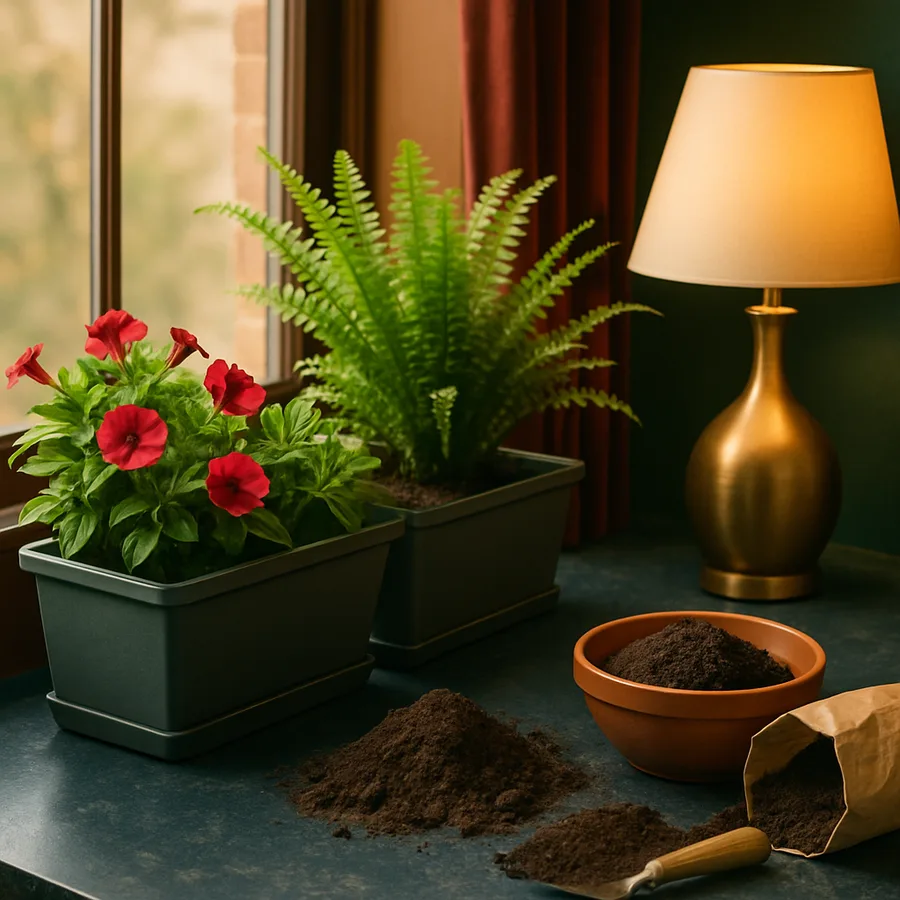
The bag of "potting soil" at the hardware store is a starting point, not an answer. A trailing sweet potato vine cascading three feet down the side of a porch and an upright dwarf snapdragon standing twelve inches above the rim of the same box have wildly different root architectures, water needs, and nutrient draws. Filling both halves of the box with the same generic mix is the most common reason mixed plantings look great in June and ragged by August.
The good news: matching soil to plant type is not complicated, and the small effort of building two slightly different mixes pays off in roughly three weeks of better appearance during peak summer.
What Do Trailing Plant Roots Actually Need?
Trailing plants such as bacopa, calibrachoa, sweet potato vine, ivy geranium, and lobelia produce extensive shallow, fibrous root systems. The roots tend to spread laterally near the surface rather than driving deep, which is an adaptation to the trailing habit. The plant invests in surface area for water capture because the foliage is constantly losing moisture as it cascades into open air.
What this means practically: trailing plants want a soil mix that holds moisture in the top three to four inches of the soil column. The Royal Horticultural Society recommends a peat-coir blend with around 30 percent perlite by volume for cascading container plants. That gives you enough water retention to keep the surface zone consistently moist through midday heat, with enough air space to prevent the dense surface roots from suffocating after a heavy watering.
A common mistake is reaching for a moisture-retention crystal additive (the polyacrylamide gels sold for containers). The University of Maryland Extension has documented that these crystals work well for upright plants with deep roots but can hold so much water in the surface layer that shallow-rooted trailers develop crown rot. Skip them for the trailing side of the box.
Soil pH is the other quiet factor that affects trailing plants more than uprights. Most peat-based mixes start mildly acidic (pH 5.5 to 6.2), which suits the majority of trailing annuals, but the pH drifts upward through the season as alkaline tap water and fertilizer salts accumulate. By August the same mix can read pH 7.0 or higher, which is enough to lock out iron uptake in calibrachoa and verbena and produce the yellowing leaves that most homeowners mistake for nitrogen deficiency. A monthly test with a $10 soil pH meter, or a quick rinse with rainwater if you have a barrel, keeps the pH in the right range without any guesswork. This is one of those small habits that separates window boxes that look great in mid-September from boxes that have visibly checked out by Labor Day.
How Are Upright Plant Roots Different?
Upright window box plants such as geraniums, snapdragons, salvia, and dwarf zinnias drive deeper, woodier root systems. The taproot or central root mass typically reaches the bottom of a 9-inch box within four weeks of planting, and the secondary roots branch laterally from the lower half of the soil column rather than the upper.
This changes the soil priorities significantly. Upright plants want more structure at depth, better drainage at the bottom of the box, and a higher nutrient reservoir to fuel vertical growth and flowering. The American Society for Horticultural Science has published research showing upright bedding plants in containers grow 20 to 35 percent more biomass when the lower half of the soil column contains 25 to 30 percent coarse perlite or pumice, compared to a uniform peat mix throughout.
Practically, this means building a layered mix on the upright side: a slightly coarser blend at the bottom four inches and a finer blend at the top. The two layers do not need to be wildly different. A 70/30 peat-perlite at the bottom and a 80/20 peat-perlite at the top works well for most upright annuals.
Can A Single Box Hold Two Different Soil Mixes?
Yes, and this is the trick that separates window boxes that hold their look through August from the ones that do not. The technique is straightforward: divide the box mentally into the upright zone (typically the back row, against the wall) and the trailing zone (typically the front rim).
Fill the upright zone with the layered coarser mix described above. Fill the trailing zone with a finer, more moisture-retentive blend. The two mixes will blend slightly at their interface within the first watering, but the bulk of each root system will stay in its preferred zone for the full season.
One reader question that comes up often: do the two mixes need a physical barrier between them? No. Roots from neither plant type will cross the interface in significant numbers if each plant has its preferred conditions where it was planted. The roots simply have no reason to leave the optimal zone.
The USDA Agricultural Research Service has published container research showing that zoned soil mixes in mixed plantings improve overall plant performance scores by roughly 15 percent compared to uniform mixes, and that the effect is most pronounced in the second half of the growing season when plants are most stressed.
What About Fertilizer Strategy For Mixed Plantings?
Trailing and upright plants do not draw nutrients at the same rate or the same depth. A surface-applied granular fertilizer feeds the shallow trailers efficiently but barely reaches the deep root zone of the uprights before the next watering washes it through.
The strategy that works best for mixed window boxes uses two fertilizer applications. First, mix a slow-release pelleted fertilizer (Osmocote or equivalent, with a roughly 14-14-14 NPK ratio) into the lower half of the soil column at planting time at a rate of about one tablespoon per gallon of soil volume. This feeds the upright plants slowly through their deep roots over the full season.
Second, apply a water-soluble bloom fertilizer (with a higher phosphorus ratio such as 10-30-20) at half strength every two weeks through the watering can. This delivers nutrients to the surface where the trailing plants can use them and supports flowering across the whole box.
Cornell University's container gardening guidance specifically recommends this two-track fertilizing approach for any mixed planting where the deep-rooted and shallow-rooted plants are expected to perform equally through the season. A single fertilizer strategy almost always favors one group at the expense of the other.
A note on micronutrients that often gets overlooked: iron and magnesium deficiencies show up faster in container plantings than in ground beds, particularly in alkaline tap water regions. Yellowing between the leaf veins of geraniums or calibrachoa by mid-July is almost always an iron-availability issue, not a nitrogen one, and a single foliar application of chelated iron will correct it within a week. Adding a small dose of Epsom salt (one tablespoon per gallon of water, monthly) addresses magnesium and visibly improves flower color saturation across most window box species.
How Often Should I Refresh The Soil In A Window Box?
Annual replacement of all soil is overkill in most climates and wastes both money and the soil structure that has built up over the first season. The honest answer: replace the top third every spring and replace everything once every three years.
The reason the top third matters most: that is where salt buildup from fertilizers concentrates, where compaction is highest from rainfall impact, and where most of the seasonal mineral depletion happens. Pulling out the spent annuals also pulls out most of the surface root mass, so the top three to four inches is going to be disturbed anyway. Replace it with fresh mix, scratch in fresh slow-release fertilizer, and plant.
The Penn State Extension has documented that container soil structure (the pore space and crumb structure that supports healthy roots) collapses noticeably after about three growing seasons under typical watering, regardless of how good the original mix was. At the three-year mark, full replacement restores drainage and air space without needing to overthink the mix.
One more reader question worth addressing: can I reuse old potting mix in next year's box? Yes, but blend it 50/50 with fresh mix, and only use it where you are not planting the same species as the year before. Soil-borne disease pressure builds in containers faster than in open ground, and repeat-planting the same species in the same mix is a reliable way to invite trouble.
Where To Start
Pick your plants first, then decide your mix. If your box will be all trailing plants (a sweet potato vine and calibrachoa monoculture, for instance), use the fine, moisture-retentive mix throughout and skip the layering. If it will be all upright (geraniums and snapdragons), use the coarser layered mix throughout. The zoned approach only earns its complexity in genuine mixed plantings where you have both habits in the same box.
From there, build the mixes from named components rather than buying premixed bags labeled for "window boxes," which are usually generic peat-perlite blends sold at a premium. A bale of compressed coir, a bag of perlite, and a bag of slow-release fertilizer will mix enough custom soil for three boxes at lower total cost than buying premixed. Mix it on a tarp, fill the box, water it once before planting so the mix settles, top off if needed, and then plant. The single most common first-season mistake is to skip the pre-watering settle step and end up with a box that looks half-empty within a week.
More Articles You May Like



Comments
Post a Comment