
Door Knob Backset Measurement Two And Three Eighths Versus Two And Three Quarters
Door Knob Backset Measurement Two And Three Eighths Versus Two And Three Quarters
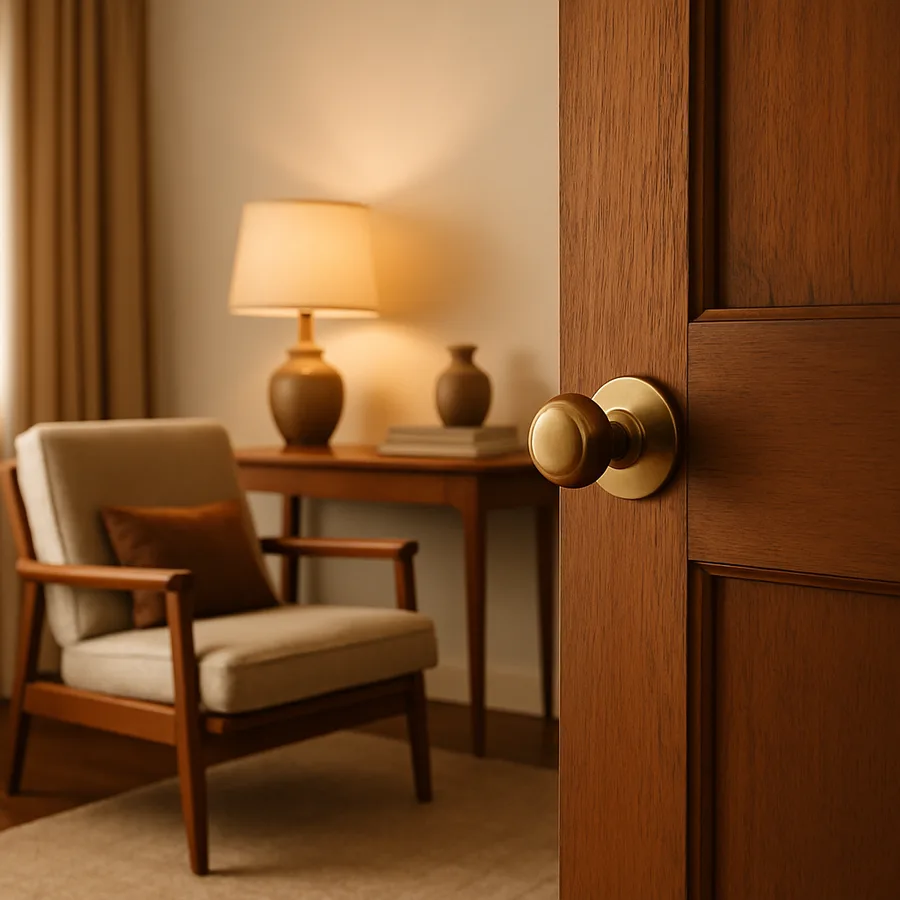
Stand in front of any interior door in a typical American home, pull the knob loose, and you will find one of two numbers stamped into the latch face: 2-3/8" or 2-3/4". These are the only two backset dimensions you are ever likely to encounter in residential construction, and yet they trip up homeowners, remodelers, and even seasoned trim carpenters with surprising regularity. Choosing the wrong one means a knob that hits the doorstop, a latch that will not throw, or a strike plate that misses by a frustrating quarter inch.
The backset is simply the distance from the edge of the door to the center of the bored hole where the knob spindle passes through. It is one of the oldest standardized measurements in the door hardware industry, governed today by the Builders Hardware Manufacturers Association (BHMA) under ANSI/BHMA A156.2 for bored locks. Understanding which backset you have, and why, prevents a return trip to the hardware store and a lot of swearing in the hallway.
Where The Two Backset Standards Came From
Before the 1950s, mortise locks dominated American doors. A locksmith chiseled a deep rectangular pocket into the edge of the stile and dropped in a brass case that handled latching, locking, and the spring action all in one assembly. Backset on a mortise lock was determined by the lock body itself, and there was no real industry standard.
The bored cylindrical lock, patented by Walter Schlage in the 1920s and refined through midcentury, changed everything. Instead of a chiseled pocket, the new design used two perpendicular drilled holes: a 2-1/8" cross-bore through the face of the door and a 1" edge-bore for the latch. The backset, measured from the door edge to the center of the cross-bore, needed a consensus number. Manufacturers settled on 2-3/8" for interior residential doors and 2-3/4" for exterior and heavier-duty applications. According to the Door and Hardware Institute, more than 90% of US residential interior doors built since 1970 use the 2-3/8" backset, while 2-3/4" predominates on exterior and commercial doors.
Why two numbers instead of one? The longer backset gives the lock body more clearance for deadbolt cylinders, security pins, and the thicker reinforcing plates demanded by exterior doors. The shorter backset keeps the knob closer to the door edge, where it feels natural to the hand and leaves more room for narrow stiles on closet and pantry doors.
The history is also a story of incremental harmonization. Schlage, Yale, Sargent, Russwin, and Corbin each had slightly different preferred dimensions throughout the postwar boom, and pre-hung door manufacturers had to stock multiple latch configurations to match them. When the American National Standards Institute formalized the two-backset system through the BHMA in the late 1960s, it allowed door manufacturers to drill a single bore pattern that would accept hardware from any major brand. Today, more than 95% of pre-hung interior doors sold in the US ship with a factory bore pattern that accommodates both backsets via adjustable latches, according to the Window and Door Manufacturers Association.
How To Measure A Backset Without Removing The Door
The good news: you do not need to pull the door off its hinges to find the backset. Open the door so the latch is exposed. Place a tape measure flush against the door edge, with the hook anchored on the edge surface. Read the distance to the dead center of the knob spindle. The reading will be one of two numbers, and the tolerance is roughly 1/16" either way because of how the holes are bored.
If the spindle sits 2-3/8" from the edge, you have the short backset. If it sits 2-3/4", you have the long one. Anything in between almost certainly means you misread the tape, because the bored holes are factory-drilled to standard centers and the door manufacturer would not have hit a non-standard dimension by accident.
What about replacement latches that say "adjustable backset"? These are designed to fit either dimension. The latch tongue slides on an internal track, and you set it before installing by rotating a small cam or pulling and clicking it to the desired length. Schlage, Kwikset, and Defiant all sell adjustable latches as the default in homeowner-grade replacement packs, which is why so many big-box knob sets ship without you ever having to specify the backset at all.
Verifying the strike plate alignment matters as much as measuring the spindle. The strike plate is mortised into the door jamb at a position that should mirror the latch location exactly. Close the door slowly until the latch tongue contacts the strike plate, and observe where the contact point falls. If the tongue strikes above, below, or off-center on the strike opening, the issue may be a sagging hinge rather than a backset mismatch. A door that has dropped 1/8" over time often masquerades as a backset problem when the actual fix is tightening the hinge screws or adding a longer screw into the framing stud behind the jamb.
What about doors with rim locks or surface-mounted hardware? These bypass the backset measurement entirely because the lock body sits on the door face rather than inside a bored hole. Rim locks are common on historic doors, garden gates, and some farmhouse-style barn doors. The mounting requires through-bolts and a separate strike plate that catches the surface-mounted bolt. Backset becomes irrelevant when the hardware does not pass through the door at all, which is one reason rim locks remain popular on restoration projects where the original door has been bored and re-bored multiple times by previous owners.
When 2-3/8" Is Almost Always Correct
Interior passage doors, bedroom doors, closet doors, and bathroom privacy doors built for single-family homes in the United States since approximately 1965 use the 2-3/8" backset with very few exceptions. The hole pattern is so universal that even pre-hung interior doors from Masonite, Jeld-Wen, and TruStile come bored to this dimension as a baseline. Many ship with the bored holes already cut at the factory.
The reasoning is partly ergonomic and partly economic. A 2-3/8" backset puts the knob about 2-3/4" from the door edge when you account for the rose escutcheon. That distance feels natural for adult hands and minimizes the leverage required to pull a door closed. It also reduces material waste, because narrower stiles can be used on lightweight panel doors without compromising the structural integrity around the lock prep.
Are you renovating a 1970s ranch and pulling old hollow-core doors? Almost certainly 2-3/8". Updating brass knobs to brushed nickel in a 1990s suburban tract home? 2-3/8". The exceptions are rare enough that you can plan your hardware order around this assumption and only verify on installation day.
When 2-3/4" Shows Up And Why
The longer backset appears on heavier doors and in higher-security applications. Exterior front doors, side doors leading from a garage to the house, and most commercial entrance hardware default to 2-3/4". The extra 3/8" gives the deadbolt body room to accommodate hardened anti-saw pins, longer throws, and reinforced strike plate engagement.
You will also find 2-3/4" on doors that originally shipped with mortise locks and were later retrofitted with bored cylindrical hardware. The retrofit kits assume the larger backset because mortise lock pockets were typically centered farther from the edge. According to a 2024 hardware retail survey by the Window and Door Manufacturers Association, roughly 78% of replacement exterior entry locksets sold in the US specify 2-3/4" backset as the primary configuration.
One curveball: some midcentury homes, particularly those built between 1955 and 1968, used 2-3/4" backsets on interior doors as well. Builders during that period sometimes specified the heavier hardware for perceived durability, even on bedroom and closet doors. If you live in a house from that era and your knob feels unusually far from the edge, measure before ordering replacements.
What Happens When You Install The Wrong Backset
Mismatched backset is one of the most common DIY hardware failures, and the symptoms are immediate and unmistakable. Install a 2-3/8" latch in a door bored for 2-3/4" and the latch tongue will not reach the strike plate. The door swings closed and bounces back open. Install a 2-3/4" latch in a 2-3/8" hole and the tongue extends so far past the strike that the rose plate will not sit flush, the spindle binds, and the knob refuses to turn fully.
The fix is straightforward if you catch it before screwing everything down: return the latch and exchange it for the correct dimension, or swap to an adjustable latch and reset the cam. The disaster scenario is when a homeowner forces an incorrect latch into place, strips out the screws, and gouges the strike plate mortise trying to make it work. At that point you are looking at chisel work, a new latch, and possibly a new strike plate with a fresh mortise cut.
Have you ever wondered why some doors close with a sharp click and others wheeze and rattle? The answer is often a backset issue masked by years of adjustment, shims under the strike plate, and bent latch tongues. A properly matched backset produces a clean, satisfying click every time without any of the workarounds.
The compounding problem with mismatched backsets is that they cause secondary wear on the entire door system. A latch tongue that does not seat properly in the strike will scrape every time the door closes, gradually peeling paint off the strike plate and depositing it on the latch. Over years, the latch develops a black gummy buildup that further degrades function. Door installers in the National Association of Home Builders network report that approximately 30% of warranty service calls for "doors that will not latch properly" trace back to original backset mismatches that compounded over the first two years of occupancy.
Edge Cases And Specialty Hardware
Pocket doors, barn doors, and French door latches throw all the standard rules out the window. Pocket doors use mortise-style edge pulls and surface-mounted privacy latches that do not have a traditional backset. Barn doors use saloon-style latches or magnetic catches that mount on the surface rather than through a bored hole. French doors with surface bolts and flush bolts likewise sidestep the entire backset conversation.
Specialty hardware also appears on closet bi-fold doors, which use track-mounted aligners rather than knobs and latches. Dummy knobs, which are decorative pulls used on inactive doors of a French pair or on closet doors that latch with a roller catch, mount with through-bolts rather than spindles and do not require a backset measurement at all.
European-style doors imported from Germany, Italy, or Spain often use metric backsets of 55mm or 60mm, which translate roughly to 2-3/16" and 2-3/8" respectively. Replacement hardware sourced from the original manufacturer is usually necessary because standard US locksets will not fit cleanly. Houzz design surveys note that fewer than 2% of US homes have European metric door hardware, but the number is rising in luxury renovations and Passivhaus-certified new construction.
Another reader question worth flagging: what about old solid-core mahogany doors from the 1930s and 1940s? Many of these were bored later by previous owners, and the backset can be anywhere from 2-1/4" to 2-7/8". If you are restoring a prewar home, measure every door individually before placing a hardware order, because the consistency you can rely on in postwar construction simply does not exist.
Choosing The Right Hardware For Your Door
Before you stand in the hardware aisle pulling boxes off the shelf, walk through your house with a tape measure and a notepad. List every door that needs new hardware, note the backset (2-3/8" or 2-3/4"), and flag whether each door is passage, privacy, or has an existing deadbolt. This 10-minute audit will save you hours of returns and frustration.
For most interior remodels, buy hardware with adjustable backset latches as a default. Schlage F-series, Kwikset Signature series, and Emtek's residential line all offer adjustable latches in their standard packs. The unit cost is identical to fixed-backset versions, and the flexibility means a single SKU covers both door types. If you are buying in bulk for a flip or whole-house refresh, this single decision eliminates the most common installation headache.
For exterior doors, do not compromise on the deadbolt. Specify a 2-3/4" backset deadbolt rated to ANSI/BHMA Grade 2 at minimum, with hardened steel anti-drill pins and a 1" throw. Pair it with a matching handleset or knob, and reinforce the strike plate with 3" wood screws that bite into the framing studs rather than just the jamb. Industry penetration testing has shown that strike plates secured with 3/4" screws fail under as little as 70 pounds of lateral force, while properly anchored plates resist over 300 pounds.
Stock at least one or two adjustable-backset latches in your toolbox even if you do not have an immediate project. They cost under $10 each and they remove the variable that most often forces a midnight run to the hardware store when a latch breaks at the worst possible time. Same goes for spare strike plates: a small pack of four basic strikes covers any house and provides the matching hardware for any latch replacement scenario.
Ready to upgrade your door hardware? Start with the door you use most, measure the backset, and stock spare adjustable-backset latches in your toolbox for the next time something breaks at an inconvenient hour. The 30 seconds it takes to verify the dimension up front saves the trip back to the store and turns a frustrating Saturday afternoon into a five-minute install.

Comments
Post a Comment