Roman Shade Cordless Versus Corded Operation Difference
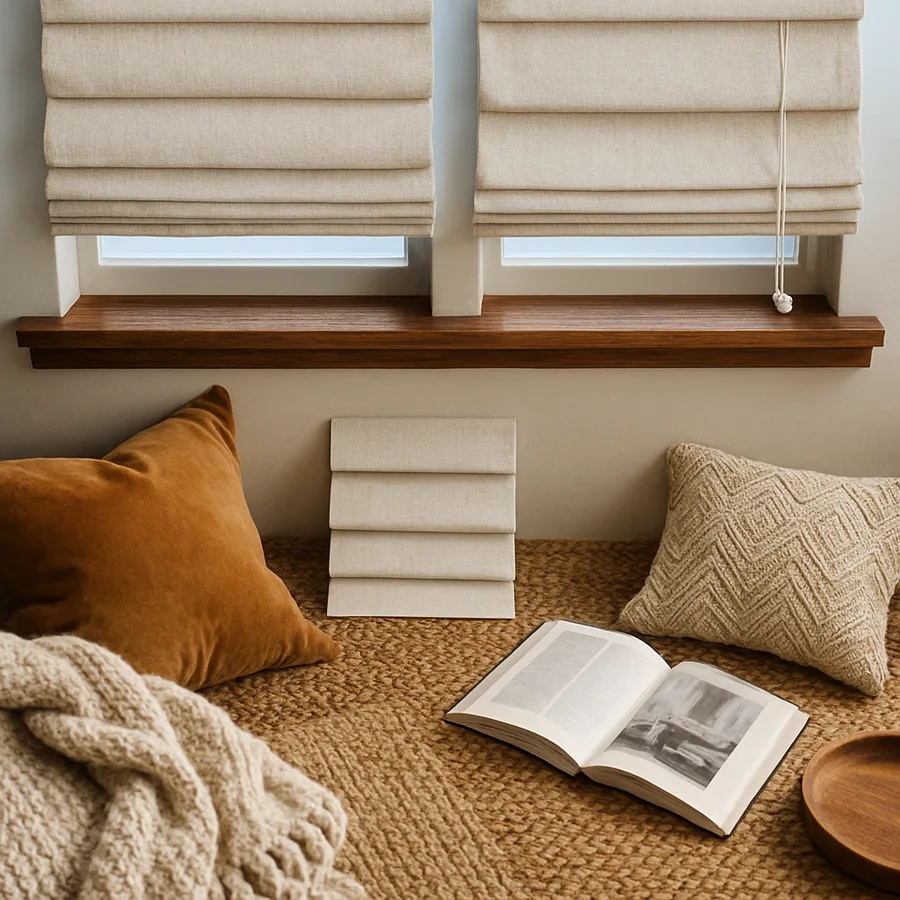
The choice between cordless and corded Roman shades looks small on a spec sheet and feels huge once you actually live with the window. One pulls down like a soft accordion of fabric with a gentle tug on the bottom rail. The other rides up and down on a continuous loop you tuck behind a wall hook. Both lift the same shade, but they do not feel the same in the morning when you have coffee in one hand and the dog circling your feet.
If you are shopping right now and trying to decide, the difference comes down to four practical things: how the mechanism works, who is in the house, how the shade looks when it is down, and what each option costs over the life of the shade.
How Each Mechanism Actually Works
A corded Roman shade uses lift cords that run vertically through the back of the fabric and over a pulley inside the headrail. You pull the cord, the pulley turns, and the shade folds up in stacked horizontal pleats. The cord ends in a tassel or a continuous loop. To lower the shade, you release the cord lock and let gravity do the work, slowing it with light tension in your hand.
A cordless Roman shade hides that whole system. Most use a spring-tensioned lift assist inside the headrail, sometimes paired with a small clutch that catches the shade at whatever height you stop at. You grasp the bottom rail directly, push it up to raise, pull it down to lower. There are no visible cords on the front of the shade and nothing hanging down the side wall. The internal cords still exist on better-built versions, but they are sealed inside the headrail and never come out.
The Window Covering Manufacturers Association notes that since 2018 nearly all stock window coverings sold in the United States must be cordless or have inaccessible cords by default. Custom orders are the main exception. That regulatory push is why cordless has become the assumed default in big-box stores while corded has shifted toward the custom and specialty side of the market.
Safety, Households, And When Each Style Fits
The safety conversation is the loudest one. The U.S. Consumer Product Safety Commission has tracked corded window coverings as a hidden hazard for decades, with roughly one child a month strangled or seriously injured by accessible window cords according to their published incident data. That is the engineering reason cordless became standard. If you have small children, grandchildren who visit, or pets that climb drapes, cordless is the obvious pick and not really a debate.
Corded still earns its place in a few situations. Very tall windows past about seven feet are physically awkward to operate cordless because you have to reach the bottom rail to lower it. A continuous-loop cord stays at a fixed height regardless of where the shade is, which is friendlier on a transom window or a stairwell. Heavy fabrics like blackout-lined linen also lift more smoothly on a corded system because the cord gives you mechanical advantage that a spring assist cannot fully match.
For most living rooms, bedrooms, and kitchens at normal ceiling heights, cordless wins on safety and on the cleaner look of the side profile.
Appearance, Daily Use, And The Stack At The Top
Here is the detail that surprises people: cordless and corded Roman shades do not look identical when raised. Cordless shades need a slightly taller headrail to house the spring mechanism, which means a larger stack at the top of the window when the shade is up. On a window with limited height above the frame, that stack can swallow an inch or two of glass you wanted to see.
Corded mechanisms are flatter and lighter, so the folded stack is more compact. If you are dressing a window where the top of the frame sits very close to the ceiling or to a crown molding, ask for the stack dimensions before ordering. The American Society of Interior Designers recommends always measuring the available reveal both above and inside the frame before specifying a Roman shade so the stack does not visually shorten the window. You can read more about specifying soft window treatments through the American Society of Interior Designers.
Day to day, cordless feels faster. One hand, one motion, done. Corded takes two coordinated motions and a glance at the wall hook to secure the loop. Neither is hard, but if you raise and lower a shade multiple times a day, cordless removes a small chore you did not realize was a chore.
How To Decide Between Them
Start with the window height. If the bottom rail will sit at or below your shoulder when the shade is fully raised, cordless is the right call. Reaching up to lower a shade above your head every morning gets old fast and the spring tension on tall cordless shades tends to wear sooner because of the longer travel.
Next, audit the household. Kids under eight, frequent visits from grandchildren, or cats that climb anything vertical all point to cordless without hesitation. Adult-only homes with tall windows have more flexibility, and a corded continuous-loop system with a tension device anchored to the wall (the kind that prevents a free-hanging loop) gives you the operational ease of corded without the classic strangulation risk.
Budget is the last factor. Cordless mechanisms add roughly fifteen to thirty percent to the price of an equivalent Roman shade at most retailers, and the spring assemblies do eventually wear out, typically after seven to ten years of daily use. Corded systems last longer mechanically because cord and pulley assemblies are simpler and field-replaceable. If you are outfitting a whole house and counting every dollar, that gap matters.
A question worth asking yourself before you order: which window in your home do you raise and lower most often, and would a one-handed pull at the bottom rail change how you use that room? If yes, pay for cordless on that window even if you go corded on the rarely touched ones.
If you want a second pair of eyes on the call, most reputable window treatment retailers offer a free in-home consultation. Take them up on it before you commit to a whole-house order, especially if some of your windows are tall, awkwardly placed, or shared with a child's room.
More Articles You May Like



Comments
Post a Comment