Outdoor Bar Counter Materials That Survive Weather Cycles
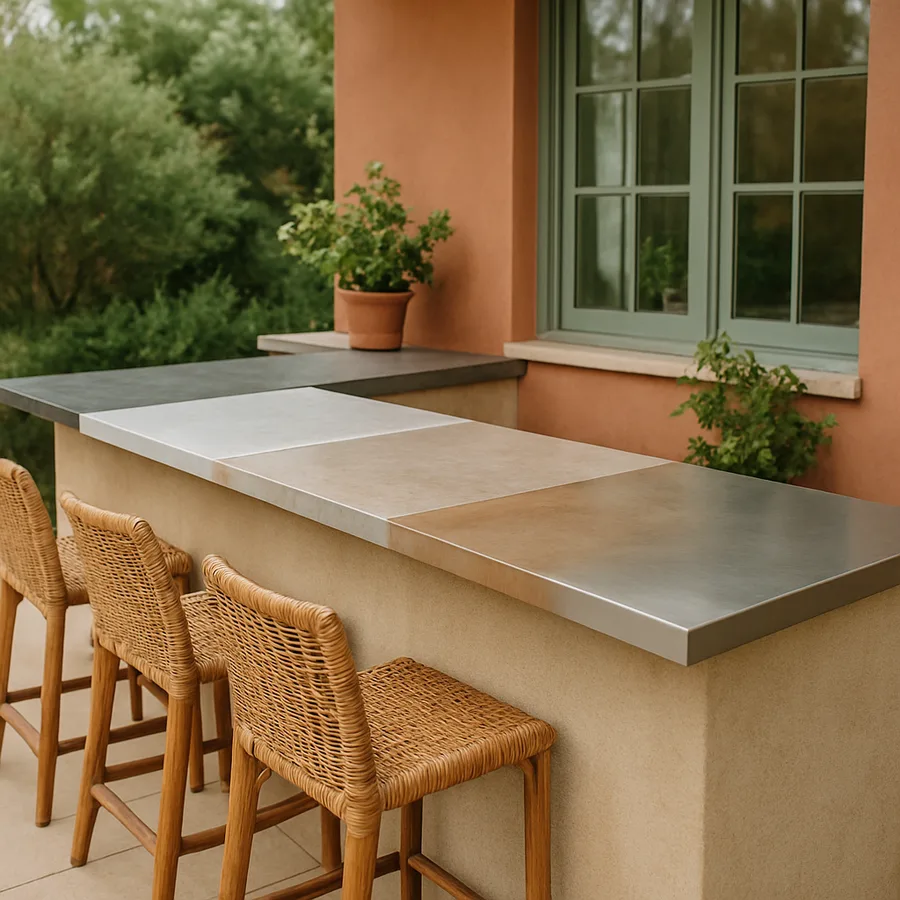
An outdoor bar lives a harder life than any countertop indoors. It absorbs direct sun for hours each summer, freezes through winter, sheds the acidic juice of citrus garnishes, and tolerates the occasional dropped tumbler. The surface that worked beautifully in a kitchen renovation may crack, etch, or fade within a single year when transplanted outdoors. Choosing the right material is less about appearance and more about understanding how each substrate responds to thermal expansion, ultraviolet exposure, and porosity.
This guide examines the outdoor bar counter materials homeowners and designers most often consider, weighing the long-term performance of each against climate and use. The conversation matters because outdoor kitchens are no longer a niche; the National Kitchen and Bath Association (NKBA) reports that outdoor cooking spaces remain among the most-requested project categories year over year, and the bar counter is the social heart of any such space. Selecting a surface that lasts means understanding the trade-offs between density, sealing, weight, and cost before the cabinets are framed.
The Climate Variables That Drive Material Failure
Before evaluating any individual material, the homeowner should map the conditions the counter will face. Four variables dominate. The first is the freeze-thaw cycle: water trapped inside a porous stone expands as it freezes, fracturing the material from the inside out. In northern climates this single mechanism eliminates many otherwise attractive options. The second is ultraviolet exposure, which degrades binders in engineered surfaces and bleaches pigments in coloured concrete. The third is staining from food, citrus, wine, and sunscreen, all of which behave differently from the spills found in an indoor kitchen. The fourth is thermal shock, the sudden temperature swing that occurs when a sun-baked counter meets a cooler of ice or a pitcher of cold water.
Climate zone matters more than aesthetics in this conversation. According to American Society of Heating, Refrigerating and Air-Conditioning Engineers (ASHRAE) climate data, much of the northern United States and Canada experiences more than one hundred freeze-thaw cycles per year, and any porous material installed in those zones must be either sealed aggressively or replaced with a non-porous alternative. Coastal installations add salt spray, which accelerates corrosion in metals and certain stones. Hot, arid regions impose punishing UV loads but escape the freeze-thaw problem entirely.
Homeowners often ask which material is best overall. The honest answer is that there is no universal winner. The right surface depends on the specific climate, the cooking style, and the willingness to perform periodic maintenance. The sections below evaluate the major contenders against those filters.
Granite: The Default With Real Caveats
Granite remains the most common outdoor bar counter material in North America, and for defensible reasons. It is dense, durable, and resistant to scratches and heat. Most granite slabs absorb less than one percent water by weight when sealed properly, which makes them broadly compatible with freeze-thaw cycling. The variety of patterns and colors also lets designers match the counter to nearby stonework or hardscape.
The caveats are worth knowing. Not all granite is equally dense. Lighter-colored granites, particularly those quarried with significant feldspar content, can be more porous than darker varieties. A reputable fabricator will share absorption data for the specific slab. Outdoor installations also demand a more aggressive sealing schedule than indoor ones, typically once per year rather than once every three to five, and they benefit from a honed or leathered finish rather than a polished one, because polished granite shows water spotting more readily and becomes slippery when wet.
Color stability is another consideration. Direct sun will gradually shift the appearance of certain granites, especially those with high mineral variation. Darker stones absorb more heat and can become uncomfortable to touch on summer afternoons; lighter ones stay cooler but display etching from citrus juice more visibly. Most installers recommend a thickness of three centimeters for outdoor use, with mitered edges sealed carefully to prevent water intrusion at the joints.
Porcelain Slab: The High-Performance Newcomer
Large-format porcelain slabs have rapidly become the technical favorite of outdoor designers, and the performance data explains why. Porcelain is fired at extreme temperatures, producing a surface with water absorption typically below 0.5 percent. It is engineered to be UV-stable, freeze-thaw resistant, and almost completely impervious to staining. Citrus, wine, and sunscreen wipe away with water. The material requires no sealing.
The trade-offs are real but manageable. Porcelain slabs are thinner than stone, usually twelve or twenty millimeters, and require careful substrate preparation and fabrication. They can chip at edges if struck by heavy cookware, and not every fabricator has the tooling to cut and mitre them well. Pricing has come down significantly as supply has grown, and porcelain now competes directly with mid-range granite while offering measurably better outdoor performance.
Aesthetic range is another draw. Porcelain manufacturers reproduce the look of marble, granite, concrete, and even weathered metal at large scale, allowing designers to specify a marble appearance for an outdoor bar where actual marble would be a maintenance disaster. The honed and structured finishes also provide better slip resistance than polished options, an important detail for a surface that will see frequent rain and spilled drinks.
Concrete: Designer Favorite, High Maintenance
Cast concrete counters offer a sculptural quality that no other material delivers. They can be poured to any shape, integrated with sinks and drains, and finished in any color through pigment integration. Designers love them because they read as both rustic and contemporary depending on the finish, and because they belong to the building rather than sitting on it. Outdoor concrete bars are a regular feature in West Coast and Southern projects.
Performance is the long conversation. Concrete is porous and must be sealed with a high-quality penetrating sealer, often topped with a sacrificial wax in heavy-use installations. Without diligent sealing, concrete will stain from wine, oil, and citrus, and it will absorb water that can cause cracking through freeze-thaw cycles. Even with sealing, hairline cracks are part of the material; designers generally treat them as character rather than failure, though some clients find this difficult to accept.
Color stability is the other watch point. Pigmented concrete will lighten under sustained UV exposure, and the rate of fading depends on the pigment chemistry. Industrial-grade iron oxide pigments hold color longer than economy alternatives, but no pigmented concrete remains perfectly constant over a decade outdoors. Many designers now recommend leaving outdoor concrete in its natural gray tone for this reason, letting weathering add patina rather than fighting it.
Soapstone, Stainless Steel, and Specialty Surfaces
Beyond the three dominant choices lie several specialty materials worth knowing. Soapstone, a dense metamorphic rock with high talc content, is extraordinarily non-porous and chemically inert. It will not stain from citrus or wine, and it tolerates freeze-thaw cycling well. The trade-off is a relatively soft surface that scratches and shows wear; many homeowners welcome this patina, while others find it unacceptable. Soapstone also tends toward a narrow color palette, mostly grays with occasional green veining.
Stainless steel counters, common in commercial outdoor kitchens, deliver near-perfect resistance to weather, stains, and bacteria. The NSF International certifies stainless steel grades for food contact use precisely because of these properties. The aesthetic is industrial, the surface scratches readily into a brushed patina, and direct sun can make stainless uncomfortably hot to touch. Marine-grade 316 stainless resists salt corrosion far better than the more common 304 grade and is worth the cost premium near coastlines.
Other specialty options include lava stone, an extraordinary but expensive material that holds enameled color brilliantly and resists everything weather can deliver, and quartzite, a natural stone often confused with quartz that performs more like granite but with marble-like aesthetics. Engineered quartz, by contrast, is generally not recommended outdoors because the resin binders degrade under UV exposure and most manufacturers void warranties for exterior installations. Many homeowners ask about this directly, and the answer is the same from every reputable fabricator: quartz belongs indoors.
Substructure, Drainage, and Installation Details
The best counter material will fail if the substructure beneath it is wrong. Outdoor counters need a frame designed for weather, generally either welded steel, marine-grade plywood with appropriate cladding, or masonry. The bar should drain water rather than trap it, which means a slight slope away from any wall, proper flashing at any connection to a structure, and weep holes in masonry assemblies that allow incidental moisture to escape.
Edge details deserve specific attention. A bullnose or eased edge resists chipping better than a sharp square edge, and a slight drip groove on the underside of any overhang prevents water from tracking back onto cabinet faces below. Mitered edges, while elegant, require careful fabrication and sealing to prevent water intrusion at the joint; many installers prefer a thick-look apron achieved through fabricated buildup rather than a true mitered slab on outdoor projects.
How thick should an outdoor counter overhang be? For seated bar use, an overhang of twelve inches gives knee clearance without requiring corbel support, though some materials and spans need bracketing. The NKBA publishes clearance guidelines that translate directly to outdoor work, and following them prevents the discomfort of a bar that looks right but feels cramped. Reader-asked questions like these tend to surface only after construction begins; addressing them at the layout phase saves rework.
Cost, Lifespan, and Long-Term Value
Material cost is only part of the equation. Installation, sealing, and replacement over a twenty-year horizon often outweigh the initial slab price. Granite and porcelain typically deliver the best long-term value for general residential outdoor use, with porcelain pulling ahead in climates with severe freeze-thaw cycling because of its near-zero water absorption. Concrete is the most variable; a well-built and well-sealed concrete counter lasts decades, while a casually built one may need significant repair within five years.
Industry estimates from outdoor kitchen specialists suggest that material selection accounts for between twenty and thirty-five percent of total outdoor bar cost, depending on cabinet construction and appliance choices. The remainder goes to framing, plumbing, electrical, and finished surfaces. Spending the additional money for porcelain over a budget granite typically adds five to ten percent to the whole project, a small premium relative to the difference in long-term maintenance.
Resale value is another data point. Realtor surveys consistently show that outdoor kitchens deliver above-average return on investment for homes in warm-weather markets, with the bar counter often serving as the visual focal point that drives buyer interest. A counter that still looks new at the open house carries more weight than one that has clearly weathered hard. Choosing for longevity is also choosing for the next owner.
Conclusion
The material question for an outdoor bar counter sits at the intersection of climate, use, and aesthetics, and no single answer fits every project. Porcelain slab has emerged as the technical leader for most North American installations, offering near-perfect resistance to staining, freezing, and UV exposure without ongoing sealing. Granite remains an excellent default when honed and properly maintained, while concrete rewards owners willing to accept patina and perform diligent care. Specialty materials like soapstone and stainless steel solve specific problems beautifully when those problems are paramount.
The decision-making sequence matters as much as the final choice. Begin with climate, then layer in cooking style and maintenance tolerance, then evaluate aesthetics. A homeowner in coastal Maine and a homeowner in coastal California face different problem sets, and a material that excels in one location may struggle in the other. Consulting both a fabricator and a local landscape architect or outdoor kitchen designer before specifying the slab tends to surface climate-specific issues that catalog photography hides.
What unites every successful outdoor bar is the same principle: the surface was selected for the actual conditions it will face, the substructure was built to drain water rather than trap it, and edge details were specified to resist chipping and absorbance. When those pieces are correct, the counter becomes part of the architecture rather than a piece of furniture, and it ages into the patio rather than against it.
Considering a project this season? Walk the patio at three different times of day, document the sun exposure, check the local freeze-thaw history, and bring those notes to a qualified fabricator before signing a slab order. Reference the National Kitchen and Bath Association outdoor kitchen guidelines and the NSF International standards for any food-contact surface before finalizing the specification, then move forward knowing the choice is grounded in performance data rather than showroom impression.
More Articles You May Like



Comments
Post a Comment