Infrared Tabletop Heater Versus Mushroom Style For Decks
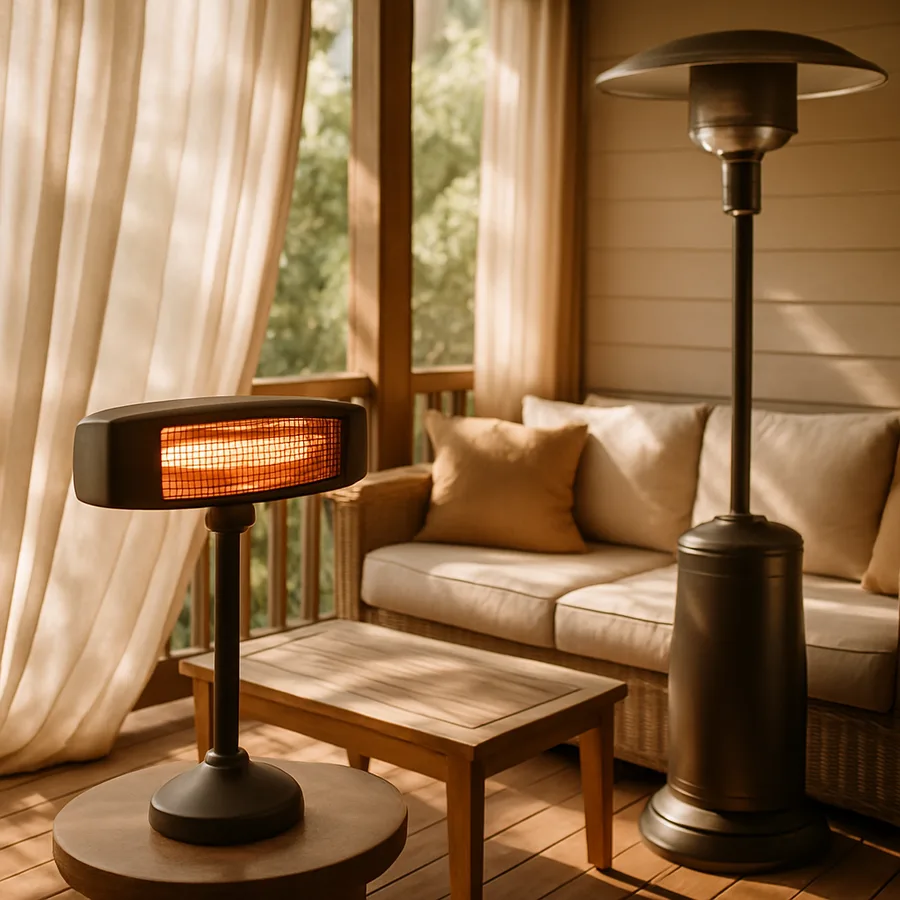
Walk through any patio furniture showroom in October and you face the same crossroads: a small infrared tabletop unit humming quietly on a display table, or a tall mushroom-style propane heater radiating warmth in a wide circle. Both products promise to extend deck season. Both have legitimate use cases. Choosing between them comes down to deck geometry, the kind of gatherings you actually host, and a few code considerations most retailers gloss over.
The Hearth, Patio & Barbecue Association reported in 2023 that tabletop infrared models were the fastest-growing patio heater category at roughly 18 percent annual growth, while traditional mushroom propane units still held the largest installed base by a wide margin. The two products are not really competitors so much as complementary tools for different problems. Here is how to figure out which problem you are actually trying to solve.
Heat Delivery And Coverage Geometry
A mushroom-style propane heater radiates heat outward in a 360-degree pattern from the burner at the top, then deflects that heat downward via the namesake dome reflector. Typical units output 40,000 to 48,000 BTU per hour and produce a comfort radius of roughly 4 to 6 feet at moderate ambient temperatures. The heat warms people, not surfaces, which is exactly what you want in an open-air setting.
Infrared tabletop heaters work fundamentally differently. They emit electromagnetic radiation in the near-infrared spectrum that travels in straight lines until absorbed by skin, clothing, or solid surfaces. The heat warms what the radiation hits directly. Coverage is highly directional, typically a 2 to 3 foot focused zone, and the unit produces no convective warmth in the surrounding air. The American Society for Testing and Materials publishes ASTM E1933 covering infrared measurement methodology that manufacturers use to validate coverage claims.
The practical difference: a mushroom heater warms everyone within a circle. An infrared tabletop heater warms whoever is directly in front of it. If you host parties where people circulate, the mushroom design serves better. If you have a two-person bistro setup where the same two people sit in the same chairs all evening, the tabletop infrared excels.
Response time is another important difference. Infrared units begin warming exposed skin within seconds of activation because the radiation travels at the speed of light and converts to heat on contact. Mushroom heaters take three to five minutes to reach steady-state output because they rely on convective air heating, which depends on warming a column of air around the dome and letting it radiate outward. For a quick step outside between courses, infrared wins. For an extended evening on the deck, mushroom heaters deliver more consistent comfort once they reach equilibrium.
Cold-weather performance also diverges. Below 40 degrees Fahrenheit ambient, convective heat from a mushroom unit dissipates rapidly into the surrounding air mass, and effective comfort radius shrinks by roughly half. Infrared radiation, by contrast, is largely unaffected by air temperature because it heats objects rather than air. Many deck owners who live in cold-winter regions report that infrared units actually outperform mushroom heaters at temperatures below freezing despite lower total BTU output.
Deck Surface, Clearance, And Code Considerations
Wooden decks introduce a fire-safety consideration that concrete patios do not face. The National Fire Protection Association NFPA 58 governs propane appliances and requires specific clearances around any combustible material. Most mushroom-style propane heaters require a minimum 24-inch clearance from any overhead structure and 36 inches of clear floor space around the base. Manufacturers typically prohibit use under enclosed roofs, pergolas with solid covering, or low-ceiling porch overhangs.
Tabletop infrared units, especially electric models, sidestep many of these restrictions. They produce no open flame, no combustion byproducts, and minimal radiated heat to surrounding surfaces. The International Code Council's International Residential Code generally permits electric infrared heaters in covered porches and screened enclosures where propane units are explicitly prohibited.
One question every deck owner should ask: do you have a roof, awning, or pergola over the seating area? If yes, your safe options narrow to electric infrared. If the deck is fully open to the sky, both options become available. This single factor eliminates many product choices before any other comparison matters.
Deck board material adds another layer of consideration. Composite decking made from wood-plastic composite (WPC) is more susceptible to heat damage than natural wood because the plastic component softens above 175 degrees Fahrenheit. A mushroom heater's tip-over risk introduces brief exposure to flame at ground level that can permanently mar composite surfaces. Pressure-treated softwood, cedar, and tropical hardwood decking handle brief heat exposure better but can scorch under sustained radiant heat from a malfunctioning unit. Place any heater on a non-combustible base mat rated for outdoor heating appliance use.
Snow and ice loads matter for permanently mounted infrared units. Wall-mounted heaters on a covered porch typically face no winter loading, but exposed-roof installations need to handle ice accumulation on the housing. Choose units with a steeply sloped or louvered top surface that sheds precipitation rather than collecting it. Several manufacturers now publish snow-load ratings for their outdoor models, though the certification process is not yet universal across the industry.
Fuel Source, Operating Cost, And Practical Convenience
Mushroom heaters run almost exclusively on propane from a 20-pound tank concealed in the base. A typical 40,000 BTU burner empties a full tank in roughly 9 to 11 hours of continuous use. At current retail propane prices tracked by the U.S. Energy Information Administration, that works out to roughly 2.50 to 3.50 dollars per operating hour depending on regional fuel costs.
Electric infrared tabletop units draw 1,500 watts on standard models, equating to roughly 0.20 to 0.30 dollars per hour at average residential electricity rates. Some larger commercial-grade infrared units draw 2,500 to 3,000 watts and require a 240-volt circuit. For most residential decks, a 1,500-watt unit on a standard GFCI-protected 120-volt outlet handles the job without electrical work.
Circuit loading matters when running multiple infrared units simultaneously. A standard 15-amp residential circuit handles roughly 1,800 watts of continuous load, which means a single 1,500-watt heater leaves little headroom for accessory lighting, sound systems, or a small electric grill on the same circuit. Two heaters require a dedicated 20-amp circuit at minimum, and three or more typically demand a sub-panel installation. Plan the electrical capacity before committing to a multi-heater layout, because retrofitting circuit capacity after the deck is finished can cost two or three thousand dollars.
Convenience differs sharply too. Mushroom heaters require you to track tank levels, schedule refills, and physically swap tanks every few weeks of heavy use. Infrared tabletop units turn on with a switch and require no fuel management. For homeowners who hate logistics, this is not a minor advantage.
Tank exchange logistics add up faster than buyers expect. A heavily used mushroom heater on a deck that hosts twice-weekly gatherings can burn through six to eight tanks per cool-weather season. Exchange-program tanks at hardware stores typically cost 24 to 30 dollars per swap, while refilling at a propane retailer costs 16 to 22 dollars per fill but requires driving the tank somewhere and waiting. Either way, the monthly chore intrudes on the very leisure the heater was supposed to enable. Buyers who value spontaneity often migrate to electric over time even when their initial purchase was propane.
Natural gas conversion kits exist for some mushroom heaters and eliminate the tank-swap chore entirely. The conversion requires a dedicated gas line stub at the deck, typically costing 800 to 2,500 dollars to run from the home, plus the orifice conversion kit at roughly 75 to 150 dollars. Over a decade of heavy use, the math favors natural gas conversion if your deck is within reasonable distance of the home's existing gas service. For occasional users, the conversion never pays back.
Aesthetics, Noise, And The Social Experience
The visual presence of a mushroom heater is substantial. Most stand 87 to 91 inches tall and dominate the visual field of a small deck. Some homeowners love this commanding presence; others find it overwhelming on a 200-square-foot deck where it competes with the seating itself. The unit also emits a soft but persistent hissing sound from the burner, which conversation typically masks but which becomes noticeable during quiet moments.
Infrared tabletop heaters sit unobtrusively at 14 to 22 inches tall, slot between place settings, and generally produce no audible noise during operation. They are visually quiet. They disappear into the table setting in a way that mushroom heaters never can.
For ambiance, mushroom heaters have one undeniable charm: a visible blue flame at the top that adds light to evening gatherings. Some infrared units mimic this with a faint orange glow from the heating element, but the effect is more subtle. If the ritual of an outdoor flame matters to you, mushroom designs win that experience. If sleek invisibility matters more, infrared tabletops win it.
Material finishes also affect how each style ages on the deck. Mushroom heaters typically use powder-coated steel for the burner column and stainless steel or coated aluminum for the dome reflector. Powder coating fails first, usually at welded seams where moisture penetrates, producing rust streaks within five to seven seasons of exposed use. Higher-end models with marine-grade stainless steel or hammered finish details cost roughly twice as much but reach ten to fifteen seasons without visible degradation. Infrared tabletops use less metal surface area overall and concentrate the finish on a smaller housing, which generally ages more gracefully.
Lighting integration is a quiet advantage of premium infrared tabletop models. Several manufacturers now include integrated LED accent lighting around the heating element, providing both warmth and ambient illumination from a single fixture. This is particularly useful on decks where overhead string lights would interfere with sight lines or where the budget for separate lighting hardware is tight. Mushroom heaters generally do not integrate lighting because the heat plume would shorten LED life dramatically.
Bottom Line
Mushroom-style propane heaters belong on open decks where multiple people gather, where the visual statement of a tall flame heater enhances rather than crowds the space, and where the homeowner accepts propane logistics as part of the deal. Infrared tabletop heaters belong on small bistro setups, covered porches where propane is prohibited, and any deck where the social pattern centers on a small group sitting in stable seating positions.
Many homeowners ultimately own both: a mushroom heater for the back deck and an infrared tabletop for the screened porch. If your budget allows only one, walk the deck this weekend with a tape measure, note your ceiling clearance, count your usual guest list, and let those numbers point you to the right answer. Then order the unit before the cold snap arrives and supply chains slow, because every fall the patio heater section sells out in late October and the choice gets made for you.
More Articles You May Like


Comments
Post a Comment