Water Softener Selection For Hard Water Areas
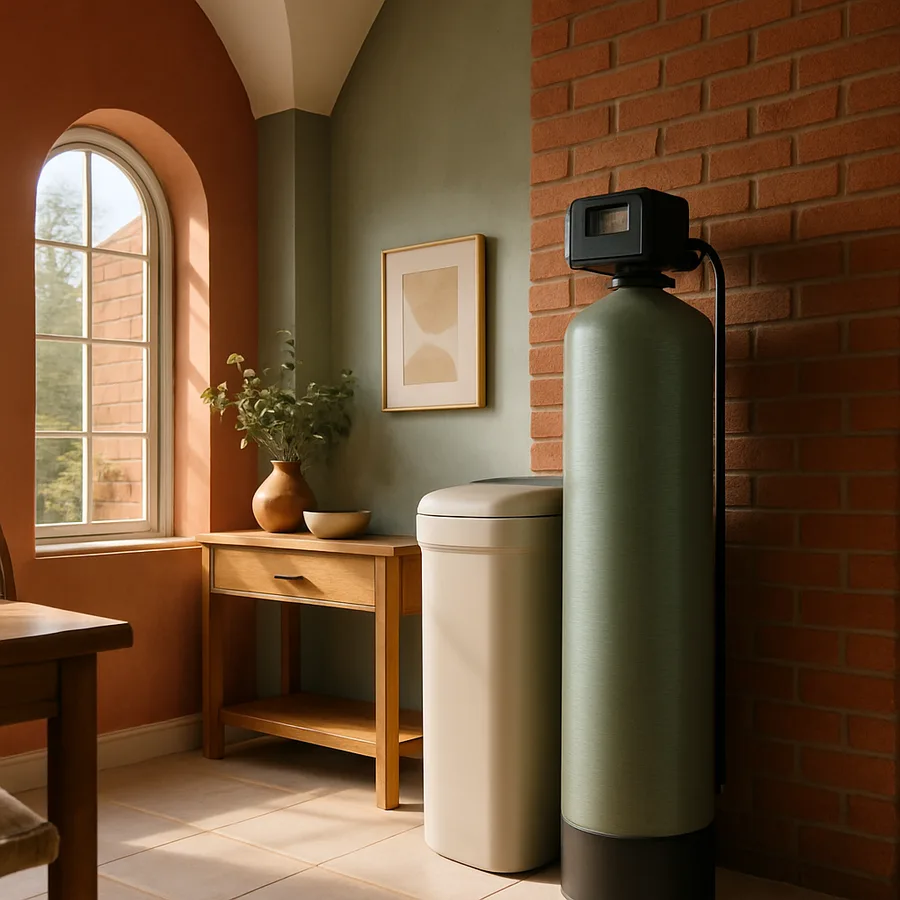
Hard water is one of those household problems that hides in plain sight. The crusty white ring around the faucet, the dishwasher film, the laundry that never feels quite soft, the shower head that drips even after replacement, the water heater that hums and groans years before it should fail. None of these symptoms alone shouts "buy a softener," but together they add up to a quiet drain on every plumbed appliance in the house. According to the U.S. Geological Survey, roughly 85 percent of American homes have water classified as hard or very hard, defined as more than 7 grains per gallon (gpg) of dissolved calcium and magnesium. If you live in the Midwest, the Mountain West, or much of the South, hard water is almost certainly your default condition.
Understanding What Hardness Actually Means
Hardness is a measurement of dissolved calcium carbonate and, to a lesser extent, magnesium. It is reported either in grains per gallon or in parts per million (ppm), with 1 gpg equal to 17.1 ppm. The Water Quality Association (WQA) classifies water as soft below 1 gpg, slightly hard from 1 to 3.5 gpg, moderately hard from 3.5 to 7 gpg, hard from 7 to 10.5 gpg, and very hard above 10.5 gpg. Many municipal supplies in the Phoenix, Las Vegas, San Antonio, and Indianapolis metros exceed 15 gpg, which is the territory where unprotected appliances visibly suffer.
Before buying anything, get a number. Your city water utility publishes an annual EPA-mandated Consumer Confidence Report that lists hardness alongside other parameters. The EPA Consumer Confidence Report portal links to every public water system's report by ZIP code. If you are on a private well, you need an independent lab test, because well water can vary dramatically by depth and season, and may also contain iron, manganese, or hydrogen sulfide that affect softener selection.
Iron is the variable that surprises homeowners most. Even modest iron levels above 0.3 ppm will foul a softener resin bed within months if the unit is not specified to handle it. Ask your test report to include total iron and, if elevated, distinguish ferrous (dissolved, clear) from ferric (precipitated, rusty) iron. The treatment approach differs for each.
Sizing by Daily Grain Load
A softener is sized not by household size alone but by the total grains of hardness it must remove between regeneration cycles. The standard formula is straightforward: number of people in the household, multiplied by typical daily water use of 75 gallons per person per EPA WaterSense averages, multiplied by hardness in gpg. A family of four in 15 gpg water has a daily load of 4 x 75 x 15 = 4,500 grains. Over a typical seven-day regeneration interval that comes to 31,500 grains.
Softener capacity is rated in grains, with common residential sizes at 24,000, 32,000, 48,000, 64,000, and 80,000 grains. The temptation is to pick the unit closest to your weekly load, but that is the wrong approach. Resin efficiency drops sharply when the unit is run near capacity, and salt use per grain removed actually rises. The WQA recommends sizing so the unit regenerates roughly every five to seven days at moderate salt dose, which usually means buying a unit rated 50 to 100 percent above your calculated weekly load. For the family of four above, a 48,000 or 64,000-grain unit is the sweet spot.
Have you ever bought an appliance based on the smallest size that "would work" only to wish you had gone one size up? Softeners are a particularly easy place to oversize sensibly. The price difference between a 48,000 and a 64,000-grain unit is often less than 100 dollars, but the larger unit will use less salt per year and last longer.
Salt-Based Ion Exchange Versus Salt-Free Alternatives
True softening, in the chemical sense, means physically removing calcium and magnesium ions from the water. The only residential technology that does this is salt-based ion exchange, in which water passes through a bed of negatively charged resin beads that swap their attached sodium ions for the calcium and magnesium in the water. When the resin saturates, a brine solution from the salt tank rinses the calcium off and recharges the resin with fresh sodium. Everything else marketed as a softener is something else.
So-called salt-free conditioners use template-assisted crystallization (TAC) or similar technologies to convert dissolved calcium into microscopic crystals that pass through plumbing without sticking. The calcium is still in the water, it just precipitates less readily. Independent testing summarized by the WQA certified products database shows these systems can meaningfully reduce scale formation in water heaters and pipes, but they do not produce the slippery, sudsy feel of true soft water, and they do not improve cleaning effectiveness in the dishwasher or laundry. They are also typically more expensive upfront.
For most households in genuinely hard water, salt-based ion exchange remains the technology of choice. The exceptions are households on septic systems with regulatory restrictions on brine discharge, households with sodium-restricted dietary needs at every tap, or households in mildly hard water where the scale-prevention benefit of TAC is sufficient. Some homeowners install both: a salt-based unit for the hot-water loop and a TAC system on the cold drinking line.
Regeneration Type and Efficiency
How a softener decides to regenerate has a larger impact on long-term cost than the brand name on the front. Time-clock regeneration, the oldest method, simply runs a regen cycle every X days regardless of actual use. It is reliable but wasteful when household water use varies. Demand-initiated regeneration (DIR), sometimes called metered regeneration, uses a flow meter and regenerates only when a calculated grain capacity has been used. The NSF/ANSI 44 standard for residential softeners explicitly recognizes DIR as a more efficient design, and NSF-certified DIR units must meet a salt efficiency threshold of at least 4,000 grains removed per pound of salt.
The newest tier, sometimes called proportional brining, takes DIR one step further and adjusts the brine dose to match the partial capacity used, which can push salt efficiency above 5,500 grains per pound. Over a decade, the salt savings between a basic time-clock unit and a high-efficiency proportional-brining unit can exceed 1,000 dollars, and the regeneration water savings exceed 10,000 gallons per year for a typical family. ENERGY STAR does not currently certify softeners, but several manufacturers report energy savings on connected appliances of 5 to 10 percent on water heaters running soft water, due to eliminated scale buildup on heating elements.
Twin-tank designs deserve special mention for households where uninterrupted soft water matters. A single-tank softener delivers hard water during the regeneration cycle, which typically runs at night to minimize disruption. A twin-tank unit always has one tank online and one regenerating, so soft water is available 24 hours a day. For households with shift workers, large homes with frequent guest use, or any well system where short bursts of hard water during regen could damage downstream equipment, the twin-tank premium is worth it.
Certification, Warranty, and Installation Standards
The water treatment market is crowded with brands of vastly different quality, and certification is the simplest way to separate the engineering from the marketing. The two relevant marks are NSF/ANSI 44 for ion-exchange softeners and the WQA Gold Seal, which incorporates the same testing protocol with additional manufacturer audit requirements. Any softener worth buying should carry one or both certifications. The certification confirms that the unit's claimed grain capacity, salt efficiency, and pressure drop are independently verified, not just printed on a brochure.
Resin quality is the longest-lived component and the most variable. Standard 8-percent crosslink resin is the industry default and lasts about 10 to 12 years on typical municipal water. Premium 10-percent crosslink resin lasts 15 to 20 years and tolerates chlorine and chloramine far better, which matters because most U.S. utilities disinfect with one of these. If you are on chlorinated municipal water, paying the premium for 10-percent resin is one of the easiest long-term upgrades you can make.
Installation must comply with the IAPMO Uniform Plumbing Code or the International Plumbing Code in your jurisdiction. Key requirements include an approved bypass valve, a backflow-protected drain connection to a floor drain or standpipe with proper air gap, and pressure within the manufacturer's specified range. Many local jurisdictions also require a hose-bibb outside the softener loop for outdoor watering, both to avoid wasting softened water on lawns and to keep sodium out of garden beds.
Long-Term Operation, Maintenance, and Wastewater
A well-chosen softener is one of the least demanding appliances in the house, but it is not maintenance-free. Salt must be checked and replenished, typically every six to eight weeks for a family of four. Use the salt type the manufacturer specifies: solar salt and evaporated pellets are the two most common, with evaporated salt producing less tank residue and recommended for any system with a low brine float. Rock salt is cheap and tempting but contains insoluble residue that accumulates in the brine tank and eventually requires a thorough cleaning.
Resin bed cleaning with a citric acid or sodium bisulfite cleaner every six to twelve months extends resin life substantially, especially in iron-bearing water. Many newer head valves include an automatic cleaning cycle that introduces cleaner from a small bottle during normal regeneration, which removes the chore from the homeowner's calendar entirely.
The environmental footprint of softening is real and worth understanding. Each regeneration cycle discharges 25 to 80 gallons of brine to the sewer or septic system, depending on unit size and efficiency, along with the equivalent of 1 to 4 pounds of salt. The EPA has documented elevated chloride levels in some inland watersheds downstream of areas with high softener density, and several Western states now require high-efficiency demand-initiated units in new construction. Are you on a septic system? Check your local code; some jurisdictions require a separate dry well for softener discharge specifically to protect the leach field.
Conclusion
Selecting a water softener for a hard water area is, at its core, a three-step exercise: confirm your hardness number with a real test, size the unit so it regenerates roughly weekly at moderate salt dose, and insist on demand-initiated regeneration with NSF/ANSI 44 or WQA Gold Seal certification. Skipping the first step leads to undersized units that disappoint. Skipping the second leads to oversized units that waste salt and money. Skipping the third leads to a softener that costs more to run for a decade than it should.
Salt-free conditioners have a legitimate place in mildly hard water or in regulatory environments that restrict brine discharge, but for the majority of American homes in 10-plus gpg water, salt-based ion exchange remains the only technology that produces genuinely soft water. The performance difference is unmistakable from the first hot shower. Within a few weeks, dishwasher residue disappears, laundry feels noticeably softer, soap and shampoo go further, and the water heater stops the gurgling that signals scale formation on the element.
Long-term, the savings from a properly sized and efficient softener show up everywhere plumbed. WQA field studies have documented water heater lifespan extensions of 30 to 50 percent and dishwasher and washing machine lifespans roughly 30 percent longer on softened water, plus measurable detergent and energy savings. Across the typical 15-year life of the softener, the cumulative benefit on appliance lifetime alone usually exceeds the total cost of the softener and salt.
Pull your utility's Consumer Confidence Report this week, get a 10-dollar hardness test strip if you are on a well, and use those two numbers to size a certified demand-initiated softener before your next appliance fails. Hard water rarely breaks anything dramatic in a single year, but it quietly subtracts months from the life of everything it touches, and the cure is well-engineered, well-understood, and available at any plumbing supply house in the country. Doing the math correctly the first time is the entire difference between an appliance that just works and an appliance that disappoints.
More Articles You May Like



Comments
Post a Comment