Tower Fan Versus Pedestal Fan For Bedroom Cooling
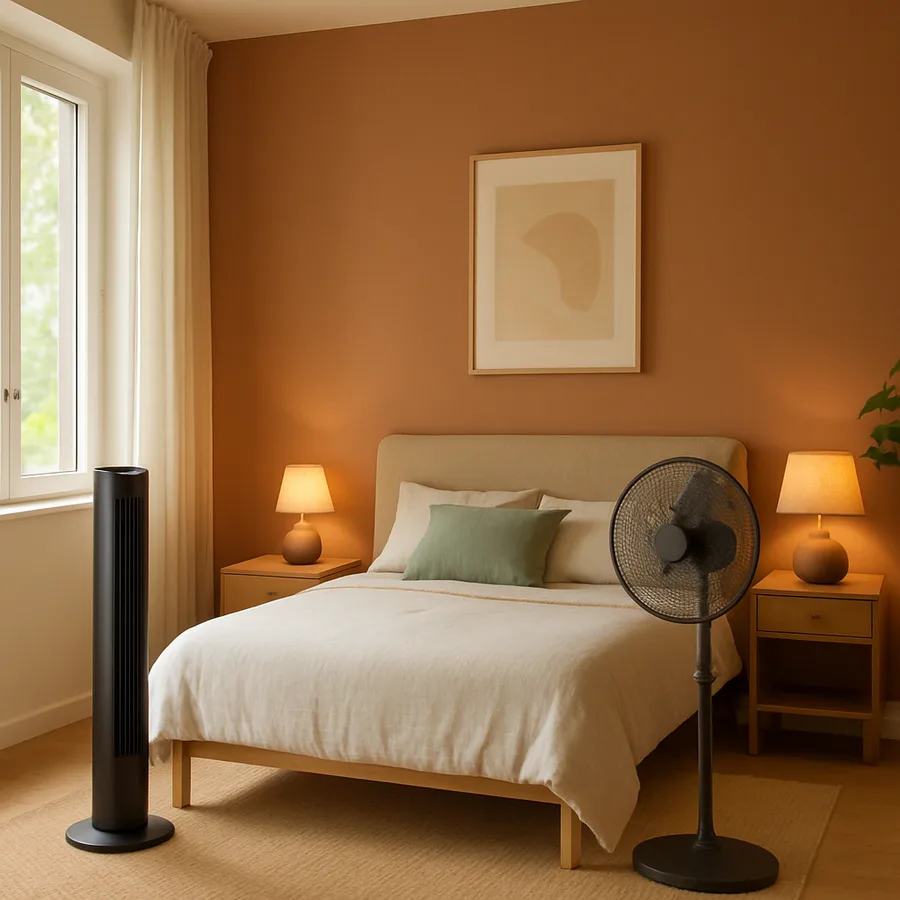
The bedroom is the most demanding room in the house for a cooling fan. It needs to be quiet enough for sleep, powerful enough to move warm summer air, compact enough to live in a tight floor plan, and safe enough to run unattended for hours. Tower fans and pedestal fans both promise to do this work, yet they reach the goal by very different design choices. Choosing between them is less a matter of brand and more a matter of which trade-offs you can live with for eight hours every night.
This guide compares the two formats head to head - how they move air, how they sound, how they handle small spaces, how they age, and how each one feels at 3 a.m. when you have been listening to it for five hours. The right fan will become invisible to your sleeping brain; the wrong fan will become the thing you blame for waking up tired. Let us look at what separates the two.
How Tower Fans Move Air
A tower fan uses a tall vertical column with an internal impeller, also called a bladeless or squirrel-cage rotor, that draws air in through side vents and pushes it out through a slim front face. The air stream is broad and laminar, often sweeping across an oscillation arc of 60 to 90 degrees. Because the impeller is enclosed, tower fans have no exposed blades, which makes them safer around children and pets and easier to keep clean. The footprint is small, typically under one square foot, which suits bedrooms where floor space is at a premium.
Tower fans tend to operate in the 40 to 50 dBA range at medium settings, with the quieter premium models reaching 35 dBA at low speed. They generally move less air than a pedestal fan of comparable price - typical airflow runs between 400 and 800 CFM - but they distribute that air evenly across a wider arc. The result is a steady, ambient feeling of motion rather than a focused breeze. For bedrooms where the goal is gentle air circulation rather than direct cooling on a specific spot, this distribution pattern works in the fan's favor.
Most tower fans include built-in features that pedestal designs rarely match: timers, sleep modes that gradually reduce speed, ionizers, air filters in some models, and remote controls. Have you ever woken up shivering at 2 a.m. because a fan that felt right at bedtime got too aggressive once the room cooled? A tower fan's sleep mode usually drops the speed every 30 minutes precisely to avoid that scenario, which is a meaningful comfort feature in a bedroom context.
How Pedestal Fans Move Air
A pedestal fan uses a traditional axial design - an exposed multi-blade rotor on a horizontal shaft, mounted on an adjustable vertical pole. The blades, typically three to five in number with significant pitch, push air in a focused column that can be aimed at a specific zone. Most pedestal fans offer tilt adjustment and oscillation up to 90 degrees, and the height of the head can usually be set anywhere from three to five feet off the floor. Pedestal designs move significantly more air than tower fans, with CFM ratings often between 1,500 and 3,500 at high speed.
Noise on pedestal fans varies widely by build quality. Cheap pedestal fans can hit 60 dBA or more at high speed and rattle as the motor ages. Quality pedestal fans with brushless DC motors operate in the 35 to 45 dBA range at moderate settings, comparable to tower fans, while delivering several times the airflow. The U.S. Department of Energy notes that any fan-based cooling allows occupants to comfortably raise thermostat settings by about four degrees Fahrenheit, and pedestal fans' higher CFM makes that thermostat shift more reliable in larger bedrooms.
The trade-offs are spatial. A pedestal fan needs roughly 1.5 to 2 square feet of floor and an obstruction-free zone in front of the blades. Exposed blades require child and pet awareness; quality pedestal fans use safety grilles with small gaps, but smaller fingers can still reach inside cheap models. Pedestal fans are also heavier and harder to relocate than tower fans, which matters if you intend to move the fan between bedroom and living room across seasons.
Noise - The Variable That Decides Sleep
Bedroom fans live and die on noise. The World Health Organization recommends bedroom noise levels below 30 dBA for undisturbed sleep, while practical guidance from sleep researchers identifies 35 to 45 dBA as a workable range when the noise is steady and continuous. A fan that runs at 38 dBA all night will rarely disturb sleep; a fan that runs at 38 dBA but produces a mechanical click every few minutes will. The character of the noise matters as much as the volume.
Tower fans usually win on noise character. The enclosed impeller produces a smooth, broadband whoosh with very few mechanical artifacts. Pedestal fans can match that smoothness, but only when the bearings and motor are high quality. Cheap pedestal fans develop bearing whine, blade-edge whistle, or oscillation gear chatter as they age, all of which become detectable above the steady airflow noise. After two summers of nightly use, a $40 pedestal fan often sounds different than it did new, while a $200 pedestal fan with sealed bearings sounds the same for many years.
The lesson is to budget for quietness regardless of format. Cheap tower fans hum and rattle; quality pedestal fans run smoothly. Look for fans that publish a dBA rating at each speed setting, since silence in the spec sheet usually means the manufacturer did not measure or did not want to disclose. Premium offerings in both categories increasingly use brushless DC motors, which are quieter than universal AC motors and last longer because they have no brushes to wear out.
Bedroom Layout and Footprint
Where a fan actually fits depends on the room. A small 10-by-10-foot bedroom with a queen bed, two nightstands, and a dresser may have only one practical fan location, usually a corner that does not block doorways or walking paths. Tower fans excel in this scenario because their small footprint disappears against a wall and they direct airflow upward across a wide arc. A pedestal fan in the same space can feel intrusive, blocking light, casting shadows, and getting bumped during nighttime trips to the bathroom.
A larger 14-by-16-foot primary bedroom changes the calculation. The greater volume of air needing movement makes pedestal fans' higher CFM more useful, and the room has space to accommodate the larger footprint without crowding the bed or walkways. Many homeowners in this scenario combine both - a ceiling fan for ambient air movement plus a pedestal fan for direct breeze when needed - but if forced to choose a single floor fan, the pedestal often wins on airflow per dollar at the bedroom-scale CFM levels required.
Consider placement geometry beyond raw square footage. A tower fan oriented across the foot of the bed delivers a gentle breeze over the whole sleep surface. A pedestal fan does the same if its head is raised slightly above mattress height, but if positioned too low it blows under the bed and wastes most of its air. Pedestal fans also throw air much farther than tower fans, which is an advantage in a room where the fan must sit far from the bed due to outlet placement or layout constraints.
Energy Use, Cost, and Lifespan
Both formats use modest power. A typical tower fan draws 40 to 60 watts at high speed; a typical pedestal fan draws 50 to 100 watts. Running either fan eight hours a night for a four-month summer at average U.S. electricity rates costs roughly $5 to $12, a trivial fraction of the air-conditioning savings each one enables. The ENERGY STAR program certifies select portable fans, and DC-motor models in both formats use roughly 30 to 50 percent less electricity than AC-motor equivalents at similar airflow.
Purchase price ranges overlap. Budget tower fans start near $40, mainstream quality sits between $80 and $180, and premium tower fans with brushless motors and HEPA-style filtration can reach $400 or more. Pedestal fans start near $30 for the cheapest models, mainstream quality runs $80 to $200, and premium pedestal fans with DC motors and oversized blades can reach $300 or more. At any price tier, build quality drives both noise and lifespan, and a $150 pedestal fan typically outlasts a $50 fan of either format by years.
Lifespan also depends on cleaning. Tower fans accumulate dust inside the impeller column because air must pass through narrow vents that trap fibers. Failing to clean these vents reduces airflow and overloads the motor. Pedestal fans accumulate dust on blade leading edges, which unbalances the rotor and stresses the bearings. Both formats benefit from a thorough cleaning every six to eight weeks during heavy use. The fan that looks easier to clean usually is - wide grilles and removable blade guards on pedestal fans, slide-out filters on premium tower fans.
Choosing Between the Two for Your Bedroom
If your bedroom is small, tight on floor space, shared with children or pets, and oriented toward gentle ambient air rather than focused breeze, a quality tower fan is usually the right pick. Look for a published low-speed dBA rating under 40, a sleep mode that ramps down over the night, a timer, and a remote control. Filter-equipped models are worth considering if anyone in the household has allergies, although the filtration is supplementary rather than a substitute for a true air purifier.
If your bedroom is larger, your sleeping partner runs hot, you want direct breeze on the bed, or you intend to use the fan in multiple rooms across seasons, a quality pedestal fan is usually the better choice. Look for a DC motor, an adjustable head with both tilt and height control, oscillation that can be disabled, and a remote. Budget at least $120 to $200 to escape the rattle-prone end of the category; below that price, both noise and lifespan suffer.
Which sleep symptoms have you been blaming on the wrong cause? Many people assume they wake at 4 a.m. because of caffeine, screens, or stress, when in fact a fan that drifts off-balance after midnight is the real culprit. Listening critically to your current fan for a few nights, ideally with a phone-based dB meter app, surfaces problems you have grown numb to.
Conclusion
Tower fans and pedestal fans both cool bedrooms effectively, but they reach the goal differently and suit different rooms. Tower fans win on footprint, safety, sleep-mode features, and ambient air distribution. Pedestal fans win on raw airflow, height adjustability, and focused breeze. Neither format is universally better; the right answer depends on room size, layout constraints, household composition, and personal preference for direct versus indirect cooling.
The most useful screening question is not which format but which build quality. A cheap fan of either format will be loud, short-lived, and disappointing. A quality fan of either format - featuring a DC motor, published dBA ratings, sealed bearings, and a usable warranty - will run quietly for many years and earn back its price several times over in lower air-conditioning costs. Budget for quality first and choose format second.
Cleaning and maintenance are the unsexy variables that decide whether a fan ages well. A quality tower fan with a clogged impeller column will sound rough and move little air; a quality pedestal fan with unbalanced blades will wobble and hum. Six- to eight-week cleaning intervals are sufficient for most bedrooms, and the time investment is small. Pay attention to subtle changes in noise character; they are the earliest warning that something needs attention before damage compounds.
Pick the format that matches your room, then invest in the build quality that matches your sleep. Visit a store where you can stand near both options at low speed and listen for thirty seconds with your eyes closed. The fan that fades into the background after a few breaths is the one you will sleep through; the fan that demands attention is the one you will resent at 3 a.m. Trust your ears in the showroom and let them, not the marketing copy, make the final call.
More Articles You May Like



Comments
Post a Comment