Wine Cooler Cabinet Combo Built In For Dining Rooms
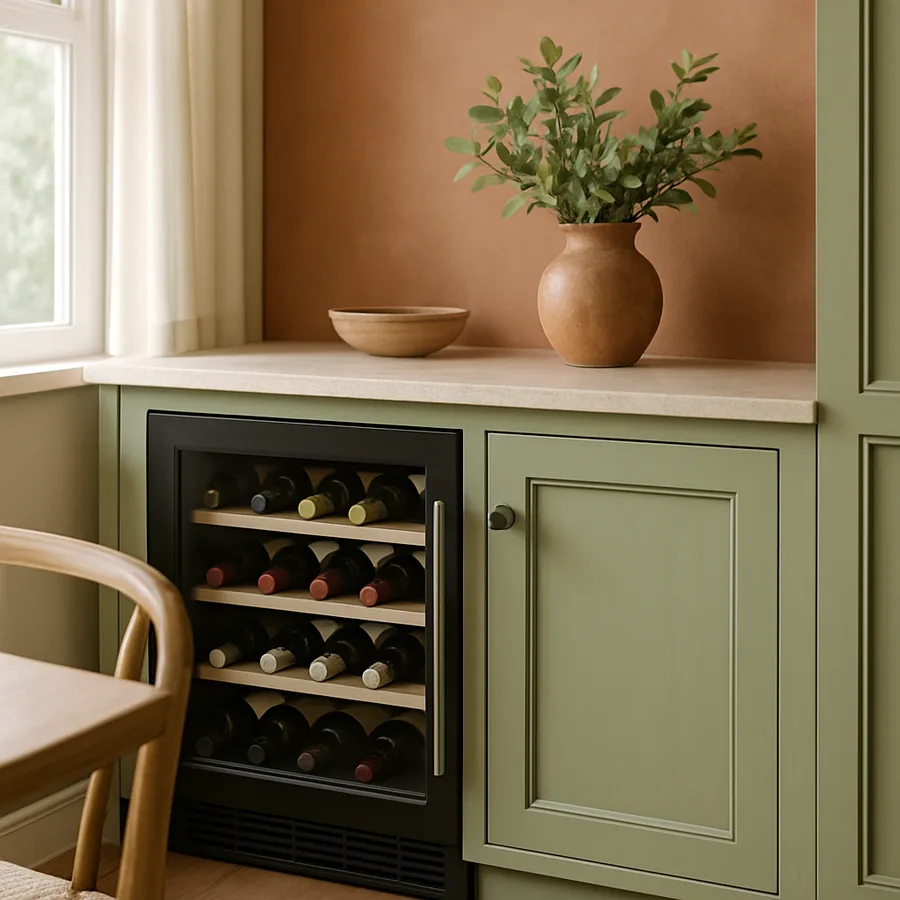
A built-in wine cooler integrated with surrounding cabinetry has become one of the most requested features in upper-tier dining room renovations. The reason is not just functional. Yes, the cooler preserves bottles at proper serving temperature. Yes, the cabinet stores glassware, decanters, and serving pieces within reach of the dining table. But the deeper appeal is architectural. A well-detailed wine cooler combo turns one wall of the dining room into a focal point that organizes the entire space and signals that this room is taken seriously. It transforms casual dining into hospitality infrastructure.
Why The Built-In Approach Outperforms Freestanding Units
Freestanding wine coolers always look like appliances. No matter how nicely finished the door, a standalone unit in a dining room reads as a piece of equipment that wandered in from the kitchen. A built-in cooler, by contrast, disappears into the cabinetry plane. The door becomes one rhythmic element in a wall of stained wood or painted millwork, and the cooler reads as architecture rather than as a product. According to research summarized by the National Kitchen and Bath Association, integrated appliance installations command a 15 to 20 percent premium in resale appraisals compared with equivalent freestanding setups.
The functional case is equally strong. Freestanding units require clearance around all sides for ventilation, which means they cannot tuck under counters or sit flush with surrounding cabinetry. Built-in units use front-venting compressor systems that allow zero side clearance and minimal top clearance. This frees up entire bays of cabinetry for glassware, linens, and serving pieces that would otherwise have to live in another room. Where do you currently keep your wine glasses, and how many trips do you make between dining room and kitchen during a typical dinner party?
Sizing The Cooler For Real Use
Wine cooler capacity ranges from roughly 24 bottles in a slim 15-inch undercounter unit to over 150 bottles in a full-height 30-inch column. The right size depends entirely on your buying and drinking patterns. A household that buys a case every quarter and drinks two bottles a week needs different capacity than one that buys in bulk during region-specific futures sales and ages bottles for a decade. Be honest about which category you fall into. Most homeowners overbuy capacity and end up filling the cooler with bottles that should not be cellared.
Dual-zone units allow simultaneous storage of reds and whites at appropriate temperatures, typically 55°F for reds in one zone and 45°F for whites and sparkling wines in the other. Single-zone units cost less and run more efficiently but force you to compromise. If your collection is consistently one or two varietals, single-zone works fine. If you serve both reds and whites at most meals, dual-zone is worth the upcharge, which typically runs $400 to $900 over the comparable single-zone model.
Ventilation: The Detail That Decides Whether The Installation Survives
Built-in wine coolers are not freestanding units shoved into a hole. They require specific front ventilation paths to dissipate compressor heat, and ignoring this requirement is the single most common installation failure. A unit that overheats due to inadequate airflow will fail prematurely, often within three to five years rather than the expected fifteen. The Association of Home Appliance Manufacturers publishes installation guidelines that specify minimum vent clearances for every major brand.
The typical requirement is a continuous front vent grille at the bottom of the cabinet face, sized for the specific BTU output of the compressor. Cabinet makers who specialize in integrated appliance installations build this grille into the toekick automatically. General carpenters who do not regularly install wine coolers sometimes miss it, with predictable warranty consequences. Confirm before installation that your unit's documentation has been read and that the cabinet maker can show you the ventilation path on a section drawing.
Cabinet Layout Around The Cooler
A wine cooler in isolation is not a wine bar. The surrounding cabinetry transforms the installation from functional storage into a complete entertaining station. The most effective layouts include three components on either side of the cooler: an upper cabinet for stemware with horizontal under-shelf glass racks, a counter zone with at least 24 inches of clear space for pouring and decanting, and a lower cabinet or drawer for serving pieces, wine tools, and bottle storage at room temperature.
Counter material matters more than you might expect. A pour zone needs to tolerate condensation rings from cold bottles, the occasional spill of red wine, and the inevitable scratch from a corkscrew tip. Natural stone like soapstone or honed marble carries the right aesthetic but requires sealing maintenance. Quartz composites resist staining without sealing but read as slightly less luxurious. Wood counters in a dining room serving zone almost always regret themselves within a year. Have you thought about how much actual liquid will hit this surface over the next decade?
Capacity Math: Bottles, Glasses, And Serving Pieces
The classic wine cellar capacity rule, often cited by the Court of Master Sommeliers, suggests that a household drinking two bottles per week and aging some bottles for five years needs roughly 500 bottles of total storage. Few residential clients pursue that scale, but the underlying math is useful. Even a casual household that hosts two dinner parties per month should maintain a working inventory of 50 to 80 bottles, which lets you serve appropriate wines without an emergency trip to the wine shop.
Glassware capacity follows a different logic. Plan for at least eight wine glasses per regular dinner-party seat, distributed across red, white, and sparkling stems. A household that seats ten at the dining table should keep 80 wine glasses available, which translates to roughly six linear feet of stemware rail at typical Riedel or Zalto spacing. Add eight to twelve cocktail and water glasses per seat for completeness. The cabinetry around the cooler needs to absorb this volume without crowding.
Design Integration With The Larger Dining Room
The wine cooler combo must feel like part of the dining room, not a kitchen element that escaped. The strongest installations match the cooler's surrounding cabinetry to the dining table or to other furniture in the room rather than to the kitchen cabinetry. If the dining table is walnut, the wine cabinet should lean walnut. If the dining room features painted millwork in a deep color, the wine cabinet should pick up that color. The cooler door itself is typically stainless steel or a panel-ready front that accepts a wood or painted face.
Lighting elevates the installation. Interior LED lighting inside the cooler is now standard on quality units and showcases bottle labels beautifully when the door is glass. External lighting on the surrounding cabinetry adds another layer. Under-cabinet LED strips wash the counter pour zone, picture lights above the stemware bay highlight glassware, and a small accent light inside the open shelving for serving pieces gives the entire installation depth at night. Architectural Digest has featured numerous dining rooms where lighting design alone elevated competent millwork into something memorable.
Electrical planning deserves attention from the start. Wine coolers require a dedicated 15-amp or 20-amp circuit depending on model, and integrated LED accent lighting, undercabinet lighting, and any small appliance receptacles on the counter all add load. A typical wine cooler combo wall consumes 1,200 to 1,800 watts at peak, which means the existing dining-room circuit almost certainly cannot support it without modification. Have your electrician verify circuit capacity during the design phase rather than discovering the problem when the cooler trips a breaker on a holiday evening. The cost to pull a new dedicated circuit during construction is a fraction of the cost to add it afterward.
Humidity control is sometimes overlooked in cooler specifications. Bottles aged for more than two or three years benefit from interior humidity between 50 and 70 percent, which prevents cork drying and label degradation. Higher-end units actively manage humidity with internal water reservoirs or vapor barriers. Less expensive units rely on the natural condensation cycle, which works adequately for short-term storage but allows corks to dry over multi-year periods. If your collection includes bottles you plan to age for a decade or more, humidity control is not optional, and the upcharge for an active humidity system is justified by the protection it provides.
Maintenance access matters in built-in installations. The cooler will need service eventually, and the surrounding cabinetry must allow the unit to slide forward for repair or replacement without dismantling the entire wall. Quality cabinet makers design the cooler bay with removable side trim or a slightly oversized opening that lets a technician work without destroying finished panels. Confirm this access path during the design phase. Cabinet makers who routinely build integrated appliance installations handle this detail automatically; general carpenters sometimes do not, and discovering the omission years later when service is needed is an expensive surprise.
The relationship between the wine cooler combo and the dining table itself deserves design attention. The ideal placement runs the cooler wall along the long side of the room, parallel to the dining table, so service to either end of the table is roughly equidistant. Placing the cooler at one end of the room forces servers to walk past every seated guest with bottles and glasses, which works for casual settings but feels awkward in more formal entertaining. The right placement is a function of how you actually use the room, and the answer changes the entire furniture plan around the dining table.
Sound levels are easy to ignore when shopping but become important after installation. Wine coolers contain compressors that cycle on and off throughout the day, and a noisy unit in a dining room produces background hum that competes with conversation. Quality units operate at 38 to 45 decibels, roughly the sound of a quiet refrigerator. Cheaper units can exceed 50 decibels, which is intrusive in a quiet room. Read the manufacturer specifications carefully and, if possible, listen to a running unit in a showroom before committing.
Bottle orientation affects both capacity and aging quality. Most quality wine coolers store bottles horizontally on rolling wooden shelves, which keeps corks in contact with wine and preserves the seal. Some compact units store bottles vertically to maximize unit count, which is fine for short-term storage but accelerates cork drying over multi-year periods. If your collection includes bottles you plan to age more than three years, prioritize horizontal storage even at the cost of slightly lower headline capacity. The aging environment matters more than the bottle count printed on the brochure.
Power-loss protection deserves consideration in regions with frequent outages. A standard wine cooler loses temperature control during a power outage and reaches ambient room temperature within four to eight hours depending on insulation and ambient conditions. A short outage poses no real risk, but a multi-day outage during summer can damage a collection significantly. Quality units include thermal mass and insulation sufficient to ride out a 24-hour outage with minimal temperature drift. For collections in regions with regular weather-related outages, a small battery backup system or a generator connection provides additional protection at modest cost.
Conclusion
A built-in wine cooler combo is one of the few dining-room upgrades that improves daily life and resale value simultaneously. The functional gains are immediate. Wine is always at proper temperature, glassware is within reach of the table, and serving pieces no longer have to migrate from a sideboard in another room. The architectural gains accumulate over time. The wall of integrated cabinetry anchors the dining room and gives the space a sense of purpose that bare drywall never delivers.
Plan the project as architecture, not as appliance shopping. Engage a cabinet maker or kitchen designer who has completed at least three integrated wine-cooler installations and ask to see them in person. The detailing that separates a great installation from a mediocre one lives in the ventilation path, the door alignment, and the integration of the cooler face with the surrounding panels. These details cannot be specified from a catalog. They have to be drawn, mocked up, and reviewed before fabrication.
Budget honestly. A complete wine cooler combo installation with quality millwork, a dual-zone 46-bottle cooler, stone counter, and integrated lighting typically runs between $14,000 and $32,000 depending on materials and region. Add another $3,000 to $6,000 if the project involves electrical work, plumbing for a small bar sink, or structural modifications. If you regularly host dinners and want to stop running to the kitchen mid-course, start interviewing cabinet makers this season. Lead times for custom millwork run sixteen to twenty-four weeks.
The dining room is one of the few rooms in a home that exists almost entirely for the experience of others. A wine cooler combo turns that experience from improvised to intentional, and the difference is felt by every guest who passes through.
More Articles You May Like



Comments
Post a Comment