Kintsugi Pottery Display For Japanese Wabi Sabi Decor
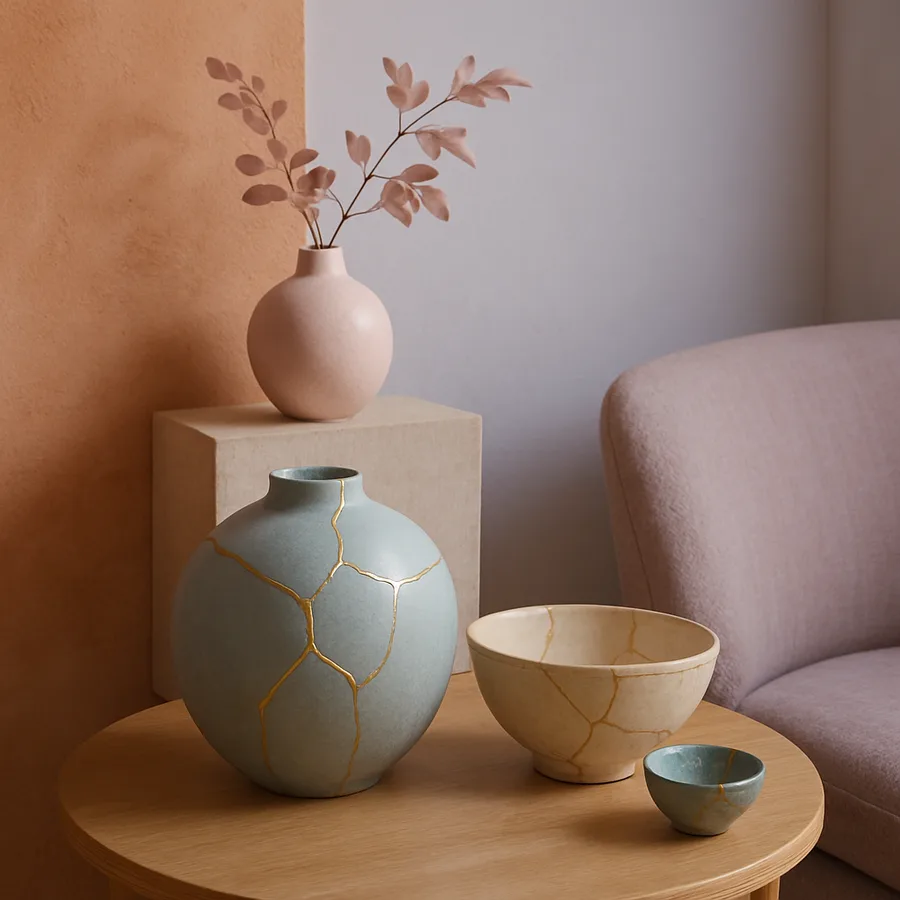
There is a particular hush that falls over a room when a piece of authentic kintsugi pottery is placed correctly on a shelf or low table. The gold or silver seams catch the eye not because they are decorative in the conventional sense, but because they tell a story that most polished objects in a home refuse to admit: this thing was broken, and the breaking made it more valuable. For homeowners drawn to wabi sabi interiors, the practice of displaying kintsugi has become one of the most evocative ways to anchor a quiet, contemplative aesthetic without resorting to minimalist sterility.
This guide walks through the cultural meaning of kintsugi, the difference between authentic and decorative pieces, where to source quality work, and how to stage these objects so they feel intentional rather than decorative. Done well, a single repaired bowl can carry a room. Done poorly, the same bowl looks like a souvenir.
The Philosophy Behind The Golden Seams
Kintsugi, literally "golden joinery," emerged in late fifteenth-century Japan, most often traced to the shogun Ashikaga Yoshimasa, who reportedly sent a damaged Chinese tea bowl back to China for repair and was so disappointed with the ugly metal staples used that he commissioned Japanese craftsmen to find a more beautiful solution. The technique that emerged used urushi lacquer mixed with powdered gold, silver, or platinum to join broken ceramic shards, transforming the fault lines into deliberate aesthetic features.
The philosophy underpinning the technique is closely tied to wabi sabi, the worldview that finds beauty in transience, imperfection, and incompleteness. A kintsugi bowl does not pretend the break never happened. It celebrates the history of the object as part of its identity. The gold seam announces that survival itself is a form of grace, and that scars can be more beautiful than unbroken surfaces. For interiors built around stillness and acceptance rather than perfection and abundance, this carries enormous weight.
Have you ever brought home a "perfect" decorative object only to feel it disappear into the visual noise of the room within a week? Kintsugi pieces resist this fate because they reward sustained attention. The eye returns to the gold lines and finds a different rhythm each time, the way one returns to a poem rather than a slogan.
Authentic Kintsugi Versus Decorative Reproductions
The market for kintsugi has exploded over the past decade, and not all of what is sold under the name is the real thing. Genuine kintsugi uses urushi, a tree-sap lacquer that takes weeks to cure and can cause severe skin reactions in untrained hands, mixed with real precious metal powder. Each repair takes a skilled craftsman anywhere from one to three months to complete properly, with multiple coats and curing cycles.
Decorative reproductions, which can be found at chain home goods stores for under fifty dollars, typically use epoxy resin tinted with gold paint or even gold leaf applied over factory cracks. These pieces can look attractive from a distance, but on close inspection the seams are flat, glossy, and uniform in width, lacking the slight irregularity and depth of true urushi work. The Japan Folk Crafts Museum in Tokyo notes that authentic kintsugi seams have a faintly raised, slightly matte quality and almost always vary in width along the break.
- Authentic kintsugi: Urushi lacquer base, real gold or silver powder, raised seams, weeks to months of curing time, prices typically starting around $300 for a small piece.
- Decorative reproduction: Epoxy or resin base, gold-tone paint or leaf, flat or glossy seams, mass-produced, prices typically $20 to $80.
- DIY kintsugi kits: A middle ground using food-safe epoxy and mica powders, suitable for sentimental repairs but not for collector-grade display.
Sourcing Quality Pieces
The most reliable path to authentic kintsugi remains direct purchase from Japanese craftsmen or established galleries that work directly with them. Several Kyoto and Tokyo studios now ship internationally, and a number of American galleries specialize in contemporary Japanese ceramics with kintsugi pieces appearing regularly in their inventories. According to a market report cited by Architectural Digest, demand for authentic kintsugi in the West has grown by an estimated 178 percent over the past five years.
When buying, ask for documentation of the maker, the materials used, and ideally photographs of the piece in its broken state before repair. Reputable galleries provide all three. Be cautious of any seller who cannot identify the original ceramic, the type of lacquer used, or the curing time involved.
For homeowners on a more modest budget, a respectable middle path is to commission a contemporary craftsman to repair a meaningful broken piece you already own, such as an inherited teacup or a wedding gift bowl. The American Society of Interior Designers has noted a sharp increase in this kind of personalized commission, where the object's history matters as much as its provenance. The American Society of Interior Designers tracks evolving client preferences in heritage-aware decor.
Selecting The Right Pieces For Your Space
Color of the underlying ceramic deserves more attention than most buyers initially give it. The contrast between the metal seam and the ceramic body is what gives kintsugi its visual power, and that contrast varies dramatically with the base color. A dark stoneware piece with bright gold seams reads as dramatic and graphic. A pale celadon piece with the same gold seams reads as delicate and ethereal. Neither is better, but they belong in different rooms and serve different emotional registers.
Provenance documentation, while sometimes overlooked, can materially affect both enjoyment and resale value. Pieces by named contemporary makers, particularly those with gallery representation or exhibition history, can appreciate substantially over time. Anonymous folk-craft pieces, while often beautiful and meaningful, do not appreciate in the same way. If collecting is part of your interest in kintsugi, prioritize documented pieces from working craftsmen who can be researched and verified.
Not every kintsugi piece works for every interior. The most successful displays tend to favor objects with strong silhouettes and matte or earthy glazes. A glossy, brightly colored teapot with gold repairs can read as kitschy, while a chalky pale clay tea bowl with a single dramatic gold seam will hold its place against almost any backdrop. Tea bowls (chawan), small vases, plates, and water containers (mizusashi) are all traditional kintsugi candidates and translate beautifully into Western interiors.
Scale also matters. Most kintsugi pieces are small, often fitting in the palm of a hand, and this intimacy is part of their power. A room full of large statement objects can swallow a small repaired bowl, so consider whether the surrounding shelf or table allows the piece to breathe. The most effective displays often pair a single kintsugi object with two or three smaller, unadorned ceramics in similar tones, allowing the gold seams to do the visual work without competition.
Arrangement Principles From Japanese Aesthetics
Traditional Japanese display draws on a concept called ma, the appreciation of empty space as an active design element. Western shelf styling often crowds objects together, but kintsugi pieces respond better to generous negative space. A single bowl on a long shelf, with nothing within twelve inches of it on either side, can feel more powerful than three bowls grouped together.
The principle of asymmetry also matters. Symmetrical arrangements feel formal and Western; kintsugi displays come alive when the eye must travel slightly off-center to find the focal point. Place pieces at uneven heights using small wooden risers, slate slabs, or stacked books to create a subtle stepped composition. Avoid the temptation to align tops or center objects within their shelves.
Lighting deserves careful thought. Direct overhead lighting flattens the seams and dulls the metal, while raking sidelight from a nearby window or a low lamp brings the gold to life. If the display is in a darker corner, a small picture light or a single warm-temperature LED puck mounted above the shelf can transform the piece without making it feel theatrically lit.
Living With Kintsugi Day To Day
One of the quiet pleasures of displaying kintsugi is that the pieces are meant to be used, not just looked at. Authentic urushi-repaired ceramics are food safe once fully cured and can be used for tea, small portions of food, or fresh flowers without harm to the repair. This dual life as object and tool is part of the wabi sabi worldview: things should serve, and they should age, and they should accumulate the marks of having been loved.
Storage and rotation are practical concerns that collectors learn to navigate. Authentic kintsugi pieces are not fragile in the alarming sense, but they are still ceramic, and the lacquered joints can be damaged by sudden temperature shifts or hard impacts. Many collectors store off-display pieces in custom wooden boxes called tomobako, which protect both the piece and the documentation that accompanies it. Rotating two or three pieces seasonally through a single display location keeps the practice alive and prevents the eye from tuning out a permanent fixture.
Travel and transport require their own attention. Insurance for authentic kintsugi can be added to a standard homeowner's policy as a scheduled item, with appraisal documentation from the gallery serving as the basis for coverage. Pieces shipped or carried any distance should travel in their original packaging or in custom-cut foam, never simply wrapped in bubble wrap and handed to a courier. The Japan Folk Crafts Museum has published guidance on handling and conservation that serves as a useful reference even for private collectors.
Children and pets present a question worth thinking through before placement. Many wabi sabi households embrace the philosophy that objects should accumulate the marks of life, including the occasional accident, and find that even children quickly learn to handle visible kintsugi pieces with appropriate care. Other households prefer to elevate display pieces beyond easy reach until children are older. Either choice is consistent with the underlying philosophy, and the decision is genuinely personal.
Cleaning is gentle and simple. Hand wash with mild soap and warm water, dry immediately with a soft cloth, and avoid abrasive scrubbers or dishwashers entirely. The gold seam will remain bright for decades with this care, though some collectors actually appreciate a slight tarnishing of silver kintsugi over time, which adds an additional layer of patina to the piece.
Have you considered building a small ritual around your kintsugi piece? Many owners use them for morning tea or as the vessel for a single seasonal flower, rotating the contents weekly. This kind of attention transforms the object from passive decor into an active participant in the rhythm of the household.
Conclusion
Kintsugi belongs to a small category of objects that do real work in a home beyond their physical function. Each piece carries a story about resilience, attention, and the refusal to discard what has been damaged. For interiors built on wabi sabi principles, that story is the entire point, and the gold seams are simply the most visible expression of it. A well-chosen kintsugi bowl can quietly reorganize the emotional center of a room.
The most common error newcomers make is treating kintsugi as a single decorative move rather than a sustained practice. One reproduction piece on a crowded shelf next to mass-produced accessories will not deliver the contemplative atmosphere most people are seeking. The technique rewards commitment: authentic materials, thoughtful arrangement, generous space, and a willingness to let the piece be the loudest thing in its corner of the room.
Budget should not be a barrier. A single small authentic piece costing three or four hundred dollars will do more for a wabi sabi interior than a dozen reproductions, and it will appreciate in both monetary and sentimental value over the years. Many collectors describe their first kintsugi purchase as the beginning of a slower, more deliberate relationship with everything else they bring into their homes.
If you are ready to begin, start by identifying a single shelf, alcove, or low table in your home that currently feels visually noisy. Clear it entirely, live with the emptiness for a week, and then bring in one carefully chosen kintsugi piece. Notice how the rest of the room reorganizes itself around that single point of attention. That is the practice, and that is the gift.
More Articles You May Like



Comments
Post a Comment