Undermount Sink Reveal Styles From Negative to Zero Reveal Compared
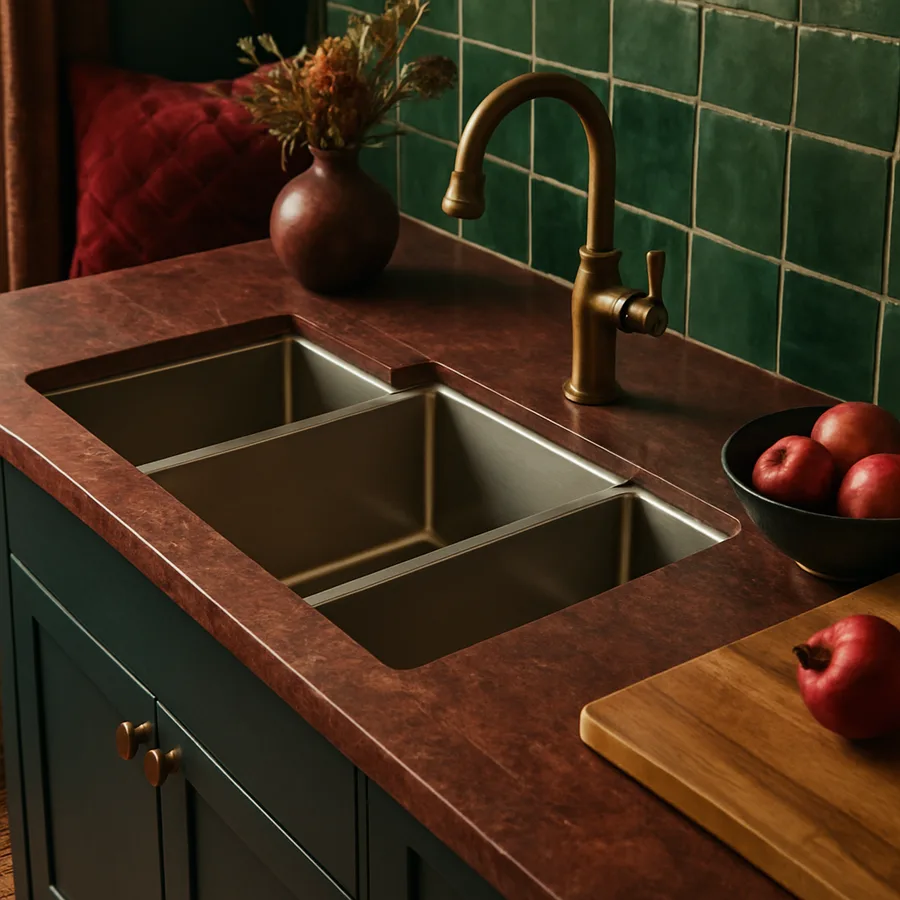
Most homeowners shopping for a new kitchen never hear the term reveal until they sit down with a stone fabricator and are asked, almost casually, which style they prefer. The fabricator already has an opinion. The countertop manufacturer has an opinion. The sink manufacturer has another. And every one of those opinions is shaped by what they find easiest to execute, not necessarily by what looks best in your kitchen or fits your cleaning habits. Understanding reveal styles before that conversation puts you in control, and the difference between a positive, zero, and negative reveal is a difference you will see and feel every single day.
A reveal is the visible band of countertop edge that surrounds the inside of the sink opening when an undermount sink is fastened beneath a stone or solid-surface counter. Depending on how the sink rim aligns with the cutout, that band can be hidden entirely behind the counter, exposed flush with the sink rim, or recessed inside the sink rim. Each configuration has a name, a fabrication cost, a maintenance profile, and a visual character, and choosing among them is one of the most consequential aesthetic decisions in a kitchen renovation.
What A Reveal Actually Is And Why It Exists
The reveal is a byproduct of the way undermount sinks are installed. The countertop is fabricated with a cutout slightly different in size from the sink's rim, and how that difference is dimensioned and finished determines the reveal style. In a positive reveal, the counter cutout is larger than the sink rim, exposing roughly a quarter to half inch of countertop edge inside the sink. In a zero reveal, the cutout matches the rim exactly, creating a flush transition. In a negative reveal, the cutout is smaller than the sink rim, hiding the rim's outer edge under the stone overhang.
The choice involves real trade-offs. According to fabrication data shared in the Marble Institute of America's stone-fabrication guidance, zero and negative reveals require fabricators to template, cut, and polish to tolerances of plus or minus an eighth of an inch, while positive reveals are forgiving up to a quarter inch. That difference in tolerance translates directly into pricing, as zero and negative reveals typically add fifteen to twenty-five percent to the fabrication cost. Why pay more for a tighter tolerance? Because what you save in dollars you may lose in cleaning frustration over the life of the kitchen.
The American Society of Interior Designers has reported in multiple practice surveys that fewer than half of homeowners receive an explanation of reveal options before signing a stone contract, and roughly one in four end up dissatisfied with their reveal style after living with it. That dissatisfaction usually traces to one of two root causes: cleaning difficulty in positive reveals where food collects on the exposed counter edge, or visual disappointment in negative reveals where the design intent gets lost behind a thick stone lip.
Positive Reveal As The Default Choice
A positive reveal is the most common undermount style in production-grade kitchens because it is the easiest to fabricate and the most forgiving of small misalignments between the sink and the counter. The stone cutout is intentionally made larger than the sink, exposing a small ledge of polished stone edge inside the sink opening. When you stand at the sink and look down, you see a band of granite, quartz, or marble bordering the basin, like a picture frame.
The advantages are practical. A positive reveal allows the fabricator to template the cutout from sink dimensions provided by the manufacturer rather than from the actual sink in hand, which speeds the production timeline. It tolerates minor sink-position errors because the visible reveal can vary by an eighth of an inch around the perimeter without anyone noticing. And it provides a clear visual separation between the sink and the counter, which some designers consider an asset for kitchens with bold stone patterns.
The disadvantages center on cleaning. The exposed stone edge inside the sink collects soap scum, food residue, and water minerals over time, and the eased polished edge that fabricators typically apply to that interior band is the same edge profile applied to the outer counter perimeter, meaning crumbs catch in the same place every time. If you cook frequently and clean fast, positive reveals create a daily friction. The reveal band must be wiped after every meal preparation or it will stain visibly within months, especially in lighter stones like Carrara marble or white quartz.
Zero Reveal As The Designer's Preferred Look
A zero reveal, sometimes called a flush reveal, places the inside edge of the stone cutout directly above the inside edge of the sink rim, creating an apparent continuous transition from counter to basin. There is no exposed stone band, no visible rim, just one surface flowing into another. This is the look featured in most high-end magazine photography and in custom kitchens designed by firms with a strong minimalist sensibility, and it has become the dominant choice in luxury renovations within the past decade.
Achieving a true zero reveal requires the fabricator to have the actual sink in hand at the time of templating, since manufacturing tolerances vary between identical model numbers. The stone cutout is templated directly from the sink's footprint, sometimes using a laser scanner for accuracy. Cutting tolerances drop from a quarter inch to less than an eighth, and the polished edge inside the cutout must align continuously with the sink rim within that tolerance. Houzz published fabricator survey data indicating that zero reveal installations take roughly forty percent longer to template and fabricate than positive reveals, and the labor cost reflects that.
What does this buy you? Visually, a zero reveal makes the sink read as part of the counter rather than a separate object, which is the foundational gesture of contemporary kitchen design. Functionally, it eliminates the cleaning ledge of the positive reveal, since debris on the counter sweeps directly into the sink without catching on a stone band. The polished stone edge does abut the sink rim and can chip if a heavy pan is dropped on it, but in normal use, zero reveals are slightly more durable than positive reveals because there is less exposed stone edge to chip in the first place.
Negative Reveal And The Engineered Concealment
A negative reveal reverses the geometry of the positive reveal. The stone cutout is smaller than the sink rim, so the stone overhangs the rim, hiding it from view. When you look down into the sink, you see polished stone curving over the edge into the basin, with the metal or porcelain rim concealed beneath. This is the most expensive of the three styles to fabricate and the most polarizing aesthetically, but in the right kitchen, it is striking.
Negative reveals are favored in two specific design contexts. The first is heavily veined natural stone where the fabricator wants the stone to read as a continuous slab without the visual interruption of a sink rim, particularly with materials like Calacatta marble or Taj Mahal quartzite. The second is in monolithic-look kitchens where the design intent is to suggest the counter and sink were carved from a single block. Both contexts justify the higher cost because the negative reveal is doing visible aesthetic work that no other detail can accomplish.
The drawbacks are real. A negative reveal places stone over the sink rim, which means the stone overhang is structurally unsupported on its inner edge. If you set heavy pots on that overhang or rest a cutting board across it with weight, the stone can crack along the rim line. Fabricators address this by adding a continuous bead of structural epoxy under the overhang, but the joint remains the weakest point of the installation. Additionally, the concealed rim makes sink replacement substantially harder; if you ever need to replace the sink, the counter overhang typically must be cut back or the entire counter section replaced. The Marble Institute and NSF International both note that negative reveals are not recommended for households with young children who may climb on counters, since the unsupported stone edge can fail under point loads.
Choosing Among Reveals For Your Specific Stone
The reveal that suits your kitchen depends almost as much on the stone you have selected as on aesthetic preference. Hard, dense quartz and granite slabs can support all three reveal styles with appropriate fabrication. Softer natural stones like marble and limestone are more forgiving of positive reveals, where the exposed edge can be re-polished if it stains or wears, and less forgiving of zero and negative reveals, where the polished edge sits in a wet zone and degrades faster than the rest of the counter.
Solid-surface counters such as Corian behave differently from stone. The seamless integration possible with solid surface materials makes zero reveals essentially the default choice, since the counter and sink can be fused into a continuous surface with no joint at all. Some manufacturers offer integrated solid-surface sinks where the sink and counter are molded as one piece, which is technically beyond zero reveal into a category sometimes called integral. If you are working with solid surface, consult with the fabricator about an integral installation rather than choosing among the three traditional reveal types.
Have you considered how the reveal style will interact with your sink's drain location and your faucet's spout reach? A negative reveal that hides a rear-mounted drain may extend the visual depth of the basin in a flattering way, while the same negative reveal on a center-mounted drain can look unbalanced. Walk through the use case with your fabricator and your designer before you sign off on the cutout drawings.
Cost, Cleaning, And Long-Term Maintenance Compared
The pricing differential among reveal styles is consistent enough across markets to plan around. A standard positive reveal on a thirty-inch single-bowl undermount sink in three-centimeter quartz typically adds two hundred to three hundred dollars to the fabrication cost. The same sink in a zero reveal adds four hundred to six hundred. A negative reveal adds six hundred to nine hundred, and on heavily veined natural stone with custom edge profiling, the cost can exceed twelve hundred dollars. Survey data from the National Association of Home Builders aligned with these ranges in its remodeling-cost report, with regional variation of roughly fifteen percent.
Maintenance over a ten-year horizon is harder to dollarize but easy to describe. Positive reveals require the most frequent cleaning attention, since the exposed band collects residue daily. Zero reveals require careful caulk inspection at the sink-stone joint, since the joint is the seal against water infiltration into the cabinet below, and a failed caulk bead in a zero reveal can route water into the sink base before anyone notices. Negative reveals require inspection of the structural epoxy bead beneath the overhang and gentle treatment of the unsupported edge.
If you sell the home within five to seven years, the resale appeal of zero and negative reveals is meaningfully higher than positive in luxury markets, while positive reveals are equivalent or slightly preferred in mid-market kitchens because buyers recognize them as standard. The American Society of Interior Designers has tracked this in regional resale studies, and the pattern holds across both coastal and inland markets, with negative reveals carrying a small premium in homes priced above the local median.
Conclusion
The reveal style is one of those kitchen decisions that lives in the small details but accumulates into the overall character of the space. A positive reveal makes a kitchen feel sturdy, traditional, and forgiving. A zero reveal makes it feel modern, precise, and continuous. A negative reveal makes it feel sculpted, custom, and uncompromising. None is objectively better; the right choice depends on the stone, the household, the budget, and the design intent.
Cost and maintenance arguments are real but rarely decisive on their own. The decisive factor for most homeowners turns out to be aesthetic alignment with the rest of the kitchen, particularly the relationship between the sink reveal and the counter edge profile. A heavy bullnose edge with a positive reveal feels coordinated and traditional. A square-eased edge with a zero reveal feels coordinated and modern. A mitered waterfall edge with a negative reveal feels coordinated and architectural. Mixing edge profiles and reveal styles produces a kitchen that reads as design-by-committee, which is the unforced error to avoid.
The conversation with your fabricator should happen early, before the sink is purchased and the counter is templated. Bring photographs of kitchens you admire, identify the reveal style in each, and ask the fabricator to walk you through the implications for your stone, your sink, and your budget. The hour spent in that conversation is the highest-leverage hour in the entire kitchen project, because the reveal you choose is the reveal you live with for the life of the counter.
Before you commit to a reveal style, request side-by-side samples from your fabricator showing positive, zero, and negative cuts in your selected stone, and review installation guidance on the National Association of Home Builders remodeling resources, the American Society of Interior Designers, and design inspiration on Houzz kitchen galleries before signing off on the templating drawings.
More Articles You May Like



Comments
Post a Comment