Under-Stair Reading Nook With Built-In Bench and Book Ledges
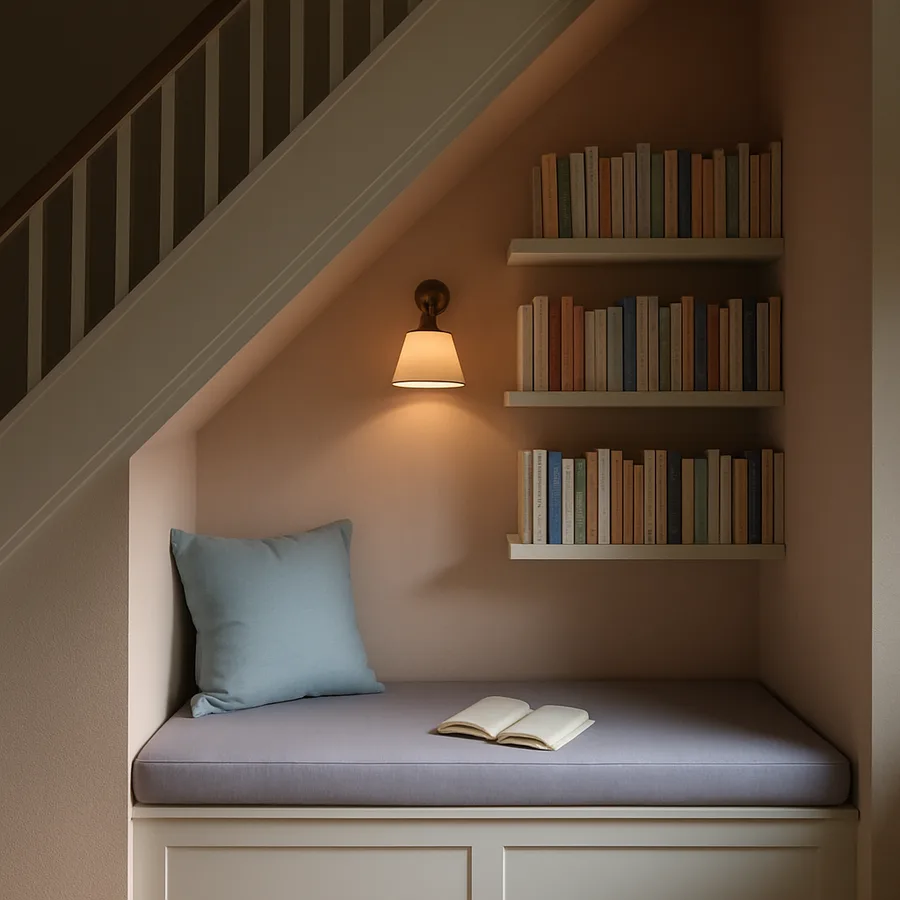
Few small renovations deliver as much daily emotional return as a properly designed under-stair reading nook. The combination of an enclosed retreat, the warm glow of a focused reading light, and the easy reach to a curated stack of books taps something fundamental about how human beings prefer to read. The American Library Association noted in its 2025 State of America's Libraries report that adult reading time has trended upward in households that intentionally created dedicated reading spaces, and the National Endowment for the Arts has tracked a measurable correlation between physical reading environments and the time families spend reading aloud with children. The under-stair cavity, often the most architecturally interesting bit of unused space in a home, is uniquely suited to becoming the reading retreat that pulls everyone away from their screens for an hour at a time.
The design challenge with a reading nook is different from the storage-driven under-stair conversions covered elsewhere in our archive. A reading nook has to be physically comfortable for extended sittings, optically calibrated for the specific task of reading without eye strain, acoustically separated enough to feel like a retreat without being claustrophobic, and visually inviting enough that people actually choose to sit in it rather than the more obvious sofa. This article walks through the bench dimensions, cushion specifications, book ledge layout, lighting selection, ventilation, and material choices that distinguish a reading nook that becomes a daily destination from one that ends up holding throw pillows and nothing else.
Why the Under-Stair Cavity Is Naturally Right for Reading
The cave-like proportions of a stair cavity match what environmental psychology research has long called refuge spaces: places with a low ceiling overhead, walls close on three sides, and a single open view outward. These conditions reduce environmental scanning load and let the brain settle into focused activity. Researchers including the late Christopher Alexander, in the architectural pattern language work that the American Institute of Architects (AIA) still references in residential design guidance, identified window seats, alcoves, and stair nooks as some of the most consistently used spots in any home, almost regardless of the rest of the house design.
The under-stair geometry adds two practical bonuses on top of the psychological fit. The sloped ceiling creates visual interest without consuming any extra floor space, and the natural enclosure provides acoustic damping that reduces ambient household noise. Have you ever tried to read on a couch in an open-plan kitchen-living-dining space and found that every dishwasher cycle and conversation pulls you out of the page? An enclosed nook reduces that interference by a meaningful margin, even without any acoustic treatment beyond the upholstered bench cushion.
The cavity also gives you intimate proximity to the books themselves. A reading nook with book ledges within arm's reach changes the flow of reading. You can put down one book and pick up another without standing, you discover books you had forgotten owned, and the visual presence of the collection itself encourages the next session. The American Society of Interior Designers (ASID) has documented in member writing that integrated bookcases produce measurably more frequent reading behavior than equivalent freestanding shelves placed elsewhere in the home.
Bench Geometry and Cushion Specifications
The bench is where the entire experience succeeds or fails. Get the dimensions wrong and the nook becomes physically uncomfortable within ten minutes, no matter how beautiful the surrounding millwork. The target dimensions, drawn from furniture industry standards and cross-checked against ergonomic research summarized by the Human Factors and Ergonomics Society, are: seat height between 16 and 18 inches from the finished floor, seat depth between 22 and 26 inches, and back support height between 14 and 18 inches above the seat where geometry permits.
The depth dimension is where most under-stair benches go wrong. A standard dining bench at 16 inches deep is fine for sitting upright but uncomfortable for the half-reclined posture readers naturally adopt. A 24 to 26 inch depth lets the user pull the legs up, lean against a side wall with a pillow, or stretch out with feet against the opposite wall. This is the geometry of a window seat or a daybed, not a bench, and it transforms how long a person will stay in the nook.
Cushion construction is the second factor. A single foam slab at the wrong density turns into a sore-back trap within an hour. The professional approach uses a two-layer cushion: a base of high-density polyurethane foam at 2.5 pound density or higher for structural support, topped with a 1 to 2 inch layer of softer memory foam or down for surface comfort. The American Home Furnishings Alliance publishes foam grade benchmarks that reasonable upholsterers will follow, and any custom cushion should specify these grades on the work order.
Upholstery fabric choice matters more for reading nooks than for general furniture because the same body returns to the same spot daily. Tightly woven performance fabrics with stain resistance handle the inevitable spilled coffee or sleeping cat, and they also resist the localized wear that accumulates on a bench used by the same person every evening. Consider washable slipcovers as an alternative to fixed upholstery if your household includes young children or pets.
Book Ledges, Shelving Layout, and Reaching Distance
The book storage approach for a reading nook is fundamentally different from a library wall. You are not storing the entire collection here; you are curating the active reading set. Narrow book ledges with a 4 to 5 inch depth and a low front lip, mounted along the back and side walls of the nook, hold books face-out and let you scan the active stack at a glance. This face-out display reads like a small bookstore display and dramatically increases the rate at which you actually start the books you have queued.
Behind or above the face-out ledges, a deeper shelving unit can hold the larger reserve collection spine-out. This two-zone approach matches how readers actually behave: the active rotation of three to ten books in face-out display, and the deeper backlog stored in a more compact format. Better Homes and Gardens (BHG) has covered this dual-shelving pattern in its small-space library features, noting that the visual impact of even a few face-out books transforms how a reading space feels.
Reaching distance defines the layout. A seated reader can comfortably reach approximately 28 inches forward and slightly less to either side. Position the most-used books within that envelope, with reserve storage outside it. The cavity geometry usually means the back wall behind the bench head is the prime real estate for face-out display, and the side walls hold the deeper reserve. Have you ever noticed how the books on a freestanding shelf across the room get read less than the books stacked on the bedside table? Proximity drives use, and the under-stair nook can put dozens of books within the same easy reach as a bedside stack.
Lighting for Extended Reading Without Eye Strain
Reading lighting is more demanding than general room lighting. The illuminated surface needs to deliver between 30 and 50 foot-candles measured at the page, the light source needs to be positioned to avoid glare on glossy paper, and the color temperature needs to support comfortable extended reading. The American Lighting Association consumer guidance recommends a minimum of 50 lumens per square foot for task reading, with the source positioned slightly behind and above the reader's shoulder.
For an under-stair nook, the practical lighting solution combines a focused task light at the head of the bench with ambient lighting that fills the cavity softly enough to avoid the harsh contrast that produces eye fatigue. A swing-arm wall sconce mounted to the side wall above the head of the bench delivers task light precisely where needed, and a low-output LED strip washing the book ledges adds the ambient layer. Choose warm white in the 2700K to 3000K range for evening reading and avoid cool white temperatures that interfere with melatonin production for late-night use.
Dimming control is non-negotiable. The same nook serves a midday reading session in full bright mode and an evening wind-down session at low brightness, and the difference is comfort versus annoyance. A simple wall-mounted dimmer near the bench, separate from the room's main lighting circuit, gives the user control without leaving the nook. The American Medical Association has issued guidance on reducing nighttime exposure to short-wavelength light specifically because of sleep impacts, which makes warm dimmable lighting in an evening reading space a health consideration as well as an aesthetic one.
Materials, Wall Finishes, and Acoustic Comfort
The interior finishes of a reading nook do quiet work that the user only notices subconsciously. Soft surfaces absorb the small ambient sounds that can pull a reader out of focus, while hard surfaces bounce them back and amplify distractions. The bench cushion alone makes a meaningful acoustic difference, and adding an upholstered back panel, a textured wall covering, or a small rug at the floor of the cavity completes the effect. Architectural acoustics consultants generally recommend at least 30% of interior surfaces in a focused-use space carry some sound absorption, which a reading nook achieves easily through normal furnishings.
Wall finish color drives mood. Deep saturated colors in the back of a reading nook produce a noticeably more enveloping feel than light neutrals, and they also reduce glare from any reading light by absorbing reflected illumination. Designers have written widely about the use of dark blues, greens, and warm browns in library and study spaces for exactly this reason. The contrast between dark cavity and warm pool of reading light is the visual signature of a great reading nook, and it is largely produced by paint choice rather than expensive materials.
The bench frame and book ledges should be built from materials that age well without fussy maintenance. Solid hardwood book ledges patina handsomely and survive decades of book contact. Painted MDF book ledges look crisp initially but show wear at the front edge within a year or two, particularly if children pull books off them. The National Association of the Remodeling Industry (NARI) has noted that material upgrades in low-square-footage millwork rarely affect total project cost meaningfully, because the materials themselves are a small fraction of total labor and finishing costs.
Ventilation, Climate, and Long-Term Comfort
An enclosed reading nook can become uncomfortably warm during extended use, particularly in summer or in homes with active wood stoves or fireplaces nearby. The fix is straightforward: provide passive ventilation through the cavity walls or design the nook with no door at all. Most successful reading nooks in real homes are openings rather than closets, with a curtain at most for occasional privacy. This open design solves ventilation entirely while preserving the visual enclosure that makes the space feel like a retreat.
If your nook will see year-round use, plan for both summer cooling and winter warmth. A small ceiling fan is rarely appropriate in a low cavity, but a discreet wall-mounted fan or a vent connected to the home's HVAC system keeps air moving during warm months. For winter comfort, a small radiant heat panel or a heated bench cushion can transform the nook from too-cold-to-use into the warmest spot in the house. Heated furniture solutions are widely available and most are UL-listed for residential continuous use.
What about books and humidity? Paper books prefer relative humidity in the 30 to 50 percent range, which most conditioned homes deliver naturally. The Library of Congress preservation guidance, which is a useful reference for serious home libraries, recommends keeping rare or treasured books out of locations with extreme humidity swings, including next to exterior walls in unconditioned cavities. For typical reading materials, normal household conditions are perfectly fine, and the ventilation provided by an open nook design prevents the moisture pockets that cause book damage.
Conclusion
An under-stair reading nook with a built-in bench and book ledges is one of the most quietly transformative renovations a household can take on. The cost is modest compared to whole-room remodels, the construction is straightforward for any competent finish carpenter, and the daily emotional return persists for as long as the household lives in the home. The keys to a nook that actually gets used are bench geometry calibrated for half-reclined reading rather than upright sitting, a two-layer cushion construction that supports extended sessions, book ledges that put the active reading rotation within easy arm reach, and lighting that delivers task-grade illumination without the harshness that ruins comfort.
Treat the design process as a precision furniture problem rather than as carpentry. The dimensions matter to the inch. The cushion specification matters to the foam grade. The lighting position matters to the angle and color temperature. Get those details right and the nook becomes the favorite spot in the house, used daily by every member of the household. Get them wrong and you have built an attractive piece of architecture that nobody actually sits in.
Material and finish choices should support a long life of daily use. Hardwood ledges, performance fabric upholstery, dimmable warm lighting, and surfaces calibrated for acoustic absorption together produce a nook that ages gracefully and welcomes the next generation of readers in the household. The slight upgrade cost over economy materials is recovered many times over in the years of comfortable use that follow, and resale value for a well-executed reading nook reads as bonus square footage to prospective buyers, particularly families with children.
Ready to start? Spend an evening reading in different spots in your current home and notice what posture you naturally adopt, what lighting feels right, and what books you wish were closer to hand. That observation will guide the bench depth, the cushion firmness, and the ledge placement more accurately than any design template. Then sketch your cavity to scale, mock up the bench position with cardboard, and sit in it for an hour with a book before committing to permanent construction. For deeper reading and case-study inspiration, the Better Homes and Gardens small-space library archives include real homeowner stories with photos and floor plans, the Houzz photo library lets you filter by reading nook style and stair type, and the ASID consumer resources cover the broader principles of designing residential retreat spaces that earn daily use.
More Articles You May Like


Comments
Post a Comment