Trundle Bed Setups for Guest Rooms and Kids Sleepovers
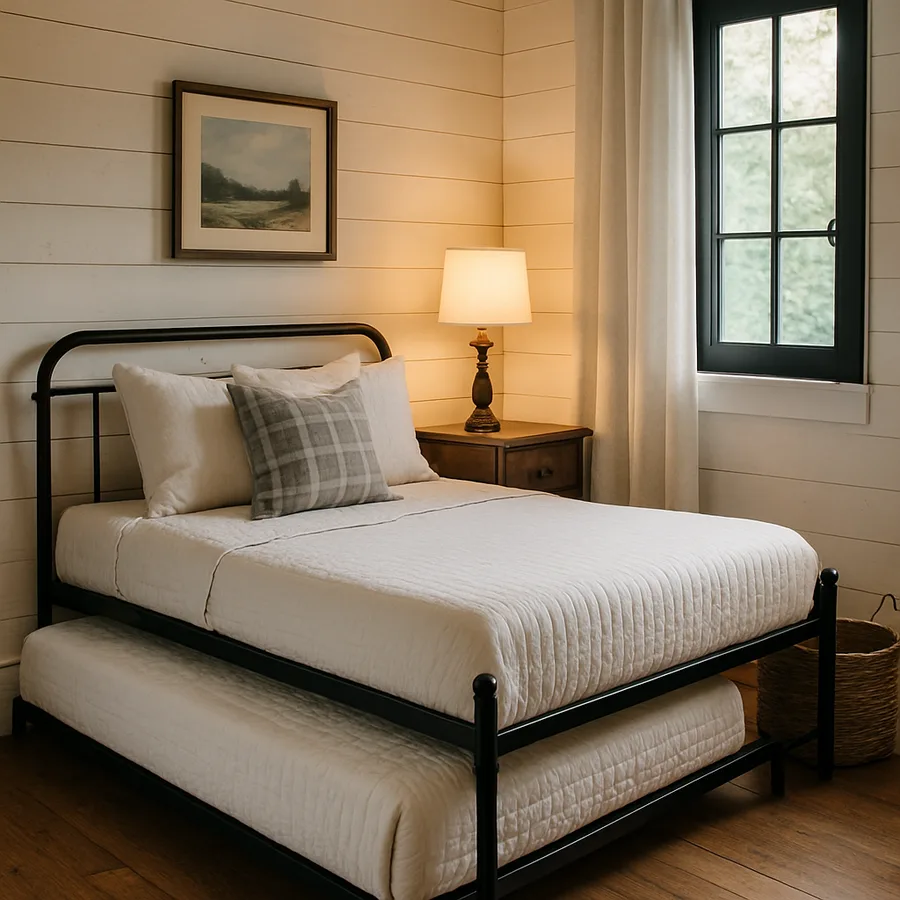
The trundle bed is the quiet workhorse of small-home sleeping arrangements. A second mattress hidden beneath a primary bed, designed to roll out when needed and disappear when not, the trundle solves two specific problems with elegance that no other furniture form matches. For families with children who host frequent sleepovers, the trundle eliminates the need for inflatable mattresses, sleeping bags, and floor pads that nobody actually enjoys sleeping on. For households with a guest room that occasionally needs to accommodate two people, the trundle eliminates the need for a second bed frame entirely.
According to data from the U.S. Census Bureau's American Housing Survey, the median number of bedrooms in newly constructed American homes has held roughly steady over the past decade even as household sizes have decreased and guest hosting expectations have increased. The result is a country full of homes with too few bedrooms for their actual use patterns. The American Home Furnishings Alliance has tracked rising sales in dual-function sleeping furniture as a direct response to this mismatch, and trundle beds rank consistently among the strongest categories.
Understanding Trundle Mechanisms
Trundle beds divide into three distinct mechanism types, and the difference between them affects both the sleeping quality of the second mattress and the practical day-to-day experience of using the bed. Choosing the wrong mechanism is the most common and most expensive mistake in trundle setup.
The roll-out trundle is the simplest and most common type. The second mattress sits on a low platform with casters, slides out from under the primary bed at floor level, and stays at floor level for sleeping. This is the most affordable mechanism, the easiest to operate, and the lowest-quality sleeping experience. Sleeping at floor level produces colder sleep in winter, dustier air in any season, and the persistent feeling of sleeping on a child's bed even for adult guests.
The pop-up trundle, sometimes called a riser or platform trundle, uses a folding mechanism that lifts the second mattress to the same height as the primary mattress when deployed. This produces a single sleeping surface comparable to a king-sized bed and is the right mechanism for households that occasionally host couples in a guest room. The mechanism adds cost and weight, and not all frames support it, but the sleeping experience is dramatically better than the floor-level alternative.
The storage trundle is a hybrid that uses the under-bed space for either a second mattress or storage drawers, depending on the household's primary need. Some designs allow conversion between the two functions, while others commit to one or the other. For households where the second sleeping function is occasional, the storage trundle that converts to a drawer-based use case the rest of the time is often the better value.
Have you thought about how often you actually need the second sleeping surface versus how often you need the storage? Most families discover that the answer is significantly more storage need than guest sleeping need. The honest accounting often points to the storage trundle as the right purchase, with the secondary sleeping function as a bonus capability.
Mattress Pairing: The Decision That Matters Most
The trundle mattress is where households most commonly cut corners, and where they most consistently regret it. Because the trundle mattress is occasionally used and stored most of the time, the temptation is to buy the cheapest acceptable option. This is the wrong move. A guest sleeping on a thin, cheap trundle mattress experiences the visit as a hardship even if every other detail is gracious. The mattress is the sleep, and the sleep is the visit.
The right approach is to match the trundle mattress to the primary mattress in firmness and quality, even if not in thickness. A pop-up trundle that combines two matched mattresses produces a unified king-sized sleeping surface. A roll-out trundle with a matched mattress produces a guest experience comparable to the primary bed even at floor level.
The thickness constraint is real. Most trundle frames accommodate a mattress in the six to eight-inch thickness range. Thicker mattresses will not fit under the primary bed in stowed position. This is the limiting parameter, and several reputable mattress manufacturers now produce specifically a trundle-thickness line in medium-firm latex or hybrid construction that delivers genuine sleeping quality at the required thickness.
The publication Better Homes and Gardens has covered the trundle mattress question repeatedly in guest room features, and the recurring conclusion is that the mattress purchase deserves a meaningful percentage of the total trundle bed budget. A two-thousand-dollar trundle bed frame with a two-hundred-dollar mattress produces a worse guest experience than a thousand-dollar frame with a thousand-dollar mattress. Allocate accordingly.
Setting Up for Kids' Sleepovers
The trundle bed is most heavily used in households with children who host frequent sleepovers. The setup considerations for this use case differ meaningfully from adult guest room setup, and the differences are worth thinking through explicitly.
For children, the floor-level roll-out trundle is often the right answer. Children sleep happily at floor level, the mechanism is simple enough for them to operate themselves, and the floor-level position eliminates the fall risk that elevated mattresses create. Children also sleep happily on thinner, less expensive mattresses than adults, which means the budget can favor the frame and the bedding rather than the mattress itself.
The bedding workflow matters more than the mattress quality for sleepover use. A trundle that requires twenty minutes of setup before each sleepover will not get used. A trundle that can be deployed in two minutes by the children themselves will get used constantly. The right workflow is a fitted sheet kept on the trundle mattress permanently, a duvet or quilt stored in a labeled basket nearby, and pillows in pillowcases stored either on the primary bed or in a closet within the room.
The Apartment Therapy editorial team has profiled numerous family bedroom setups built around trundle beds, and the consistent observation is that the trundle becomes the preferred sleepover arrangement for both the host child and the visiting child. Children prefer real beds to inflatable mattresses by a wide margin, and the trundle deploys without the parent involvement that air mattresses always seem to require.
What about siblings sharing a room? The trundle setup works beautifully here as a flex arrangement that accommodates either the daily two-child sleeping setup or the occasional sleepover guest, depending on which child has a friend visiting. The mechanism reduces the sleeping infrastructure required by half compared to two separate beds.
Guest Room Configurations: Single, Pop-Up, and the King Conversion
For dedicated guest rooms, the trundle bed configuration depends on the guest profile the room most often hosts. The three primary configurations each serve different patterns.
The single-occupancy guest room with occasional second-person capability is the most common pattern. A queen-sized primary bed with a twin-sized roll-out trundle accommodates a single primary guest comfortably most of the time, with the trundle deployed only when a second person needs to sleep in the room. This configuration is the most space-efficient and serves households whose guests are mostly individual visitors.
The regular two-person guest room is better served by a twin-over-twin pop-up trundle that converts to a king-sized sleeping surface when deployed. This configuration handles couples gracefully, separates into two sleeping surfaces when guests prefer not to share a bed, and breaks down to a single twin profile when not in use. The pop-up mechanism cost is justified for households that host couples regularly.
The multi-purpose guest room and home office is the most demanding configuration and is served best by a daybed-with-trundle combination rather than a traditional trundle bed. The daybed reads as a sofa during workday use, the trundle deploys for occasional second-person guests, and the entire arrangement supports both functions without requiring conversion between them.
Architectural Digest has covered all three configurations in guest room editorial features, and the recurring takeaway is that the right configuration follows the actual hosting pattern rather than a generic ideal. Households that host couples once a year do not need the pop-up mechanism. Households that host couples monthly should not be without it.
Frame Material, Style, and Buying Considerations
Trundle bed frames divide into the same broad material categories as conventional beds: wood, metal, and upholstered. The trundle mechanism adds construction complexity that affects durability, and frame quality matters more than it does for a static bed because the moving parts experience repeated use.
Solid wood frames in maple, oak, or cherry are the most durable long-term choice and the most flexible across decor styles. The trundle mechanism in a quality wood frame uses metal slides or casters integrated into the frame structure, with no exposed mechanism visible when the trundle is stowed. Expect to pay more for solid wood, and expect the frame to last twenty years or more with normal use.
Metal frames, typically wrought iron or tubular steel, are the most affordable and the most distinctive visually. The mechanism in a metal trundle is often more obvious than in a wood frame, with visible casters and a more industrial appearance. This is a stylistic choice rather than a quality concern. Quality metal frames last as long as wood frames and often handle the trundle mechanism with fewer adjustment problems over time.
Upholstered frames are the newest entrant in the trundle category and the most variable in quality. The trundle mechanism integrated into an upholstered frame requires careful design to avoid fabric wear at the moving points, and not all manufacturers solve this well. The American Society of Interior Designers generally recommends inspecting an upholstered trundle frame in person before purchase, with particular attention to the points where the trundle exits the frame structure.
What to look for in any frame: smooth mechanism operation under repeated cycling (test it ten times in the showroom), quality casters that roll on hardwood without damaging the floor, a locking mechanism that prevents the trundle from drifting out when stowed, and compatible mattress weight and dimension specifications that match the mattress you intend to buy.
Room Layout, Floor Surface, and the Practical Details
Trundle bed deployment requires roll-out clearance on at least one side of the primary bed, typically the side opposite the wall the bed is pushed against. This is the layout constraint most commonly overlooked at the planning stage and most disruptive when discovered post-purchase.
Plan for a clear floor zone equal to the trundle's deployed footprint, which is the trundle mattress dimensions plus a foot or two of clearance for bed-making and ingress. For a twin trundle, this means a clear floor zone roughly 40 inches wide by 80 inches long on the deployment side. Furniture, rugs, and floor lamps in this zone must be moved every time the trundle is deployed, which means in practice they will not be moved and the trundle will not be used.
Floor surface affects mechanism choice. Hardwood and tile floors accommodate caster-based trundles cleanly. Carpet, particularly thick or plush carpet, fights the casters and can make deployment difficult. For carpeted rooms, consider either a caster-free slide mechanism with felt or PTFE pads on the trundle base, or a small hardwood platform in the deployment zone that gives the casters a working surface.
The publication House Beautiful has covered guest room layout strategies built around trundle deployment in numerous features, and the consistent advice is to design the room around the deployed configuration rather than the stowed one. A guest room that looks beautiful with the trundle stowed but cannot accommodate the trundle when deployed is a guest room that fails its core function.
Conclusion
The trundle bed is a problem-solving piece of furniture, not a styling statement. It exists because households outgrow their bedroom counts, because children host friends overnight, because guest rooms need to flex between single and double occupancy, and because no one enjoys sleeping on an inflatable mattress on a hardwood floor. The piece succeeds when its mechanism is matched to its actual use pattern, when its mattress is matched to its primary bed in quality and firmness, and when the room layout accommodates its deployed footprint as easily as its stowed one.
The mechanism choice is the first decision and the most consequential. Roll-out trundles serve children and occasional adult use cleanly at the lowest price point. Pop-up trundles transform guest rooms into king-capable accommodation for couples and justify their cost in households that host adults regularly. Storage trundles serve households whose actual primary need is under-bed storage with secondary sleeping capability as a bonus. None of the three is universally correct. The right choice depends on hosting pattern.
The mattress decision deserves a substantial fraction of the budget regardless of mechanism. A guest who sleeps poorly remembers the visit as a hardship, and the mattress is the sleep. Match the trundle mattress to the primary mattress in firmness and quality within the thickness constraint the frame imposes. The investment returns dividends in every visit thereafter.
If you have been improvising guest accommodation with air mattresses, sleeping bags, or floor pads, this is the year to install a real trundle bed and stop apologizing for your hosting setup. Measure your room, identify your actual hosting pattern, choose the right mechanism, and invest in mattresses that you yourself would willingly sleep on. The piece will earn its place in your home for the next decade and change how your household experiences both daily life and overnight guests.
More Articles You May Like



Comments
Post a Comment