Pool House Kitchenette Essentials for Outdoor Entertaining
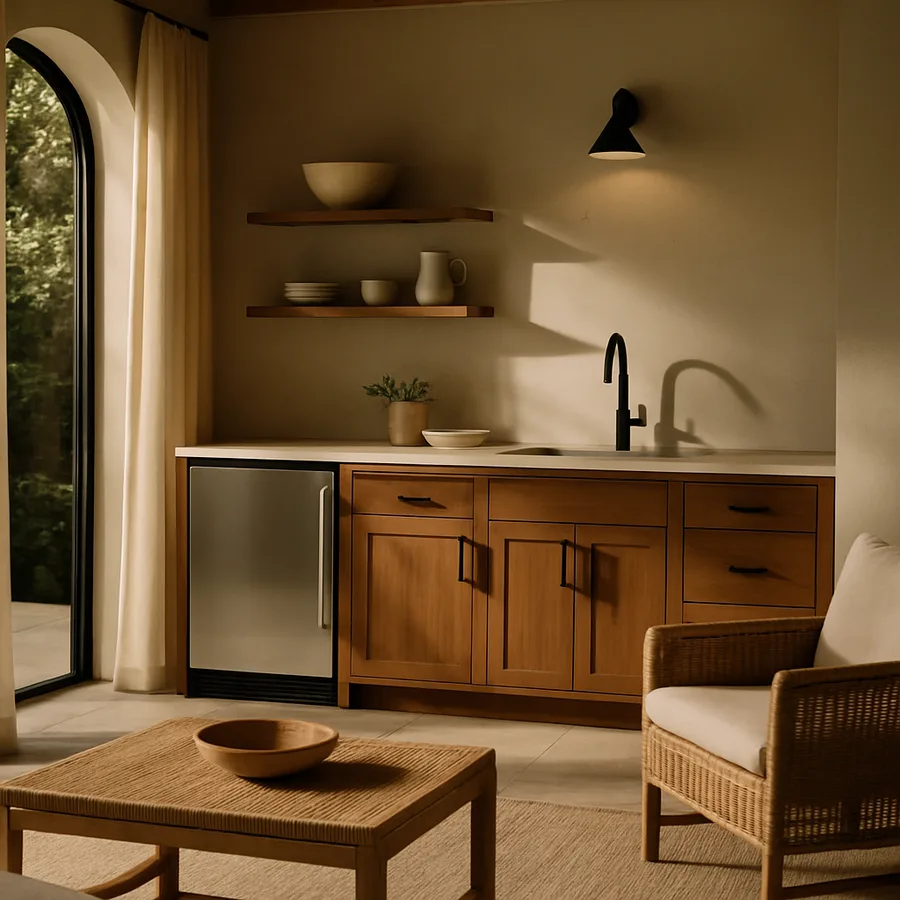
The pool house kitchenette is a small space that has to do enormous work. On a busy Saturday it might serve drinks for twelve, hold trays of skewers for the grill, supply popsicles to a swarm of damp kids, and produce coffee for one quiet adult at the end of the day. None of that requires a full chef's kitchen, but all of it requires a kitchenette designed for the realities of outdoor entertaining: humidity, sand, wet hands, sunscreen, and the occasional thunderstorm. Get the essentials right and the kitchenette becomes the social center of your backyard. Get them wrong and it becomes a charming but unused decoration.
According to the National Kitchen and Bath Association (NKBA), outdoor kitchen and beverage zones rank among the most-requested residential additions of the last several years, and the American Society of Interior Designers (ASID) has tracked steady growth in pool house kitchenette projects specifically. The National Association of Home Builders (NAHB) notes that more than 70 percent of recent custom-home buyers ranked outdoor entertaining spaces as a high priority. This guide covers what actually matters when you plan one.
Right-Sizing the Kitchenette: How Much Is Enough?
The first decision is also the most consequential. A kitchenette that tries to be a second full kitchen will dominate your pool house and inflate your budget without adding meaningful capability. A kitchenette that is too small will frustrate every person who uses it. The sweet spot for most backyards is a run between 8 and 14 linear feet, anchored by a sink, a beverage refrigerator or undercounter fridge, and counter space on either side of the sink. From there, you add specialty pieces, such as an ice maker, a single induction burner, or a small wine cooler, based on how you actually entertain.
Ask yourself a few honest questions before you sketch a layout. How often will you need to host more than eight people at once? Do you cook full meals at the pool, or is the heavy cooking happening at an outdoor grill or in your main kitchen? Do you serve mostly drinks and snacks, or do you regularly plate full dinners poolside? Your answers determine whether the kitchenette needs a full-size dishwasher or a single drawer dishwasher, whether you need a 24-inch undercounter fridge or a 36-inch outdoor refrigerator, and whether a single sink basin will suffice or you need a second prep sink.
The American Institute of Architects (AIA) regularly emphasizes designing for the actual frequency of use rather than the peak fantasy use, and that principle applies perfectly here. Most pool house kitchenettes get heavy use a handful of times each summer and lighter use the rest of the season. Design for the realistic median, then make sure the peak event is still possible without disaster.
Appliances Built for Outdoor Conditions
Standard indoor appliances will fail in a pool house environment. Humidity, salt or chlorine drift, and the temperature swings of an unconditioned space are brutal on residential refrigeration and electronics. Specify outdoor-rated appliances from manufacturers that explicitly warranty them for outdoor or three-season use. Look for stainless steel grades of 304 or 316, gaskets rated for UV exposure, and electronic controls protected by sealed membranes rather than open buttons.
The single most important appliance is refrigeration. A 24-inch outdoor-rated undercounter refrigerator handles drinks, snacks, and ingredient prep for most parties. If you regularly host larger groups, add a second beverage center or a glass-door beverage cooler so cold drinks are visible and self-serve. The Association of Home Appliance Manufacturers (AHAM) publishes performance standards that distinguish indoor refrigeration from true outdoor units, and the difference matters: an indoor fridge in a pool house typically lasts three to five years before failure, while an outdoor-rated unit often runs ten to fifteen.
Other useful additions include an undercounter ice maker sized for daily party loads (a 50-pound daily production model handles most residential entertaining), a single induction burner for warming sauces or making coffee, and a drawer microwave for quick reheating. A small dishwasher drawer, ideally rated for outdoor use, is a quiet game-changer because it lets you clear glassware between rounds rather than stacking it in the sink. Architectural Digest has covered several pool houses where the kitchenette includes nothing more than a sink, fridge, and ice maker, and the homeowners report that this minimal trio handles the vast majority of their entertaining needs.
Counters, Sinks, and Surfaces That Last
Counter material choice is where many pool house kitchenettes go wrong. Indoor favorites like marble, limestone, and even some quartz blends do not handle the combination of UV, humidity, and chlorine spray that defines a pool house. The materials that consistently perform best are quartzite (a natural stone, not to be confused with engineered quartz), granite with a sealed honed finish, porcelain slab, and concrete with a high-performance sealer. Each has trade-offs, but all four genuinely handle outdoor and three-season conditions for many years.
Engineered quartz, which dominates indoor kitchens, is generally not recommended for outdoor or unconditioned environments because the polymer resins that bind it can yellow and degrade under prolonged UV exposure. Most major quartz manufacturers explicitly exclude outdoor installations from their warranties. The Marble Institute of America (MIA) and the Natural Stone Institute (NSI) both publish detailed guides on outdoor stone selection that are worth consulting before specifying.
For sinks, specify 16-gauge 304 stainless steel at minimum, with 316 marine-grade as the upgrade where chlorine spray is a frequent reality. A single deep basin in the 24- to 30-inch range handles glassware and prep equally well. Pair it with a tall pull-down faucet rated for outdoor use, with a ceramic disc cartridge that handles hard water and humidity better than older valve designs. Add a small bar sink at the second end of the counter run if you want a dedicated drink prep zone separate from the main sink.
Storage That Keeps Salt Air, Sand, and Mildew Out
Storage in a pool house kitchenette has to balance accessibility with protection. Open shelving looks beautiful but exposes everything to humidity and dust. Fully sealed cabinetry protects contents but feels heavy in a small space. The hybrid approach works best: enclosed lower cabinets for everything that matters (small appliances, serving pieces, backup glassware) and a single section of open shelving for the items in active rotation (everyday glasses, a few platters, a stack of cocktail napkins).
Cabinet construction has to match the environment. Standard plywood and particleboard interiors will swell and delaminate within a few years in unconditioned pool house conditions. Specify marine-grade plywood or HDPE (high-density polyethylene) cabinet boxes, both of which are unaffected by humidity and even direct water exposure. Aluminum and stainless steel cabinet systems are also available and are increasingly common in higher-end outdoor kitchens. The Kitchen Cabinet Manufacturers Association (KCMA) publishes performance standards that help distinguish indoor-only construction from outdoor-rated systems.
Inside the cabinets, use rubberized shelf liners to protect glassware from vibration and humidity. Store cocktail glasses upside down to keep dust out. Keep paper goods (napkins, straws, cocktail picks) in sealed containers because humidity will limp paper within days. A small dehumidifier or a few desiccant cartridges inside cabinets adds a quiet layer of protection that is easy to overlook. Have you thought about which items will live in the kitchenette permanently versus which will move back to the main house at season's end?
Drinks, Ice, and the Beverage-First Mindset
Most pool house kitchenettes serve more drinks than meals, which means the beverage workflow deserves the same attention you would give to cooking flow in an indoor kitchen. Plan a clear path from the refrigerator to the ice maker to the counter to the trash and recycling. The fewer steps a guest takes to make a drink and dispose of the bottle, the more your kitchenette will be used.
An undercounter ice maker is the upgrade that most homeowners regret not making sooner. A residential fridge ice dispenser cannot keep up with the volume of a pool party, and bagged ice is a constant logistics problem. A dedicated ice maker producing 50 pounds per day is more than enough for most households and roughly the size of a dishwasher panel. Pair it with an insulated ice bin, an ice scoop on a chain, and tongs in a wall-mounted holder, and you have a self-service drink station that essentially runs itself.
Beverage storage benefits from layering. A glass-door beverage refrigerator at eye level shows guests what is available without opening doors. A drawer-style refrigerator below holds backup stock and prep ingredients. A small wine cooler at 54 to 58 degrees Fahrenheit, the range the Court of Master Sommeliers recommends for serving most whites and rosés, lets you offer something more intentional than what fits in a beer fridge. ASID has shared specification guides for beverage-focused kitchenettes that are well worth reviewing if drinks are your primary entertaining mode.
Lighting and Power for Day-to-Night Use
A kitchenette that only works at lunch is a kitchenette you will use at half its potential. Layered lighting transforms the space from a sunny prep zone to an evening cocktail station with one set of switches. Plan for three layers: ambient overhead, task lighting at the counter and sink, and accent lighting on shelving, glassware, or backsplash.
Specify all fixtures as damp- or wet-rated based on their location, and use warm white LEDs in the 2700K to 3000K range for ambient and accent layers. Task lighting at the counter and sink can run slightly cooler, around 3000K to 3500K, to keep work surfaces clearly visible without feeling clinical. Dimmable controls on every layer let you shift the kitchenette from prep mode to party mode to late-evening lounge with a single panel.
Power planning is critical and often underestimated. Plan for at least six GFCI outlets distributed along the counter run and within reach of every appliance, plus dedicated circuits for the refrigerator, ice maker, and any cooking appliance. The National Electrical Code (NEC) requires GFCI protection in any outdoor or wet location, and exterior receptacles within 20 feet of a pool require additional consideration. Have you also planned for a few weatherproof USB outlets so phones, speakers, and tablets stay charged through a long pool day?
Conclusion: Build a Kitchenette You Will Actually Use
The pool house kitchenettes that get used hard and loved long share a few traits. They are right-sized for the actual frequency and style of entertaining their owners do, not for a fantasy event that happens once a year. They are built with materials and appliances that genuinely tolerate outdoor and three-season conditions rather than indoor finishes that will fail within a few years. They prioritize the workflow of drinks and snacks because that is what actually happens at most pools, and they reserve cooking ambition for the grill and the main kitchen.
The best designs also plan for the small daily moments, not just the big weekend parties. The morning coffee on a quiet Sunday, the popsicle handed to a wet kid on a Tuesday, the single cold drink at the end of a hot Wednesday workday. A kitchenette that supports those moments effortlessly becomes a part of your daily life, and the structure pays for itself in pleasure long before it pays for itself in resale value.
Finally, do not undervalue the small storage and finish details. A drawer for cocktail picks. A hook for the bottle opener. A built-in trash and recycling pullout that keeps the counter clear. A backsplash that wipes clean with a single pass. These details cost almost nothing in the context of the overall project but they are exactly what separates a kitchenette that gets used three times a summer from one that gets used three times a week.
Ready to plan yours? Walk your existing pool area at the moment you most often serve drinks or snacks, and notice every step you take, every drawer you wish you had, and every surface you wish was within reach. Take that exact frustration list to a licensed designer or pool house specialist, share this guide as your shared vocabulary, and ask them to design backwards from your real entertaining habits. The kitchenette you end up with will fit your life, not someone else's photograph.
More Articles You May Like



Comments
Post a Comment