Podcast Room Setup With Acoustic Foam and Mic Booms
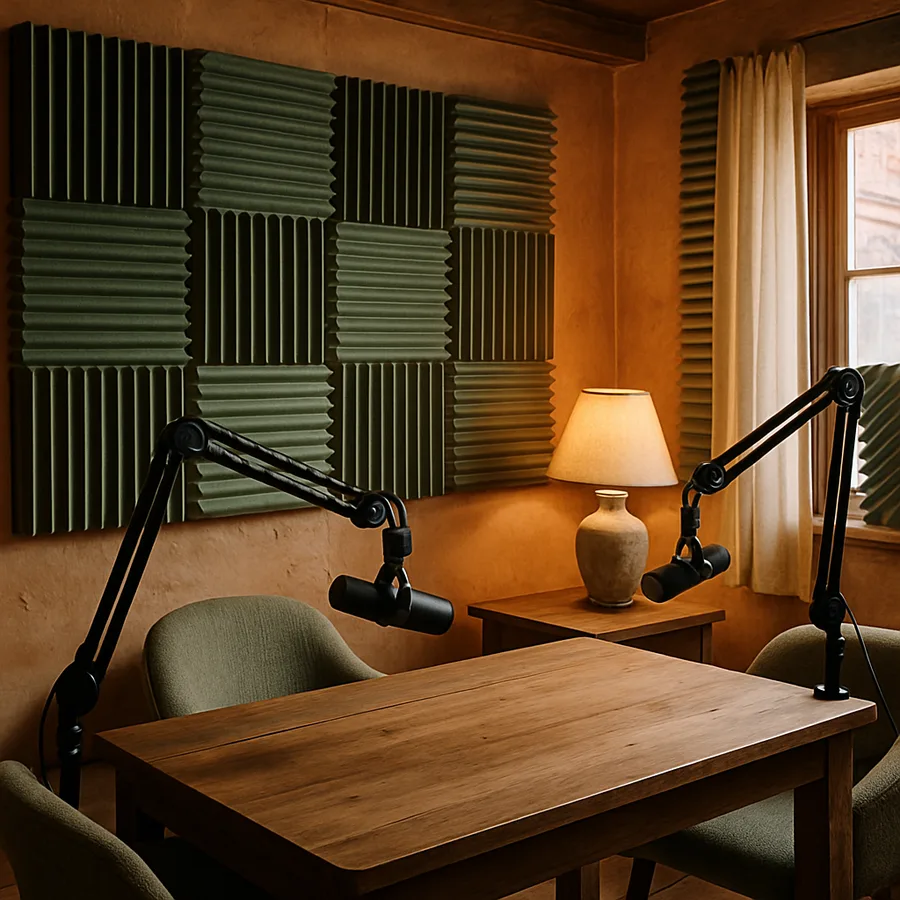
The two-host weekly podcast is one of the most common reasons spare bedrooms and home offices get converted into informal studios. The format is forgiving, the gear is cheap by professional standards, and the audience tolerates rougher edges than a commercial broadcast would. None of that, however, excuses the dull, boxy, room-stamped sound that defines so many home podcasts. Listeners may not know exactly what is wrong with a podcast that sounds like it was recorded in a closet, but they can hear it within ten seconds, and they leave. A small amount of well-targeted acoustic treatment, paired with proper microphone boom geometry, will produce recordings that compete with shows recorded in real studios for a fraction of the cost.
This guide walks through the practical setup of a podcast room around two related problems: making the room sound right and getting the microphones into the right position relative to the talent. Both problems are solvable with widely available products, and most of the choices that matter are about avoiding the common mistakes rather than chasing exotic gear. By the end of the build, the room should be quiet enough to record without ambient noise creeping into the cuts, neutral enough to flatter the voices on the show, and ergonomic enough that long sessions stay comfortable for hosts and guests.
What Acoustic Foam Actually Does, and What It Does Not
The single biggest source of confusion in home podcast acoustics is the role of acoustic foam. The two-inch open-cell foam panels sold in bulk online absorb meaningfully in the upper midrange and treble, roughly above 500 Hz, and they have negligible effect below about 250 Hz. They are useful tools for taming the harsh slap and flutter of a small hard-walled room, and they are not soundproofing in any meaningful sense. A podcast room covered in two-inch foam will still leak sound to the next room, will still receive the neighbor's lawn mower through the window, and will still have unmanaged low-frequency room modes. The foam is for one specific job, and that job is internal flutter and early-reflection control.
The Acoustical Society of America's small-room references are explicit about the cutoff: a porous absorber's effective lower frequency is governed primarily by its thickness, with two-inch foam falling off rapidly below 500 Hz and four-inch fabric-wrapped mineral wool extending useful absorption down toward 125 Hz. For a podcast room, where male and female voice fundamentals live between roughly 80 Hz and 250 Hz, this matters enormously. Foam alone will leave the lower vocal range completely untreated, and your hosts' voices will pick up the room's modal coloration even with full foam coverage on the visible walls.
Have you ever recorded a take in a foam-paneled room and still heard a slight boxy honk in playback? That is the lower-midrange decay tail, untouched by the two-inch foam, and it is the single most audible giveaway of a treated-but-not-tuned home podcast room.
The Right Treatment Recipe for a Two-Host Room
A working recipe for a typical 12-by-14-foot home podcast room mixes three product categories. Start with four-inch fabric-wrapped mineral-wool panels in the corners, treated as floor-to-ceiling vertical bass traps. These do the heavy lifting in the lower vocal range and address the modal problems that foam ignores. Add four to six two-inch fabric-wrapped panels distributed across the side walls and the wall behind each host, which kills the early reflections that smear vocal clarity. Finally, place a ceiling cloud directly above the desk, hung two to four inches below the ceiling, which kills the slap from the ceiling back down into the microphones.
The two-inch foam itself, used responsibly, is best deployed on the smaller surfaces between the larger fabric-wrapped panels and on the desk itself as a small reflection-killing layer where the microphones face. The foam's role is to fill the residual gaps in the upper-midrange treatment, not to be the entire treatment. The Audio Engineering Society's small-room recording papers consistently show that distributed treatment across multiple surface types outperforms a single large concentrated panel, even at equivalent total absorption.
Aim for a mid-band reverberation time below 0.4 seconds, with the lower end ideally not exceeding twice the mid-band value. This is shorter than a music room target and longer than a pure tracking-booth target, which is correct for a podcast where conversational naturalism matters more than maximum dryness. A free measurement-mic-and-software pass before treatment will tell you exactly how far the room is from this target, and a second pass after treatment will tell you whether you have hit it.
Microphone Booms and the Ten-Inch Rule
A counterweighted broadcast boom arm is the single most-overlooked piece of podcast gear, and it is one of the highest-impact upgrades for sound quality. A floor-stand microphone forces the talent to lean forward into a fixed position, fights the talent's natural conversational gestures, and tends to drift away from the optimal capsule angle as the session goes on. A boom arm clamped to the desk lets the microphone follow the talent's mouth at the right distance, the right angle, and the right height through a multi-hour session, with no fatigue and no drift.
For the dynamic broadcast microphones that dominate the podcast world, a working starting distance is roughly two to four inches from the talent's lips, with the capsule angled slightly off-axis so plosives bypass rather than smash directly into the diaphragm. The proximity effect, which boosts the lower midrange when the source moves close, is your friend at this distance; it adds the chest-resonance fullness that makes broadcast voices sound authoritative without dramatic equalization. Move past about ten inches and the proximity boost collapses, the room signature creeps in, and the recording loses its broadcast character.
Position the boom so the arm itself does not block the talent's view of the screen or the cohost. The standard setup clamps the boom to the rear edge of the desk and routes the upper arm over the talent's near shoulder, keeping the microphone in the foreground while the boom hardware lives in the visual periphery. For a two-host setup, mirror the booms; matching geometry on both sides keeps level matching cleaner during editing and produces visually balanced video frames if you are also recording video.
Quiet the Room Before You Worry About the Mic
Acoustic treatment fixes how the room sounds in playback, but the recording's signal-to-noise ratio is set by the room's ambient floor, and the ambient floor is set by HVAC, lighting, and computer fan noise. A typical residential bedroom with an active forced-air supply diffuser and a desktop computer under the desk runs an ambient noise level around 35 to 40 dBA, which is loud enough to creep into compressed vocal cuts and to mask the room's softer dynamics.
The biggest single ambient-noise improvement is moving the computer out of the room entirely, with a long USB or HDMI cable run through a wall and the keyboard, mouse, and monitors at the desk. If that is not possible, choose a passively cooled or low-RPM workstation, place it inside a furniture cabinet with passive ventilation, and never set it on the desk surface where its fan noise will couple into the boom arm. The HVAC supply diffuser should be sized for low face velocity, ideally below 400 feet per minute, and ASHRAE's noise-criteria guidance for residential bedrooms suggests targeting roughly NC 25 or quieter for serious recording use.
Lighting buzz is the third silent contributor. Cheap LED drivers introduce audible electromagnetic and acoustic noise that microphones pick up at distances of a few feet, and a vocal recorded at a quiet level will sit right at the noise floor of a poorly chosen recessed fixture. Specify low-noise drivers, dim from a clean electronic dimmer rather than a magnetic one, and keep dimmers physically distant from the boom arm if at all possible. The National Electrical Manufacturers Association publishes lighting noise test methods that responsible vendors report against, and choosing fixtures whose data sheets include those numbers eliminates a common surprise.
The Desk, the Chair, and the Body in the Room
Acoustic treatment ends at the human body, and the body in the room is itself a significant variable. Two hosts seated at a desk together both absorb and reflect sound, and the desk surface itself is a hard parallel reflector that bounces midrange energy back up into the microphone capsules. Place a thick wool rug on the floor under the desk extending at least eighteen inches past the chair footprints in every direction; the rug kills the floor reflection that otherwise pumps energy back up at the microphones from the most common position in the signal chain.
Use a low-pile, dense fabric on the chairs rather than smooth leather. Leather chairs reflect upper-midrange energy and squeak audibly at the worst possible moments, and microphone capsules pick up both with painful clarity. The American Home Furnishings Alliance publishes upholstery durability guidance that overlaps cleanly with acoustic-friendly choices, and a chair built for long sessions of office work is also typically a chair that does not creak, swivel-noise, or squeak under shifting weight.
Two questions worth answering before the first session. First, should there be a tablecloth or fabric runner on the desk to kill the surface reflection? Yes; even a half-inch felt or wool blanket between the talent and the microphone capsule audibly tames the upward midrange slap, and almost no studio engineer will object to the look on a podcast desk. Second, does the chair height matter? Yes; a chair set too low forces the talent to angle the head upward into the microphone, which changes the capsule's pickup pattern and produces a thinner, breathier sound than a level head position.
Ventilation, Recording Sessions, and the Endurance Problem
A podcast room with two hosts and a guest can become uncomfortable surprisingly fast. Three adults producing a sixty-minute show in a sealed 1,500-cubic-foot bedroom will measurably raise the room's carbon-dioxide level, and that single physiological variable shows up in recordings as flatter delivery, more "ums," and shorter takes before someone calls a break. ASHRAE's 62.2 standard sets residential minimums, and a podcast room hosting two or three people benefits from being on the higher side of those numbers, with a quiet supply diffuser and a quiet exhaust path keeping fresh air moving without intruding on the recording.
Treat session length as a design constraint. A room set up for a thirty-minute weekly show is a different room from one set up for a two-host live four-hour weekly stream, even if the gear is the same. The longer-session room needs better ventilation, more comfortable chairs, easier access to water and snacks without crinkly packaging, and ideally a small adjacent break-out area so guests can step away between segments. The American Institute of Architects' residential studio case studies, several of which are summarized in AES design papers, consistently show that human-factor design extends usable session length by hours per day.
Plan the session workflow before the room is finished. Where does the guest sit? Where does the producer sit if there is one? Where do hands rest, where do drinks live, and how does someone enter or leave the room mid-take without ruining a good thirty minutes of conversation? Each of those questions has implications for the desk layout, the door location, and the arrangement of the microphones, and answering them before construction is far cheaper than answering them with a circular saw later.
Conclusion
A great podcast room is not a foam-coated box. It is a tuned room with broadband absorption distributed across multiple surfaces, with corner trapping for the lower vocal range, with microphone booms positioned to flatter the natural conversational geometry of two hosts, and with an ambient noise floor low enough that the recording captures the show rather than the room. Each of those is achievable with widely available products on a realistic home-studio budget, and each of them is more impactful than upgrading the microphone or the interface.
The shows that sound professional are the ones whose hosts treated the room as a system rather than as a checklist of gear to buy. The wall panels, the ceiling cloud, the rug, the desk topper, the boom arm, the chair, the lighting choice, the HVAC tuning, and the ventilation strategy compound into a recording environment that flatters voices and supports long sessions. The shows that sound amateur are the ones where one or two of those layers were skipped, and the resulting room-stamp creeps into every cut no matter how good the gear is.
If you are about to set up a podcast room, please resist the temptation to start with a wall of two-inch foam. Take a measurement first, target a mid-band reverberation time below 0.4 seconds, treat the corners and the ceiling before the walls, and only then add the foam in the residual gaps. The published guidance from the Acoustical Society of America, the Audio Engineering Society, and ASHRAE will give you a credible plan that costs less than two months of bad takes and that will measurably improve every episode you record on it.
Ready to record a show that sounds like a show? Sketch your room, mark the desk, the chairs, and the boom positions, plan your treatment surfaces, and only then start clicking buy on panels. Your hosts, your guests, and most of all your listeners will hear the difference from the first episode, and the room will earn its setup time back across the entire run of the show.
More Articles You May Like



Comments
Post a Comment