Drum Shade Chandeliers for Low Ceiling Dining Rooms That Work
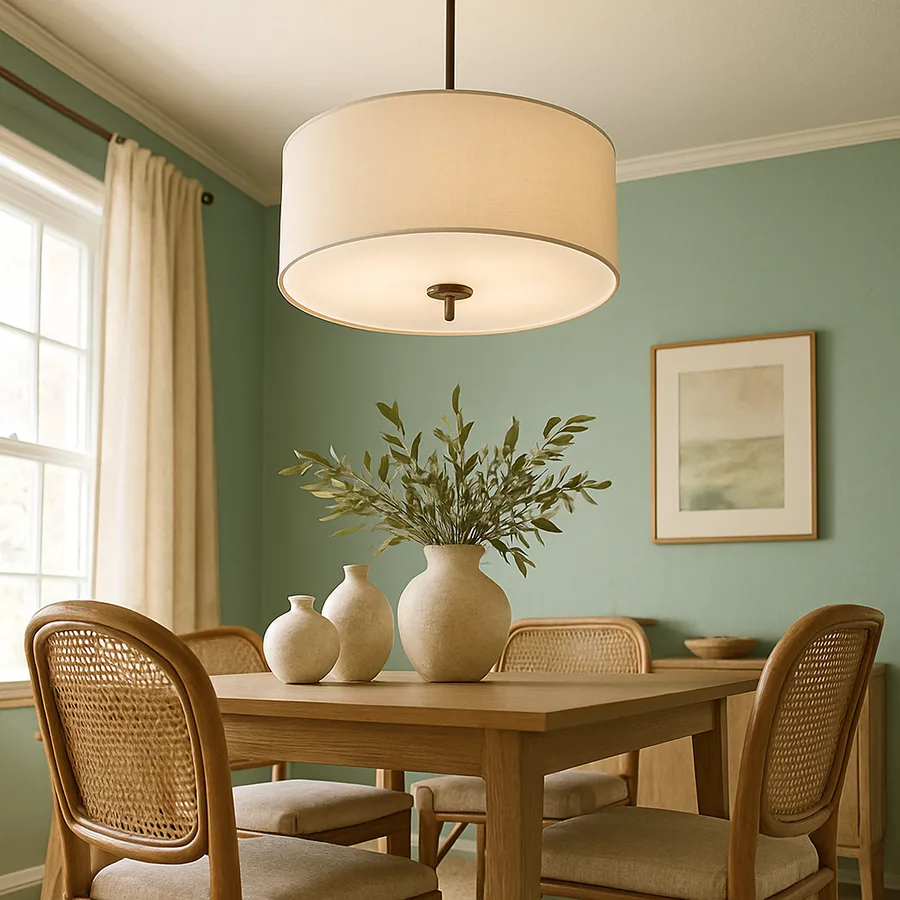
Low ceilings are the single most common complaint in dining room lighting. In homes built between 1950 and 1985, the Residential Energy Consumption Survey puts average ceiling heights at 7 feet 10 inches, well below the 9-foot benchmark that most chandelier manufacturers quietly design for. The result is a design puzzle: how do you hang a fixture with enough presence to anchor a dining table without decapitating tall guests or crowding a short room?
The drum shade chandelier is the answer, and has been for decades. The form factor is compressed vertically, diffuses light evenly across the ceiling plane, and reads as architectural rather than ornamental. This guide explains how to specify a drum shade that works in rooms as short as 7-foot-6, grounded in American Lighting Association clearance standards and ASID scale rules.
What Makes a Drum Shade "Low-Ceiling Friendly"
Three structural traits define a low-ceiling-compatible drum. First, a short overall height, typically 9 to 14 inches from canopy to shade bottom. Second, a wide-to-tall ratio of at least 2:1, meaning a drum that is 24 inches wide should be no taller than 12 inches. Third, a minimal or swap-to-flush canopy, which allows the fixture to be converted to semi-flush mount when drop clearance is tight.
The wide-to-tall ratio matters because visual weight is concentrated in the shade. A tall narrow drum looks like a hatbox dangling in space. A wide short drum reads as a ceiling ring, which the eye interprets as continuous with the ceiling plane. This is the visual trick that makes a compressed room feel intentional rather than cramped.
Have you stood under a drum shade that seemed to make the ceiling look higher? That is diffusion at work. A well-designed drum bounces a portion of its output upward through an open or partially open top, painting the ceiling with soft light. A lit ceiling always reads taller than a shadowed one, regardless of actual measurement.
Drum shades also solve a subtle photographic problem. Low-ceiling rooms photograph poorly with traditional multi-arm chandeliers because the arms appear to touch or cross ceiling lines in wide-angle shots. A drum's clean circular silhouette photographs cleanly from any angle, which matters to anyone who shares photos of their space on platforms like Houzz or Instagram.
Another structural point concerns heat dissipation. A short drum with a partially open top vents heat more effectively than a fully enclosed shade. Enclosed shades with high-wattage bulbs can discolor over time and may even shorten lamp life. Look for drums with at least a partial top opening or a heat-venting top ring, especially if you plan to use higher-output incandescent-equivalent LEDs.
Sizing the Drum to the Table
Standard chandelier sizing rules apply, with one adjustment. Take your table's narrowest dimension in inches and multiply by 0.55 to 0.66. A 42-inch round table takes a 23- to 28-inch drum. A 36-inch round wants 20 to 24. A 48-inch square pairs with 26 to 32.
The adjustment is at the bottom of the range. Drum shades read larger than open-cage chandeliers of equivalent diameter because they are visually solid. A 22-inch open-cage fixture looks small above a 42-inch table, but a 22-inch drum can look just right. When in doubt between two drum sizes, choose the smaller one in a low-ceiling room. Visual compression is the enemy you are trying to manage.
For rectangular tables in low-ceiling rooms, consider a double drum, two matching drums hung in tandem above the table. This distributes visual weight along the length without adding vertical drop, and it avoids the "short-tie" look of an undersized single drum on a long table.
Oval tables in low-ceiling rooms are particularly well-served by drums. An oval table's softer silhouette pairs naturally with the round drum shape, whereas a rectangular table in a low-ceiling room often wants a linear fixture that may conflict with the compressed ceiling plane. If you have an oval and a sub-8-foot ceiling, a drum is almost always the right call.
Drop Heights in Sub-8-Foot Rooms
The published 30-to-36-inch clearance rule assumes an 8-foot ceiling. In a 7-foot-8 room, that rule produces an impossible install. Adjust by measuring from the ceiling downward rather than from the table upward.
In a 7-foot-8 room, allow 8 to 12 inches of ceiling-to-top-of-fixture space. This places the bottom of a 12-inch drum roughly 64 to 68 inches off the floor. A standing 6-foot guest at a dining chair will still have head clearance, and the fixture will read as intentional rather than cramped. In a 7-foot-10 room, you gain another two inches, which is worth using: raise the fixture rather than stretching the drop.
For rooms from 8 feet to 8-foot-6, you can return to the standard 30-inch clearance above the table, as long as the drum's own height does not push the canopy flush. A 14-inch drum with 30 inches clearance above a 30-inch table top puts the canopy at 74 inches, which works cleanly under an 8-foot ceiling.
When clearance gets truly tight, use a semi-flush drum, which mounts within 4 to 6 inches of the ceiling. Semi-flush drums preserve the diffuser aesthetic without any suspended drop, and they qualify as chandeliers in every meaningful design sense.
Under-cabinet or perimeter lighting also plays a role in how low-hung drums feel. When the drum provides the only light in a small room, it must work harder, and a higher mounting height can leave the table underlit. Adding wall sconces or buffet lamps lets you mount the drum a touch higher without losing the sense of a well-lit table.
If you cook or do homework at the dining table, consider a drum with a secondary downlight, such as an integrated spot at the bottom center. This provides focused task light when needed while the drum itself handles ambient illumination. Many transitional drum designs now include this feature as a standard option.
Material and Light Quality
Drum shades come in linen, silk, parchment, mica, metal mesh, and increasingly, acrylic or fabric-wrapped acoustic panels. The material choice governs the light quality more than the bulb selection does.
Linen drums produce the warmest diffusion, soft-edged and forgiving, but can yellow over time. Silk drums are slightly cooler and hold color better, though they are more delicate. Parchment reads antique and casts a distinctive cream glow, suitable for traditional interiors. Mica gives a mottled amber cast beloved in craftsman and lodge interiors. Metal mesh drums, often with an inner diffuser, produce a dappled pattern on the ceiling that can be beautiful or busy depending on the mesh weave.
For a dining room, prioritize diffusion over drama. You want a drum that is forgiving to faces, not one that throws dramatic shadows. Architectural Digest editors consistently rate linen and silk drums as the most universally flattering for residential dining.
Color temperature matters too. Specify bulbs at 2700K to 3000K for a warm, restaurant-like feel. The Illuminating Engineering Society notes that dining rooms rated above 3000K tend to feel clinical in photographs and in use, especially under a diffusing drum.
Fabric choice also affects longevity. Pure linen drums develop a pleasing soft patina over time, while blended synthetics may resist aging but never acquire the same hand. For homeowners who plan to keep the fixture for a decade or more, natural fibers almost always outperform synthetic blends aesthetically, even as they require gentler maintenance.
Fitting Drum Chandeliers Into Design Styles
Drum shades are one of the most style-flexible fixtures on the market. A linen drum with a bronze frame reads transitional. A white drum with a chrome frame reads contemporary. A drum wrapped in natural rattan reads coastal or Japandi. A drum with crystal interior beading reads Hollywood Regency. The same structural form supports radically different visual vocabularies.
In a low-ceiling dining room, style alignment does more than decoration. A transitional drum in a mid-century room feels like a compromise. A correctly styled drum feels designed. When the drum's vocabulary matches your chairs, buffet, and rug, the ceiling limitation disappears visually.
Look for drums with a bottom diffuser, a frosted acrylic or linen panel at the base of the shade. Bottom diffusers eliminate the glare of exposed bulbs when a seated diner looks up, and they spread light evenly across the table surface. Houzz-featured designers almost always specify bottom diffusers for residential dining installs.
One emerging trend worth noting is the double-height drum, essentially two concentric drums of different diameters. These hybrid fixtures work surprisingly well in low-ceiling rooms when the outer drum stays wide and flat, with the inner drum adding a layer of texture rather than additional vertical drop. They read more architectural than standard single drums and suit transitional and Japandi interiors.
Very traditional dining rooms can also accept drums if the drum is wrapped in a period-appropriate material. A silk drum with a braided trim reads as Belle Epoque rather than contemporary, and pairs well with antique dining sets. Do not assume drums are inherently modern; the form factor is older than most realize.
Installation and Maintenance Considerations
Drum shades collect dust. The top of a drum acts as a shelf that accumulates fine particulate over months. Plan on a twice-yearly cleaning with a soft brush and a microfiber cloth. For fabric drums, avoid water; spot-clean only with a dry or slightly damp cloth on the outside surface.
Bulb access is another practical consideration. Some drums require removing the entire bottom diffuser to change lamps, which is a two-person job at dining-height clearances. Favor drums with a removable ring or a pivoting diffuser. The National Electrical Manufacturers Association publishes guidelines that emphasize serviceability as an overlooked metric in fixture selection.
Weight varies widely. A linen drum with a thin metal frame can weigh under 10 pounds, while a crystal-interior drum can exceed 35. Always confirm the fixture weight against your junction box rating. Older homes in the sub-8-foot ceiling cohort often have small boxes rated for 25 pounds or less, and an unplanned weight upgrade requires box replacement.
Retrofitting a drum into an older home often reveals a small, shallow junction box incompatible with modern canopy designs. Plan on a box upgrade as part of your installation budget, and ask the electrician to assess box depth before ordering. A fixture that ships and then cannot be mounted because the canopy does not clear the existing box is a frustrating and avoidable problem.
Noise is another rarely discussed consideration. Some drums with metal internal reflectors can produce faint buzzing from LED drivers, particularly at low dimmer settings. Read user reviews specifically for mentions of fixture noise before purchase, and pair the drum with a UL-listed LED dimmer rated for the exact lamp or driver you plan to use.
Conclusion
The low-ceiling dining room is not a design disadvantage. It is a design constraint that has a perfect solution, and that solution has existed for nearly a century. The drum shade chandelier evolved precisely because older houses with compressed ceilings still wanted fixtures with presence, diffusion, and formal anchoring of a table.
Choose a drum with a wide-to-tall ratio of at least 2:1. Size it at 55 to 66 percent of your table's narrow dimension. Hang it 8 to 12 inches below the ceiling in rooms under 8 feet, and use a semi-flush variant when drop clearance disappears. Specify 2700K to 3000K bulbs, a bottom diffuser, and an LED-compatible dimmer. Clean it twice a year.
Follow those rules and your compressed dining room will photograph like a published interior. More importantly, meals under a well-chosen drum feel different: softer, more enclosed, more conversation-friendly. The ceiling stops feeling like a limit and starts feeling like a carefully tuned intimate enclosure, which is what a dining room should be.
Not sure where to start? Take two minutes to measure your ceiling height and table width, then browse the Interior Bliss low-profile drum collection, where every fixture is tagged with its ceiling-minimum rating. Your perfect drum is likely already on the page.
Authority references for further reading: American Lighting Association, the professional directory at ASID, and the editorial archives at Architectural Digest.
More Articles You May Like



Comments
Post a Comment