Coffee Table Styling Vignettes With Books Trays and Greenery
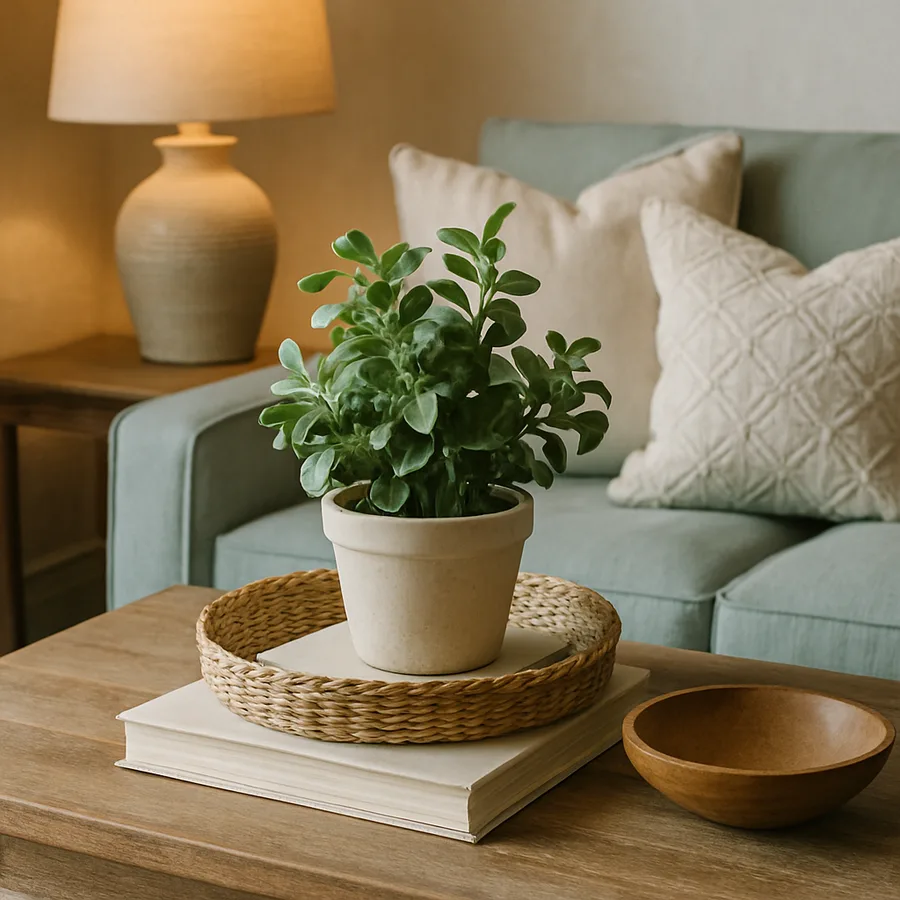
The coffee table is the most frequently photographed surface in your home, even if you never plan to photograph it. Visitors look at it. Family members rest drinks on it. Children push toys across it. It is the workhorse of the living room and, simultaneously, the canvas where your taste is most concentrated. A well-styled coffee table communicates more about a homeowner's design sensibility than almost any other surface, which is why the simple act of arranging a few objects on it has spawned an entire vocabulary of styling rules.
The good news is that coffee table styling is one of the most forgiving exercises in interior design. You do not need expensive objects, you do not need exotic plants, and you do not need to follow trends. You need three reliable categories of items working together in the right proportions and you need to understand the principles that make a vignette feel intentional rather than cluttered. Architectural Digest editors have consistently noted that the best-styled coffee tables in the world tend to use surprisingly modest materials arranged with extraordinary care, which is excellent news for anyone working with a real-life budget.
The Foundation Of Every Great Vignette
Before you place a single object, take everything off your coffee table and look at the empty surface. You need to see the table as a piece of furniture again, not as a junk drawer. This reset is essential because most homeowners style coffee tables incrementally, adding objects over months or years until the surface becomes archaeology rather than design. Starting from an empty table forces you to make deliberate choices about every item that earns a place there.
The fundamental principle of coffee table styling is the rule of three primary categories: books, a tray, and something living. Books provide horizontal mass and color. The tray provides organization and a sense of intention, corralling smaller items into a deliberate composition. Greenery introduces life, scale, and vertical interest. Almost every iconic coffee table styling moment in shelter magazines uses some version of this trio because the categories complement each other functionally and visually.
Better Homes and Gardens has reported in its home styling features that more than 80 percent of design enthusiasts say they struggle with surface styling more than any other decorating skill. The reason is that styling feels subjective when in fact it follows specific rules. Once you understand the foundational categories and proportions, the apparent mystery of magazine-worthy tabletops dissolves into a teachable craft.
Choosing And Stacking Books With Purpose
Coffee table books are not just visual filler. They are conversation starters, height-builders, and color carriers all at once. The mistake most homeowners make is buying books for the title rather than the spine and cover quality. A coffee table book should be visually beautiful both closed and open, with substantial heft, a hardcover, and a dust jacket that contributes to the room's color story.
When you stack books, aim for stacks of two or three rather than singletons. A single book sitting alone on a coffee table tends to look orphaned, while a stack reads as an intentional plinth. Vary the heights between stacks so you create a small landscape rather than a flat plain. House Beautiful has frequently demonstrated this principle in its room reveals, where stylists deliberately mix tall narrow stacks with shorter wide stacks to give the eye somewhere to travel.
One often overlooked detail is what you place on top of the books. The book stack acts as a pedestal, and whatever you set on it gets visually elevated. A small bowl, a sculptural object, a candle, or a curiosity all benefit from being lifted up onto a book stack rather than sitting flat on the table. Have you ever wondered why the same object can look like clutter on a bare table but like art on a stack of books? The answer is that the stack creates a frame around the object, which signals to the eye that it deserves attention. Every book stack is a small stage, and the object placed on top is the performer.
The Tray As Composition Anchor
If books are the building blocks of a coffee table vignette, the tray is the composition anchor. A well-chosen tray transforms a scattered collection of small items into a unified moment, and it does so by providing edges. The tray's perimeter creates a frame, and everything inside that frame reads as belonging together. Without a tray, the same items can feel like accidents waiting to be cleaned up.
Material choice matters enormously. A brass or polished metal tray adds glamour and reflects light. A leather or rattan tray adds warmth and texture. A marble or stone tray adds weight and a sense of luxury. Pantone has highlighted in multiple home decor reports that material variety on a small surface is one of the most effective ways to add visual interest without adding more objects, and the tray is your single most important opportunity to introduce a new material to the table.
Inside the tray, group items in odd numbers. Three or five small objects almost always look better than two or four because odd numbers feel more dynamic and less symmetrical. Common tray contents include a small candle, a decorative box, a sculptural object, a vessel of matches, and perhaps a small dish for keys or remotes. The tray also serves a practical function: it gives every loose object a designated home, which keeps the table from sliding into entropy throughout the week.
Selecting Greenery That Actually Survives
Living plants transform coffee tables in ways that nothing else can replicate. They add scale, movement, and an almost subconscious feeling of vitality to the room. The challenge is choosing greenery that can tolerate the conditions of your specific coffee table. Most living rooms are not ideal plant environments. They are often dim, drafty, and inconsistent in temperature, which is precisely why so many coffee table plants die within a month.
For low-light living rooms, pothos, snake plants, and ZZ plants are nearly unkillable choices that bring sculptural greenery without demanding attention. For brighter rooms with consistent indirect light, a small olive tree, a fiddle leaf fig branch in water, or a trailing string of pearls all add elegance. Architectural Digest has covered the rise of indoor greenery in residential design extensively, noting that the trend has moved away from oversized statement plants toward smaller, more curated specimens that integrate with vignettes rather than dominating them.
If real plants are simply not feasible, a small bouquet of fresh-cut flowers refreshed weekly can serve the same role with even more drama. Better Homes and Gardens has reported that regularly refreshed greenery, real or cut, is one of the most cost-effective ways to keep a coffee table looking styled rather than stale. Avoid plastic plants if at all possible. The eye reads them as fake even from across the room, and they undermine the sophistication of everything else on the surface.
Balancing Negative Space And Visual Weight
The most common mistake in coffee table styling is overcrowding. Homeowners often think more objects equal more sophistication when in fact the opposite is true. The empty space around your objects is just as important as the objects themselves. Negative space allows the eye to rest and lets each item earn its place by standing out against the surrounding emptiness.
A useful guideline is to leave at least 40 to 50 percent of the table surface visible. This empty space gives your styled vignette room to breathe and also leaves practical room for a coffee cup, a book in progress, or a remote. A table that is fully covered with styled objects is not a coffee table anymore. It is a display case, and it will rapidly become irritating to use.
Visual weight also matters. Heavy, dark, or large objects pull the eye more strongly than light, pale, or small ones. Distribute visual weight thoughtfully so that no single corner of the table dominates. If you have a heavy stack of books on one side, balance it with a substantial plant or sculptural object on the opposite side. The American Society of Interior Designers (ASID) frequently emphasizes that balance is achieved through visual weight rather than literal symmetry, and this principle applies to surface styling just as much as to furniture arrangement. Why does this matter so much? Because an unbalanced vignette will look subtly wrong even if you cannot articulate why, and the eye will keep returning to fix it mentally rather than enjoying the room.
Adapting The Formula For Different Coffee Table Shapes
Round coffee tables, rectangular coffee tables, and oversized ottoman-style coffee tables each call for slight variations of the same core formula. On a round table, build your vignette in a triangular composition with three primary zones rather than the linear layout that works on rectangles. The triangle echoes the round shape and creates visual rhythm that flows around the table rather than from end to end.
Rectangular tables benefit from divided zones. Treat the table as having three sections: a left, a middle, and a right. Place a major element in each section, with the tallest element typically in one of the side zones rather than the middle. This asymmetry feels more relaxed than a symmetrical arrangement and reads as designed rather than staged. House Beautiful has shown this technique in countless living room features, and the consistency of the approach across very different design styles speaks to its reliability.
Ottoman-style coffee tables present a unique challenge because the top surface is soft and the items must be stable. A large tray becomes essentially mandatory in this case, providing both a flat surface for styling and a way to remove the entire vignette quickly when the ottoman needs to function as additional seating. Have you considered whether your styling formula needs to be portable? On an ottoman, the answer is almost always yes, and designing your vignette to lift off as a single unit on a tray solves the practical problem elegantly.
Conclusion
The coffee table is the heart of the living room, and styling it well is one of the most accessible ways to elevate your entire home. The formula is simple: books for horizontal mass and color, a tray to organize and anchor smaller items, and greenery to bring life and vertical interest. Within that structure, you have endless flexibility to express your personal taste, your seasonal mood, and your specific room's color story.
What separates a well-styled coffee table from a cluttered one is restraint and intention. Every object earns its place by contributing to the composition, by being beautiful in its own right, or by serving a practical function that aligns with the visual story. When in doubt, remove rather than add. The single most reliable way to improve a coffee table that does not look quite right is to take one or two items off and see whether the remaining vignette feels stronger.
Coffee table styling also rewards regular attention. The tray contents can rotate seasonally. The book selection can change to reflect what you are actually reading or wanting to read. The greenery can shift from a flowering branch in spring to evergreen sprigs in winter. Treating your coffee table as a small, evolving canvas keeps your living room feeling fresh without requiring significant investment, and it keeps your design eye sharp through regular practice on a low-stakes surface.
Ready to give your coffee table the attention it deserves? Clear it completely, gather your books and your tray and a piece of greenery, and start fresh. Style with intention, edit with discipline, and your coffee table will become not just a place to set down a glass but a small daily reminder that thoughtful design transforms ordinary moments into pleasurable ones.
More Articles You May Like



Comments
Post a Comment