Sculptural Objects on Coffee Tables: Styling Without Clutter
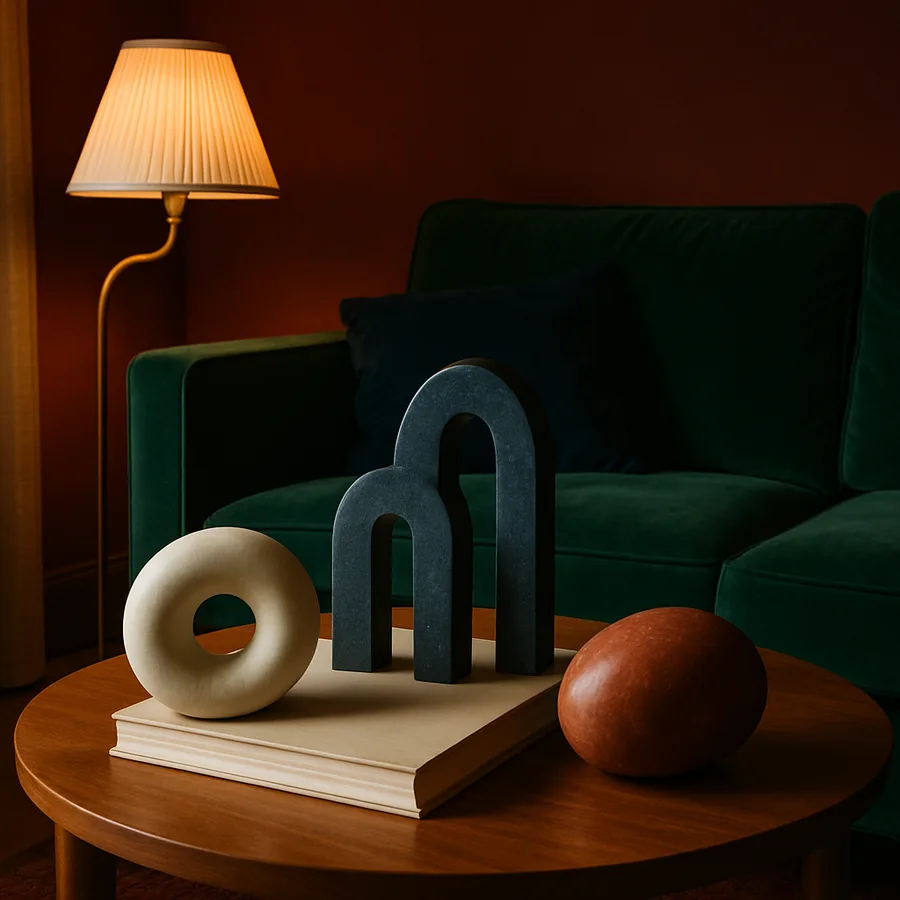
The Problem: Coffee Tables That Collect Instead of Curate
The coffee table sits at the geographic and social center of most living rooms, yet it is also the surface most vulnerable to clutter. Remote controls, coasters, half-read magazines, children's toys, and the accumulated debris of daily life tend to settle there like sediment. When homeowners attempt to style the table with decorative objects, those objects often get absorbed into the clutter rather than rising above it. The sculptural piece you carefully selected ends up buried behind a stack of mail and a forgotten coffee mug, contributing to the problem instead of solving it.
This tension between function and aesthetics is what makes coffee table styling genuinely difficult. Unlike a shelf or a mantel, which serve primarily as display surfaces, the coffee table must also accommodate drinks, snacks, books, and the general business of living. Any decorative approach that ignores this functional reality will fail within days of implementation. The American Society of Interior Designers (ASID) identifies the coffee table as the single most re-styled surface in residential design consultations, precisely because the first attempt rarely accounts for how the household actually uses the space.
Sculptural objects offer a specific advantage in this context because they occupy vertical space rather than spreading horizontally across the table surface. A tall ceramic form, an abstract metal piece, or a carved stone object draws the eye upward and establishes visual presence without consuming the footprint that functional items need. This vertical orientation is the key distinction between decorative objects that enhance a coffee table and those that simply add to its burden. Think of sculpture as a flag planted in the center of contested territory, claiming aesthetic space while leaving the surrounding area available for daily use.
The goal of this guide is to provide a concrete framework for selecting, positioning, and maintaining sculptural objects on coffee tables in a way that enriches the room without creating the clutter that drove you to redecorate in the first place. Every recommendation here has been tested against the reality of lived-in homes, not styled-for-photography showrooms. If your coffee table needs to function for a family, not just a photoshoot, these principles will work for you.
Choosing Sculptural Objects That Fit Your Table and Room
Scale is the most consequential decision and the one most frequently misjudged. A sculptural object on a coffee table should be tall enough to register as a visual presence from across the room but not so tall that it obstructs sightlines between seated guests. For standard-height coffee tables of sixteen to eighteen inches, sculpture height between eight and fourteen inches hits the sweet spot. Objects shorter than eight inches tend to disappear among books and trays, while anything taller than fourteen inches starts to feel like it belongs on the floor or a pedestal rather than a tabletop.
Material should respond to the room's existing textures. A matte ceramic piece introduces softness in a room dominated by hard surfaces like glass, metal, and polished wood. Conversely, a polished bronze or brass sculpture adds reflective warmth to spaces heavy in textiles and matte finishes. The Architectural Digest design team recommends what they call the contrast principle: always introduce at least one material on the coffee table that does not appear elsewhere on immediately adjacent surfaces. This contrast is what makes the object read as intentional art rather than a matching accessory.
Form matters independently of material. Organic, rounded shapes, such as biomorphic blobs, smooth river stones, and undulating curves, soften the rigid geometry of most coffee tables and seating arrangements. Angular, geometric sculptures, like stacked cubes, faceted polyhedra, or sharp-edged abstract forms, reinforce a modern or minimalist vocabulary. Neither approach is inherently superior, but mixing both on the same table creates visual confusion. Commit to one formal language per table surface, and let the rest of the room provide counterpoint if needed. Have you ever noticed how certain objects seem to argue with each other when placed side by side? Conflicting formal vocabularies are usually the cause.
Color should be treated with restraint on the coffee table specifically because this surface is already visually busy by nature. Neutral-toned sculptures in white, cream, charcoal, matte black, or natural stone read as sophisticated and tend to integrate smoothly across seasonal decor changes. A bright red ceramic orb might look striking in a product photograph, but on a real coffee table surrounded by books, candles, and the inevitable everyday items, it risks feeling like a competing focal point rather than a harmonious one. The National Kitchen and Bath Association (NKBA) design principles, while focused on kitchens and baths, offer a transferable guideline: keep fixed elements neutral and introduce color through easily changeable accents.
The Tray Method: Containing Decor to Protect Function
A decorative tray is the single most effective tool for maintaining the boundary between styled display and usable surface. By placing your sculptural object and its supporting items, a candle, a small book, a bud vase, inside a tray, you create a defined zone of decoration that the household unconsciously respects. Items outside the tray are available for use; items inside the tray are understood as decor. This invisible boundary is remarkably powerful in practice, and interior stylists have relied on it for decades.
Tray selection follows the same material and scale logic as sculpture selection. The tray should be large enough to hold its contents comfortably but should not occupy more than one-third of the total table surface. For a typical 48-by-24-inch rectangular coffee table, a tray measuring roughly fourteen by ten inches provides ample display area while leaving the majority of the surface open. Round tables work best with round or oval trays that echo the table's geometry. According to research shared by the Interior Design Society (IDS), trays that match the shape of their host surface create a more unified visual composition than contrasting shapes.
Within the tray, arrange items at varying heights to create a miniature landscape. The sculptural object should be the tallest element, with supporting pieces stepping down around it. A common and effective formula is one tall sculpture, one medium-height element like a candle or small plant, and one low element like a stack of coasters or a flat decorative box. This tiered arrangement gives the eye a journey from high to low, which reads as dynamic even in a compact space. The tray's edges serve as a frame, just as a picture frame contains and focuses a photograph.
Functionality within the tray is not only acceptable but encouraged. Including a small stack of attractive coasters, a matchbox for the candle, or a tiny dish for rings and small items transforms the tray from a pure display zone into something that actively serves the household. This dual purpose is what makes the tray method sustainable over time. A display that demands removal every time someone wants to use the table will be abandoned within a week. A display that accommodates use while maintaining aesthetics will persist indefinitely. What does your family actually reach for when gathered around the coffee table? Include those items inside the tray and style around them.
Five Styling Formulas That Work Every Time
Formula One: The Solo Statement. This approach places a single large sculptural object at the center of the table with nothing else competing for attention. It works best on smaller tables where surface area is limited and in minimalist interiors where visual restraint is a core value. The object needs sufficient presence to anchor the table alone, so choose something with strong form and at least ten inches in height. A single white ceramic vessel with an unusual silhouette, for example, can hold a room's attention without any supporting players. This formula requires discipline, as the temptation to add just one more thing is strong, but the payoff in visual clarity is significant.
Formula Two: The Stacked Trio. Place two or three large-format art or design books flat on the table, then set a sculptural object on top. The books provide a pedestal that adds both height and intellectual texture to the arrangement. Choose books with spine colors or cover imagery that complements the sculpture and the room's palette. This is perhaps the most commonly used formula in professional interior styling because it is reliably effective across almost every decor style. The Houzz editorial team has described it as the default starting point for coffee table styling in their published guides, and for good reason.
Formula Three: The Asymmetric Cluster. Group three to five items of varying heights toward one end of the table, leaving the opposite end entirely clear. This off-center arrangement feels casual and dynamic, and it provides a generous amount of usable surface. The cluster should include the sculptural object as its tallest element, flanked by a candle, a small plant, and perhaps a decorative box or bowl. Odd numbers of items create more visually pleasing compositions than even numbers, a principle rooted in the rule of odds that designers and photographers use extensively.
Formula Four: The Symmetrical Anchor. For formal living rooms, place a tray at the exact center of the table with the sculptural object centered within it. Flank the tray with two matching elements, such as identical small vases or candleholders, placed equidistant from the tray on either side. This mirror-image arrangement communicates order and intentionality, making it particularly effective in traditional, transitional, and Art Deco interiors. The symmetry provides a sense of completeness that asymmetric arrangements deliberately avoid.
Formula Five: The Seasonal Rotation. Designate the coffee table sculpture as a rotating element that changes with the seasons or your mood. Keep a small collection of three or four sculptural objects stored when not in use, and swap them on a regular schedule. A smooth white ceramic form for spring and summer, a textured dark stoneware piece for autumn, and a metallic object for winter holidays creates a table that feels continuously refreshed. This approach requires storage space for off-duty objects but rewards you with a living room that never feels stale.
Materials and Where to Find Them
Handmade ceramics represent the broadest and most accessible category of tabletop sculpture. Independent ceramic artists sell through platforms like Etsy, at local craft fairs, and through gallery shops in most mid-sized cities. Prices range from thirty dollars for small production pieces to several hundred for one-of-a-kind studio work. The advantage of handmade ceramics is that each piece carries subtle imperfections, finger marks, glaze variations, and slight asymmetries, that give it presence and character mass-produced objects cannot replicate. Supporting independent makers also connects your home to a creative community, which adds a narrative layer to the object's role in your space.
Cast metal sculptures in bronze, brass, and aluminum offer durability and a refined weight that ceramics cannot match. A solid brass abstract form has a satisfying heft when picked up, and its surface develops a natural patina over time that enriches its appearance. Brands like Global Views, Arteriors, and Kelly Wearstler Home produce sculptural objects specifically designed for residential tabletop use, with bases weighted to prevent tipping. These pieces occupy a higher price bracket, typically one hundred to five hundred dollars, but their longevity and material quality justify the investment for a surface as central and visible as the coffee table.
Natural materials like carved stone, polished crystal, and petrified wood bring geological interest to the table. A chunk of rough-edged rose quartz or a slice of polished agate placed on a small brass stand introduces color and texture that manufactured objects cannot replicate. The American Society of Interior Designers has documented a sustained trend toward natural and organic materials in residential accessorizing, driven partly by biophilic design research showing that natural elements in interior spaces correlate with reduced occupant stress. A stone object on your coffee table does more than look good; according to research promoted by the International WELL Building Institute, it subtly connects the indoor environment to the natural world.
For budget-conscious styling, thrift stores and estate sales are underrated sources of sculptural objects. A vintage ceramic vase with an interesting silhouette, stripped of its original dried-flower arrangement and displayed empty, functions beautifully as sculpture. Brass figurines from the mid-twentieth century, once dismissed as kitschy, have re-entered mainstream design appreciation and are widely available at secondhand prices. The key is evaluating each object for its form alone, independent of its original function. A teapot with a striking shape, displayed without its lid, is sculpture. A wooden tool with an elegant curve, cleaned and placed on a book, is sculpture. Recontextualization is the designer's most cost-effective technique.
Maintenance and Adapting to Real Life
Dust is the persistent enemy of tabletop displays. Coffee tables collect dust faster than elevated surfaces because of their proximity to foot traffic, upholstered seating, and the general circulation patterns of occupied rooms. A weekly wipe-down with a microfiber cloth keeps sculptural objects looking sharp. For textured or porous surfaces like unglazed ceramic or natural stone, a soft-bristled brush, the kind sold for cleaning camera lenses, reaches into crevices that cloth misses. Neglecting dust maintenance is the fastest way to turn a styled table into one that looks abandoned.
Households with young children face particular challenges. Fragile ceramic and glass objects on a low table within a toddler's reach are invitations to disaster. During the years when small hands explore every surface, shift to unbreakable materials like wood, soft stone, or woven objects. A carved wooden sphere, a smooth river stone, or a woven grass orb provides the same sculptural interest without the risk of shattered ceramics and potential injury. This adaptation is temporary and practical; there is no design failure in prioritizing safety during a specific life stage.
Pets introduce their own considerations. Cats are drawn to any new object placed at their level, and a tail swipe can send a top-heavy sculpture off the table edge. Weighted bases, museum putty on the underside, and wide-bottomed shapes all reduce the likelihood of pet-related casualties. Dogs with enthusiastically wagging tails present the same risk from a different direction. If your household includes an exuberant Labrador, keep the sculptural display toward the center of the table rather than at the edge, and choose objects that can survive a fall to a carpeted floor. A report by the American Pet Products Association found that 67 percent of American households include at least one pet, making pet-compatible styling a mainstream concern rather than a niche consideration.
Seasonal adjustments keep the display from becoming invisible. Even the most beautiful arrangement fades into the background after several months of unchanged presence. Rotating the sculptural object quarterly, rearranging the supporting items monthly, or simply shifting the position of the tray from one end of the table to the other every few weeks resets your perception and maintains the display's ability to catch your eye. A coffee table that surprises you occasionally is one that continues to bring pleasure long after the initial styling session.
Conclusion: Sculpture as the Anchor of a Living Room
A well-chosen sculptural object transforms a coffee table from a passive surface into an active design element. It provides a vertical focal point that lifts the eye, introduces material interest that enriches the room's texture, and establishes an aesthetic anchor that organizes the other items sharing the table. When paired with the tray containment method and a styling formula matched to your room's proportions and your household's needs, sculpture makes the difference between a coffee table that merely exists and one that genuinely contributes to the room's atmosphere.
The critical insight is that successful coffee table styling is not about maximizing decoration but about strategic restraint. One strong sculptural piece, properly scaled and thoughtfully placed, outperforms a dozen smaller objects scattered without purpose. The tray draws a boundary that protects the display from encroaching clutter while remaining functional for the daily activities the table must support. Every item on the surface should be there by decision, not by default.
Start this weekend with a single experiment. Clear your coffee table entirely, choose one object from elsewhere in your home that has an interesting shape, and place it at the center of the table on top of two stacked books. Live with that arrangement for a week and observe how it changes the way the table functions and how the room feels. That simple exercise will teach you more about sculptural styling than any number of inspiration images. Once you see the impact a single deliberate object can make, you will never go back to an unstyled surface.
More Articles You May Like



Comments
Post a Comment