Closet Accessory Drawers For Belts Ties and Watches
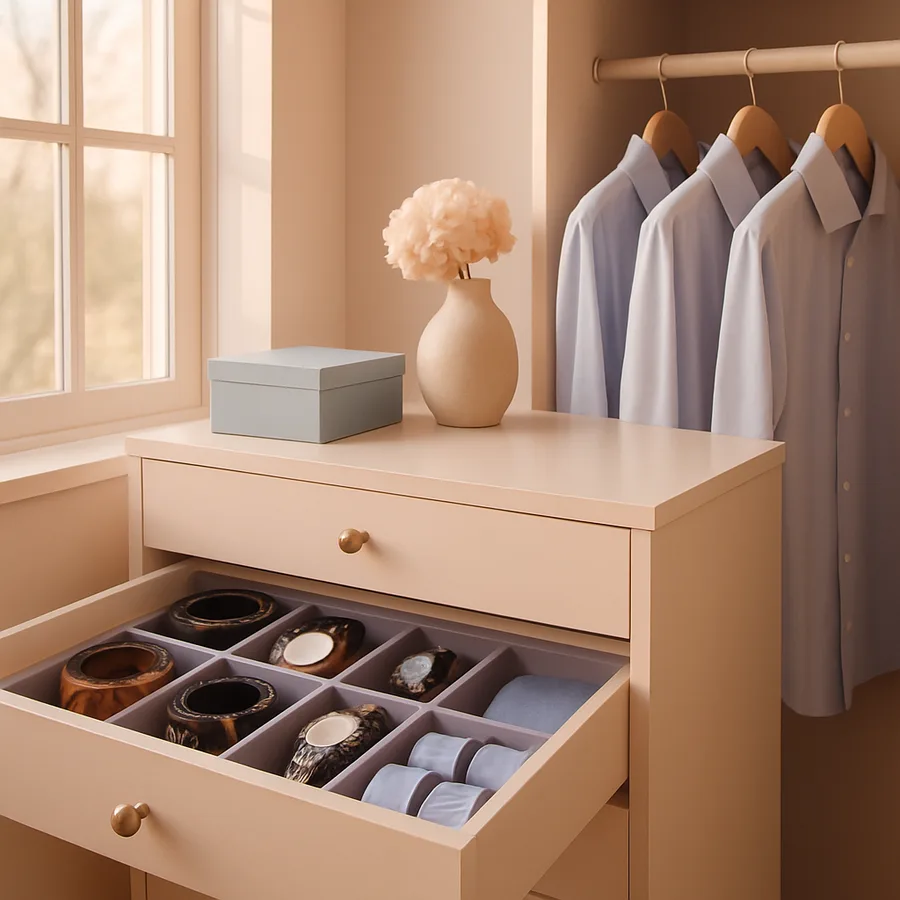
The accessory drawer is one of the most under-considered components of a closet renovation, and the consequences show up every morning. Tangled belts, creased ties, and scratched watch crystals are the predictable result of generic drawers asked to handle items that each demand their own particular geometry. A thoughtfully designed accessory drawer system protects valuable pieces, accelerates daily dressing, and quietly contributes to the editorial feel that separates a luxury closet from an ordinary one. Industry data referenced by the American Home Furnishings Alliance (AHFA) shows that purpose-built accessory inserts now appear in the majority of premium closet specifications, up substantially from less than a third of installations a decade ago.
This guide walks through the design considerations that matter most: how each accessory category should be stored, what materials and configurations deliver the best long-term results, and how to integrate accessory drawers into a broader closet without compromising hanging space or shoe storage. The right drawer system is not the most expensive one; it is the one calibrated to the specific collection and routine of the person actually using it. The differences in execution are often invisible in showroom photography but become deeply apparent within a few weeks of daily use.
Belt Storage Strategies and Drawer Geometry
Belts are deceptively difficult to store well. The leather wants to lie flat or be hung, but most closets default to coiling belts inside small bins, which causes permanent curl and accelerated cracking along the fold lines. The two effective approaches are flat storage in dedicated belt drawers and vertical hanging on dedicated belt racks mounted inside the closet wall or door interior. Each has clear advantages, and the choice depends on how many belts you own and how much horizontal drawer real estate you can spare.
Flat belt drawers use shallow trays divided into long rectangular compartments, with each belt stored in a relaxed flat coil rather than a tight roll. The drawer typically runs the full width of the closet base cabinetry, and a single drawer can hold between eight and fifteen belts depending on width. Velvet or microfiber lining prevents the belts from sliding when the drawer opens, and dividers keep buckles from scratching neighboring pieces.
Vertical belt hangers preserve belts in their natural straight state, which is the gentlest possible storage for high-quality leather. The downside is that they consume vertical wall space that could otherwise serve hanging clothes, and they expose belts to dust unless installed inside a closed cabinet. The Container Store offers both freestanding belt valets and integrated hanging bars in a wide range of formats. National Association of Productivity and Organizing Professionals (NAPO) guidance generally favors flat drawer storage for collections under fifteen belts and hanging systems for larger collections.
Tie Storage That Prevents Creasing and Accelerates Selection
Ties present the opposite challenge of belts. The fabric is delicate, the construction is interlined, and any storage method that compresses the bias of the fabric will produce permanent creases that no steamer can fully remove. The traditional tie rack inside a closet door causes exactly this problem because gravity pulls the tie down across the rack edge for months at a time. Modern tie storage has largely moved away from this approach in favor of flat or rolled drawer storage that respects the fabric structure.
The most effective tie drawers use shallow inserts with foam-rolled holders that allow each tie to be loosely coiled around a soft cylindrical form. The roll preserves the natural drape of the fabric without creating a hard fold, and the visible ends of each tie make selection nearly instantaneous. A drawer of twelve to twenty rolled ties can be scanned and selected in less than three seconds, which is meaningfully faster than rummaging through a hanging rack.
Some closet designers prefer flat tie storage in long shallow drawers, with each tie laid out fully extended. This format requires more drawer area per tie but produces zero creasing and excellent visibility. Resources from organizations including the ASID show flat tie storage in many of their featured closet projects, particularly in dressing rooms attached to primary suites where space is generous. Have you noticed how often the ties you actually wear are the ones you can see at a glance, while the ones buried at the back of a rack quietly fall out of rotation?
Watch Storage, Cushioning, and Protecting Crystals
Watches are the most valuable items per cubic inch in most accessory collections, and they require the most careful storage. The two failure modes are scratching of the crystal or case from contact with hard surfaces or other watches, and degradation of the leather or rubber strap from compression or moisture exposure. Both failures are preventable with the right drawer setup, and both are common in poorly designed closets.
The standard solution is a watch tray with cushioned bolsters, where each watch wraps around a soft pillow that maintains the natural curve of the strap and lifts the case off the tray surface. Quality bolsters are typically wrapped in suede or microfiber, and they absorb minor impacts that would otherwise scratch the case back. A typical drawer-mounted tray holds between eight and twenty watches depending on bolster size and case dimensions.
For collections that include automatic mechanical watches, integrated watch winders can be specified within a closet drawer or adjacent compartment. Winders rotate the watches periodically to keep their movements running, which preserves the lubricants inside and prevents the seal degradation that follows long periods of inactivity. According to data referenced by the Better Homes & Gardens editorial team and major closet trade publications, integrated winders have become a standard luxury feature in renovations specified for collectors with three or more automatic pieces.
Drawer Inserts, Lining Materials, and Construction Quality
The insert is where a generic drawer becomes a precision storage instrument, and the choice of material directly affects how the drawer will look and perform over the next decade. Velvet, ultrasuede, and high-quality microfiber are the three dominant lining materials, each with distinct advantages. Velvet looks the most luxurious and provides excellent grip but can attract lint and shows wear at high-contact points after several years of heavy use.
Ultrasuede is the technical favorite among many luxury closet manufacturers because it combines the visual richness of velvet with much greater durability and a slight resistance to lint accumulation. Ultrasuede also cleans more easily than velvet, accepting gentle vacuum and spot cleaning without showing the worn paths that develop on velvet over time. The cost premium is meaningful but typically modest in the context of a full closet renovation.
Microfiber lining is the budget-conscious choice and performs surprisingly well for accessories that do not require maximum grip. The material is durable, easy to clean, and available in a wide range of colors that allow coordination with the rest of the closet finish palette. The construction quality of the insert itself matters as much as the lining; thin laminate inserts with cheap edge banding will show wear quickly, while solid hardwood or thick MDF inserts with proper edge treatment maintain their crisp appearance for decades.
Layout, Drawer Depth, and Integration With the Broader Closet
The physical drawer dimensions determine which storage strategies are even possible. A drawer too shallow cannot accommodate watch bolsters or rolled ties, while a drawer too deep wastes vertical space and forces accessories to stack on top of each other in ways that damage the items. The sweet spot for most accessory drawers is between two and four inches of internal depth, with the deeper drawers reserved for watches and the shallower ones serving belts and ties.
Drawer width should be planned around the longest item in the category. Belt drawers benefit from widths of at least thirty inches to accommodate flat storage of full-size belts, while tie and watch drawers can work in narrower widths. Have you measured the actual length of your longest belt before specifying drawer dimensions, or are you assuming standard sizing will work? NAPO consultants regularly flag undersized accessory drawers as one of the most common post-installation regrets in renovation surveys.
Integration with the broader closet is where accessory storage either elevates the whole installation or feels like an afterthought. Stacking accessory drawers vertically in a single tower at one end of the closet creates a dedicated dressing station that consolidates the morning routine into one location. Soft-close hardware, integrated lighting that activates when the drawer opens, and continuous finish carrying through from the surrounding cabinetry all signal craft and reward the user every single day.
Investment, Maintenance, and Long-Term Care
Quality accessory drawer systems represent a meaningful investment but typically account for less than ten percent of the total cost of a primary closet renovation. The cost is modest relative to the daily benefit and the protection provided to the actual accessories, which often individually exceed the price of the storage system itself. A single luxury watch or designer belt can cost more than the entire drawer it sits in, which puts the math in clear perspective.
Maintenance is straightforward when the right materials are specified upfront. Velvet and ultrasuede should be vacuumed gently every few months with a soft brush attachment, with spot cleaning reserved for visible marks. Wood and laminate insert structures need occasional dusting and an annual check of the drawer slides, which can loosen over years of heavy use. Soft-close drawer hardware should be lubricated according to the manufacturer's schedule to maintain the smooth action that makes the drawers a pleasure to use.
Reorganization should happen at least annually, ideally as part of a seasonal closet review. Belts that have not been worn in a year often signal an opportunity to either rotate them out or restyle them into outfits that have drifted out of rotation. The AHFA notes that closet drawer use patterns shift substantially over five-year windows, and accessory drawers benefit from periodic reconfiguration to match how the wardrobe has evolved.
Conclusion: Quiet Investments That Compound Over Time
Accessory drawers are the kind of closet investment that produces returns slowly and consistently rather than dramatically and immediately. The compounding benefit is real. Better-protected pieces last longer, the morning routine moves faster, the closet itself feels considered rather than improvised, and the cumulative time and money savings over a decade quietly justify the original specification cost many times over. These are not the splashy elements of a closet renovation, but they are often the elements that owners report missing most when they move into homes without them.
The right system for your collection depends on what you actually own and how you actually dress. Take an honest inventory before any renovation conversation begins. Count your belts, ties, watches, cufflinks, scarves, and any other accessories that need dedicated storage. Note their dimensions, fragility, and frequency of use. This data should drive the drawer specification, not generic showroom layouts that assume a hypothetical user with hypothetical needs.
Resources from professional organizations including the ASID, NAPO, and the AHFA consistently emphasize the value of accessory-specific design in published renovation guidance. The investment in proper inserts, quality materials, and thoughtful integration delivers daily pleasure for decades, which is the highest return any home improvement can offer. Audit your current accessory chaos, photograph the tangle, and use it as the starting point for a system that will quietly serve you better every single morning.
If you are working with a closet designer, bring photographs of your current accessories laid out on a flat surface and a list of any specific pieces you consider irreplaceable. The designer can use this information to specify inserts that fit precisely rather than approximately, which is the difference between a drawer that feels custom and one that feels generic. The closet you build today should still serve you a decade from now, and accessory drawers chosen with care will be among the components you appreciate most.
One additional consideration that justifies extra design attention is the integration of cufflinks, tie bars, and small jewelry pieces alongside the major accessory categories. These items are easy to lose, easy to scratch, and easy to forget when laying out an outfit if they are not visible in the same drawer space as the ties and watches they pair with. A single shallow tray with subdivided compartments lined in microfiber, placed at the top of an accessory drawer tower, solves this problem and makes the morning routine substantially smoother. Many premium closet manufacturers offer this kind of micro-organization tray as a standard accessory, and the small additional cost typically pays back the first time a favorite cufflink does not disappear into a sock drawer for six months.
More Articles You May Like


Comments
Post a Comment