Bay Window Curtain Rods That Bend Around Three-Sided Frames
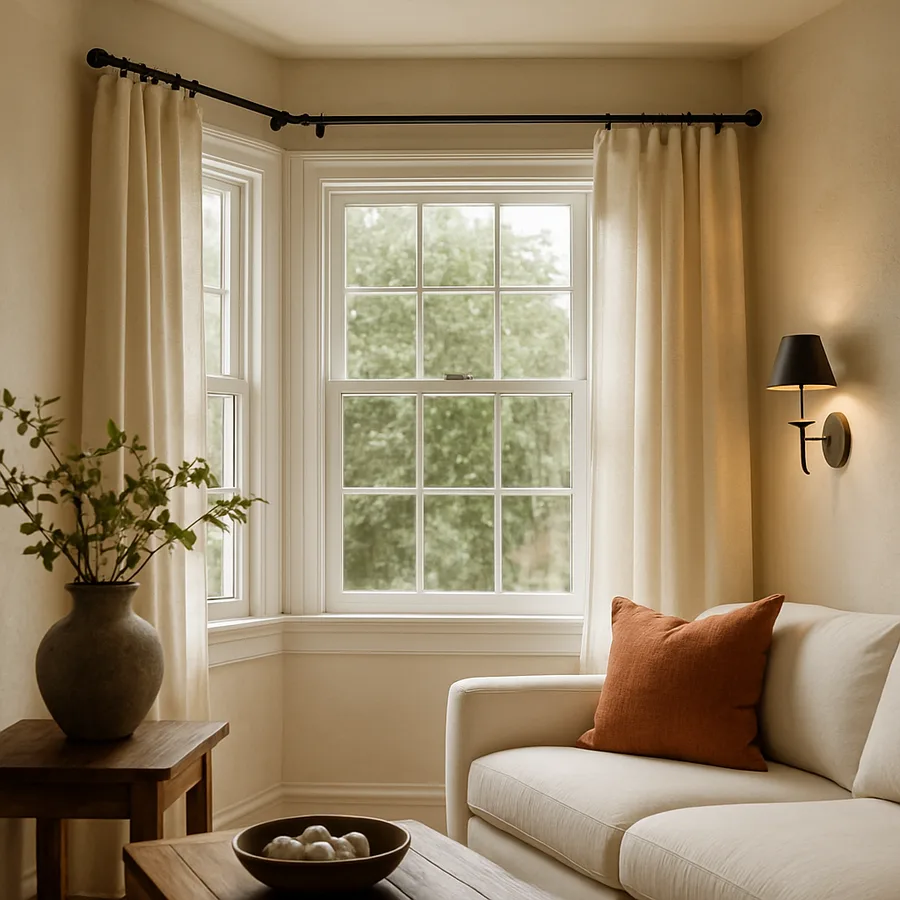
Treating a bay window with curtains is one of the most rewarding finishes in residential design and one of the most botched. A bay is geometrically demanding: three windows meet at two interior corners, the angles are rarely perfect 30 or 45 degrees, and the wall above the window is often shallow, sloped, or interrupted by trim. A standard straight curtain rod cannot follow this geometry, so the wrong solution either skips the corners (leaving gaps), forces three separate panels (creating visual fragmentation), or uses a tension-style rod that sags within months. The right answer is a bendable, hinged, or pre-formed bay window rod engineered for the specific corner angles of your window.
This guide walks through the rod systems available, how to measure correctly for each, the fabric weight limits, and the installation choices that determine whether the curtains glide smoothly or stick frustratingly at the corners. Whether you are styling a Victorian bay in a heritage home, a contemporary box bay in a new build, or a polygonal bow window in a 1970s ranch, the underlying decisions are the same. Get the rod right and the curtains will look effortless. Get it wrong and you will fight the installation for as long as you live with it.
The Three Rod Systems for Bay Windows
There are essentially three rod families that handle bay window geometry, and each has distinct strengths. The first is the flexible bendable rod, typically a thin-gauge metal rod that arrives straight and is hand-bent on site to match your window angles. These are the budget-friendly choice, available in major home centers for under 100 dollars, and they work well for lightweight sheer or unlined cotton curtains. The downside is that they are visibly thin, sag under heavier fabric, and cannot accommodate curtain rings that pass smoothly through the corners.
The second system is the hinged or articulated rod, which uses pre-engineered straight sections joined by hinge connectors at the bay corners. These rods are far more substantial, usually three-quarter inch to one and a quarter inch in diameter, and support medium-weight lined drapery. The hinge connectors come in fixed angles (commonly 90, 120, 135, and 150 degrees) or adjustable hinges that can dial in any angle from 90 to 180. Brands like Kirsch, Forest, and TMS all offer hinged systems in the 200 to 600 dollar range for a typical three-window bay.
The third option is the custom bent rod, fabricated to your specific bay measurements by a metal shop or specialty drapery supplier. The rod arrives as a single continuous piece bent to your exact angles, sometimes in a half-inch or larger diameter for heavy fabrics. These are the premium solution, priced from 500 to over 1,500 dollars depending on diameter, finish, and bracket complexity. The Houzz directory of window-treatment professionals consistently shows custom bent rods as the choice for projects where the curtains will support significant interior design weight, such as living rooms and primary bedroom suites.
Measuring a Bay Window Correctly
Accurate measurement is non-negotiable. Bay window angles are almost never exactly 30, 45, or 90 degrees, and a three-degree error at the corner accumulates into a one-inch gap by the time the rod reaches the far end of the bay. Begin with a digital angle finder, available for under 25 dollars at any hardware store. Measure each of the two interior corner angles to the nearest degree and write them down on a sketch.
Next, measure the three rod-length segments: the front segment (parallel to the main wall) and the two side segments. Measure these along the line where the rod will actually mount, typically two to four inches above the window casing and extending two to six inches past each side casing. Bracket placement matters: position brackets within four inches of each corner so the rod cannot deflect at the joint, and add an intermediate bracket if any segment exceeds four feet. The National Kitchen and Bath Association (NKBA) publishes window-treatment planning guidelines that recommend brackets every 36 to 48 inches along each segment to prevent rod sag under loaded fabric.
Always sketch the bay in plan view (looking down from above) and elevation (looking at it head-on) before ordering. Send both sketches to your supplier with the angles and lengths labeled. If you are ordering a hinged system, confirm that the hinge angle options include or can adjust to your measured angles; many homeowners discover after delivery that a 110-degree corner cannot accommodate a 120-degree fixed hinge. Have you written down both interior angles to the nearest degree? If not, that is the first job before any rod purchase.
Fabric Weight, Drape, and the Stack-Back Problem
Curtain rods on a bay window must support more than dead weight; they must also handle the friction of curtain rings or grommets passing along the rod, which roughly doubles the effective load when curtains are in motion. Fabric weight per square yard is the variable that determines rod diameter. Lightweight sheers (under 5 ounces per square yard) work on flexible thin rods. Medium drapery (8 to 14 ounces, typically lined cotton or linen) needs a three-quarter inch hinged rod. Heavy lined or interlined drapery (14 to 24 ounces, common in formal living rooms and primary bedrooms) demands a one-inch or larger custom bent rod with intermediate brackets.
The bigger trap is stack-back, the bunched fabric that gathers at the ends of the rod when curtains are open. On a flat window, stack-back is just a styling concern. On a bay window, stack-back becomes a structural problem because each panel must compress around the corner brackets without binding. Better Homes and Gardens recommends planning for stack-back of 25 to 33 percent of the total rod length on a typical lined drapery, which means a 12-foot total bay rod needs approximately three feet of clear stacking space split between the two ends.
If your bay is constrained by adjacent walls or built-ins that prevent generous stack-back, consider stationary side panels that frame the bay without operating, paired with separate roller shades or cellular shades inside each window for light control. This approach delivers the visual softening of drapery without the operational headache of forcing fabric around corners. Will your panels actually be opened and closed daily, or are they primarily decorative? The answer should drive whether you invest in operational hardware or stationary styling.
Bracket Choices and Mounting Surfaces
Bracket selection on a bay window is more nuanced than on a flat window because the bracket must mount into stable framing while clearing the rod's hinge or bend. Standard face-mount brackets screw into the wall above the window. They are the easiest to install but require solid blocking or studs at the bracket positions, which is rarely available exactly where you need it on a bay window. The National Association of Home Builders notes that headers above bay windows often consist of dimensional lumber that may not align with your desired bracket spacing, so anchor selection matters.
Ceiling-mount brackets solve the framing problem by attaching to ceiling joists above the bay, which are usually predictable and structurally sound. They also push the curtain stack-back further into the room, freeing the wall above the window for trim, paneling, or art. The trade-off is visual: ceiling-mounted curtains read more contemporary and may not suit traditional architecture. Specify a return bracket at each end so the curtain hugs the wall rather than hanging in mid-air.
For heavy fabrics, consider double brackets at corner points, where a hinged rod is most vulnerable to deflection. The dual-anchor approach distributes load and prevents the hinge from working loose under repeated curtain operation. The American Society of Interior Designers (ASID) consistently recommends specifying bracket type, anchor type, and bracket spacing in writing on any window-treatment work order, which prevents on-site improvisation that compromises the installation.
Layered Treatments: Combining Rods With Shades or Blinds
Bay windows frequently benefit from a layered treatment that combines a bent curtain rod with inside-mount shades or blinds. The drapery handles the framing, softening, and stack-back, while the shades handle the light control, privacy, and insulation. This layered approach is standard practice in Architectural Digest features, where bay windows almost always show drapery softening the geometry plus discrete cellular or roman shades inside each window for daytime privacy.
The order of operations matters. Install the inside-mount shades first, before the curtain rod, so the shade brackets do not interfere with the rod brackets. Choose shades that fully retract above the visible glass when raised, otherwise the curtain hardware competes visually with the partially raised shade. Cellular shades with a top-down/bottom-up mechanism are particularly effective in bay windows because they preserve sky views while shielding the lower glass from the street.
Color coordinate the shade fabric to either disappear into the wall (light neutral) or echo the drapery (subtle tonal match). High-contrast shade colors compete with the drapery and fragment the visual flow across the three windows. The NKBA recommends keeping inside-mount shades within two values of the wall color or two values of the drapery color, never both, to maintain visual hierarchy in layered treatments.
Common Installation Mistakes and How to Avoid Them
The most common mistake on bay window curtains is incorrect rod length. Many homeowners measure the window casing and order a rod the same length, only to discover that the curtain panels have nowhere to stack when open. Add at least 12 inches of rod beyond each side casing for stack-back, and ideally more if your fabric is heavy or your window is wide. Rod that is too short leaves curtains permanently covering some of the glass.
The second common mistake is installing the rod too low. Curtain rods on bay windows should mount at least four to six inches above the window casing, and ideally close to the ceiling, to maximize the visual height of the window. Better Homes and Gardens stylists consistently flag low-mounted rods as the single most aging mistake in residential curtain installation. Even on an eight-foot ceiling, mounting the rod within three inches of the ceiling adds visual stature to the bay and to the room.
The third mistake is using rings on hinged rods without testing them first. Many curtain rings catch at hinge connections, requiring manual nudging at each corner every time the curtains are operated. Before committing to rings, test a sample with your specific rod system, or switch to traverse rod systems that use carriers running in an enclosed channel rather than rings on an exposed rod. Traverse systems glide smoothly around corners but are visually less elegant; the trade-off is operational reliability for visual presence.
Conclusion
A bay window deserves curtain hardware engineered for its geometry. Flexible thin rods work for sheers, hinged rods work for medium drapery, and custom bent rods earn their premium for heavy lined panels in formal rooms. Within each category, accurate angle measurement, proper bracket spacing, and realistic stack-back planning separate beautiful installations from frustrating ones. None of these decisions are difficult, but they all require taking ten minutes with a digital angle finder before clicking the buy button.
Budget realistically. A complete bay window curtain installation, including rod, brackets, lined drapery panels, and inside-mount shades, typically runs 800 to 3,500 dollars depending on fabric grade and rod tier. The labor portion is significant because bay installations take twice as long as flat-window installations, so factor in either professional installation or a full Saturday of careful measuring and drilling if you are doing it yourself.
If your bay window currently sits naked or hosts a thin, mismatched curtain that nobody notices, the upgrade path is straightforward. Measure your angles this weekend, sketch the bay in plan and elevation, and request quotes from at least two suppliers before ordering. Send your sketch to a window-treatment professional for a free consultation, then commit to the rod tier that matches your fabric weight and operational expectations. The right rod system delivers two decades of effortless curtain operation; the wrong one becomes a daily annoyance you will eventually rip out and replace anyway.
More Articles You May Like



Comments
Post a Comment