Custom Radiator Covers That Double as Window Seats at Home
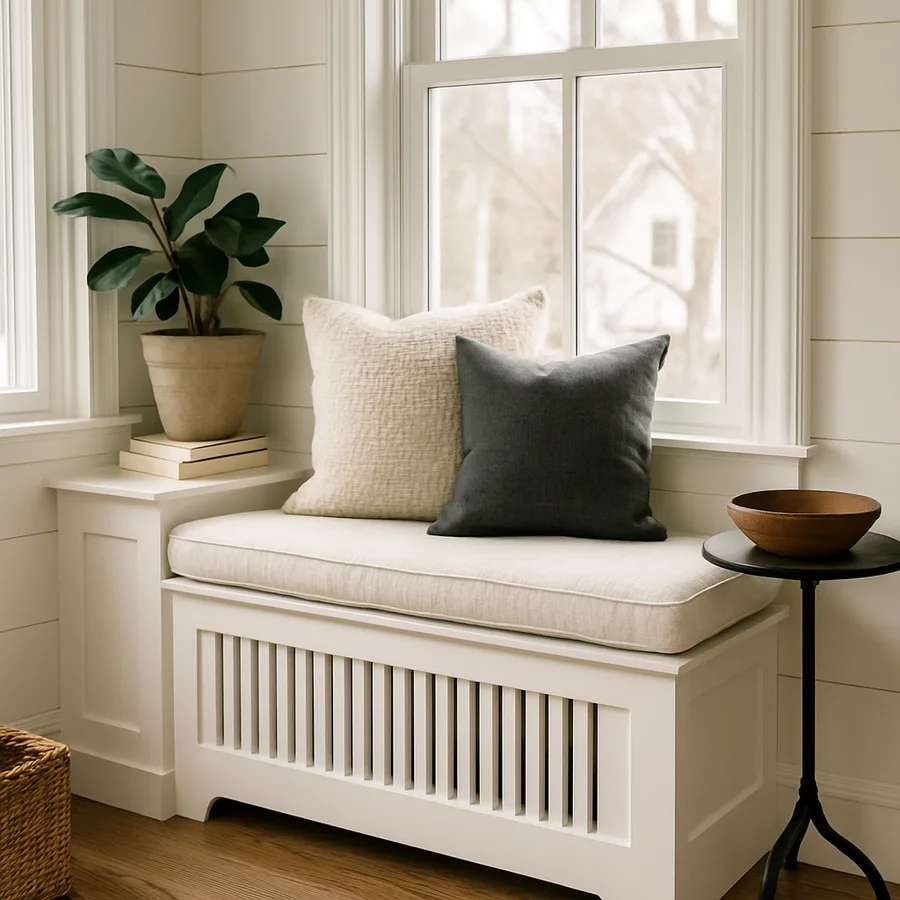
Few pieces of architectural millwork pull double duty quite as gracefully as a custom radiator cover that doubles as a window seat. In older homes where cast iron radiators sit stubbornly beneath sun-flooded windows, homeowners often wrestle with two competing realities: the radiator needs to breathe, and the bay window deserves to be enjoyed. A built-in window seat that conceals the radiator solves both problems with one carpenter's invoice. According to a 2025 report from the National Association of Home Builders, built-in seating ranked among the top fifteen most-requested custom millwork upgrades in renovations valued above thirty thousand dollars, with bay-window seating leading the category by a comfortable margin.
The appeal is obvious to anyone who has ever curled up with a book on a sunny January afternoon. A bench draped in linen cushions, baskets tucked beneath, a soft heat radiating up through perforated metal grilles, snow piling on the sill outside, the cat asleep on a folded throw. That picture sells itself. But getting from a bare radiator to that finished tableau requires careful planning around heat clearance, cushion depth, hinge selection, and the occasional plumbing surprise. This guide walks through every decision that matters, drawn from professional cabinetmakers, energy specialists, and the published guidance of organizations like the American Society of Interior Designers.
Why a Window Seat Radiator Cover Outperforms a Standalone Cabinet
The traditional radiator cabinet sits in front of the radiator, projects six to ten inches into the room, and offers a flat top that becomes a magnet for clutter. A window seat radiator cover reframes that entire footprint. Instead of stealing floor space, it claims the dead zone beneath the window and transforms it into seating, storage, and architectural emphasis all at once. In rooms under one hundred and forty square feet, that single move can recover the equivalent of a small armchair without sacrificing a square inch of usable floor.
There is also a thermal argument worth understanding. A poorly designed cover can reduce a radiator's heat output by fifteen to twenty percent, according to data published by the U.S. Department of Energy. That penalty disappears almost entirely when the cover is engineered with adequate intake at the bottom and exhaust slots above the radiator, which a window seat naturally accommodates because the seat top is elevated above the heat source. Cabinetmaker Sara Linden, who specializes in pre-war Brooklyn brownstones, told one interior trade publication that her bench-style covers consistently outperform cabinet-style covers on convection because the airflow path is taller and straighter.
Aesthetically, the bench reads as architecture rather than furniture. It looks intentional. It looks original to the house even when it was installed last Tuesday. And for resale, that distinction matters more than most homeowners realize.
Measuring and Planning Around Heat Clearance
The first measurement to capture is not the radiator itself but the window stool height, which is the horizontal trim piece at the bottom of the window casing. Your finished seat top should sit roughly half an inch below that stool so the cushion edge tucks neatly against the trim without crushing it. Standard seating height runs between sixteen and eighteen inches from the floor, which conveniently matches the height of most domestic radiators with two to four inches of clearance to spare.
Above the radiator you need at least two inches of vertical air space before the underside of the seat. Below the radiator you need at least four inches of intake clearance, which means the front kick panel must be ventilated, not solid. The American Society of Heating, Refrigerating and Air-Conditioning Engineers publishes detailed guidance on convector clearance, and the practical takeaway is simple: starve a radiator of intake air and you starve the room of warmth. Think of the cover as a chimney with a cushion on top.
Have you ever wondered why some window seat covers feel scorching to sit on while others feel pleasantly warm? The answer is almost always the gap between the radiator's top surface and the underside of the bench. Less than an inch and the seat conducts heat directly into the cushion. Two to three inches with proper venting and the seat stays comfortable even when the boiler is running flat out.
Material Choices That Hold Up to Daily Heat Cycles
Wood is the default and for good reason. Poplar, soft maple, and paint-grade pine all behave predictably under the heat cycles a radiator imposes, which can swing the surrounding microclimate by twenty degrees Fahrenheit between morning and evening. Avoid MDF for any face that sits within four inches of the radiator surface. MDF tolerates heat poorly, off-gasses formaldehyde at elevated temperatures, and tends to swell at joints when humidity drops, which is exactly what happens in a heated room in winter.
For the seat top, three-quarter-inch furniture-grade plywood with a hardwood edge band gives you stability without the seasonal movement of solid wood panels longer than thirty inches. This Old House has covered several radiator-cover builds where the host explicitly recommends quarter-sawn white oak for seat tops in homes with significant humidity swings, since quarter-sawn stock moves roughly half as much across its width as flat-sawn lumber. You can read more about wood movement and millwork in their project archive.
For the front grille, the three durable choices are perforated steel, woven brass cane, and traditional laser-cut MDF panels finished with high-temperature paint. Perforated steel offers the highest open area, which translates directly into better heat output. Brass cane reads more residential and pairs beautifully with painted millwork. MDF grilles are the most affordable but have the lowest open area, typically around forty percent compared to sixty-plus percent for perforated steel.
Storage Strategies Beneath the Bench
Here you face a fundamental fork in the road. Lift-up seat storage on piano hinges gives you the largest possible storage volume but requires clearing whatever is on the cushion every time you want access. Front-facing drawers or doors stay accessible all the time but reduce ventilation area significantly and complicate the airflow path. The third option, which is increasingly popular in design publications, is open cubbies sized for woven baskets, leaving the front entirely vented while still offering tidy organization.
If you do choose lift-up storage, specify a soft-close torsion hinge rated for at least fifty thousand cycles. Cheap piano hinges sag within two years and start binding within three. The Häfele and Blum hardware lines both offer compliant options that hold the seat lid open at any angle, which prevents the slammed-finger emergency that ends many DIY radiator-cover projects. For families with small children, this single hardware upgrade is non-negotiable.
What gets stored matters too. The microclimate inside a heated cavity is hostile to anything that hates heat: candles soften and bow, vinyl records warp, leather dries and cracks, and certain photographs fade. Reserve the space for textiles, board games, holiday linens, and the genuinely heat-tolerant. Have you considered using the storage as a dedicated home for winter throws and slippers, the kind of objects that actively benefit from being warm when you reach for them?
Cushion Construction for Comfort and Heat Tolerance
The cushion is what separates a built-in that gets used daily from one that becomes a glorified shelf. Specify a five-inch-thick high-density foam core, between thirty-five and forty-five pound compression, wrapped in a half-inch layer of polyester batting to round the edges. That construction holds its shape through years of daily sitting and resists the body-impression sag that plagues thinner cushions.
For the cover fabric, prioritize natural fibers with tight weaves. Heavyweight linen, cotton velvet, and wool flannel all perform well above radiators because they breathe rather than trapping moisture. Avoid pure synthetics directly above heat sources. Performance fabrics with acrylic or polyester face yarns can release plasticizers when subjected to repeated heat cycles, which over time produces a faintly chemical smell that is impossible to launder out.
Add a removable, washable cover with a hidden zipper along the back edge, where the cushion meets the wall. Removable covers extend a cushion's useful life from roughly four years to twelve or more, according to published estimates from upholstery trade associations. Keep two covers in rotation if the seat is in a high-traffic room. The math on having a second cover in storage pays for itself the first time someone spills a mug of coffee on movie night.
Working With a Carpenter Versus Going Modular
A fully custom site-built bench from a finish carpenter typically runs between eighteen hundred and forty-five hundred dollars depending on region, length, and storage complexity, with high-cost metropolitan markets pushing well above that. Modular off-the-shelf radiator covers from manufacturers like Wooden Radiator Cabinet Company or Fichman Furniture Design start around four hundred dollars but rarely include integrated seating, which means you are still hiring a carpenter to convert them.
The honest middle path is a semi-custom build using stock cabinet boxes from a local cabinet shop, a custom face frame and seat top installed on site, and off-the-shelf perforated metal panels from suppliers like McNichols or Banker Wire. That approach typically lands at twelve hundred to two thousand dollars installed and looks indistinguishable from a fully custom build to anyone who is not specifically inspecting the joinery. The American Society of Interior Designers recommends getting at least three quotes for any built-in over one thousand dollars, since regional pricing variation can exceed forty percent for identical specifications.
Whichever path you choose, get a written scope of work that explicitly addresses three things: heat clearance dimensions, removable access panels for plumbing service, and finish schedule including primer, sealer, and topcoat layers. The plumbing access point matters more than most people anticipate. Radiator valves fail. Bleed points clog. Pipes occasionally need to be cut and re-soldered. A bench that has to be partially demolished to reach a stuck valve will cost you the value of the bench within one bad winter.
Conclusion
A custom radiator cover that doubles as a window seat is one of the few millwork investments that genuinely earns its cost back in daily pleasure rather than resale alone. It claims unused floor space, organizes clutter, frames a window beautifully, and creates the kind of intimate reading nook that magazines have been photographing for a century. Done correctly, it improves the radiator's heat distribution rather than impeding it, because the tall convection path inside a bench-style cover often outperforms the short stub of a conventional cabinet. Done incorrectly, it cooks the cushion, starves the room of warmth, and traps a stuck valve behind eighty pounds of finished plywood.
The decisions that separate the two outcomes are not glamorous. They are dimensions, hinge specifications, ventilation area, and the finish schedule on the inside faces that nobody will ever see. Spend an extra weekend on those details before the carpenter starts cutting. Read the relevant ASHRAE clearance guidance, study the airflow diagrams in This Old House archives, and walk through your radiator's serviceable parts with a plumber present so you know exactly which panel needs to be removable. None of that is exciting. All of it is the difference between a built-in you love for thirty years and a built-in you regret in eighteen months.
Once the bench is in and the cushion is sewn and the first cold morning arrives, the design challenge gives way to simply enjoying the room. Light a lamp on the sill, leave a pair of slippers tucked into the lower cubby, and let the radiator do quiet work behind the grille while you do the reading. Ready to start sketching your own window seat radiator cover? Measure your window stool height tonight, photograph your radiator with a tape measure laid across it, and bring those numbers to a finish carpenter or design-build firm this week. The longest part of any project like this is the waiting list. Get on it now and you will be sitting on the finished bench by next heating season.
More Articles You May Like



Comments
Post a Comment