Utility Sink in the Laundry Room: Placement and Plumbing Tips
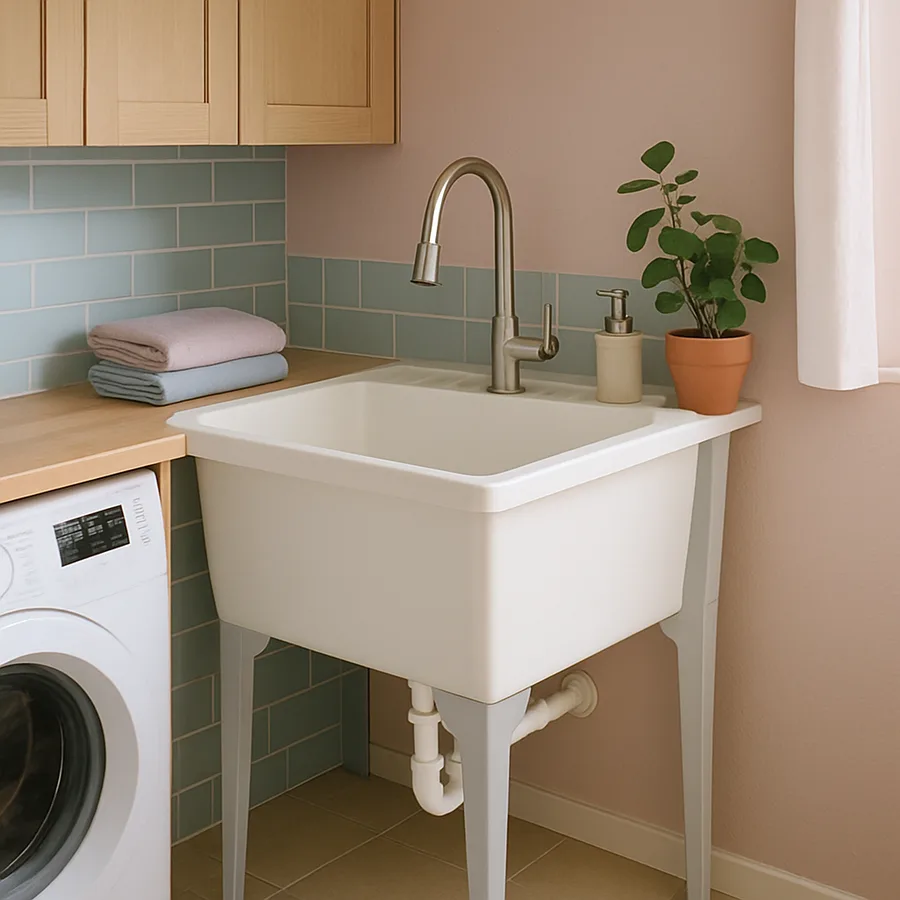
The Case for Adding a Utility Sink to Your Laundry Space
A utility sink in the laundry room solves problems that no other fixture can address. Hand-washing delicates, pretreating stained garments, rinsing muddy boots, soaking cloth diapers, and filling mop buckets all require a deep basin with running water. Without one, homeowners resort to bathroom sinks that are too shallow, kitchen sinks that create hygiene conflicts, or awkward workarounds involving buckets and bathtubs. A dedicated laundry sink eliminates every one of those compromises.
The National Kitchen and Bath Association (NKBA) reports that utility sinks appear in 68% of newly built homes with dedicated laundry rooms, a figure that has risen steadily over the past decade. That growth tracks with broader consumer demand for laundry rooms that function as genuine workspaces rather than afterthought closets. Builders and designers have responded by making utility sinks a standard specification in mid-range and above floor plans.
Beyond laundry tasks, a utility sink serves as a general-purpose cleaning station for the entire household. Pet owners use them for bathing small dogs. Gardeners rinse vegetables and clean tools. Hobbyists wash paintbrushes and craft supplies without worrying about damaging a polished kitchen basin. The deep bowl and high-arc faucet typical of utility sinks handle these tasks with ease, making the fixture one of the hardest-working elements in the home.
If your laundry room lacks a utility sink, adding one is more feasible than most homeowners expect. The plumbing infrastructure is already partially in place: your washing machine requires both hot and cold supply lines and a drain connection. Tapping into those existing lines to feed a nearby sink is a manageable project for experienced DIYers and a routine job for licensed plumbers. The planning stage, however, deserves careful attention to get placement and plumbing details right the first time.
Choosing the Right Sink Type for Your Laundry Room
Freestanding utility sinks are the most common choice for laundry rooms. They sit on their own legs or a metal frame, require no cabinetry, and offer maximum basin depth, often 12 to 14 inches. Materials range from molded thermoplastic to fireclay to stainless steel. Freestanding models are the easiest to install because they need only supply and drain connections without any countertop modifications or undermount hardware.
Drop-in sinks mount into a cutout in an existing countertop or a purpose-built cabinet. This option provides a cleaner, more integrated look and creates usable counter space on either side of the basin. Drop-in utility sinks are available in composite granite, porcelain, and stainless steel. They work particularly well when the laundry room doubles as a mudroom or pet-washing station, where the surrounding countertop surface adds functionality.
Wall-mounted sinks save floor space and work well in tight laundry closets or galley-style rooms. They anchor directly to the wall framing with a bracket system that supports the weight of the filled basin. According to the American Society of Interior Designers (ASID), wall-mounted utility sinks are gaining popularity in urban apartments and compact homes where every square foot of floor area is critical. The trade-off is reduced basin depth, typically eight to ten inches, which limits capacity for soaking large items.
Which sink style matches your space and workflow? Consider basin depth first. If you plan to soak comforters or hand-wash bulky items, a freestanding sink with a 14-inch basin is difficult to beat. If your primary use is pretreating stains and rinsing small items, a drop-in model integrated into a countertop provides a more refined aesthetic without sacrificing meaningful utility.
Optimal Placement Within the Laundry Room
Placement determines how comfortably and efficiently you use the sink every day. The most logical position is adjacent to the washing machine, within arm's reach. This arrangement lets you pretreat a garment at the sink and transfer it directly into the washer without crossing the room. It also simplifies the plumbing because the sink can share the washer's existing supply lines and drain through the same waste pipe.
Leave at least 24 inches of clear floor space in front of the sink for comfortable standing and working. Building codes in most jurisdictions require a minimum of 21 inches of clearance in front of any plumbing fixture, but 24 to 30 inches is the practical standard recommended by the NKBA for utility areas. If your laundry room has a standard door swing that intrudes into this zone, consider switching to a pocket door or barn door to reclaim the clearance.
Avoid placing the sink directly opposite the washer and dryer in a narrow room where opening machine doors would block access to the basin. A galley-style laundry room with machines on one wall and the sink on the opposite wall needs at least 48 inches of aisle width between them. Anything less creates a bottleneck that makes laundry day an exercise in spatial negotiation rather than efficient workflow.
Corner placement can be a smart solution in L-shaped or irregularly shaped laundry rooms. A corner-mounted sink leaves wall space open for cabinets, a folding counter, or a drying rack. Some homeowners position the sink near the laundry room entrance so it doubles as a handwashing station, a configuration that proved especially popular during recent years when household hygiene awareness surged across the country.
Plumbing Supply Lines: Connecting Hot and Cold Water
The simplest approach to feeding a utility sink is to branch off the existing washing machine supply lines. Most washing machine hookups include separate hot and cold shutoff valves connected to the home's water supply. Adding a tee fitting to each valve creates a second outlet that feeds the sink without requiring a new pipe run from the main line. This method keeps material costs low and avoids opening walls.
Use braided stainless steel supply hoses rated for residential plumbing to connect the tee fittings to the sink faucet. These hoses are flexible, burst-resistant, and available in lengths from 12 to 60 inches at any hardware store. Avoid using the same unbraided rubber hoses found on older washing machines, as they are prone to cracking and catastrophic failure. The Insurance Institute for Business and Home Safety (IBHS) reports that washing machine hose failures are among the top five sources of residential water damage claims, and the same risk applies to sink supply lines made from inferior materials.
If the sink is located more than six feet from the existing supply valves, a dedicated pipe run may be necessary. This involves tapping into the nearest hot and cold water lines, running copper or PEX tubing through the wall cavity, and installing new shutoff valves at the sink location. PEX tubing has become the preferred material for residential retrofits because it is flexible, freeze-resistant, and requires fewer fittings than rigid copper. A licensed plumber can complete this type of run in two to three hours in most cases.
Install individual shutoff valves for the sink regardless of which supply method you choose. Quarter-turn ball valves are the gold standard because they seal completely, operate with a simple lever, and rarely fail. Having dedicated shutoffs allows you to service the sink faucet or replace the basin without cutting water to the washing machine, a detail that becomes important when a plumbing repair is needed on laundry day.
Drain Connections and Venting Requirements
Drain plumbing is where utility sink installations get more complex. The sink drain must connect to the home's drain-waste-vent (DWV) system, and local building codes dictate exactly how that connection must be made. In most jurisdictions, a utility sink requires a 1.5-inch or 2-inch drain pipe that ties into an existing branch drain or the main waste stack. The washing machine standpipe, if present, often provides the nearest connection point.
A common and code-compliant method is to install a wye fitting on the existing washing machine drain pipe and connect the sink drain to the branch. The wye directs flow from both fixtures into the same waste line. A P-trap must be installed under the sink basin to prevent sewer gases from entering the room. The trap should be accessible for cleaning, as utility sinks tend to accumulate lint, sand, and debris that can cause slow drainage over time.
Venting is the detail that many DIY installers overlook, sometimes with unpleasant consequences. Every drain fixture needs a vent pipe that connects to the home's vent stack, allowing air to enter the drain system and prevent siphoning of the P-trap. Without proper venting, the sink drains slowly, gurgles audibly, and can emit sewer odors. An air admittance valve (AAV), also known as a Studor vent, is an acceptable alternative to a traditional vent pipe in many jurisdictions and is far easier to install in retrofit situations.
Do you know whether your local code permits air admittance valves? Check with your municipal building department before starting work. Some areas require a traditional vent pipe connected to the roof stack, which involves significant additional work. Pulling a permit for the sink installation, while adding cost and time, protects you from code violations that could surface during a home inspection and derail a future sale.
Faucet Selection and Practical Accessories
A utility sink faucet must handle a wider range of tasks than a kitchen or bathroom faucet. Look for a model with a high-arc spout that provides clearance for filling buckets and large containers. Pull-down spray heads, once exclusive to kitchen faucets, are now available in utility sink configurations and make rinsing garments and cleaning the basin itself far more convenient. Commercial-style spring faucets offer the greatest reach and flexibility.
Material quality directly affects longevity in a laundry environment. Faucets with ceramic disc cartridges outlast rubber-washer models by a wide margin and resist the mineral buildup common in areas with hard water. Brass construction beneath the finish coating prevents corrosion from bleach vapors and detergent splashes. Budget faucets made from zinc alloy or plastic internals may save money upfront but typically require replacement within three to five years under regular utility sink use.
Accessories extend the sink's functionality significantly. A fitted basin rack keeps delicates off the drain and allows water to circulate during soaking. A lint trap strainer installed in the drain prevents fibers from entering the plumbing system, reducing the frequency of drain cleanups. A retractable clothesline mounted above the sink creates a drip-dry station for hand-washed items. According to Better Homes and Gardens, these small additions collectively transform a basic sink into a comprehensive garment care station.
Consider the faucet handle type as well. Single-lever handles are easier to operate with wet or soapy hands, and they allow quick temperature adjustment with one motion. Cross-handle designs offer a more traditional aesthetic but require two-handed operation. If the sink will be used primarily for pretreating stains with specific water temperatures, a single lever with clear temperature indication is the more practical choice.
Conclusion: A Utility Sink Makes Every Laundry Task Easier
Adding a utility sink to your laundry room is an investment in daily convenience that pays dividends every time you pretreat a stain, hand-wash a delicate garment, or fill a mop bucket without leaving the room. The planning process requires attention to placement, supply connections, drain plumbing, and code compliance, but none of these challenges are insurmountable with the right information and preparation.
Start by assessing your existing plumbing infrastructure. Identify the supply valves and drain connections your washing machine uses, and determine how far the sink will sit from those points. Choose a sink type that fits your room dimensions and primary use cases. Select a faucet built from durable materials with a high-arc spout that accommodates your tallest bucket or basin.
Whether you handle the installation yourself or hire a licensed plumber, the result is a laundry room that functions at a fundamentally higher level. The utility sink is not a luxury addition reserved for large custom homes. It is a practical fixture that belongs in every laundry room, regardless of size, and the tools and materials to install one are readily available at any home improvement retailer in the country.
Take the first step today: measure the available space next to your washing machine, check your local building code for permit requirements, and browse utility sink options online or at your nearest home center. A weekend of focused work will give you a fixture you will wonder how you ever managed without.
More Articles You May Like



Comments
Post a Comment