Transform Your Workspace: Innovative Office Interior Design Ideas for Maximum Productivity
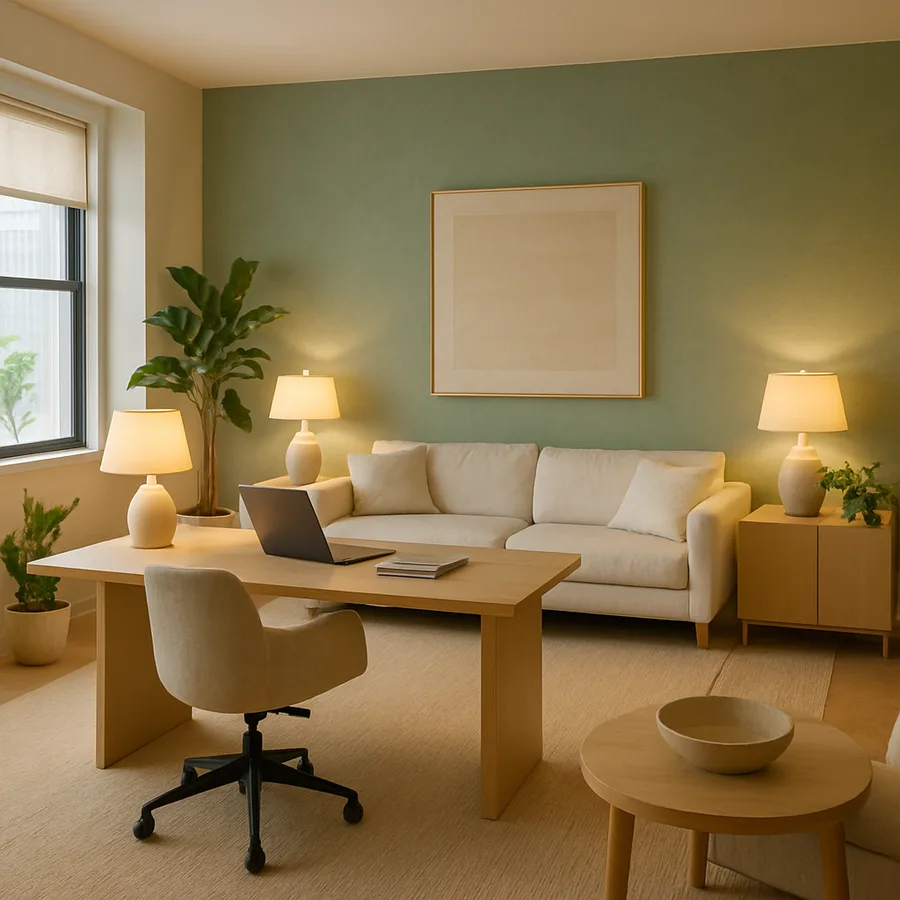
1. Biophilic Design: Bringing Nature into the Workplace
Biophilic design is one of the most impactful strategies for creating offices that genuinely support human performance. The concept, rooted in the idea that humans have an innate connection to the natural world, translates into workspaces filled with living plants, natural materials, water features, and abundant daylight. Research published by the World Green Building Council found that offices with natural elements reported a 15% increase in employee wellbeing and a 6% boost in productivity. These are not marginal gains; for a company of 100 employees, that productivity improvement represents significant value recovered through thoughtful design choices.
Living walls and potted plants are the most visible expressions of biophilic design, but the approach runs much deeper. Material selection plays a crucial role, with natural wood, stone, cork, and bamboo creating sensory connections to the outdoor environment that synthetic materials cannot replicate. The grain patterns in a wood conference table, the cool touch of a stone reception desk, and the textured surface of a cork bulletin board all engage the senses in subtle but meaningful ways. These tactile experiences reduce the sterile, artificial quality that characterizes many conventional offices and replace it with warmth and organic complexity.
Natural light deserves special attention in any biophilic office design. The International Interior Design Association has consistently emphasized daylight access as one of the most requested features among office workers, and the science supports that preference. Exposure to natural light regulates circadian rhythms, improving sleep quality and daytime alertness. Offices designed to maximize daylight penetration through strategic window placement, glass partitions, and reflective surfaces create environments where people feel more energized and focused. Where natural light is limited, circadian lighting systems that mimic the color temperature shifts of daylight throughout the day offer a compelling alternative.
Water features, once considered extravagant, have found a practical place in modern office biophilic design. The sound of flowing water masks distracting background noise while providing a calming auditory backdrop that supports concentration. Small tabletop fountains in reception areas, wall-mounted water features in collaboration zones, and even aquariums in break rooms all contribute to the biophilic experience. The key is selecting features appropriate to the space's scale and function. A dramatic waterfall wall might suit a corporate lobby, while a simple desktop fountain is more appropriate for a small team workspace.
2. Flexible and Activity-Based Workspaces
The rigid assignment of one desk to one person is giving way to a more dynamic model where the workspace adapts to the task at hand. Activity-based working (ABW) provides employees with a variety of settings designed for different types of work: quiet focus areas for deep concentration, collaborative zones for team brainstorming, casual lounge spaces for informal conversations, and private pods for phone calls and video conferences. This diversity of environments acknowledges that no single workspace configuration can optimally support the full range of activities that knowledge workers perform in a typical day.
Furniture selection is critical to making flexible workspaces function effectively. Modular desks that can be quickly reconfigured, lightweight chairs that move easily between zones, and mobile whiteboards that follow the conversation wherever it goes all support the fluid movement that activity-based working requires. Height-adjustable desks have become a baseline expectation, with the Society for Human Resource Management (SHRM) reporting that sit-stand desks rank among the top five most requested workplace amenities. These desks allow individuals to alternate between sitting and standing throughout the day, reducing the health risks associated with prolonged sedentary posture while giving workers control over their physical comfort.
Acoustic management becomes exponentially more important in flexible environments where different activities occur in close proximity. A collaboration zone buzzing with creative energy should not undermine the concentration of someone in the adjacent focus area. Sound-absorbing ceiling panels, acoustic felt wall coverings, white noise systems, and strategic placement of buffer zones between noisy and quiet areas all contribute to effective acoustic zoning. Have you noticed how certain cafes feel conducive to work despite background chatter, while some offices feel distracting even when relatively quiet? The difference often comes down to acoustic design, and getting it right is essential for flexible workspaces to deliver on their promise.
Wayfinding and signage play an underappreciated role in the success of activity-based environments. When employees cannot quickly identify which spaces are available and what each zone is designed for, the system breaks down and people default to claiming a single spot for the entire day. Clear visual cues such as color-coded zones, digital availability indicators, and intuitive naming conventions help people navigate the workspace efficiently. The best ABW environments feel intuitive after just a day or two of use, with the physical design guiding behavior naturally rather than requiring extensive orientation or training.
3. Smart Technology Integration for Seamless Workflows
Technology should be invisible until you need it and effortless when you do. This principle guides the most effective smart office designs, where integrated systems manage lighting, temperature, audio-visual equipment, and room booking without requiring users to wrestle with complicated interfaces. Sensor-driven automation adjusts lighting levels based on natural light availability and occupancy, ensuring that energy is not wasted on empty rooms while maintaining optimal illumination for occupied ones. The American Society of Interior Designers notes that intelligent building systems can reduce energy costs by up to 30% while simultaneously improving occupant comfort.
Conference room technology has become a particular pain point in many offices, with meetings routinely starting late because participants struggle to connect laptops to displays, activate video conferencing systems, or find the right input on a projector. Smart meeting rooms solve these problems through wireless presentation systems, one-touch video calling platforms, and automated room setup protocols that activate the appropriate configuration when a meeting is scheduled. Digital scheduling panels outside each room show real-time availability, and occupancy sensors automatically release rooms that were booked but not occupied, freeing them for impromptu use.
Personal environment control is an emerging technology trend that addresses one of the oldest complaints in office design: temperature disagreements. Individual comfort preferences vary widely, and a single thermostat setting will always leave some people too warm and others too cold. Personal heating and cooling devices integrated into workstations, combined with app-based controls that allow individuals to adjust their immediate microclimate, are beginning to resolve this perennial conflict. These systems use localized heating and cooling to keep each person comfortable without affecting the overall building temperature, reducing both complaints and energy waste.
Power and connectivity infrastructure deserves careful planning to support smart technology without creating visual chaos. Cable management systems, wireless charging surfaces built into desktops, and distributed power outlets eliminate the tangle of cords and adapters that clutters many workspaces. USB-C and wireless connectivity should be available at every workstation and in every meeting room, with redundant systems ensuring that a single technical failure does not disable an entire zone. The physical infrastructure of a smart office is like plumbing: it should work perfectly and remain completely out of sight.
4. Color Strategy and Material Psychology
The colors and materials in an office environment exert a constant, often subconscious influence on the people who work there. Research from the University of Texas at Austin found that white and gray offices, long considered neutral and inoffensive, actually increased feelings of sadness and depression among workers. Meanwhile, spaces incorporating blue and green tones promoted calmness and focus, and environments with warm accents of yellow and orange stimulated creative thinking. These findings suggest that the conventional all-white office is not just boring but actively counterproductive, and that strategic color deployment can meaningfully influence cognitive and emotional states.
A thoughtful color strategy assigns different palettes to different functional zones based on the cognitive states each area is designed to support. Focus areas benefit from cool blues and muted greens that promote sustained concentration. Collaboration spaces come alive with warmer, more stimulating tones that encourage energetic interaction. Breakout areas and lounges can incorporate deeper, richer colors that signal relaxation and informal conversation. The transitions between zones should feel natural, with color shifting gradually rather than abruptly, creating a sense of flow throughout the office.
Material choices carry their own psychological weight. Hard, reflective surfaces like glass and polished metal convey precision and formality, making them appropriate for client-facing areas and executive spaces. Soft, textured materials like wool felt, linen upholstery, and brushed wood create warmth and approachability, suiting team spaces and social areas. The tactile dimension matters as much as the visual: running a hand along a smooth wooden handrail or sinking into a plush lounge chair triggers physiological relaxation responses that no visual stimulus alone can produce. Designing for touch is designing for comfort at the deepest level.
What message does your current office communicate through its colors and materials? If the answer is "nothing" or "institutional indifference," there is significant room for improvement. Even modest interventions such as introducing a feature wall in a carefully chosen color, replacing harsh fluorescent lighting with warmer alternatives, or adding textile elements like area rugs and upholstered panels can shift the character of a space dramatically. These changes do not require a gut renovation; they can be layered into existing environments incrementally, allowing you to test the impact of different strategies before committing to a comprehensive redesign.
5. Wellness-Centered Design Features
The line between workplace design and employee wellness has effectively disappeared, with progressive organizations recognizing that the physical environment is a determinant of health outcomes. Wellness-centered office design goes beyond ergonomic chairs and standing desks to encompass air quality, acoustic comfort, access to nature, opportunities for physical movement, and support for mental health. The WELL Building Standard, administered by the International WELL Building Institute, provides a rigorous framework for evaluating and certifying spaces that prioritize human health, covering categories from air and water quality to light, thermal comfort, and community.
Indoor air quality is perhaps the most consequential wellness factor and the one most often neglected. Studies cited by the Harvard T.H. Chan School of Public Health found that improved ventilation and lower concentrations of volatile organic compounds (VOCs) were associated with significant improvements in cognitive function, including better scores on tests of crisis response, strategy, and information usage. Specifying low-VOC paints, adhesives, and furnishings; installing high-quality air filtration systems; and ensuring adequate fresh air circulation are design decisions that directly affect how well people think. The investment in air quality infrastructure pays for itself through improved decision-making and reduced sick days.
Dedicated spaces for physical movement and mental restoration are no longer luxuries reserved for tech campuses. Even modest offices can incorporate a stretching area with yoga mats, a quiet meditation room with subdued lighting and comfortable seating, or a walking path that encourages movement breaks throughout the day. These spaces signal to employees that their employer values their health and recognizes that sustained cognitive performance requires periodic recovery. The presence of wellness spaces also normalizes the act of taking a break, reducing the cultural stigma that sometimes discourages people from stepping away from their desks.
Ergonomic design remains foundational to workplace wellness, but the definition of ergonomics has expanded beyond the traditional focus on desk and chair specifications. Today, ergonomic thinking encompasses the full range of postures and movements a person adopts throughout the day. Lounge seating for reading, perch-height stools for quick stand-up meetings, floor cushions for informal brainstorming, and outdoor benches for fresh-air breaks all contribute to postural variety that reduces the physical strain of spending eight or more hours in a single environment. The goal is not to find the perfect position but to facilitate constant gentle variation.
6. Branded Environments That Tell a Story
An office is a three-dimensional expression of an organization's identity, and the most compelling workspaces use design to communicate who the company is and what it stands for. Branded environments go far beyond hanging the logo in the lobby. They weave the organization's values, history, and aspirations into every material choice, spatial arrangement, and design detail. A company that values transparency might use glass extensively, creating visual openness throughout the office. One that celebrates innovation might incorporate experimental materials, interactive installations, and spaces designed specifically for prototyping and testing new ideas.
The reception area sets the first impression and should communicate the brand narrative immediately and unmistakably. Visitors should feel the company's personality the moment they walk through the door, through the materials underfoot, the artwork on the walls, the quality of the furniture, and the overall atmosphere of the space. Houzz commercial design professionals emphasize that reception areas function as brand touchpoints that influence client perceptions before a single word is exchanged. Investing in this space is not vanity; it is strategic communication through design.
Internal branding serves a different but equally important purpose: reinforcing culture and fostering belonging among employees. Mission statements and core values gain more power when they are expressed spatially rather than just printed on a poster. A company that values collaboration demonstrates this through open floor plans and abundant meeting spaces. One that prizes individual excellence provides high-quality private workstations and resource libraries. The alignment between stated values and physical environment builds credibility and trust, while misalignment creates cynicism. Employees notice when a company talks about innovation but houses its teams in rows of identical gray cubicles.
Storytelling through design also creates opportunities for cultural expression that strengthens team identity. A timeline wall documenting company milestones, a gallery showcasing employee-created art, a library of books recommended by team members, or a display of products the company has created all weave the organization's narrative into the physical space. These elements give employees touchstones of shared identity and give visitors insight into the culture they are engaging with. The most effective branded environments feel authentic rather than manufactured, as though the design grew organically from the people and mission it represents.
Conclusion: Designing for How People Actually Work
The common thread connecting every idea in this article is a commitment to designing offices around actual human needs rather than abstract aesthetic ideals or cost-per-square-foot calculations. Biophilic elements, flexible layouts, smart technology, strategic color, wellness features, and branded environments all succeed because they start with an understanding of how people think, feel, move, and collaborate. The most productive offices are not the most expensive or the most architecturally dramatic; they are the ones that most thoughtfully serve the activities and experiences of the people inside them.
Implementing these ideas does not require a blank check or a blank canvas. Many of the strategies discussed here can be introduced incrementally, allowing organizations to test approaches, gather feedback, and refine their environments over time. Start with the changes that address your team's most pressing pain points. If noise is the primary complaint, invest in acoustic solutions first. If energy and morale are lagging, introduce biophilic elements and improve lighting. If meetings are consistently unproductive, upgrade your conference room technology. Targeted interventions based on real needs generate the most immediate and visible returns.
Consider conducting a workplace experience survey to identify which aspects of your current office most significantly impact satisfaction and productivity. The data you gather will prioritize your investment and build the business case for design improvements with quantifiable objectives. Armed with that information, engage a commercial interior designer experienced in workplace design to develop a phased implementation plan that fits your budget and timeline.
The workspace is not a passive container for work; it is an active participant in every task, conversation, and creative breakthrough that occurs within it. Treating it as such, investing in its quality with the same seriousness you bring to hiring talent and developing products, is one of the highest-return decisions an organization can make. The innovative ideas explored here are not futuristic concepts but proven strategies being implemented in offices around the world right now. The question is not whether they work but how soon you will put them to work for your team.
More Articles You May Like



Comments
Post a Comment