Boost Productivity with These Innovative Office Interior Design Ideas
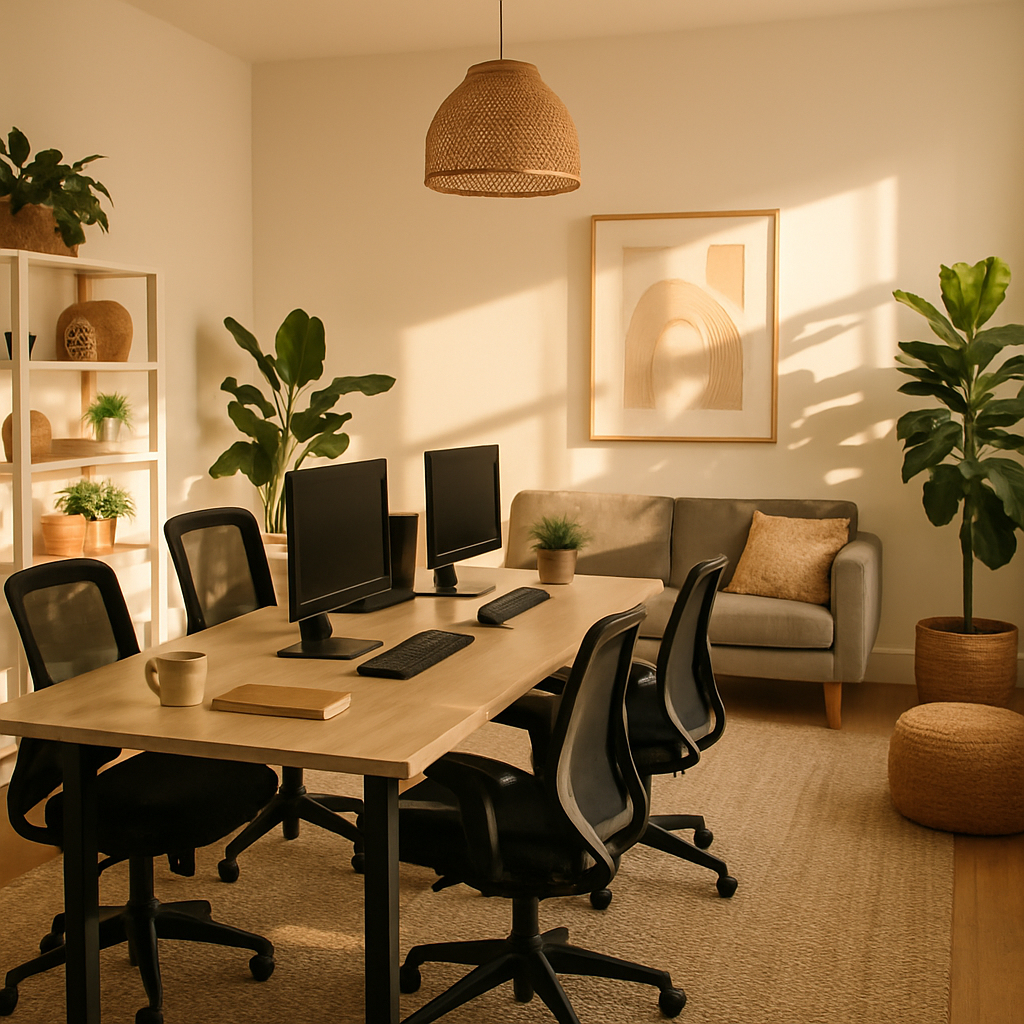
Productivity is not born from willpower alone; it is cultivated by the environments we inhabit. The connection between workspace design and output quality has been studied extensively, yet many offices still operate in layouts that actively hinder the people working inside them. Cluttered desks, insufficient lighting, relentless noise, and uninspiring aesthetics extract a hidden tax on attention, creativity, and morale that no amount of motivational training can offset. Research compiled by the International Interior Design Association (IIDA) demonstrates that employees in well-designed offices are up to 20% more productive than those in standard environments, a figure that translates directly into competitive advantage. The good news is that productivity-boosting design does not require unlimited budgets or architectural overhauls. Many of the most impactful interventions are surprisingly accessible, rooted in evidence-based principles that anyone can apply. This guide presents innovative ideas that turn your workspace into a genuine productivity engine, from the macro decisions of layout and zoning to the micro details of texture, temperature, and technology.
Activity-Based Workspaces That Match Tasks to Settings
The single greatest productivity drain in most offices is the assumption that one workstation suits every task. A person drafting a strategy document needs an entirely different environment from someone brainstorming with a team or conducting a confidential phone call, yet all three are often expected to work from the same open desk. Activity-based working (ABW) replaces assigned seating with a curated menu of settings, each designed for a specific mode of work. Focus pods offer acoustic isolation and minimal visual distraction. Collaborative tables with writable surfaces and digital displays support group problem-solving. Informal lounges with soft seating and low lighting encourage relaxed ideation. By giving employees the autonomy to choose the right tool for the right task, ABW leverages environmental psychology to unlock performance gains that rigid layouts cannot deliver.
Implementing ABW successfully requires more than scattering different furniture types across a floor plate. The ratio of settings must reflect actual work patterns, informed by observation studies and employee surveys rather than guesswork. A team of software engineers might need twice as many focus pods as collaborative spaces, while a sales department might skew heavily toward phone booths and huddle rooms. Transition between settings should be frictionless: personal belongings travel in lightweight lockers or tote bags, wireless technology eliminates the tether of docking stations, and wayfinding signage helps newcomers navigate unfamiliar layouts. The National Council for Interior Design Qualification (NCIDQ) includes activity-based planning in its professional competency framework, recognizing it as a core skill for modern workplace designers.
Have you ever watched how your team actually moves through the office during a typical day? The patterns may surprise you. Most employees develop habitual routines that waste time and energy simply because the layout does not accommodate the natural rhythm of their work. A brief occupancy study, even one conducted informally with a notepad and a floor plan, can reveal which settings are overcrowded, which sit empty, and where bottlenecks form. That data becomes the blueprint for an ABW reconfiguration that converts wasted space into productive square footage. The investment in observation pays for itself many times over in reduced real-estate costs and amplified output per person.
Biophilic Elements That Restore Mental Energy
Mental fatigue is the silent productivity killer that no amount of coffee can remedy. Attention is a finite resource that depletes throughout the day, and environments devoid of natural elements accelerate that depletion. Biophilic design counteracts cognitive fatigue by introducing living plants, natural materials, water features, and daylight into the built environment, providing the subtle sensory stimulation that allows the brain to recover between periods of concentrated effort. The American Society of Interior Designers (ASID) has championed biophilic principles for commercial interiors, citing multiple peer-reviewed studies that link exposure to natural elements with improved concentration, faster problem-solving, and reduced error rates. The effect is not placebo; it reflects deep evolutionary programming that responds to nature with involuntary physiological relaxation.
Practical biophilic interventions span a wide range of complexity and cost. At the simplest end, potted plants on desks and shelves introduce living greenery that improves air quality while providing visual relief from digital screens. Moss walls and vertical gardens create dramatic focal points in lobbies and break areas without requiring soil or heavy irrigation infrastructure. Natural materials such as bamboo, cork, reclaimed timber, and stone replace synthetic laminates and plastic finishes, adding tactile warmth that engages senses beyond sight alone. Even the soundscape can be biophilic: recordings of flowing water, birdsong, or rustling leaves played through concealed speakers have been shown to reduce perceived stress in workplace settings, an approach sometimes called sonic biophilia.
Daylight is the single most impactful biophilic element, and its influence on productivity is well documented. Employees seated near windows consistently report higher job satisfaction and better sleep quality than those in interior zones, a finding that has driven the trend toward shallow floor plates and light shelves that bounce sunlight deeper into buildings. Where natural light is limited, full-spectrum LED fixtures that simulate its spectral properties offer a credible substitute. What percentage of your team currently works within sight of a window? If the answer is low, prioritizing daylight access in your next layout revision could deliver the largest single productivity gain available. The combination of living greenery, natural materials, and abundant light creates a workspace that replenishes the very cognitive resources it demands, a self-reinforcing cycle that sustains performance across the entire workday.
Smart Technology That Eliminates Friction
Every moment spent fumbling with a conference-room remote, searching for an available meeting space, or adjusting an uncomfortable thermostat is a moment stolen from productive work. Smart technology addresses these friction points by automating routine environmental adjustments and putting information at occupants' fingertips. Sensor-driven HVAC systems maintain optimal temperature and humidity without manual intervention, learning occupancy patterns over time and pre-conditioning spaces before people arrive. App-based room booking eliminates the frustration of wandering the floor in search of an open meeting room, while real-time occupancy dashboards show which desks and pods are available at a glance. These incremental savings compound into significant productivity gains when multiplied across an entire workforce and every working day.
Audiovisual technology has undergone a parallel revolution. One-touch meeting-start systems that automatically connect to video-conferencing platforms, wireless screen-sharing that works across operating systems, and AI-powered noise cancellation built into ceiling microphones have transformed the meeting experience from a source of technical frustration into a seamless extension of in-person conversation. Digital whiteboards that save and distribute notes at the end of a session eliminate the time previously spent photographing and transcribing analog boards. Architectural Digest (AD PRO) has profiled numerous offices where technology integration was treated as a design discipline rather than an IT afterthought, noting that the most successful implementations are those where the technology disappears into the architecture, available when needed and invisible when not.
The cost of smart technology varies widely, with consultation fees typically running between $150 and $500 per hour depending on system complexity and geographic market. However, the return extends beyond productivity to include energy savings, space optimization, and employee satisfaction. How many minutes per day does your team lose to environmental friction, the small annoyances of finding rooms, adjusting lighting, connecting devices, and waiting for systems to boot? Even a conservative estimate of fifteen minutes per person per day, at an average loaded labor cost, yields an annual figure that dwarfs most technology investments. Eliminating friction is not glamorous, but it is one of the most reliable paths to measurable productivity improvement available to any organization willing to invest in intelligent infrastructure.
Color Psychology Applied to Workspace Zones
Color is a powerful and often underutilized lever for shaping behavior and mood within the workplace. The science of color psychology provides evidence-based guidance for palette decisions that go far beyond aesthetic preference. Cool blues and soft greens promote concentration and reduce anxiety, making them ideal for focus zones and individual workstations where sustained attention is the primary requirement. Warm yellows and oranges stimulate conversation and creative thinking, supporting brainstorming rooms and social hubs where energy and interaction are welcome. Neutral backgrounds of warm gray, greige, and off-white provide a restful canvas that prevents the visual fatigue associated with overly saturated environments, allowing accent colors to do their work without competition. Houzz surveys of commercial design professionals consistently rank strategic color application among the top five most cost-effective interventions for improving workplace performance.
The application of color extends beyond wall paint. Furniture upholstery, carpet tiles, acoustic panels, and even ceiling planes can carry color cues that reinforce the intended character of each zone. A gradient approach, where color intensity increases as occupants move from quiet periphery to energetic core, creates an intuitive wayfinding system that reduces the need for signage. Floor-to-ceiling color blocking on feature walls anchors distinct neighborhoods within an open plan, giving teams a sense of place and identity without the rigidity of physical partitions. The Japandi palette of muted earth tones, soft whites, and natural wood delivers a universally calming foundation that suits organizations preferring a less directive approach to color zoning.
What colors dominate your current workspace, and were they chosen deliberately or inherited by default? Many offices operate in builder-standard whites and grays that communicate nothing beyond neutrality, missing the opportunity to support different work modes through intentional chromatic design. A focused color strategy does not require repainting an entire office; targeted accent walls, new upholstery, and colored acoustic panels can shift the character of a zone in a weekend. Test your choices at small scale before committing to large areas, and gather feedback from the people who will live with them daily. The most productive palette is one that the occupants find genuinely supportive, not one imposed from a trend report without local validation.
Ergonomic Micro-Environments for Sustained Performance
Ergonomics at the enterprise level is well understood: adjustable chairs, sit-stand desks, and proper monitor placement form the standard toolkit. But the next frontier of productivity-focused design lies in ergonomic micro-environments, carefully tuned combinations of furniture, lighting, temperature, and acoustics that optimize conditions for specific tasks down to the individual level. A writing station might pair a slightly reclined chair with warm task lighting and white-noise masking, creating a cocoon of concentration that fends off distraction. A coding station might feature a dual-monitor arm, a keyboard tray angled to reduce wrist strain, and cool-white lighting that enhances screen contrast. Each micro-environment is a purpose-built tool, as specialized as the software running on the machines it supports.
Temperature personalization is an emerging dimension of ergonomic micro-design. Studies consistently show that thermal discomfort reduces cognitive performance by as much as 10%, yet centralized HVAC systems deliver a single temperature to every workstation regardless of individual preference. Personal climate devices, including desk-mounted fans with air-purification filters, heated chair pads, and localized radiant panels, give occupants control over their immediate thermal envelope without disrupting colleagues. IIDA design standards increasingly recommend incorporating personal climate control into workplace specifications, recognizing that the productivity cost of thermal dissatisfaction far exceeds the equipment investment required to address it.
Are the workstations in your office truly optimized for the tasks performed at each one, or are they identical configurations applied uniformly across the floor? The shift toward ergonomic micro-environments does not demand bespoke furniture for every employee; it requires a thoughtful inventory of work modes and a willingness to vary configurations accordingly. Providing three or four distinct station types, each tuned for a different activity, gives people the ability to select the physical setup that best supports their current task. Combined with the activity-based approach discussed earlier, ergonomic micro-environments transform the office from a one-size-fits-none compromise into a precision instrument calibrated for sustained human performance across the full spectrum of knowledge work.
Restorative Spaces That Prevent Burnout
Productivity is not about maximizing hours at the desk; it is about maximizing the quality of output during the hours that matter. Restorative spaces, areas explicitly designed for recovery and mental reset, are an increasingly recognized component of high-performance workplace design. Meditation rooms with dimmable lighting, acoustic isolation, and natural textures provide a retreat for employees experiencing cognitive overload. Nap pods, once dismissed as Silicon Valley eccentricity, are gaining mainstream acceptance as research confirms that a brief afternoon rest can restore alertness and creative problem-solving capacity to morning-fresh levels. The WELL Building Standard, frequently referenced by ASID-certified professionals, includes restorative space provisions among its criteria for promoting occupant well-being, lending institutional weight to what many organizations still consider a progressive experiment.
Break areas deserve as much design attention as boardrooms. A well-designed kitchen and lounge space serves multiple restorative functions: nourishment, social connection, and mental distance from work tasks. Residential-scale furniture, warm lighting, and materials that contrast deliberately with the office floor, perhaps exposed brick, open shelving, and pendant fixtures reminiscent of a café, signal that this is a space for decompression rather than productivity. The presence of natural daylight, greenery, and views to the outside reinforces the restorative message. Access to outdoor terraces, courtyards, or even balconies extends the menu of recovery options, offering fresh air and sunlight that no interior finish can replicate. These spaces do not reduce output; they protect the cognitive resources that sustain it.
How does your office currently support recovery during the workday? If the answer is a vending machine and a plastic chair in a windowless room, the opportunity for improvement is enormous. Even modest investments in restorative design, a comfortable reading nook by a window, a small garden visible from the break room, a quiet room with a comfortable armchair and soft lighting, send a powerful message that sustainable performance matters more than presenteeism. Teams that recover well produce better work, make fewer errors, and stay with their organizations longer. Designing for restoration is not an indulgence; it is a strategic decision that recognizes human beings as the most valuable and most perishable resource in any enterprise.
Conclusion
Boosting productivity through office interior design is not a matter of implementing a single trend or purchasing a particular piece of furniture. It is the cumulative effect of aligning every environmental variable, layout, biophilia, technology, color, ergonomics, and restoration, with the way human beings actually think, feel, and work. The innovative ideas presented in this guide share a common principle: they treat the office as an active participant in performance rather than a passive container for desks and chairs. Each intervention addresses a specific dimension of the productivity equation, from reducing cognitive friction to replenishing the attentional resources that drive creative output. The most effective approach is systematic rather than piecemeal, beginning with observation and measurement, progressing through evidence-based design, and culminating in a workspace that earns its place as a genuine competitive advantage. If you are ready to transform your office into a productivity engine, start by consulting a designer accredited by NCIDQ or IIDA, commission a workplace assessment, and let the data guide your investments toward the changes that will deliver the greatest return for your team and your organization.
More Articles You May Like



Comments
Post a Comment