Cold Water vs Hot and Cold Pot Fillers: Which to Install
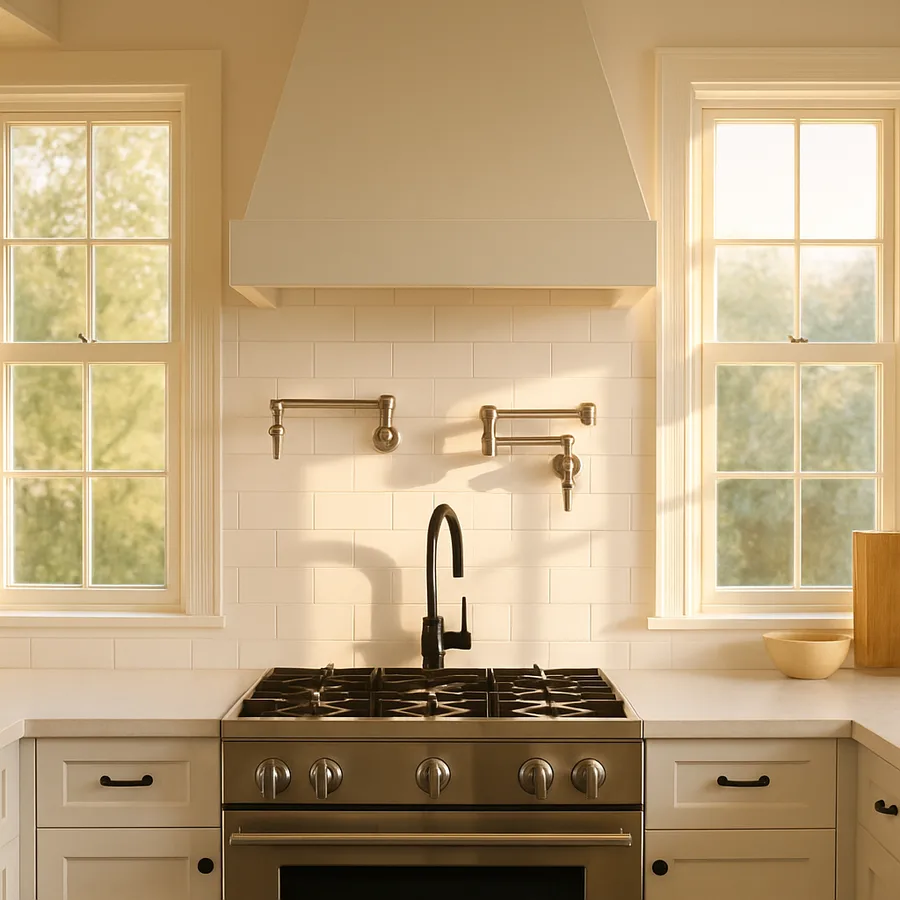
Most homeowners assume that all pot fillers deliver only cold water, and that assumption is correct for the vast majority of installations. However, hot-and-cold pot fillers do exist, and they represent a small but growing segment of the market that appeals to serious home cooks and professional-style kitchen builders. The decision between cold-water-only and hot-and-cold models involves more than just temperature preference; it touches on plumbing complexity, installation cost, safety considerations, and fundamental questions about how you use water at the stove. Understanding the trade-offs between these two configurations helps you make an informed choice rather than defaulting to the more common option without considering whether the alternative might serve you better.
The International Association of Plumbing and Mechanical Officials (IAPMO) reports that approximately 95 percent of residential pot filler installations in North America are cold-water-only configurations. This overwhelming preference for cold water reflects both practical plumbing simplicity and a reasonable cooking philosophy: water that will be boiled does not benefit from starting warm because the energy savings are negligible and the safety risks of hot water at an open, drainless fixture are real. But the five percent who choose hot-and-cold models have their own valid reasons, and dismissing the option without examining those reasons means potentially overlooking a configuration that better matches your cooking workflow.
This article provides a thorough comparison of both configurations, covering the plumbing requirements, cost differences, safety implications, and practical cooking scenarios where each option delivers the most value. By the end, you will have a clear sense of which configuration aligns with your kitchen's design, your cooking habits, and your budget.
Why Cold-Water-Only Pot Fillers Dominate the Market
The overwhelming prevalence of cold-water-only pot fillers is rooted in a combination of plumbing simplicity, lower cost, and a practical cooking logic that is difficult to argue against. Running a single cold water supply line to the wall behind the stove is the least complicated plumbing task involved in a pot filler installation. The cold water line typically branches from the nearest existing cold supply, often from the kitchen sink supply located a few feet away, and runs horizontally through the wall cavity to the stub-out behind the stove. This single-line run requires one connection at the source, one run of pipe through the wall, and one connection at the pot filler valve, keeping labor and material costs minimal.
The cooking logic behind cold-water-only pot fillers is straightforward and scientifically sound. Water destined for boiling will reach 212 degrees Fahrenheit regardless of its starting temperature, and the time difference between starting with 55-degree cold water and 120-degree hot water is approximately two to three minutes on a standard residential burner. That modest time savings is offset by a water quality concern that many cooks are unaware of: hot water from a residential water heater has typically sat in the tank for an extended period, and during that time it can absorb higher levels of dissolved minerals, sediment, and in older homes, lead from solder joints. The Environmental Protection Agency (EPA) recommends using cold water for cooking and drinking precisely because cold water pipes and cold water from the municipal supply carry lower concentrations of these dissolved substances.
From a safety perspective, cold-water-only pot fillers eliminate the risk of accidental scalding at a fixture that has no drain or basin to contain splashing water. When you turn on a hot-and-cold pot filler and the hot water arrives at full temperature, any splash or misdirected stream hits the stove surface, the backsplash, or potentially your hands and arms. With a cold-water-only model, an accidental splash is startling but not dangerous. This safety distinction is particularly relevant in households with children who might reach the pot filler handles out of curiosity, since cold water poses no burn risk even if the fixture is turned on unexpectedly.
The maintenance simplicity of a single-supply pot filler is another practical advantage. One supply line means one set of connections to monitor for leaks, one shut-off valve to maintain, and one less penetration through the wall behind the stove. Every additional plumbing connection is a potential failure point, and in the harsh environment behind a cooking range where heat and steam accelerate corrosion, minimizing the number of connections reduces the long-term maintenance burden. For most households, the cold-water-only configuration delivers everything they need from a pot filler with the least possible complexity and risk.
The Case for Hot-and-Cold Pot Fillers
Despite the strong arguments for cold-water-only models, hot-and-cold pot fillers serve specific cooking workflows that cold water alone cannot address. The most compelling use case is for cooks who frequently need warm or hot water at the stove for purposes other than boiling. Dissolving gelatin, activating yeast, blanching vegetables in pre-heated water, and preparing hot beverages like tea or instant coffee directly at the stove are tasks where starting with hot water saves meaningful time and eliminates an extra trip to the sink. For professional-style home kitchens where the cook is preparing multiple dishes simultaneously, the ability to access hot water without leaving the range area can genuinely improve workflow efficiency.
Bakers and pastry chefs who work from home kitchens are among the most enthusiastic adopters of hot-and-cold pot fillers. Many baking processes require water at specific temperatures, and having precise temperature control at the stove eliminates the need to carry bowls of water from the sink. Tempering chocolate, proofing dough, and making sugar syrups all benefit from water that is already warm, and a dual-temperature pot filler allows the cook to blend hot and cold water to reach the exact temperature needed without a thermometer trip to the sink. The American Institute of Baking (AIB) notes that water temperature is one of the most critical variables in bread making, and having temperature control at the workstation reduces the chance of temperature drop during transport from sink to stove.
Some homeowners choose hot-and-cold pot fillers for cleaning convenience at the stove. Hot water is more effective than cold water at cutting grease and dissolving food residues, so being able to rinse the stovetop area with warm water directly from the pot filler simplifies the post-cooking cleanup routine. This benefit is modest compared to the primary cooking advantages, but for people who already plan to install a pot filler and are deciding between configurations, the added cleaning convenience can tip the balance toward the dual-temperature option.
The aesthetic and symmetry argument also plays a role for some homeowners. Dual-handle pot fillers, with one handle for hot and one for cold, have a balanced visual appearance that some designers and homeowners prefer over the asymmetric look of a single-handle cold-water model. In traditional kitchen designs where cross-handle fixtures are a design feature, the dual-handle pot filler matches the visual language of the traditional bridge faucet at the sink, creating a cohesive look across the kitchen's water fixtures. This is a secondary consideration that rarely drives the decision on its own, but it contributes to the overall design rationale in kitchens where visual consistency is a priority.
Plumbing Requirements and Installation Complexity
The plumbing requirements for a hot-and-cold pot filler are substantially more complex than for a cold-water-only model, and this complexity directly affects both the installation cost and the range of kitchens where the option is practical. A dual-temperature pot filler requires two separate supply lines to the wall behind the stove: one from the cold water supply and one from the hot water supply. The hot water line must connect back to the water heater, which may be located in a basement, utility closet, or garage that is a considerable distance from the kitchen. Running a hot water line that distance involves more pipe, more fittings, more labor, and potentially more wall openings than the single cold line required for a standard pot filler.
The wall cavity behind the stove must accommodate both supply lines, which can be challenging in walls that also contain range hood ductwork, electrical wiring for the range, or gas lines. Standard interior walls with 2x4 framing have a cavity depth of approximately 3.5 inches, which is sufficient for two half-inch supply lines and the pot filler valve body, but the margin is tighter than with a single supply line. If the wall contains a vent duct for a ducted range hood, the available cavity space may be insufficient for dual supply lines, forcing the plumber to reroute the duct or choose a different installation approach. Discussing the wall cavity contents with your plumber before committing to a hot-and-cold configuration prevents discovering a space conflict after the wall is opened.
The hot water delivery delay is a practical issue that many homeowners do not consider until after installation. Hot water from the water heater must travel through the supply line before it reaches the pot filler spout, and the water sitting in the line between the heater and the fixture is cold. Depending on the distance and pipe diameter, you may need to run the hot side for 30 seconds to two minutes before the water reaches the desired temperature. During that waiting period, cold water flows through the pot filler and must go somewhere, but there is no drain at the fixture to receive it. You either fill a pot with the initial cold water and pour it out later, or you let it flow onto the stove surface, which creates a mess and wastes water. Recirculating hot water systems can reduce this delay, but they add another layer of complexity and cost to the installation.
Installation costs for a hot-and-cold pot filler typically run 40 to 60 percent higher than a cold-water-only installation. The additional hot water line, extra fittings, second shut-off valve, and increased labor time add 500 to 1,500 dollars to the project depending on the distance from the water heater and the accessibility of the plumbing routes. In new construction, the cost premium is on the lower end because the walls are open and both lines can be run simultaneously. In renovation projects, the premium is higher because accessing and patching the wall for two penetrations instead of one roughly doubles the drywall and backsplash repair costs.
Safety Analysis and Code Considerations
The safety implications of a hot-and-cold pot filler are more significant than many homeowners realize, and local building codes in some jurisdictions reflect this concern. A pot filler is an open-spout fixture mounted in a location where people are actively working with heat, sharp utensils, and their attention focused on cooking. Introducing hot water at temperatures up to 140 degrees Fahrenheit, which is the standard setting for many residential water heaters, adds a scald risk that does not exist with cold-water-only models. The American Burn Association reports that water at 140 degrees can cause a third-degree burn in approximately five seconds of contact, and splashing water from a pot filler can make contact with skin before the user has time to react.
Several municipal building codes have addressed this concern by requiring specific safety features on hot-and-cold pot fillers. Some jurisdictions require a thermostatic mixing valve that limits the maximum output temperature to 120 degrees Fahrenheit, which reduces scald risk while still providing warm water for cooking purposes. Others require an anti-scald device that automatically shuts off water flow if the temperature exceeds a preset threshold. These code requirements add components and cost to the installation, and they vary by locality, so checking with your local building department before proceeding with a hot-and-cold installation ensures compliance and avoids the cost of retrofitting safety devices after the inspection.
The absence of a drain or basin below a pot filler amplifies the safety concern because any water that misses the pot or splashes during use falls directly onto the stove surface. With cold water, this creates a mess but no injury risk. With hot water, splashed water on a hot stove surface can instantly generate steam that rises into the cook's face and arms, creating a secondary burn hazard beyond the direct contact risk. The combination of hot water, a hot stove, and no containment basin creates a risk profile that is unique to hot-and-cold pot fillers and does not exist with any other kitchen fixture. Understanding and accepting this elevated risk is part of the decision to install a dual-temperature model.
For households with children or elderly residents, the cold-water-only configuration is the strongly recommended choice. Children are naturally curious about faucet handles, and a child who turns on a cold-water pot filler creates a minor mess. A child who turns on a hot-water pot filler could sustain a serious burn. Similarly, elderly residents with reduced reaction time or sensation in their hands are at higher risk of scald injury from hot water at an open fixture. If your household includes anyone in these vulnerable groups now or in the foreseeable future, the safety argument against a hot-and-cold pot filler is compelling enough to override the convenience benefits.
Making the Decision Based on Your Cooking Profile
The most reliable way to decide between cold-water-only and hot-and-cold configurations is to examine your actual cooking habits over a two-week period and note every instance where you use water at the stove. Record what temperature you needed, what you were cooking, and whether the water was destined for boiling or for a temperature-sensitive application. If the overwhelming majority of your stove-side water use involves filling pots that will be brought to a full boil, the cold-water-only model serves your needs completely and the additional cost and complexity of dual temperature lines is wasted. If you frequently find yourself needing warm or hot water at the stove for applications other than boiling, the hot-and-cold model addresses a real gap in your kitchen workflow.
Consider your cooking style and cuisine as part of this assessment. Western home cooking traditions rely heavily on boiling and simmering, which are temperature-destination cooking methods where the starting water temperature is irrelevant. Asian and Middle Eastern cuisines that involve more blanching, quick-soak techniques, and precise temperature preparations may benefit more from hot water access at the stove. Professional and semi-professional home bakers who work with water-temperature-sensitive doughs and batters also have a legitimate use case. If your cooking skews toward boiling pasta, making soup, and steaming vegetables, cold water is all you need. If your cooking involves more nuanced water temperature requirements, the dual-temperature option merits serious consideration.
Your kitchen's plumbing infrastructure also influences the practicality of each option. If your water heater is located close to the kitchen, the hot water line run is short, the delivery delay is minimal, and the installation cost premium is modest. If your water heater is on the opposite end of the house or in a detached garage, the long hot water line run increases cost, creates a longer delivery delay, and adds more potential failure points along the extended pipe run. The plumbing infrastructure question is not about preference but about physics and geometry, and it can make the hot-and-cold option impractical regardless of how much you might want it.
Finally, consider the future flexibility of your installation. If you install a cold-water-only pot filler now but think you might want hot water later, adding the second supply line after the fact is expensive and disruptive because it requires reopening the wall. If there is a reasonable chance you will want hot water in the future, running both supply lines during the initial installation and capping the hot line for later use costs relatively little extra during the rough-in phase and preserves the option without committing to it. This pre-plumbing approach is a practical compromise that several plumbing professionals recommend for homeowners who are genuinely uncertain about which configuration they will prefer long-term.
Conclusion
For the vast majority of home kitchens, a cold-water-only pot filler is the correct choice. It is simpler to install, less expensive to purchase and maintain, safer to operate, and perfectly adequate for the primary purpose of filling pots that will be heated on the stove. The cooking logic, water quality considerations, and safety profile all favor the cold-water configuration, which is why 95 percent of installations follow this approach. Choosing cold water is not settling for less; it is choosing the solution that best fits the use case with the least complexity and risk.
The hot-and-cold pot filler is a specialized option that serves a narrower set of cooking profiles. If you frequently need warm or hot water at the stove for temperature-sensitive cooking applications, if your plumbing infrastructure supports a short hot water line run, and if your household does not include children or elderly residents at elevated scald risk, the dual-temperature configuration can enhance your cooking workflow in meaningful ways. The additional cost and complexity are justified when the hot water access addresses a genuine and frequent need rather than a theoretical convenience.
How often do you actually need warm or hot water at the stove, and what specific cooking tasks require it? Is your water heater located close enough to the kitchen to make a hot water line run practical and affordable?
Track your stove-side water use for two weeks before making your final decision. Write down every time you fill a pot or use water near the stove, noting the temperature you needed and what you were preparing. That simple log will give you concrete data to base your decision on, replacing guesswork with evidence from your own kitchen habits. The right configuration is the one that matches how you actually cook, not how you imagine you might cook in an ideal scenario.
More Articles You May Like



Comments
Post a Comment