Montessori Bedroom Setup for Toddlers on a Tight Budget
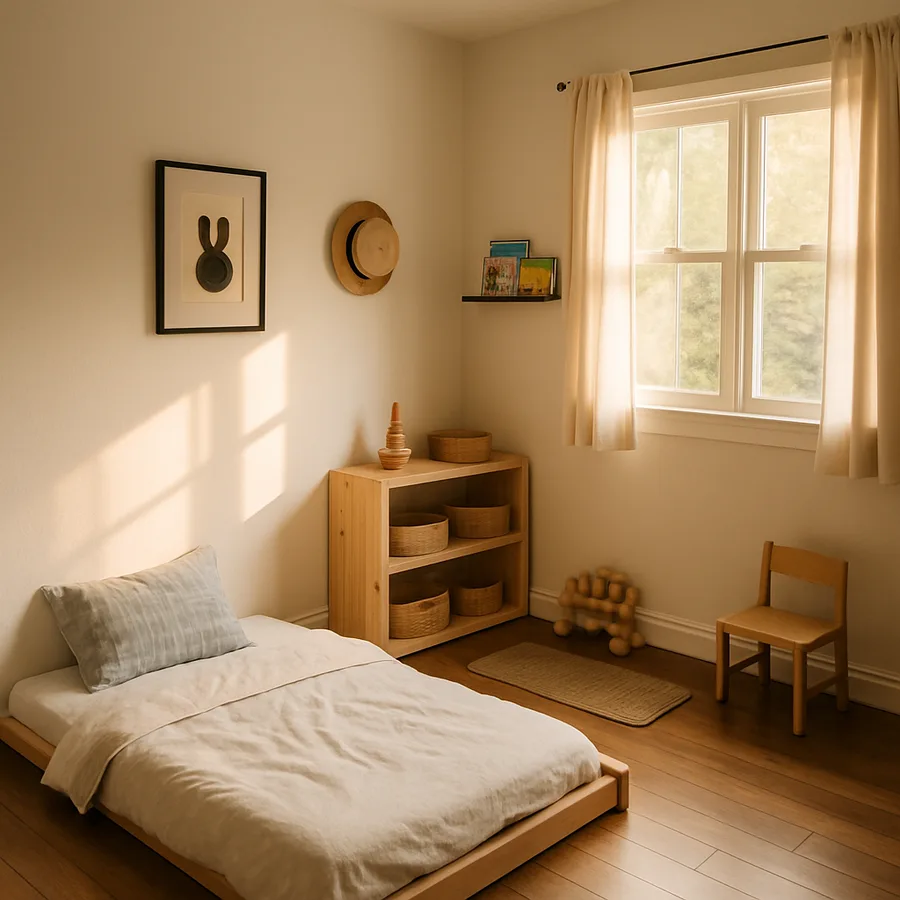
What a Montessori Bedroom Actually Requires
The Montessori bedroom has become one of the most discussed concepts in modern parenting, and like many popular ideas, it has accumulated layers of commercial interpretation that obscure the original principles. Instagram-perfect Montessori rooms filled with handcrafted European furniture, imported wooden toys, and designer textiles suggest that creating this environment requires a substantial financial investment. That suggestion is fundamentally misleading. The core principles of a Montessori bedroom are child-accessible furniture, freedom of movement, order, and simplicity, and none of these principles require expensive products to implement. In fact, excess spending often works against the Montessori philosophy by cluttering the space with more objects than a toddler can meaningfully engage with.
Dr. Maria Montessori developed her educational philosophy in early twentieth-century Italy while working with children from economically disadvantaged families. The approach was designed to work with minimal resources, relying on thoughtful environmental design rather than specialized equipment. The American Montessori Society (AMS) emphasizes that a Montessori environment is defined by its adherence to principles of child independence, order, and purposeful activity, not by the brand names or price points of its furnishings. A bedroom that enables a toddler to get in and out of bed independently, choose their own clothing, select their own activities, and maintain order in their space is a Montessori bedroom, whether it was furnished for two hundred dollars or two thousand.
The essential elements of a Montessori toddler bedroom can be listed concisely: a floor-level bed that the child can enter and exit without assistance, low open shelving with a limited number of toys and activities displayed accessibly, a child-height clothing area where the toddler can see and reach their own clothes, a small table and chair for seated activities, and minimal decoration placed at the child's eye level rather than the adult's. Every other element, from specific furniture brands to particular aesthetic styles, is optional embellishment. Understanding this distinction between essential and optional is the key to building a Montessori bedroom on a tight budget.
How much would you expect to spend on these five essential elements if you approached each one with creativity and resourcefulness rather than a catalog? The answer, which the rest of this article will demonstrate with specific strategies and price points, is significantly less than the Montessori industry would suggest. A fully functional Montessori toddler bedroom can be assembled for under three hundred dollars using a combination of affordable new purchases, secondhand finds, and simple DIY projects. The result is a room that serves your child's developmental needs just as effectively as its expensive counterparts.
The Floor Bed: Options From Free to Under One Hundred Dollars
The floor bed is the signature element of the Montessori bedroom and the feature that most clearly distinguishes it from a conventional toddler room. The purpose is straightforward: a bed at floor level allows the child to get in and out independently, supporting their growing autonomy and eliminating the containment dynamic of a crib. When a toddler wakes, they can leave their bed, engage quietly with materials in their room, and begin their day on their own terms rather than standing in a crib calling for a parent. This independence is a foundational Montessori value, and the floor bed is its most tangible expression in the bedroom.
The most budget-friendly floor bed is a crib mattress or twin mattress placed directly on the floor. This approach costs nothing beyond the mattress itself, which many families already own from the crib phase or can acquire secondhand for twenty to forty dollars. Place the mattress in a corner of the room where two walls provide a natural boundary on two sides, and the bed is functional immediately. Some parents add a pool noodle beneath the fitted sheet along the open edge to create a subtle bumper that prevents rolling out during sleep. The Consumer Product Safety Commission (CPSC) considers a mattress on the floor to be a safe sleep surface for toddlers who have outgrown the crib, provided the room is fully childproofed and free of hazards at floor level.
A simple wooden floor bed frame elevates the mattress slightly, provides a visual boundary that defines the bed area, and adds a finished appearance to the room. Building one from standard lumber is one of the simplest DIY furniture projects available, requiring only four lengths of 2x4 lumber, wood screws, and basic tools. The total material cost is typically fifteen to thirty dollars. Cut two pieces to the mattress length and two to the mattress width, screw them together at the corners to form a rectangular frame, and sand any rough edges. The mattress sits inside the frame, held in place by the low walls on all four sides. Dozens of free plans for this exact build are available online, and the entire project takes under two hours.
For parents who prefer to purchase rather than build, commercially available floor bed frames range from sixty to one hundred fifty dollars for basic models. The house-shaped floor bed frame, which has become iconic in Montessori bedroom photography, is available from multiple manufacturers on Amazon, Walmart, and IKEA at prices between seventy and one hundred twenty dollars. These frames add visual charm and provide a structure for draping lightweight fabric or hanging a small mobile, though neither addition is necessary for the bed's function. The IKEA Kura bed, when placed on its low setting, also functions as a floor bed at a price point under two hundred dollars and provides lasting value as the child grows. Budget priority should always favor a quality mattress over the frame, since the mattress affects sleep quality directly while the frame is purely structural and aesthetic.
Low Shelving and Toy Rotation on a Shoestring
Open shelving at the child's height is the second essential element, serving as the activity center where the toddler independently selects what to play with, work on, or explore. The Montessori approach to shelving emphasizes a limited number of items, typically six to ten activities or toys, displayed neatly with space between each item. This deliberate limitation reduces decision overwhelm, encourages deeper engagement with each item, and makes cleanup manageable for a toddler. When the child has finished with an activity, they return it to its place on the shelf before selecting another, building habits of order and responsibility that are central to the Montessori method.
The least expensive shelving option is a standard bookcase laid on its side. A vertical bookcase that stands five feet tall becomes a waist-height horizontal shelf unit that is perfectly scaled for toddler access. Thrift stores, yard sales, and online marketplaces consistently offer basic bookshelves for five to twenty dollars, and laying one on its side immediately creates a functional Montessori shelf unit. Secure the unit to the wall with an L-bracket and wall anchor, which costs under five dollars and is a non-negotiable safety step, and the shelf is ready for use. The CPSC reports that furniture tip-overs cause an average of one child fatality every two weeks in the United States, making anti-tip anchoring the most important safety measure in any toddler room.
IKEA's Kallax shelf unit in the two-by-two or two-by-four configuration has become the de facto standard Montessori shelf for budget-conscious families, and for good reason. The cube format provides defined spaces for individual activities, the height is appropriate for toddler access, and the price, thirty-five to seventy dollars depending on size, is difficult to beat for a new, purpose-built unit. The Kallax is sturdy enough to support the weight of a toddler using it for balance while pulling up or cruising, provided it is wall-anchored. Cube storage bins that fit the Kallax openings are available from multiple retailers for three to eight dollars each and provide concealed storage for items that are not in the current rotation.
Toy rotation is the practice that makes a small number of shelved items feel perpetually fresh and engaging. The concept is simple: display six to ten items on the shelf, and store the remaining toys in a closet, bin, or another room. Every one to two weeks, swap a few items from the shelf with items from storage. The "new" items, which the child has not seen recently, generate renewed interest and extended engagement, while the stored items rest until their next rotation. This practice costs nothing, requires no special equipment, and dramatically reduces the perceived need to purchase new toys. Does your child have toys they have forgotten about? Those forgotten toys are your rotation inventory, ready to be rediscovered with the excitement of something new.
Child-Height Clothing Access Without Custom Furniture
Enabling a toddler to participate in choosing and putting on their own clothing is a key Montessori bedroom feature that supports independence, decision-making, and self-care skills. The traditional approach of storing children's clothing in tall dressers and high closet rods makes these items inaccessible to the child, requiring adult assistance for every clothing interaction. A Montessori clothing setup brings a limited selection of weather-appropriate clothing to the child's level, allowing them to see their options, make choices, and begin practicing the physical skills of dressing independently.
The simplest budget solution is a low clothing rack, which can be purchased for fifteen to thirty dollars from retailers like IKEA, Amazon, or Target. A child-sized garment rack holds four to six outfits on hangers at a height the toddler can reach, making the daily clothing selection visual and tangible. Limit the rack to current-season, weather-appropriate clothing, storing off-season and excess items in a closet or bin out of the child's reach. This curation prevents the overwhelm of too many choices and ensures that whatever the child selects is appropriate to wear. The Association Montessori Internationale (AMI), the organization founded by Maria Montessori herself, recommends offering toddlers a choice between two to three complete outfits rather than an open-ended wardrobe, striking a balance between independence and appropriate guidance.
A small set of low drawers or bins supplements the clothing rack for items that do not hang well: underwear, socks, pajamas, and folded casual clothes. A three-drawer plastic storage unit from any discount retailer costs ten to twenty dollars and provides adequate capacity for a toddler's folded clothing needs. Labeling each drawer with a simple picture, a drawing of socks on the sock drawer, pants on the pants drawer, strengthens the child's understanding of categorization and helps them return clean laundry to the correct location. As the child's reading develops, text labels can replace or supplement the pictures, turning the dresser into a quiet literacy reinforcement tool.
For families with standard closets in the toddler's room, a tension rod installed at child height creates a low hanging space within the existing closet for under ten dollars. Mount the tension rod approximately twenty-four to thirty inches above the closet floor, low enough for the toddler to reach hangers independently. The upper closet rod remains in place for adult use or for storing out-of-rotation clothing. This approach requires no permanent modification to the closet and can be adjusted upward as the child grows. A small step stool placed inside the closet, costing ten to fifteen dollars, extends the child's reach to slightly higher shelving as they grow taller and more confident, gradually expanding their accessible territory within the existing storage infrastructure.
Activity Zones, Reading Nooks, and Practical Life Areas
Beyond the bed, shelving, and clothing area, a Montessori bedroom benefits from defined zones where specific types of activity take place. A small table and chair set creates a workspace for drawing, puzzles, playdough, and other seated activities. Child-sized table and chair sets are available from IKEA for under twenty-five dollars, and secondhand sets appear frequently at thrift stores and on marketplace platforms for five to fifteen dollars. The table should be low enough that the child's feet rest flat on the floor when seated, which provides physical stability and comfort during focused activities. This proper sizing is functional, not merely aesthetic, as the American Occupational Therapy Association (AOTA) notes that appropriate seating posture supports fine motor development and sustained attention in young children.
A reading corner encourages independent book engagement, one of the most valuable habits the Montessori bedroom can cultivate. The setup needs nothing more than a small cushion or folded blanket on the floor and a few books displayed with covers facing forward rather than spines out. Forward-facing book display is a core Montessori principle for young children because toddlers identify books by their cover images rather than spine text, and a book they can see is a book they are far more likely to pick up and explore. DIY forward-facing book shelves can be made from IKEA spice racks, which cost approximately five dollars each and mount to the wall at toddler height to display three to five books with covers visible.
Practical life activities are uniquely Montessori elements that teach real-world skills through purposeful work. In a bedroom context, this means providing the child with tools and access to care for their own space: a small broom and dustpan for sweeping, a hamper at their height for dirty clothes, a mirror at their level for self-awareness and grooming practice, and hooks at their height for hanging bags, hats, or jackets. Each of these items costs under ten dollars at discount retailers, and collectively they transform the bedroom from a space where things are done for the child into a space where the child participates meaningfully in their own environment.
The wall art and decoration in a Montessori bedroom should be positioned at the child's eye level, approximately eighteen to twenty-four inches above the floor, rather than at adult eye level. This placement respects the child's perspective and ensures they can engage with the visual environment of their room. Framed family photos, simple nature prints, or postcards of artwork hung low on the wall provide visual interest that the child can actually see and discuss. A shatterproof mirror mounted low on one wall gives the toddler a full-body view of themselves, supporting body awareness and self-recognition. These decoration strategies cost virtually nothing if you use prints or photos you already own, reframed or repositioned from other locations in your home.
Safety-Proofing the Independent Bedroom
A Montessori bedroom grants the child freedom to move independently through the space, which makes thorough childproofing essential rather than optional. Every item in the room must be safe for unsupervised interaction, because the child will interact with everything they can reach, including objects and fixtures you might not expect them to notice. Electrical outlets need tamper-resistant covers or built-in shutters. Cords from blinds, curtains, or electronics must be eliminated or secured out of reach. Furniture must be anchored to walls. Windows must have locks or guards that prevent opening beyond four inches. The room should contain nothing small enough to be a choking hazard and nothing heavy enough to cause injury if pulled from a shelf.
The floor bed specifically introduces a safety consideration that cribs address by design: the child can leave the bed at any time, including during the night. This means the entire bedroom floor must be safe for a sleepy, disoriented toddler navigating in low light. Remove any obstacles that could cause tripping. Ensure nightlight placement provides enough visibility for safe movement without being bright enough to disrupt sleep. Consider a baby gate at the bedroom door rather than a closed door, which allows the child to call out and see the hallway while preventing unsupervised access to the rest of the house. The ASID notes that safety and accessibility are foundational design principles in any child-centered space, and the Montessori bedroom requires particular attention because it deliberately maximizes the child's freedom of movement.
Temperature regulation is a practical concern in a room where a toddler sleeps without the confinement of crib rails and may kick off blankets during the night. A wearable blanket or sleep sack appropriate for the room temperature ensures the child stays warm regardless of blanket position. Room temperature should be maintained between sixty-eight and seventy-two degrees Fahrenheit, as recommended by the AAP for safe toddler sleep. A simple room thermometer, available for under ten dollars, allows parents to verify temperature conditions without entering the room and potentially disturbing the sleeping child.
Review the room's safety setup every three to four months as the child grows and develops new physical capabilities. A shelf that was safely out of reach at eighteen months may be climbable at twenty-four months. Drawers that a younger toddler could not open may become accessible as hand strength develops. The safety landscape of a Montessori bedroom is not static; it evolves with the child's abilities, and regular reassessment ensures the room remains both independent and safe. This ongoing attention is not burdensome, as it takes fifteen minutes per review, but it is essential for maintaining the balance between freedom and safety that defines the Montessori bedroom approach.
Your Budget Montessori Bedroom Action Plan
Building a Montessori toddler bedroom on a tight budget is an exercise in prioritization rather than deprivation. Begin with the three highest-impact elements: the floor bed, the low shelf unit, and the child-height clothing access. These three features, which can be assembled for well under one hundred fifty dollars using the strategies outlined above, transform a conventional bedroom into a functional Montessori environment. Everything else, the table and chair, the reading nook, the practical life tools, and the low-hung art, can be added incrementally as budget allows, without diminishing the room's effectiveness in the interim.
Secondhand sourcing should be your first approach for every furniture item. Toddler furniture has a brief useful lifespan, typically two to four years, which means the secondhand market is constantly supplied with gently used items at a fraction of their retail price. Facebook Marketplace, Craigslist, local parent groups, and thrift stores are reliable sources for floor bed frames, shelf units, table and chair sets, and clothing racks. Inspect secondhand items for structural integrity, check for recall status on the CPSC recall database, and clean thoroughly before use. The environmental benefit of secondhand purchasing, keeping functional items out of landfills, aligns naturally with the Montessori value of respect for the world the child is growing into.
Resist the pressure to create a picture-perfect room before the child begins using it. The Montessori bedroom is a living environment that should evolve with the child rather than a finished showpiece that is presented complete on day one. Start with the essentials, observe how your child uses the space, and make adjustments based on their actual behavior and interests. You may discover that the activity shelf needs to be in a different location, that the reading corner works better near the window than in the corner you initially chose, or that your child engages more with practical life tools than with traditional toys. These observations, available only through actual use, are more valuable than any design plan created in advance.
The total cost of a fully functional Montessori toddler bedroom, assembled thoughtfully with a combination of budget purchases, secondhand finds, and simple DIY projects, should fall between one hundred fifty and three hundred dollars. That figure includes the floor bed and mattress, shelf unit, clothing rack or low rod, table and chair, basic safety equipment, and initial activity materials. Compare this with the thousands of dollars that Montessori furniture retailers charge for curated room packages, and the conclusion is clear: the Montessori bedroom is accessible to families at every income level, and the most important investments are not financial but attentional. Observe your child, prepare the environment thoughtfully, and adjust as they grow. Start with one element this weekend, the floor bed or the low shelf, and build from there as your budget and energy allow.
More Articles You May Like



Comments
Post a Comment