How to Achieve a Balanced Look with Modern Contemporary Interior Design Styles
Achieving visual balance in a modern contemporary interior is both an art and a discipline, requiring a nuanced understanding of how proportions, colors, textures, and spatial relationships interact to create environments that feel harmonious, intentional, and complete. Balance does not mean symmetry in every instance, nor does it demand rigid adherence to formulas; rather, it involves cultivating a sensitivity to the visual weight of objects and the relationships between them, then making adjustments until the room communicates a sense of resolved equilibrium. The American Society of Interior Designers (ASID) identifies balance as one of the five foundational principles of interior design, alongside unity, rhythm, emphasis, and proportion, and notes that rooms perceived as unbalanced are consistently rated as less comfortable and less aesthetically pleasing regardless of the quality of individual furnishings they contain. This guide explores the practical techniques and conceptual frameworks that enable homeowners to achieve the sophisticated balance that distinguishes exceptional modern contemporary interiors from merely adequate ones.
Understanding Symmetrical and Asymmetrical Balance
The two primary modes of visual balance in interior design are symmetrical balance, where elements are mirrored across a central axis, and asymmetrical balance, where different elements of equivalent visual weight are distributed to achieve equilibrium without mirror repetition. Symmetrical arrangements create a sense of formality, order, and classical elegance that many homeowners find instinctively appealing, as the mirrored composition communicates stability and completeness in a way that is immediately legible to the eye. A bedroom with matching nightstands and lamps flanking a centered bed, or a living room with identical armchairs facing each other across a coffee table, exemplifies symmetrical balance, and these arrangements form the compositional backbone of many modern contemporary interiors.
Asymmetrical balance is more challenging to achieve but offers greater dynamism, visual interest, and a sense of spontaneity that prevents spaces from feeling overly rigid or predictable. In an asymmetrical composition, different objects achieve equilibrium through careful calibration of their visual weight, which is determined by factors including size, color intensity, texture, pattern complexity, and visual density. A large, light-colored artwork on one side of a fireplace might be balanced by a smaller, darker sculptural object on the other side, with the darker object's greater visual intensity compensating for its smaller scale. The International Interior Design Association (IIDA) teaches that mastering asymmetrical balance is what separates competent designers from exceptional ones, as it requires a trained eye and confident intuition rather than simple replication of a mirror pattern.
Most successful modern contemporary interiors employ a combination of both balance modes, using symmetry to establish a stable framework in key areas and introducing asymmetrical elements to inject vitality and prevent the space from feeling static. A living room might feature a symmetrically arranged seating group as its core composition, with asymmetrically placed floor lamps, side tables of different heights, and an off-center artwork arrangement adding layers of visual complexity. This hybrid approach captures the stability of symmetry and the energy of asymmetry, creating rooms that feel both grounded and alive. The proportion of symmetrical to asymmetrical elements is a matter of personal preference, with more formal sensibilities gravitating toward greater symmetry and more relaxed or eclectic tastes embracing more asymmetrical compositions.
Color Balance and the 60-30-10 Framework
One of the most reliable tools for achieving color balance in modern contemporary interiors is the 60-30-10 rule, which distributes color across a room in proportions that naturally produce a sense of harmony and visual order. Under this framework, the dominant color occupies approximately 60% of the room's visible surface area, typically appearing on walls, large area rugs, and major upholstery pieces; the secondary color accounts for about 30%, appearing in smaller furniture, window treatments, and bedding; and the accent color provides the remaining 10% through decorative accessories, artwork, and small textiles. This proportional distribution creates a clear color hierarchy that guides the eye smoothly through the space rather than allowing it to bounce chaotically between competing hues.
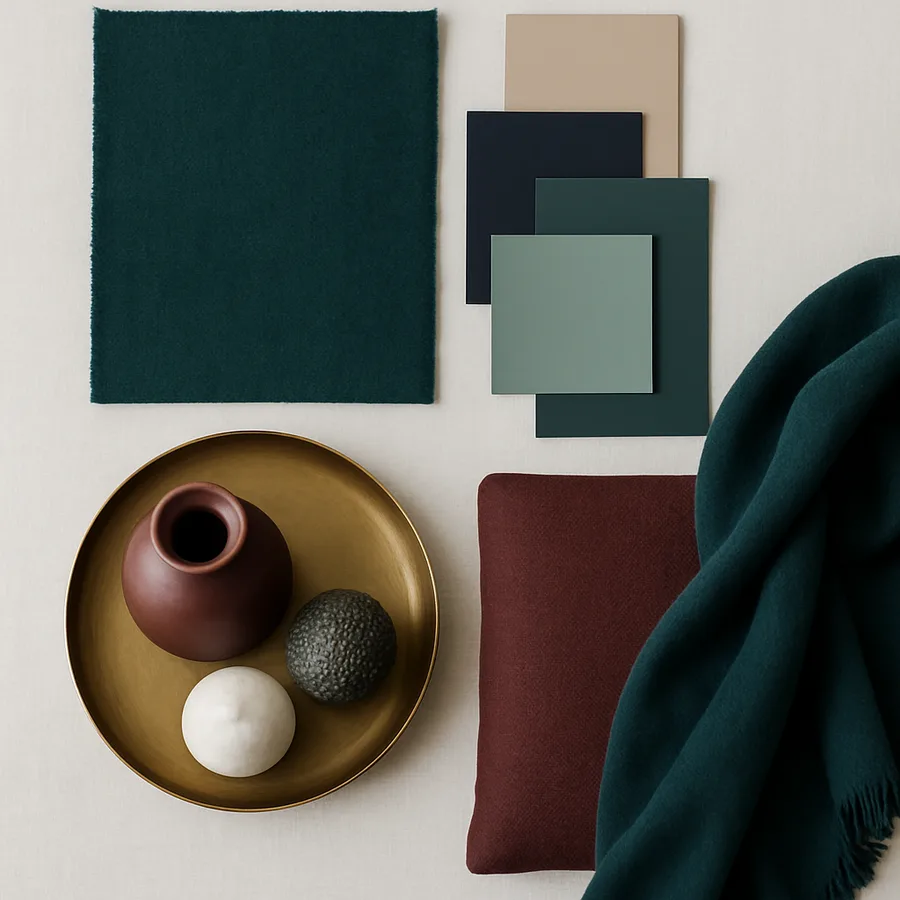
In modern contemporary applications, the 60% dominant color is almost always a neutral, ranging from warm whites and soft grays to deeper taupes and charcoals depending on the desired mood and the room's natural light conditions. The 30% secondary color introduces a subtle tonal shift, perhaps a warmer wood tone against cool gray walls or a soft blue-gray textile against warm beige surfaces, creating depth without drama. The 10% accent color is where personality and punctuation enter the composition, with a carefully chosen hue such as deep emerald, burnt orange, or matte gold providing focal points that enliven the neutral foundation. Houzz data shows that rooms adhering to approximate 60-30-10 proportions receive consistently higher aesthetic ratings from both professionals and consumers than rooms with more evenly distributed color, confirming the empirical effectiveness of this classical framework.
Applying the 60-30-10 rule does not require mathematical precision but rather a general awareness of proportion that prevents any single color from either dominating monotonously or appearing so sparingly that it feels random and disconnected. Common pitfalls include allowing the accent color to creep beyond its 10% allocation, which dilutes its impact and can make a room feel busy, or neglecting the secondary color entirely, which leaves too stark a contrast between the neutral foundation and the accent elements. The National Council for Interior Design Qualification (NCIDQ) recommends stepping back and photographing a room during the design process, as the camera's flattening effect makes color proportions easier to evaluate than in-person viewing, where the three-dimensional depth of the space can obscure imbalances that are immediately visible in a photograph.
Scale and Proportion in Furniture Selection
The scale and proportion of furniture relative to the room and to other pieces within it constitute one of the most critical and most frequently mishandled aspects of achieving balance in modern contemporary interiors. A sofa that is too large for its room overwhelms the space, making walls feel close and pathways feel cramped, while a sofa that is too small looks lost and fails to anchor the seating area with sufficient visual presence. The relationship between furniture scale and room dimensions should feel natural and effortless, with each piece occupying a proportion of the available space that leaves room for comfortable circulation while avoiding the emptiness that makes a room feel uninhabited or neglected.
Proportion, which refers to the dimensional relationships between different elements rather than their absolute size, is equally important and often more subtle in its effects. A coffee table should be roughly two-thirds the length of the sofa it serves, sitting at a height that is level with or slightly below the sofa seat cushions; side tables should reach approximately the height of the adjacent armrest; and artwork hung above a piece of furniture should be between two-thirds and three-quarters the width of the furniture below it. These proportional relationships create visual connections between elements, linking them into cohesive groupings rather than leaving them as isolated objects that happen to share the same room. ASID provides detailed proportion guidelines for common furniture groupings, and while these are guidelines rather than absolute rules, they offer a reliable starting point for homeowners developing their proportional instincts.
Testing scale and proportion before committing to purchases prevents costly mistakes that are difficult and demoralizing to correct after the fact. Taping the footprint of a proposed piece of furniture on the floor using painter's tape, cutting cardboard to the dimensions of a planned artwork and temporarily affixing it to the wall, or using one of the many augmented reality furniture apps that render items at accurate scale within a photograph of your room are all practical strategies for evaluating whether a piece will achieve the proportional balance the room requires. What piece of furniture in your current home feels either too large or too small for its setting, and how might adjusting its scale or replacing it entirely shift the room's overall sense of balance?
Textural Balance and Material Distribution
Textural balance in modern contemporary interiors involves distributing hard and soft, rough and smooth, matte and glossy surfaces throughout a room in proportions that prevent any single textural quality from dominating and creating a one-dimensional sensory experience. A room composed entirely of hard, smooth surfaces, such as a marble floor, glass coffee table, leather sofa, and lacquered sideboard, will feel cold, echoing, and uninviting regardless of how beautiful the individual pieces may be. Conversely, a room overwhelmed by soft textures, such as thick carpet, plush upholstery, heavy curtains, and fringed throw blankets, can feel suffocating and visually heavy. The goal is a dynamic equilibrium where contrasting textures create conversations across the room, each surface highlighting the qualities of its neighbors through difference.
The distribution of textures should respond to the room's function and the sensory experience appropriate to that function. Bedrooms benefit from a higher proportion of soft textures that promote relaxation and physical comfort, while kitchens and bathrooms appropriately emphasize hard, cleanable surfaces that support hygiene and practicality. Living rooms and dining rooms occupy a middle ground where the mix of textures should support both comfort and conviviality, combining the inviting softness of upholstery and textiles with the visual crispness of wood, stone, or metal surfaces that prevent the space from feeling too casual or soporific. IIDA guidelines suggest that each room should contain at least four distinct textural categories, spanning from very soft through medium soft, medium hard, to very hard, to achieve the sensory complexity that registers as richness and completeness.
Layering textures within a single surface area is a technique that modern contemporary designers use to add depth and interest without introducing additional objects or colors. A bed might be layered with crisp cotton sheets, a waffle-knit cotton blanket, a chunky knit throw, and linen-covered pillows, creating a textural gradient within a single neutral color story that transforms a simple sleeping surface into a rich, inviting composition. Similarly, a console table display might combine a smooth ceramic vase, a rough-textured woven basket, and a polished brass candleholder, creating a small-scale textural narrative that rewards close examination. These micro-compositions of contrasting textures contribute to the overall textural balance of a room and demonstrate the kind of thoughtful layering that distinguishes professionally designed spaces from those that merely contain attractive objects.
Spatial Balance Through Negative Space
Negative space, the unfilled area between and around objects, is one of the most powerful yet most overlooked tools for achieving balance in modern contemporary interiors. Just as a musician uses silence between notes to give each note definition and impact, an interior designer uses empty space to give each object room to breathe, to be seen clearly, and to contribute its full visual weight to the room's overall composition. A crowded arrangement of beautiful objects can actually feel less impactful than a sparser arrangement of the same objects with adequate space between them, because the clutter prevents the eye from isolating and appreciating any single element. NCIDQ training emphasizes that the ability to strategically deploy negative space distinguishes professional-quality design from the amateur instinct to fill every surface and corner.
In practice, effective use of negative space in modern contemporary interiors means resisting the temptation to push furniture against walls, leaving some shelf space intentionally empty, allowing wall areas to remain unadorned as visual rest stops, and maintaining clear floor space that provides both physical and visual room to move. A bookshelf styled with a mix of books, objects, and empty segments feels more dynamic and intentional than one crammed full from end to end. A wall with a single well-proportioned artwork surrounded by generous breathing room feels more curated and impactful than a gallery wall packed with competing images. The discipline of negative space is difficult for many homeowners because it can feel wasteful to leave expensive square footage visually unoccupied, but the perceptual impact of this restraint is profound and immediately recognizable.
Calibrating the right amount of negative space requires sensitivity to the specific room and its intended atmosphere, as different functions and personal styles call for different densities of occupation. A meditation corner benefits from extensive negative space that creates an atmosphere of calm and openness, while a library or study can sustain a denser arrangement of objects without feeling cluttered because the accumulation of books and artifacts is functionally appropriate and visually expected. The general guideline for modern contemporary spaces is that approximately 30% of any visible surface, whether floor, wall, shelf, or countertop, should remain unoccupied, creating a consistent rhythm of presence and absence that prevents both visual overload and uncomfortable emptiness. Experiment with temporarily removing objects from a cluttered surface and observing how the remaining items gain clarity and impact as the negative space around them increases.
Balancing Function and Aesthetics in Every Decision
The ultimate form of balance in modern contemporary interior design is the equilibrium between functional utility and aesthetic beauty, ensuring that no room sacrifices practical performance for the sake of appearance or abandons visual quality in pursuit of pure efficiency. This balance is the defining aspiration of the modern contemporary approach, distinguishing it from purely decorative styles that prioritize appearance over livability and from purely utilitarian approaches that neglect the emotional and psychological impact of visual beauty. ASID research consistently confirms that homeowners report highest satisfaction with spaces that score well on both functional and aesthetic measures, validating the integrated approach that modern contemporary design champions.
Every design decision, from selecting a sofa to choosing a bathroom faucet, offers an opportunity to honor this dual standard by evaluating candidates against both functional criteria, such as comfort, durability, ease of cleaning, and ergonomic fit, and aesthetic criteria, such as form, proportion, material quality, and stylistic compatibility with the surrounding environment. A dining chair that is visually stunning but uncomfortable for extended meals fails the functional test; a dining chair that is supremely comfortable but visually discordant with the table, room, and adjacent furnishings fails the aesthetic test. The modern contemporary ideal is a chair that excels on both dimensions, and the expanding marketplace of well-designed furnishings makes this dual standard increasingly achievable at various price points.
Homeowners can cultivate the habit of dual evaluation by establishing a simple checklist that they apply to every potential acquisition, asking questions such as: Does this item serve a clear functional purpose in my daily life? Does its form, material, and color contribute positively to the room's visual composition? Is it built to last, or will it need replacement within a few years? Does it make me feel something positive when I look at it or use it? Items that answer affirmatively to all four questions are worth investing in; items that fail on any dimension should be reconsidered or replaced with alternatives that better satisfy the integrated standard. This disciplined approach to acquisition, applied consistently over time, is the most reliable path to achieving the balanced, cohesive, and deeply satisfying modern contemporary interior that reflects both your practical needs and your aesthetic aspirations.
Conclusion
Achieving a balanced look with modern contemporary interior design styles requires attention to multiple dimensions of balance simultaneously, from the visual equilibrium of symmetrical and asymmetrical compositions to the proportional harmony of the 60-30-10 color framework, from the scalar relationships between furniture pieces and their containing rooms to the textural conversations between contrasting materials, and from the strategic deployment of negative space to the integrated evaluation of function and beauty in every design decision. These dimensions are not independent but deeply interconnected, so that an improvement in one area, such as refining the color balance, often reveals and supports opportunities for improvement in another, such as clarifying the textural composition or adjusting furniture scale.
Begin your journey toward a more balanced interior by conducting an honest assessment of your current space, identifying the specific dimension of balance that feels most lacking, whether it is color proportion, furniture scale, textural variety, or the interplay of positive and negative space. Focus your initial efforts on that dimension, using the frameworks and techniques described in this guide, and observe how the resulting changes ripple through the room's overall composition. Consult resources from ASID, IIDA, NCIDQ, and Houzz for further guidance and inspiration, and remember that balance in design, as in life, is not a fixed destination but an ongoing practice of awareness, adjustment, and refinement that rewards patience and intentionality at every step.
More Articles You May Like



Comments
Post a Comment